The best standing desks under $300 in 2026 are not the desks the big testers recommend — and that is the honest place to start. We price-checked and spec-checked seven electric standing desks sold on Amazon for under $300, from a $95 desk with a built-in power strip to a $270 desk with three drawers, read every live listing for height range, load rating, motor spec, warranty language and tabletop material, and put them against the one thing budget desks are judged on: stability at standing height. The short version: $100 to $250 buys you a genuinely serviceable desk in 2026, the wobble is real but manageable, and the warranty — not the motor — is the number most buyers ignore until it matters.
Affiliate disclosure: As an Amazon Associate I earn from qualifying purchases. We earn commission from qualifying purchases made through links on this page. This never affects our rankings or what we recommend.
What’s in this guide
- How we picked these standing desks
- The 7 best standing desks under $300 at a glance
- 1. SEDETA 63" Farmhouse (best with storage)
- 2. DeskShow 60×28 (best large desktop)
- 3. HUANUO 48×24 with drawers (best all-round)
- 4. ErGear 48×24 (best value)
- 5. Veken 55-inch (best wide desk)
- 6. FEZIBO 48×24 (best budget 48-inch)
- 7. Huuger 47×24 with power (best under $100)
- Setting it up: the heights that actually matter
- Does standing even help? What the research says
- Where the money goes: what each price band buys
- Why the big testers refuse to recommend budget desks
- The failure patterns that show up in month two
- Who should not buy a cheap standing desk
- Do the marketing claims survive a reality check?
- FAQ
- The verdict
How we picked these standing desks
We are not a furniture lab, and we did not run a motor to failure. Here is exactly what this guide is and is not. Every hard number — desktop size and thickness, height range, load rating, motor and preset specification, warranty length, warranty coverage, price, discount and stock message — was read from the live Amazon listing for each desk on 20 September 2026. The stability and health framework comes from named sources: BTOD.com, which built a machine called the WobbleMeter specifically to measure standing-desk deflection objectively and publishes the scores; Wirecutter, which has tested more than 40 standing desks since 2013 and explains in detail why it declines to recommend a budget pick; Business Insider, whose reviewers logged hundreds of hours at nearly two dozen desks; the Cochrane review of workplace sitting interventions for the health evidence; and OSHA’s computer-workstations guidance for setup. Where a listing made a claim we could not check, we say so. You can read our full process on our how we test and choose products page.
We ranked the seven on six inputs: stability at standing height (the one thing budget desks get wrong), the height range (whether it fits you at all), the load rating (which is really a proxy for how much wobble you will get), the tabletop (one-piece or split board), the warranty (length and what it covers — the single best signal of build quality at this price), and what the desk is for — a 47-inch bedroom desk and a 63-inch farmhouse workstation are not interchangeable.
Sourcing note: this is editorial analysis of listings, published stability testing and government guidance, not our own bench data. Prices in this segment move weekly and several of these listings carry aggressive, short-term discounts. The numbers here are a snapshot from the date above.
The 7 best standing desks under $300 at a glance
Every desk below is sold on Amazon and was in stock when we checked. Read the load rating and the warranty columns together — in this price band they tell you more about the frame than any marketing line does.
| Product | Standout spec | Price | Track record | Deal |
|---|---|---|---|---|
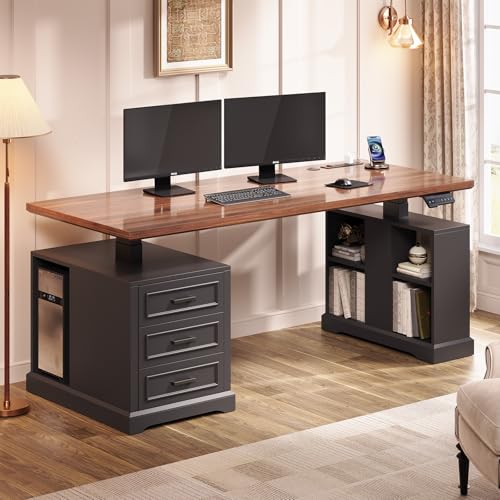 SEDETA SEDETA 63" Farmhouse Electric Standing Desk with 3 Drawers, Storage Shelves |
63" top; 3 drawers + shelves; built-in power strip (4 outlets, 2 USB); 3 memory heights; L | $269.99 |
4.4 ★ 185 ratings #153 in Home Office Desks |
In Stock |
 DeskShow DeskShow Black 60×28 in Electric Standing Desk, 1 Inch Thick Tabletop |
60×28" 1"-thick top; 2.5mm steel base, double-beam; 220 lb load; 27.9–45.7" | $179.99 $199.99 |
4.6 ★ 362 ratings #12 in Computer Workstations |
10% OFF Prime Exclusive In Stock |
 HUANUO HUANUO 48″ x 24″ Electric Standing Desk with 2 Drawers, C-Clamp Mount Compatib |
48×24"; 2 desktop drawers + 2 hooks; C-clamp mount edge; 27.5–46.4"; 4 preset h | $149.99 $199.99 |
4.6 ★ 1,258 ratings #44 in Home Office Desks |
25% OFF Prime Exclusive In Stock |
 ErGear ErGear Height Adjustable Electric Standing Desk, 48 x 24 Inches Sit Stand up D |
48×24"; 28.4–46.8"; 3 memory presets; motor tested 50,031 cycles; low-VOC mater | $109.98 $159.99 |
4.5 ★ 11,995 ratings #3 in Home Office Desks |
31% OFF In Stock |
 Veken Veken 55 Inch Large Electric Standing Desk, Gaming Table, White |
55" desktop; under-52 dB motor; memory presets; cable management; 28–47" height | $109.99 $139.99 |
4.5 ★ 2,522 ratings #1 in Utility Tables |
21% OFF In Stock |
 FEZIBO FEZIBO Standing Desk 48 × 24 Inch Electric Height Adjustable, Maple |
47.2×23.6"; 28.3–46.5"; 3 presets; 176 lb capacity; 45 dB motor, 50,000-cycle t | $99.98 $112.99 |
4.5 ★ 4,843 ratings #4 in Home Office Desks |
12% OFF In Stock |
 Huuger Huuger 47 X 24 Inch Electric Standing Desk with Power Outlets and USB-C Port, |
47×24"; 28.7–46.5"; 3 presets; built-in 4 AC + 1 USB + 1 USB-C; under-35 dB mot | $94.98 $109.99 |
4.4 ★ 278 ratings #7 in Home Office Desks |
14% OFF In Stock |
1. SEDETA 63" Farmhouse — best with storage
The SEDETA is the most desk you can buy under $300: a 63-inch farmhouse-style top with three drawers, open storage shelves and a CPU stand, plus a built-in power strip with four outlets and two USB ports, all on an electric frame with three memory heights and an LED display, for $269.99. If you are equipping a home office from scratch and want the desk to also be the storage, this is the one that replaces two pieces of furniture.
The honest trade is weight and stability. Farmhouse desks put a lot of mass on top and storage underneath, and at this price the frame is not the braced steel you would get from a $600 desk. It carries 4.4 stars from about 185 ratings, a reasonable but modest pool. Treat it as a workstation that stands rather than a standing desk that stores.
What we like
- 63-inch top with three drawers, open shelves and a CPU stand — the most storage here
- Built-in power strip with four AC outlets and two USB ports
- Three programmable memory heights with an LED display
- The most capability per dollar at the top of the under-$300 band
What could be better
- A heavy, top-loaded desk, which is the worst case for wobble at standing height
- 4.4 stars from about 185 ratings — a modest evidence pool
- No stated load rating, which is a gap on a desk this large
- The farmhouse look is a commitment, not a neutral finish
Flaws but not dealbreakers: mass up top and a modest rating pool. As the only desk here that replaces a filing cabinet as well, the SEDETA earns its slot as the storage pick.
2. DeskShow 60×28 — best large desktop
The DeskShow is the best pure desk here: a 60-by-28-inch, one-inch-thick top on a 2.5mm steel base with a double-beam frame that the listing claims gives “rock-solid stability,” a 220-pound load rating, a 27.95 to 45.67-inch height range and three programmable presets, for $179.99 against a $199.99 list. It is also ranked #12 in Amazon’s computer-workstations category, and it carries 4.6 stars from about 362 ratings.
Two details make it the pick for a dual-monitor setup. The one-inch top is thicker than most desks at this price — and thickness is a real stability ingredient, because a thicker top resists the flex that turns into wobble. And the 28-inch depth gives you room to push a monitor back, which is the single easiest way to sit more upright. At $179.99 it is the cheapest desk here with a genuinely large, thick work surface.
What we like
- 60×28-inch top with a full one-inch thickness — the largest, thickest surface under $200 here
- 220-pound load rating and a 2.5mm steel base with a double-beam frame
- 4.6 stars from about 362 ratings, and #12 in its Amazon category
- $179.99 against a $199.99 list, with three memory presets
What could be better
- “Rock-solid” is a claim; no third-party stability score exists for this model
- A 60-inch desk needs real space — measure before you buy
- No drawers or built-in power, unlike the SEDETA and HUANUO
- At 4.6 from 362 ratings the pool is decent but not deep
Flaws but not dealbreakers: an unverified stability claim and no storage. For a large, thick, dual-monitor surface under $200, the DeskShow is the best pure desk in this guide.
3. HUANUO 48×24 with drawers — best all-round
The HUANUO is the best all-rounder here, and it wins on evidence: 4.6 stars from about 1,258 Amazon ratings, by far the deepest pool in the under-$200 tier, on a 48-by-24-inch desk with two desktop drawers, two hooks, a 27.5 to 46.4-inch height range, four preset heights and a 2.36-inch rear platform edge that takes a C-clamp monitor arm, for $149.99 against a $199.99 list — a 25% cut.
That C-clamp edge is the detail most buyers miss and the one that matters most: it lets you clamp a monitor arm to the desk instead of clamping to a wall, which frees the entire desktop and fixes your monitor height without a stack of books. Combined with the drawers and the deepest rating pool at this price, it is the desk we would put in a normal home office.
What we like
- 4.6 stars from about 1,258 ratings — the deepest evidence pool under $200 here
- Two desktop drawers and two hooks, plus a C-clamp-compatible rear edge for a monitor arm
- Four preset heights across a 27.5 to 46.4-inch range
- $149.99 against a $199.99 list — a 25% discount
What could be better
- No stated load rating, so the frame’s real ceiling is unclear
- 48 inches is a two-monitor desk, not a three-monitor desk
- Curved ergonomic edges are comfortable but limit flush accessories
- The drawer space is shallow — paperwork, not binders
Flaws but not dealbreakers: no published load rating and a mid-sized top. With the deepest rating pool and a monitor-arm edge, the HUANUO is the safest all-round buy under $200.
4. ErGear 48×24 — best value
The ErGear is the value pick and, unusually for this price band, it is the most-reviewed desk in the entire guide: 4.5 stars from about 12,000 Amazon ratings, on a 48-by-24-inch desk with a 28.35 to 46.77-inch height range, three memory presets, a motor the listing says was “tested 50,031 times and still going strong,” low-VOC materials and aerospace-grade lifting-column connectors, for $109.98 against a $159.99 list — a 31% cut, and the steepest discount here.
When one desk in a category carries 12,000 ratings and the next has 1,258, that is not a coincidence: it is the desk the market converged on. It also means the failure modes are fully visible in the reviews rather than hidden, which is exactly what you want when you are buying a motorised product at this price. If you want the lowest-risk purchase, this is it.
What we like
- 4.5 stars from about 12,000 ratings — the deepest evidence pool in this guide by far
- $109.98 against a $159.99 list; the steepest discount here at 31%
- A motor the listing says was tested for 50,031 lift cycles
- Low-VOC materials and a 28.35 to 46.77-inch height range with three presets
What could be better
- No stated load rating on the listing
- A 48-inch top with no drawers or built-in power
- The vintage-brown finish is the only colourway on this listing
- No anti-collision detail, which matters in a household with children or pets
Flaws but not dealbreakers: no published load rating and a plain feature set. As the most-reviewed budget desk on Amazon with a 31% discount, the ErGear is the lowest-risk pick in this guide.
5. Veken 55-inch — best wide desk
The Veken is the width play: a 55-inch desktop with built-in cable management, a motor the listing rates at under 52 dB, memory presets and a 28 to 47-inch height range, for $109.99 against a $139.99 list. It ranks #1 in its Amazon utility-table category and carries 4.5 stars from about 2,522 ratings, the second-deepest pool here.
The reason to choose it over the ErGear is horizontal space, not extra features. Going from 48 to 55 inches is the difference between two monitors and two monitors plus a laptop and a notebook — and because the Veken keeps a mid-size frame under a wider top, the footprint it demands on the floor is still reasonable. The quiet motor matters if you take calls at the desk, since a desk that whines when it moves is a desk you stop moving.
What we like
- A 55-inch desktop that fits two monitors plus a laptop — the widest under-$150 desk here
- 4.5 stars from about 2,522 ratings, the second-deepest pool in this guide
- A motor the listing rates at under 52 dB, with built-in cable management
- $109.99 against a $139.99 list, and #1 in its Amazon category
What could be better
- No stated load rating
- The listing itself warns stability “may vary slightly by floor type” — carpet is the weak case
- No drawers, power strip or monitor-arm edge
- A 55-inch top needs wall space most small rooms do not have
Flaws but not dealbreakers: a floor-dependent stability caveat and no storage. For the widest usable desktop under $150, the Veken is the pick.
6. FEZIBO 48×24 — best budget 48-inch
The FEZIBO is the pick that the biggest reviewer in this category explicitly declined to test, and the reason is worth knowing before you buy (we cover it in the disagreement section below). What it is: a 47.2-by-23.6-inch electric desk with a 28.3 to 46.5-inch range, three memory presets, a 45 dB motor the listing says was tested for 50,000 lift cycles, a 176-pound capacity, FSC-certified wood and a splice desktop, for $99.98 against a $112.99 list — and 4.5 stars from about 4,800 ratings, the third-deepest pool here.
For under $100, the numbers are genuinely strong, and the 176-pound rating is one of the few published load figures in this guide. The honest caveats are the ones Wirecutter raises: the warranty on the electronics and motor is short, and a 176-pound ceiling is real. If your setup is a laptop and one monitor, neither matters. If it is a tower PC, two monitors and a printer, buy the DeskShow instead.
What we like
- $99.98 with a published 176-pound capacity — one of the few stated load ratings here
- 4.5 stars from about 4,800 ratings, the third-deepest pool in this guide
- A 45 dB motor tested for 50,000 lift cycles, per the listing
- FSC-certified wood and three memory presets across a 28.3 to 46.5-inch range
What could be better
- A short warranty on the electronics and motor — the reason Wirecutter passes on it
- A 176-pound ceiling leaves little headroom for heavy dual-monitor setups
- A splice (multi-piece) desktop rather than a one-piece top
- 23.6 inches of depth is on the shallow side for large monitors
Flaws but not dealbreakers: a short electronics warranty and a 176-pound ceiling. For a light laptop-plus-monitor setup under $100, the FEZIBO is the best-evidenced budget 48-inch desk here.
7. Huuger 47×24 with power — best under $100
The Huuger is the cheapest desk in this guide at $94.98 against a $109.99 list, and it is the one that solves the cable problem out of the box: a built-in charging station with four AC outlets, one USB-A and one USB-C, a 47-by-24-inch top with a 28.7 to 46.5-inch range, three presets, a digital display, and an upgraded motor the listing rates at under 35 dB — the quietest claim here. It carries 4.4 stars from about 278 ratings.
For a small room, this is the desk that removes the power strip, the extension lead and the wall-wart clutter in one purchase. The trade is scale: 47 inches and a thinner frame than the desks above, and a 278-rating pool is the smallest here apart from the SEDETA. If you want the cheapest possible route to a standing desk that also charges your laptop, this is it.
What we like
- $94.98 — the lowest price in this guide, with a 14% discount
- Built-in power station: four AC outlets plus USB-A and USB-C
- A motor the listing rates at under 35 dB, the quietest claim here
- 47×24-inch top with three presets across a 28.7 to 46.5-inch range
What could be better
- The smallest rating pool apart from the SEDETA — about 278 ratings
- No published load rating, and the thinnest frame in this guide
- 47 inches is a single-monitor-plus-laptop desk
- Under-35 dB is a manufacturer claim, not a measured figure
Flaws but not dealbreakers: a small rating pool and a thin frame. As the cheapest desk here with built-in power, the Huuger is the best sub-$100 buy in this guide.
Setting it up: the heights that actually matter
A standing desk can only help if you set it to the right height, and most people do not. OSHA’s computer-workstations guidance is the cleanest checklist available and it is free: the “top of monitor at or just below eye level,” “head and neck balanced and in-line with torso,” “shoulders relaxed,” “elbows close to body and supported,” “lower back supported,” “wrists and hands in-line with forearms,” and “feet flat on the floor.” OSHA is also explicit that there is “no single ‘correct’ posture,” which is the whole point of an adjustable desk.
For the two numbers that matter, Wirecutter’s guide gives workable approximations, attributed to the furniture retailer Wayfair: for sitting height, “divide your height in inches by 2.5”; for standing height, “multiply your height in inches by 0.6.” Wirecutter says it found the sitting guideline accurate to within about half an inch to an inch. So a 5-foot-8 user (68 inches) wants roughly a 27-inch seated height and a roughly 41-inch standing height. That is worth checking against the listings here before you buy: every desk in this guide tops out between 45.7 and 47 inches, which is comfortable for most people up to about 6-foot-2, and tight above that.
Does standing even help? What the research says
This is the question the marketing skips, and the honest answer is more modest than the sales copy. The Cochrane review Workplace interventions for reducing sitting at work pooled 34 studies and 3,397 employees and found that “the use of sit-stand desks seems to reduce workplace sitting on average by 84 to 116 minutes per day,” and that total sitting time — including outside work — also fell. That is a real effect, measured across randomised trials.
But the same review is blunt about the limits: “the quality of evidence is low to very low for most interventions, mainly because of limitations in study protocols and small sample sizes,” the medium-term reduction was smaller than the short-term one, and “the effects are likely to reduce with time.” In other words, a sit-stand desk reliably changes how you sit at work; it has not been shown to change your long-term health outcomes. Buy one because you want to sit less and move more, not because the desk is a medical device.
Which is why the routine matters as much as the desk. Sitting disease cuts both ways, and it is worth knowing that standing all day is not the goal either: the point of an adjustable desk is to alternate. Stand for the meetings and the email, sit for the deep work, and set a reminder — the Cochrane data also found that “short breaks (one to two minutes every half hour)” cut sitting time by around 40 minutes a day. If you want to make the most of a home office, our ergonomic office chairs guide covers the other half of the equation, and our laptop stands guide covers raising a screen without a new desk.
Where the money goes: what each price band buys
In this segment the price steps are small but the trade-offs are not, so it is worth being explicit about where the money stops buying anything useful.
- Under $100. A single-motor frame, a thinner top and a short warranty on the electronics — the Huuger at $94.98 and the FEZIBO at $99.98 live here. You still get presets, a quiet motor and a real height range. What you give up is frame rigidity and, at the very bottom, load headroom.
- $100–$150. The value heart of the market. The ErGear at $109.98, the Veken at $109.99 and the HUANUO at $149.99 add depth, width, drawers and, in the HUANUO’s case, the deepest rating pool under $200. This is where we would spend.
- $150–$250. You are buying size and materials rather than more motor. The DeskShow at $179.99 gets you a 60-inch one-inch-thick top; nothing else in this band adds a genuinely better frame.
- $250–$300. Storage and aesthetics. The SEDETA at $269.99 is the only desk here that replaces furniture. Past about $270, the honest move is to stop and consider a $600-class desk with a 10- to 15-year warranty — which is exactly the argument Wirecutter makes.
One cost the sticker price hides is the anti-fatigue mat. Standing on a hard floor for an hour is worse than sitting; a $40 mat is the cheapest upgrade you can make to any desk on this page, and it is not optional if you plan to actually stand.
Why the big testers refuse to recommend budget desks
This is where a roundup earns its keep, and the disagreement here is unusually clean. Wirecutter, which has “reviewed and tested more than 40 standing desks” since 2013, has a section titled, literally, “Why don’t we have a budget standing-desk pick?” The answer: of the inexpensive desks it researched, “seemingly reasonable price tags of $200 to $600 were invariably accompanied by major flaws” — lower-quality materials, harder assembly, low weight limits, narrow height ranges and short warranties. It specifically notes that most desks in this price range have “tabletops made of split particle board” and “can hold only up to 150 pounds… compared with the 300-pound-average weight limits” of its $600 picks. It calls out one of our picks by name: it “didn’t test” the FEZIBO “because of its two-year limited warranty on electronic components and motor and its paltry weight limit of 155 to 175 pounds.”
We do not dispute any of that. We rank this tier anyway, for a reason Wirecutter itself concedes: Business Insider, whose reviewers logged “hundreds of hours” at nearly two dozen desks, describes roughly $200 as “about as low as you’ll find for a sturdy motorized standing desk,” and adds that the better budget models “don’t look cheap, which is an issue we’ve seen with other budget standing desks.” The desks here are not as good as a $600 Uplift. They cost a quarter as much. Every trade Wirecutter lists — a one-to-three-year warranty, a 150-to-176-pound ceiling, a splice top — is real, and we have named which picks carry which of them so you can decide whether you care.
Where we agree completely is on stability. BTOD’s WobbleMeter work is the closest thing this category has to an objective test, and its conclusion is that “the most stable desks come down to frame engineering, solid cross supports, well-fit glides, and a strong foot design, not price alone” — but also that “every standing desk is most stable at sitting height, around 30 inches, and gets less stable as you raise it.” That is the honest expectation-setting for a $100 desk: it will be fine at 30 inches and perceptibly livelier at 45. Plan to type gently at full height.
The failure patterns that show up in month two
Budget standing desks rarely fail in week one. They fail in the same few places once the novelty wears off. Read across this category and the pattern is consistent.
- Wobble appears at standing height, not sitting height. This is not a defect; it is physics. BTOD’s testing shows the gap between desks is widest at 46 inches. If you type hard at full height, the desk will move.
- The motor stalls under a load it was never rated for. Most of these listings do not publish a load rating at all, and the ones that do say 176 to 220 pounds including the top. A monitor arm clamped to the back edge adds leverage the rating does not account for.
- The keypad loses its memory. Preset heights that reset after a power cut or a firmware quirk are one of the most common complaints in this tier. Check the reviews for your specific listing before you rely on presets.
- The splice line shows. A multi-piece top can telegraph its seam under a monitor clamp or after a season of humidity. One-piece tops (the DeskShow) avoid this; splice tops (the FEZIBO) are cheaper for a reason.
- Anti-collision either does not exist or is over-sensitive. Cheaper desks often omit it entirely; the ones that have it sometimes stop for a shadow. In a household with children or pets, treat it as a safety feature worth checking rather than assuming.
- Warranty claims get hard at year three. The short electronics warranty is the most predictable long-term cost in this tier, and it is the exact risk Wirecutter cites. Keep your order confirmation.
Who should not buy a cheap standing desk
A $100 to $270 standing desk is a genuinely good purchase in 2026. It is also the wrong one for some buyers, and it is cheaper to know now.
- You want the desk to last a decade without thought. A $600-class desk with a 10- to 15-year warranty is the honest answer; you will pay once instead of twice.
- You run a heavy setup. A tower PC, two large monitors, a printer and speakers will push or exceed the 176 to 220 pound ceilings here. Buy the DeskShow or step up a tier.
- You are over about 6-foot-2. Every desk in this guide tops out at 45.7 to 47 inches, which is short of a comfortable standing height for taller users. Check the maths from the height section above first.
- You type heavily at full standing height. Wobble is worst at the top of the range; if that is how you work, spend more on the frame.
- You need the desk to move silently on calls. The quietest motor here is rated under 35 dB, and that is a claim, not a measurement.
- Per pick: skip the SEDETA if you want maximum stability rather than storage; skip the DeskShow if you need drawers; skip the HUANUO if you run three monitors; skip the ErGear if you want built-in power; skip the Veken if your floor is deep carpet; skip the FEZIBO if a long electronics warranty matters; and skip the Huuger if you need more than a laptop and one monitor.
Do the marketing claims survive a reality check?
Budget desk listings sell four claims. Here is what each is actually worth.
- “Rock-solid” / “wobble-free.” Every desk wobbles at standing height; the question is how much. BTOD’s WobbleMeter scale puts 0 to 20 at “excellent,” 21 to 30 “very good,” and 31 to 50 as “noticeable to most people.” No budget desk publishes a score, which is the tell.
- “Tested for 50,000 cycles.” A cycle count is a motor-lifespan claim, not a stability or build-quality claim. Fifty thousand up-and-down cycles is genuinely good for a motor; it says nothing about whether the frame will still be tight.
- “176 lb / 220 lb capacity.” Read the number with a caveat that the listings do not include: the capacity usually includes the tabletop itself, and a clamped monitor arm adds leverage the rating does not model.
- “0 dB / ultra-quiet.” Desks do not move silently. The claims here range from under 35 dB to under 52 dB, and none of them is a third-party measurement. Assume a soft mechanical hum, not silence.
- “Ergonomic.” The desk does not make you ergonomic; OSHA’s checklist does. A sit-stand desk set to the wrong height is worse than a fixed desk set to the right one.
What survives the check is what actually makes these desks worth buying: a real height range that fits you, the deepest rating pool you can find, a one-piece top where you can get it, and a warranty you have read. Everything else on the listing is decoration.
FAQ
Is a $100 standing desk worth it?
Yes, for a light setup. Business Insider describes roughly $200 as about as low as you can go for a sturdy motorized desk, and the better models in that band do not look cheap. Below $100 you are trading frame rigidity and warranty length rather than functionality — you still get a motor, presets and a real height range.
What height should a standing desk be set to?
Wirecutter, citing the furniture retailer Wayfair, gives two approximations: for sitting height, divide your height in inches by 2.5; for standing height, multiply it by 0.6. Then check it against OSHA’s checklist: monitor top at or just below eye level, elbows close to your body, wrists in line with forearms, feet flat.
Do standing desks actually help your health?
They reliably reduce sitting. The Cochrane review of 34 trials found sit-stand desks cut workplace sitting by 84 to 116 minutes a day, but rated the evidence quality low and noted the effect is “likely to reduce with time.” Treat the desk as a way to sit less, not as a health intervention.
Why does my standing desk wobble?
Because stability falls as height rises, on every desk. BTOD’s WobbleMeter work finds that frame engineering, cross supports, glides and foot design drive stability more than price, but that even the best desks are less stable at 46 inches than at 30. A wall-adjacent position and a lighter typing style help more than any spec.
How long do budget standing desk motors last?
The listings here claim 50,000 lift cycles on the better motors, which is far more movement than a home office generates in years. The likelier failure is the electronics or the keypad, and that is exactly what the short warranty periods in this tier cover — check the warranty before you buy, not after.
The verdict
Buy the HUANUO 48×24 if you want the safest all-round desk under $200 — 1,258 ratings, drawers and a monitor-arm edge at $149.99. Choose the ErGear if you want the lowest-risk purchase in the category (12,000 ratings, 31% off), the DeskShow for the largest thick top, the SEDETA if you need the desk to be your storage, the Veken for maximum width, the FEZIBO if $100 is the line you will not cross, and the Huuger if you want built-in power at the lowest price here. Whatever you choose, set it to the right height, add an anti-fatigue mat, and expect it to move a little at full extension — that is the honest deal at this price.