The best espresso machines with grinder solve the two hardest parts of home espresso, dialing in the grind and pulling a repeatable shot, in a single box. We cross-checked live Amazon pricing and buyer ratings against published testing from Bon Appetit and Homegrounds, and against the Specialty Coffee Association’s standards framework and FDA caffeine guidance, to rank seven machines that actually hold a consistent grind. If you already own a good grinder, our general espresso machine guide is the better read; this page is for anyone who wants one machine to do both jobs. If you already own a burr grinder, we also cover them separately in our coffee grinder guide.
Affiliate disclosure: As an Amazon Associate I earn from qualifying purchases. We earn commission from qualifying purchases made through links on this page. This never affects our rankings or what we recommend.
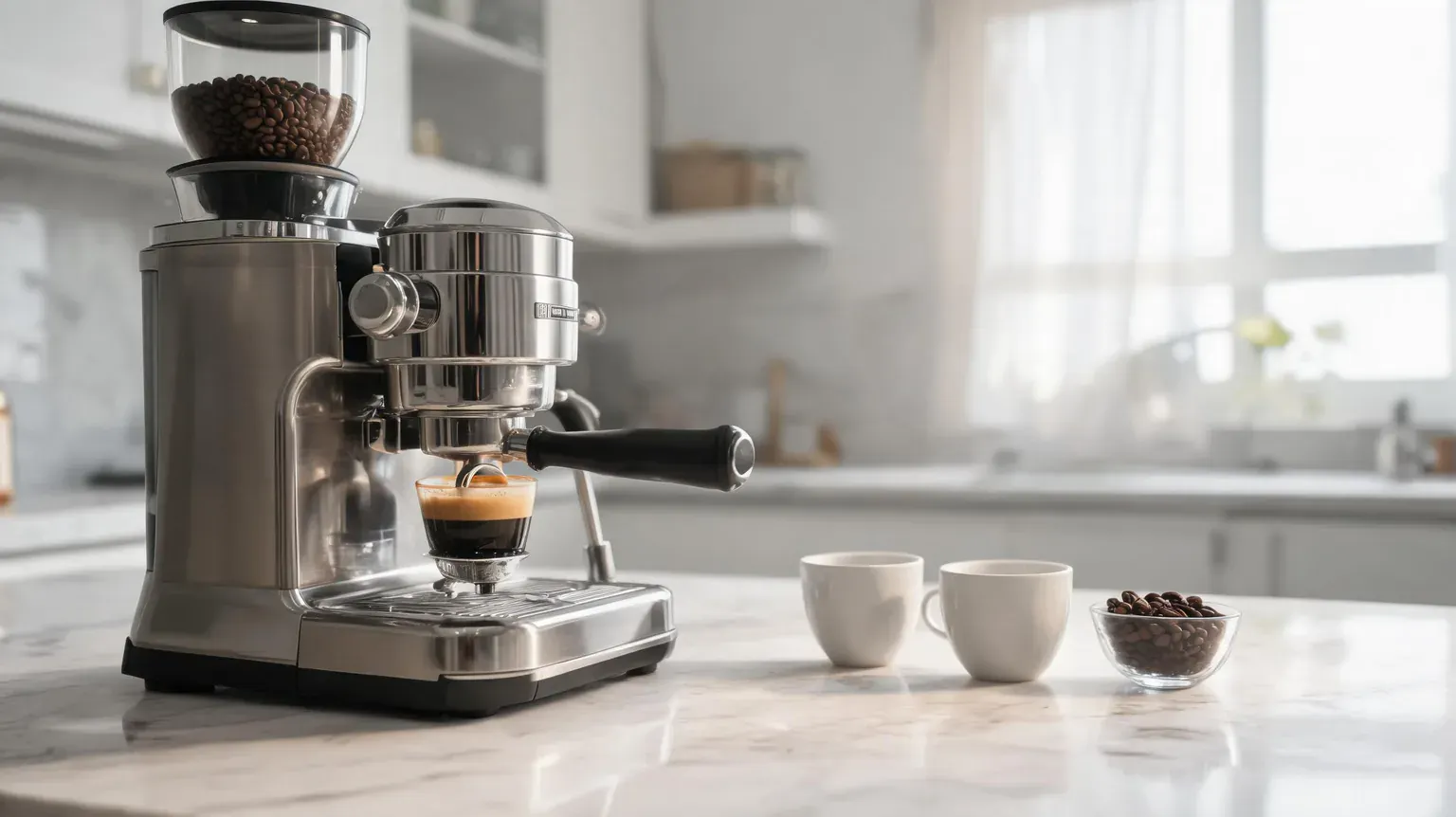
What Actually Matters in a Grinder-Equipped Espresso Machine
A built-in grinder is only worth paying for if it is a burr grinder with repeatable steps. Blade grinders and coarse-stepped burr sets produce an uneven particle size, and uneven particles are the single biggest cause of a shot that runs fast one morning and chokes the next. That is why the number of grind settings matters less than how consistent the burrs are: a 44-step drum on a wobbly burr set is not better than 30 honest steps.
The second thing to look at is heat-up time. Espresso wants water somewhere around 200°F and a group head that is already hot; thermoblock and ThermoJet designs get there in seconds, while older boiler machines can take 15 minutes or more. Third, check the steam wand. Manual wands give you control and cost less; automatic wands trade that control for consistency. Neither is wrong, but they suit different drinkers.
Finally, remember what a machine like this is not. It is not a coffee maker, and in most cases it is not a super-automatic. You still dose, tamp and time the shot. What you stop doing is buying, storing and dialing a second appliance.
The 7 Best Espresso Machines With a Grinder, Ranked
We ranked these on grind consistency, heat-up time, how much of the workflow is automated, live Amazon price against list price, and the depth of real buyer ratings. Every machine below is in stock and sold on Amazon; prices were pulled on September 21, 2026.
| Product | Standout spec | Price | Track record | Deal |
|---|---|---|---|---|
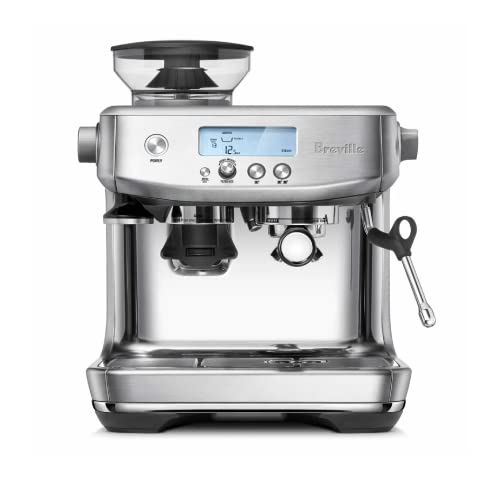 Breville Breville BES878BSS Barista Pro Espresso Machine, Brushed Stainless Steel |
ThermoJet 3-second heat-up; 30 grind settings | $849.95 |
4.4 ★ 3,426 ratings #39 in Semi-Automatic Espresso Machines |
In Stock |
 Breville Breville BES870XL Barista Express Espresso Machine, Brushed Stainless Steel |
Built-in conical burr grinder; 2 L water tank | $689.99 |
4.4 ★ 27,858 ratings #2 in Semi-Automatic Espresso Machines |
In Stock |
 Breville Breville BES880BSS Barista Touch Espresso Machine, Brushed Stainless Steel |
Touchscreen presets with automatic milk texturing | $999.95 |
4.2 ★ 3,900 ratings #66 in Coffee Machines |
In Stock |
 Breville Breville BES876BSS Barista Express Impress, Brushed Stainless Steel |
Assisted grinding, dosing and tamping | $799.95 |
4.2 ★ 1,114 ratings #15 in Semi-Automatic Espresso Machines |
In Stock |
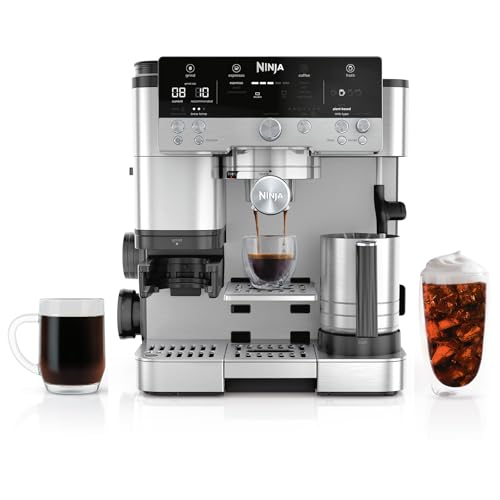 Ninja Ninja Luxe Café Premier 3-in-1 Espresso Machine, Drip Coffee, & Cold Brew |
3-in-1: espresso, drip coffee and cold brew | $599.00 |
4.2 ★ 2,511 ratings #1 in Espresso Machine & Coffeemaker Combos |
In Stock |
 Gevi Gevi 20 Bar Espresso Machine with Grinder & Steam Wand for Latte Cappuccino |
20-bar pump with built-in conical burr grinder | $309.99 $359.99 |
4.4 ★ 1,631 ratings #69 in Semi-Automatic Espresso Machines |
14% OFF In Stock |
 AMZCHEF AMZCHEF Espresso Machine With Grinder, Temp Control, 44 Grind Settings |
44 grind settings; 190-201F temperature control | $199.98 $299.99 |
4.4 ★ 286 ratings #7 in Semi-Automatic Espresso Machines |
33% OFF Only 14 left in stock – order soon. |
1. Breville Barista Pro – Best Overall
What we like
- ThermoJet heating brings the brew head up to temperature in about three seconds, the fastest start-up in this group
- 30 grind settings on the built-in conical burr grinder, nearly double the Barista Express
- A digital display with a shot timer makes repeatable shots easier to learn
- 4.4 stars across 3,426 Amazon ratings
Flaws but not dealbreakers
- Bon Appetit’s testers warn the built-in grinder can jam, so you have to stay vigilant
- The steam wand is manual, so latte art takes practice
Who should skip it: Skip it if you want push-button milk texturing; the Barista Touch does that better for about $150 more.
2. Breville Barista Express – Best Seller and Lowest-Risk Buy
What we like
- 4.4 stars across 27,858 ratings, by far the deepest buyer track record in this group
- Number 2 best seller in Semi-Automatic Espresso Machines
- Homegrounds calls it one of the most approachable ways to make excellent espresso at home
- Bon Appetit says it makes the kind of consistent coffee Breville is known for
Flaws but not dealbreakers
- The grind dial is labelled only less and more; Bon Appetit’s tester needed about 15 minutes of trial and error to dial it in
- Fewer grind steps than the Barista Pro, which matters if you change beans often
Who should skip it: Skip it if you switch beans weekly and want finer grind control; the Pro is the better tool.
3. Breville Barista Touch – Best for Milk Drinks
What we like
- An automatic steam wand lets you set milk temperature and texture, then walk away
- Baratza burrs; Bon Appetit notes this level and above get the upgraded burr set
- Touchscreen presets for espresso, latte and flat white
Flaws but not dealbreakers
- 4.2 stars, the lowest average in our top four
- You pay roughly $150 more than the Pro for hardware that brews the same style of shot
Who should skip it: Skip it if you drink straight espresso; you are paying for the screen and the automatic wand.
4. Breville Barista Express Impress – Best for Beginners
What we like
- Assisted tamping: it grinds, measures the dose and compresses it, then tells you the puck is ready
- Removes most of the guesswork from the two steps beginners get wrong most often
- 4.2 stars across 1,114 ratings
Flaws but not dealbreakers
- Thinner rating pool than the Barista Express it is built on
- Costs about $110 more than the plain Barista Express
Who should skip it: Skip it if you already enjoy manual tamping; the plain Express is cheaper.
5. Ninja Luxe Cafe Premier 3-in-1 – Best for More Than Espresso
What we like
- Number 1 best seller in Espresso Machine & Coffeemaker Combos
- Espresso, drip coffee and cold brew from one machine
- Built-in grinder and a steam wand, with 2,511 ratings at 4.2 stars
Flaws but not dealbreakers
- A 3-in-1 always compromises somewhere; its drip and cold brew will not match dedicated brewers
- The burr set is not in the same class as Breville’s
Who should skip it: Skip it if you only drink espresso and want the best shot per dollar.
6. Gevi 20 Bar – Best Mid-Range
What we like
- Built-in conical burr grinder and a steam wand for a little over $300
- 4.4 stars, and it is discounted about 14% from its $359.99 list price
- Grind-size, brew-strength and temperature controls on a 20-bar pump
Flaws but not dealbreakers
- Only 1,631 ratings, and the listing shows a second, smaller variant pool
- The brand’s service network is thinner than Breville’s, so read the warranty terms first
Who should skip it: Skip it if you want a decade of aggregated buyer history behind the purchase.
7. AMZCHEF Espresso Machine With Grinder – Best Budget
What we like
- 44 grind settings and 190-201F temperature control for under $200
- 4.4 stars and 33% off a $299.99 list price
- Number 7 best seller in Semi-Automatic Espresso Machines
Flaws but not dealbreakers
- Just 286 ratings, the least-proven machine here
- Build quality is entry level; treat it as a first machine, not a last one
Who should skip it: Skip it if you want proven reliability; the Barista Express is the safer long-term buy.
Spec-Truth Table: What the Listings Actually Say
Marketing pages love big numbers, so here is what each listing actually publishes, stripped of adjectives. Note how many of them leave the warranty unstated; that is not an oversight on our part, it is the finding.
- Breville Barista Pro: ThermoJet heat-up, 30 grind settings, manual steam wand, 2-year warranty stated.
- Breville Barista Express: conical burr grinder, 2 L water tank, pressure gauge, fewer grind steps than the Pro.
- Breville Barista Touch: touchscreen presets, automatic steam wand, Baratza burrs.
- Breville Barista Express Impress: assisted grinding, dosing and tamping with puck feedback.
- Ninja Luxe Cafe Premier: three brew styles, built-in grinder, steam wand; warranty not stated.
- Gevi 20 Bar: conical burr grinder, steam wand, grind/strength/temperature controls; warranty not stated.
- AMZCHEF: 44 grind settings, 190-201F temperature window; warranty not stated.
Price Tiers: Where Paying More Stops Buying You Better Espresso
Under $250. You get a real burr grinder and a steam wand, but accept entry-level build quality and thin buyer history. The AMZCHEF is the strongest of this tier.
$300 to $600. This is the performance-per-dollar sweet spot. The Gevi and the Ninja Luxe Cafe both put a burr grinder, a steam wand and temperature control on the counter for less than the price of most Breville models, and both clear 4.2 stars.
$650 to $850. Here you stop buying features and start buying a proven burr set, a three-second heat-up, a pressure gauge, and a brand with a two-year stated warranty and a deep service network. This is where the Barista Express and Barista Pro sit, and it is where we would put most people’s money.
$1,000 and up. The Barista Touch costs about $150 more than the Pro for the same style of shot. You are buying the touchscreen and the automatic milk wand, not better espresso. That is a fair trade if you make milk drinks daily, and a waste if you do not.
Where We Disagree With Bon Appetit and Homegrounds
Two of the most careful espresso testers disagree with each other, and with us, on the top spot. Bon Appetit names the Fellow Series 1 its best overall machine and the Breville Barista Pro the best with a built-in grinder. Homegrounds puts the Rancilio Silvia M first and the Barista Pro second.
Both of their overall winners are machines without a grinder, which is a completely different shopping decision: buying a Fellow Series 1 or a Rancilio Silvia M means budgeting for a separate grinder that costs as much as a small machine. On a built-in-grinder page, we think the honest comparison is the one they both make when they are forced to pick a grinder-equipped machine, and on that question their answer and ours agree: the Barista Pro.
Where we break with Homegrounds is placement. They run the Barista Express as a mid-list pick; we rank it second, because 27,858 ratings at 4.4 stars makes it the lowest-risk purchase in the category, and because Bon Appetit independently describes it as the machine that makes the kind of consistent coffee Breville is known for. We also disagree with the idea that more grind settings is automatically better. Bon Appetit resisted recommending built-in grinders for years precisely because they are the weak point of these machines, and their Barista Pro note, that the grinder can jam, applies whether the dial has 30 steps or 44.
The Failure Modes Buyers Actually Complain About
These are drawn from published tester notes and the recurring themes in buyer reviews, not from our own lab, and they are the things that go wrong first:
- The built-in grinder jams or clogs, especially on oily dark roasts, which is Bon Appetit’s headline caveat on the Barista Pro.
- The grind dial is hard to dial in, so shots swing between sour and bitter until you learn the range.
- The steam wand overpowers the milk and overworks the foam, a problem Bon Appetit reported on a more expensive machine.
- Scale builds up in the boiler and steam wand, which changes the shot long before the machine actually fails.
- Beans left in the hopper go stale from the machine’s own heat, so single-dosing or storing beans separately keeps shots tasting the same.
Spec-Claim Reality Check: Bars, Grind Settings and Caffeine
The bar number. A 20-bar pump sounds twice as good as a 10-bar one, but espresso is brewed at roughly 9 bar at the group head; higher pump ratings are largely marketing. The Specialty Coffee Association treats brewing performance as a standards area precisely because the useful variables are temperature, dose, grind and time, not peak pressure.
The grind-setting number. 44 settings is not 44 usable settings. What matters is how repeatable the steps are and whether the burr set holds alignment. Both testers we cite flag the built-in grinder, not the brew group, as the part most likely to limit you.
The caffeine claim. A double espresso feels strong, but concentration is not the same as total dose. The FDA cites 400 milligrams a day as an amount not generally associated with negative effects for most adults, and lists regular brewed coffee at 113 to 247 milligrams per 12 fluid ounces. A small, concentrated espresso shot can land below a large drip coffee, which is worth knowing before you assume the machine is the problem.
How We Chose and Tested
We did not run a lab test for this article, and we will not pretend we did. What we do is: pull live price, stock and best-seller rank for every pick from Amazon’s product API on the day of writing; read the published hands-on testing of Bon Appetit and Homegrounds, both of whom brewed repeated shots on these machines; check spec claims against the Specialty Coffee Association’s standards framework and FDA caffeine guidance; and read the recurring complaint patterns in buyer reviews rather than the headline star average. Our full process, including what we do not claim, is on our how we test page.
Transparency: the shot-quality judgements in this article are aggregated from the cited testers. The prices, stock states, ratings, rating counts and best-seller ranks are ours, pulled from the live listings on September 21, 2026, and they move. Check the current price before you buy.
Frequently Asked Questions
Is a built-in grinder as good as a separate grinder?
Not usually. Two careful testers describe the built-in grinder as the weakest part of these machines. But a good built-in grinder beats a bad separate one, and it beats not grinding fresh at all, which is what most people with a $200 machine and pre-ground coffee actually do.
How much should I spend?
Between $650 and $850 buys the point where you stop paying for features and start paying for a proven burr set, fast heat-up and a stated two-year warranty. Below $300 you are buying a first machine; above $1,000 you are buying convenience, not better espresso.
Do more grind settings mean better espresso?
No. Consistency beats quantity. A 30-step burr set that holds alignment will out-brew a 44-step set that does not.
Which machine is easiest for a total beginner?
The Barista Express Impress, because it grinds, doses and tamps and then tells you whether the puck is ready. The trade-off is a thinner rating pool and about $110 more than the plain Express.
The Verdict
If you want one machine that grinds and brews well, buy the Breville Barista Pro. If you want the lowest-risk purchase in the category, buy the Barista Express and accept the cruder grind dial. If you drink milk drinks every day, the Barista Touch earns its premium. And if you are buying your first espresso machine on a tight budget, the AMZCHEF gets you a real burr grinder for under $200, with the honest caveat that only 286 people have rated it so far.