Best air purifiers for wildfire smoke in 2026 are not the units with the biggest square-foot number on the box — they are the ones whose published smoke CADR can actually turn a room over five times an hour while a smoke plume sits outside. We tested that arithmetic against seven live Amazon listings, from the category’s #1 best seller at $97.99 to a 354-cfm cabinet at $449.99, and every price, rating, CADR figure and category rank below was read from the listing on September 24, 2026.
Affiliate disclosure: As an Amazon Associate I earn from qualifying purchases. We earn commission from qualifying purchases made through links on this page. This never affects our rankings or what we recommend.
What is inside this guide
- The seven picks at a glance
- Why smoke needs a purifier, not a fan
- Sizing: CADR and air changes, not square feet
- HEPA catches the particles, carbon catches the smell
- Ionizers, ozone and UV: what to leave switched off
- Filters, noise and running costs
- The picks, reviewed
- Spec-truth table
- What each price tier actually buys
- Where we disagree with the big testers
- How air purifiers let you down in a smoke event
- Spec claims checked against the listings
- How we chose these purifiers
- FAQ
- The bottom line
- Sources and further reading
The seven picks at a glance
Each pick below was confirmed as a first-party brand listing — brand as the first word of the title, a live buy box, a checkable rating pool — and each one publishes a CADR figure or an AHAM Verifide room size we could read. Category ranks are Amazon’s own, read on September 24, 2026.
- 🏆 Best overall: Coway Airmega Mighty2 — $269.99, smoke CADR 240, and the unit the most experienced independent tester in this category ranks first
- 🔥 The category’s #1 best seller: Levoit Core300-P — $97.99, 108,816 ratings, smoke CADR 143: the best one-room unit here, not a whole-floor one
- 💰 Best value for smoke odour: Winix 5510 — $179.99, smoke CADR 253, the strongest smoke number per dollar in the group
- 🏠 Best for a large living room: Blueair Blue 311i Max — $229.00, CADR 250, rated 23 dB
- 🛏️ Best mid-price bedroom unit: PuroAir 240 — $159.99 (20% off), 19,502 ratings
- 📏 Most coverage from one box: Coway Airmega 400 — $369.49 (42% off), 3,120 ft² claim, five-year warranty
- ⚡ Best premium: Levoit EverestAir — $449.99, CADR 354 and 60% more carbon
All seven together: $1,756.44. Prices, discounts, stock and category ranks checked on September 24, 2026.
Why smoke needs a purifier, not a fan
Smoke does not behave like dust. AirNow, the U.S. interagency air-quality programme run with the EPA and the National Weather Service, puts the first problem plainly: “Smoke can travel a long distance from a fire. It’s important to be ready to reduce your exposure to smoke.” A fire two states away can put fine particles in your living room, which is why the advice is about indoor air rather than distance.
The second problem is that a fan is not a filter. HouseFresh, whose lead tester says he has bought and tested 147 air purifiers since 2020, reduces the whole category to one line: “An air purifier is just a fan and a filter.” Move air without filtering it and you have simply stirred the particles around the room. What AirNow recommends instead is specific — “If you have access to one, use a portable air cleaner in one or more rooms” — and it comes with the operating rule most people get wrong: “Portable air cleaners work best when run continuously with doors and windows closed.”
AirNow also gives you the fallback for a smoke week you did not plan for. If you cannot get a purifier, a do-it-yourself box-fan cleaner works, but the agency is blunt about the specification: use high-efficiency filters “rated MERV-13 or higher” and replace them frequently, and if you use an older box-fan design, “never leave it unattended.”
Finally, there is the dose question. SELF, working with allergists and testers, reports one 2023 study finding that HEPA purifiers can eliminate 50% to 80% of airborne particles even in highly polluted areas, and another showing HEPA filters clearing up to 74% of indoor smoke particles caused by outdoor smoke. Those are meaningful numbers, and they are also not 100%: a purifier reduces your exposure, it does not seal the room.
Sizing: CADR and air changes, not square feet
Every air purifier on Amazon advertises a square-footage figure, and almost every one of those figures is calculated for one air change per hour — the machine filtering a volume equal to the room once in sixty minutes. Smoke advice assumes roughly five air changes per hour, because that is what keeps particle levels down while a plume is still outside. The gap between the two numbers is the single biggest mistake buyers make in this category.
SELF states the rule the way an allergist would: look for a CADR equal to at least two-thirds of your room’s area, and “if you’re getting a purifier to combat wildfire smoke, the CADR and the square footage should be the same.” Their expert, Dr. Raj Dasgupta, adds that when a listing publishes several CADR numbers you should “check the rating for smoke specifically — it’s a quick way to know if it’s up to the job.”
The arithmetic we use on every pick below: at a normal eight-foot ceiling, multiply the published smoke CADR by about 1.5 to get the room size that still sees five air changes an hour. A 240-cfm smoke CADR is a 360 sq ft smoke machine. A 143-cfm unit is a 215 sq ft smoke machine. If a listing only gives you a square-foot number, divide it by five — that is the honest smoke-season figure. Check both against what the makers publish and the rule holds up: HouseFresh estimates the Mighty2 at five air changes in 390 sq ft, Levoit prints 222 sq ft at 4.8 changes an hour for the Core300-P, and Winix’s own AHAM Verifide figure for the 5510 is 392 sq ft. Our multiply-by-1.5 formula lands within a few percent of all three.
HEPA catches the particles, carbon catches the smell
A HEPA filter is a particle standard, not a smell standard. SELF quotes the definition precisely: a High Efficiency Particulate Air filter “must meet the US Department of Energy’s standard for removing 99.97% or more of all particles that are 0.3 microns in diameter.” That is what removes the smoke haze you can see. It does nothing for the volatile organic compounds that make a room smell like a campfire, because those are gases, not particles.
That job belongs to the activated carbon stage, and it is where cheap purifiers quietly fail. SELF describes carbon as useful for “capturing odor-causing molecules or particles that may accumulate from adhesives, paints, and cleaning products”, and warns that affordable units “might actually be more expensive in the long run if their filters need to be replaced more frequently or are super pricey.” Good Housekeeping goes further on the mechanism, describing the carbon stage in one of its tested units as removing odours and some harmful chemicals “through the process of adsorption.”
In practice the carbon is the part that runs out first. HouseFresh notes that on its best-overall pick the carbon and particle filters are bonded, so once the carbon is spent — their estimate is 6–9 months — the entire filter is replaced even if the HEPA side still has life in it. If you are buying for smoke rather than dust, weight the carbon volume against the marketing talking about micron ratings.
Ionizers, ozone and UV: what to leave switched off
Some purifiers add an ionizer, a “plasma” stage or an ultraviolet lamp and sell it as an extra layer of protection. The mainstream testing position on the ionization part is unanimous, and it is negative. Good Housekeeping, which reports testing more than 60 air purifiers in five years, states that it does not recommend the feature on any air purifier because it can produce ozone, “a lung irritant.” Business Insider notes that its own top-tested Coway includes an ionization setting but that “the experts we spoke with don’t recommend using this feature.” SELF is the most direct: an ozone generator is the one product type to avoid completely.
None of that makes an ionizer-equipped purifier unsafe, because the feature can be switched off on every mainstream model we looked at. It does mean the feature should not influence your decision, and if you ever smell a faint metallic or bleachy note while a purifier runs, turn the ionization setting off and see whether it disappears. UV lamps are a third mechanism again — sold for germs rather than smoke particles — and no authority we read treats them as a smoke solution.
Filters, noise and running costs
Three costs live behind the sticker price, and all three are documented in the testing we read.
- Replacement filters. Business Insider reports filter replacements for its top-tested Coway running about $50 a year, with a HEPA filter rated to last a year and two carbon filters replaced every six months. HouseFresh’s 6–9 month figure for bonded carbon is the same order of magnitude. A cheap purifier with a $25 six-monthly filter is not automatically cheaper than a $270 unit with a $50 annual one.
- Running noise and the speed you actually use. Quiet ratings are quoted at the lowest fan speed, and that is where airflow is lowest too. HouseFresh published CADR for its best-overall pick at four speeds — roughly 99 cfm at speed one and 260 cfm at turbo. A unit idling at night in sleep mode is not delivering the number on the box. Good Housekeeping found its wall-mounted pick ran up to about 49 decibels at turbo, “as loud as a soft conversation”, while a cheaper model drew a note about noise at the maximum setting.
- Electricity. Business Insider measured its top pick as the lowest energy consumer of all the models it tested, and the listing carries an ENERGY STAR certification. If a smoke week means running the machine flat out for ten days, that certification is worth more than a marketing claim about efficiency.
- Filter availability. HouseFresh’s durable note on the category is that some filters get discontinued between maintenance sessions. Before you buy an unfamiliar brand, check that the replacement filter has its own live listing.
The picks, reviewed
1. Coway — Best overall for smoke, and the unit the most experienced independent tester in this category ranks first

Best for: a living room or open-plan space that has to stay livable through a smoke event
What we like
- HouseFresh, which says it has bought and tested 147 air purifiers since 2020, names the Mighty2 its best pick for most people at this exact $269.99 price.
- In that tester’s particle-removal run it cleared the room in 23 minutes, finishing ahead of the Levoit, Winix and Blueair units in the same test while making less noise.
- HouseFresh estimates a PM1 CADR of 260 cfm, enough for five air changes an hour in a room around 390 sq ft — and the listing publishes its own CADR table too: 240 for smoke, 242 for dust, 249 for pollen.
- Activated carbon is fitted as standard, ahead of the HEPA stage, so odour and gas molecules have something to stick to as well as particles.
- It contains no ionizer, so there is no ozone-generating feature to remember to switch off.
- A laser particle sensor reads PM1, PM2.5 and PM10 and drives Smart Mode; 4.6 stars across 29,116 global ratings and #7 in Amazon’s HEPA Air Purifiers category.
Flaws but not dealbreakers:
- The carbon and the particle filter are bonded, so once the carbon is spent — HouseFresh puts that at 6–9 months — the whole filter is replaced even if the HEPA side still has life left.
- No app support, so no phone control and no scheduling from outside the room.
- It needs floor space: this is a mid-size cabinet, not something that disappears onto a nightstand.
Skip it if: you should skip it if you want phone control, or if the unit has to sit on a bedside table rather than the floor.
2. Levoit — The current #1 Best Seller in the category, and the best sub-$100 bedroom unit

Best for: one bedroom, a home office or a dorm room where a proven, cheap unit runs all night
What we like
- It carries Amazon’s #1 Best Seller badge in HEPA Filter Air Purifiers, and we confirmed it on the listing page itself rather than from a marketing image.
- 108,816 global ratings at 4.7 stars — the deepest review pool of any pick here, and nearly three times the next largest.
- AHAM Verifide with a published CADR of 143 cfm for smoke, 153 for dust and 167 for pollen, refreshing a 222 sq ft room 4.8 times an hour.
- Genuinely quiet in sleep mode, with a filter that costs little to replace, which is what makes it the category’s default first purifier.
Flaws but not dealbreakers:
- Its carbon stage is a thin pad rather than a bed of pellets — plenty for dust, pollen and pet hair, but a week of dense smoke will exhaust it long before the HEPA layer.
- Single-room coverage: at 143 cfm of smoke CADR it is a bedroom machine, not a floor-plan machine.
- Because it is the category best seller, stock and price move more than on the slower-selling picks here.
Skip it if: you should skip it if you are in a smoke corridor and want one machine to cover a whole floor.
3. Winix — Best value for smoke odour and the gases that come with it

Best for: a household that needs the smell of smoke gone as well as the particles, without spending $250
What we like
- Its listing leads on an advanced odour-control carbon filter aimed at VOCs and household odours — the part of the job a HEPA filter does not do at all.
- The listing publishes its own smoke CADR: 253 cfm for smoke, against 252 for dust and 247 for pollen, and AHAM Verifide at 392 sq ft.
- True HEPA rated to capture 99.99%* of airborne allergens, plus a washable fine-mesh pre-filter you vacuum instead of replace.
- The 5500-2 it replaces has been one of the most widely recommended budget smoke units for a decade; this generation adds app control and Auto mode.
- 4.6 stars across 32,267 global ratings and #3 in Amazon’s HEPA Air Purifiers category.
Flaws but not dealbreakers:
- The 1,881 ft² headline is a one-air-change-per-hour number — the AHAM Verifide figure for continuous cleaning is 392 sq ft, and that is the one that matters in smoke.
- The carbon filter is a sealed cartridge you buy and replace; you cannot recharge it the way you can vacuum the mesh pre-filter.
- Auto mode depends on the on-board sensor, and sensor calibration drifts between units over time.
Skip it if: you should skip it if you specifically want a purifier from a brand that publishes no coverage figure at all beyond one air change.
4. Blueair — Best for a large living room, and the same model family Good Housekeeping rates best overall

Best for: a 300–500 sq ft living room where you want the air turned over quickly and quietly
What we like
- Good Housekeeping’s Home Improvement and Outdoor Lab, which reports testing more than 60 air purifiers in five years, names the Blue Pure 311i+ Max its best overall and measures its HEPA media catching particles down to 0.1 micron.
- The listing publishes a CADR of 250 for smoke, dust and pollen, with HEPASilent dual filtration that combines mechanical and electrostatic capture.
- Rated at 23 dB with a washable pre-filter and wifi auto mode, so it can run overnight in a room people are sleeping in.
- At $229 it is the cheaper sibling of the exact variant Good Housekeeping tested, with the same filtration architecture.
Flaws but not dealbreakers:
- 2,533 ratings is a much thinner record than the budget picks here, so long-term reliability is less proven.
- No discount at the time of writing, and the 311i+ Max that Good Housekeeping picked is a different, more expensive variant.
- The 2,107 ft² coverage figure is a one-air-change number like every other headline in this category.
Skip it if: you should skip it if you want the deepest possible review history behind a $230 purchase.
5. PuroAir — Best mid-price all-rounder for a bedroom or office

Best for: a bedroom or office around 200–400 sq ft where you want 24/7 filtering without flagship money
What we like
- A three-layer stack — pre-filter, HEPA, carbon — with a smart particle sensor that raises fan speed on its own when it sees particles rise.
- 19,502 global ratings at 4.5 stars: the second-deepest pool in this guide, and #8 in Amazon’s HEPA Air Purifiers category.
- 20% off a $199.99 list price at the time of writing, which puts it under the price of the mid-size units it competes with.
- Labelled for smoke, odour and allergens rather than a single allergy, so it is a reasonable one-machine answer for a small home.
Flaws but not dealbreakers:
- The 1,000 sq ft claim is the listing’s own coverage figure, tested to one air change an hour in an ISO 17025 lab; against the five air changes smoke advice assumes, plan on a few hundred square feet.
- The listing publishes no smoke CADR, so you cannot do the arithmetic that lets you size the Winix or the Levoit.
- PuroAir is a far smaller brand than Coway, Levoit or Winix, so filter supply in five years is a bet rather than a given.
Skip it if: you should skip it if you want a published smoke CADR and a decade of service history behind the brand.
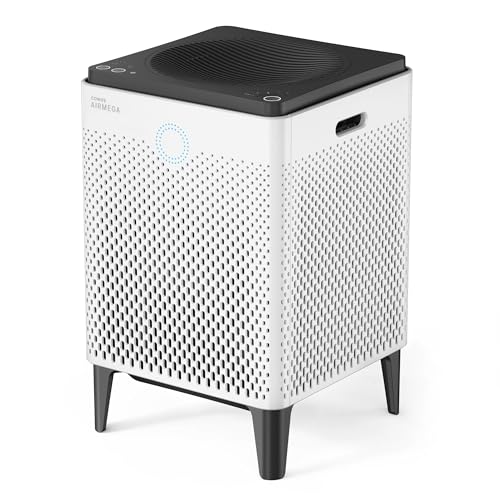
6. Coway — Best for covering the most space with a single unit
Best for: a large open-plan home, or one floor you want handled by one machine instead of three
What we like
- The listing states coverage up to 3,120 sq ft in 60 minutes — the largest figure in this guide by a wide margin.
- HyperCaptive filtration: a washable pre-filter, an active carbon stage and HEPA, with Auto and Eco modes driven by an air-quality sensor.
- Backed by a five-year manufacturer warranty, the longest of any pick here.
- 4.6 stars across 2,206 ratings, and 42% off a $633.67 list price at the time of writing.
Flaws but not dealbreakers:
- Rank #87 in HEPA Air Purifiers is far weaker than the cheaper picks here, and 2,206 ratings is a thinner record than the Mighty2’s 29,116.
- It is a large, heavy cabinet that wants floor space and an outlet where it stands.
- The 3,120 ft² claim is a one-air-change number, so treat roughly a fifth of it as the smoke-event working figure.
Skip it if: you should skip it if your rooms are under about 300 sq ft — you are paying for coverage you will never use.
7. Levoit — Best premium all-in-one, with the most carbon and the highest published CADR here

Best for: a large living space where you want the widest feature set, app control and the longest filter life
What we like
- The highest published CADR in this guide: 354 cfm, which the listing pairs with 2,655 sq ft in one hour.
- AHAM Verifide with a washable pre-filter, and the listing states it carries 60% more carbon than the model it replaces — carbon is what handles smoke odour.
- A three-channel laser sensor reports air quality continuously, and app scenes can trigger the unit automatically when particles rise.
- 10% off a $499.99 list price, and 4.7 stars on the Levoit large-room pool.
Flaws but not dealbreakers:
- Amazon served the identical 24,907-rating figure for this listing and the Levoit Core 600S-P, so treat that count as a family figure rather than a model-specific one.
- $449.99 is more than the Mighty2 plus several years of replacement filters, for performance that is better but not four-figures better.
- It is bulkier and heavier than anything here except the Coway Airmega 400.
Skip it if: you should skip it if you want the most smoke-cleaning per dollar — the same money buys the Mighty2 and years of filters.
Spec-truth table: what the live listings actually say
Everything in this table was transcribed from the manufacturer listings on September 24, 2026. Note how many of the coverage figures are one-air-change numbers, and how much of the group publishes no smoke CADR at all.
| Brand & model | Coverage claim (as listed) | Published CADR | Filtration & carbon | Standout | Rating pool & live rank |
|---|---|---|---|---|---|
| Coway COWAY Airmega Mighty2 Air Purifier, Next Gen of AP-1512HH, for Large Room | 1,800 ft² in 60 min (listing); ≈390 ft² at 5 ACH | Smoke 240 / Dust 242 / Pollen 249 cfm | Washable pre-filter + bonded HEPA and pelleted carbon | No ionizer | 4.6★ (29,116 ratings) · $269.99 · #7 in HEPA Air Purifiers |
| Levoit Levoit Air Purifier for Home Pets Hair Allergens in Bedroom Quiet Purifier | 1,073 ft² at 1 ACH (listing); 222 ft² at 4.8 ACH | Smoke 143 / Dust 153 / Pollen 167 cfm | HEPA-grade media + carbon pre-filter pad | Quiet sleep mode | 4.7★ (108,816 ratings) · $97.99 · #1 in HEPA Air Purifiers |
| Winix WINIX 5510 Air Purifier (New Generation of 5500-2 with App Support) for Ho | 1,881 ft² at 1 ACH (listing); AHAM Verifide 392 ft² | Smoke 253 / Dust 252 / Pollen 247 cfm | True HEPA + sealed odour-control carbon cartridge | Washable mesh pre-filter | 4.6★ (32,267 ratings) · $179.99 · #3 in HEPA Air Purifiers |
| Blueair BLUEAIR Air Purifiers for Home up to 2,107 ft², Blue 311i Max, WiFi, Auto | 2,107 ft² at 1 ACH (listing) | Smoke / Dust / Pollen 250 cfm | HEPASilent (mechanical + electrostatic) + activated carbon | Rated 23 dB | 4.5★ (2,533 ratings) · $229.00 · #23 in HEPA Air Purifiers |
| PuroAir PuroAir 240 HEPA Air Purifier for Home Large Rooms — Covers Up To 1,000 Sq | 1,000 ft² at 1 ACH (listing, ISO 17025 lab) | Not published | Pre-filter + HEPA + CarbonTech carbon | Smart particle sensor | 4.5★ (19,502 ratings) · $159.99 · #8 in HEPA Air Purifiers |
| Coway COWAY Air Purifier for Home Up to 3,120 ft², Washable Pre-Filter and HEPA | 3,120 ft² in 60 min (listing); ≈620 ft² at 5 ACH | Not published | Washable pre-filter + active carbon + HEPA | 5-year warranty | 4.6★ (2,206 ratings) · $369.49 · #87 in HEPA Air Purifiers |
| Levoit Levoit Smart Air Purifier for Large Room, Washable Pre-Filter EverestAir-P | 2,655 ft² at 1 ACH (listing); ≈530 ft² at 5 ACH | 354 cfm (listing) | Washable pre-filter + HEPA + 60% more carbon | App scenes + 3-channel sensor | 4.7★ (24,907 ratings) · $449.99 · #12 in HEPA Air Purifiers |
What each price tier actually buys
The spread here runs from $97.99 to $449.99, and above a certain point you stop buying cleaner air and start buying coverage, carbon volume and convenience. Here is the honest map.
- Under $100 — one room, and only one. The Levoit Core300-P at $97.99 is the category’s #1 best seller with a published smoke CADR of 143 cfm, which is a 215 sq ft smoke machine. For a bedroom or an office that is a genuinely good buy. For a hallway it is a placebo, and the thin carbon pad will not hold up to a ten-day smoke event.
- $150–$230 — the value band, and where the best number per dollar sits. The Winix 5510 at $179.99 publishes a 253-cfm smoke CADR — more smoke airflow than several units costing twice as much — plus the odour-control carbon stage that smoke actually needs. The PuroAir 240 at $159.99 and the Blueair Blue 311i Max at $229.00 fill the bedroom and living-room slots either side of it.
- $270–$450 — coverage, carbon and features. The Mighty2 at $269.99 is the best-evidenced unit in the guide. The Coway Airmega 400 at $369.49 buys the largest coverage claim here with a five-year warranty. The Levoit EverestAir at $449.99 buys the highest CADR here, 354 cfm, with 60% more carbon than the model it replaced.
- Where paying more stops buying performance. Our stopping point is about $270. Beyond that the money buys floor coverage, filter volume and app features, not cleaner air per dollar — and there is published evidence for that: in HouseFresh’s own head-to-head particle-removal runs, the $269.99 Mighty2 finished ahead of more expensive Levoit, Winix and Blueair units while making less noise. Above roughly $450 the mainstream testers move into a different bracket — Good Housekeeping’s large-space pick is an Alen 75i, its design pick a Windmill Max, and its space-saving pick a wall-mounted RabbitAir MinusA2 — all of which are more machine than a two-bedroom flat needs, and none of which is claiming a better smoke number than the 354 cfm EverestAir.
Where we disagree with the big testers
On the leading pick we agree with the specialist, and that is worth saying out loud. HouseFresh, the site that has bought and tested 147 air purifiers in the same space over six years, names the Coway Airmega Mighty2 its best pick for most people; so do we, for smoke specifically, because it pairs a 240-cfm smoke CADR with carbon as standard and no ionizer. Where we part company is what to do about the rest of the list.
The #1 best seller is not the smoke pick. Amazon’s best-selling air purifier is the $97.99 Levoit Core300-P, with 108,816 ratings — and it is not the machine to carry you through a smoke event. Its smoke CADR is 143 cfm, its carbon stage is a thin pad, and none of the testers we read ranks it first for smoke either. We keep it in the guide because it is the unit most readers will have in their basket already, and because it is a legitimately good bedroom purifier. We just refuse to let a best-seller badge decide a smoke recommendation.
We think the mainstream lists start too high. Business Insider’s pick for large rooms is a Blueair Blue Signature at $337.99, and Good Housekeeping’s best overall and large-space picks are $300–$700 machines. Every one of those is a well-tested product. But the only head-to-head particle-removal result we found in this category came out the other way: the $269.99 Coway beat pricier Levoit, Winix and Blueair models in the same test. If you are buying for a smoke event rather than for a living-room aesthetic, the extra $100–$400 is discretionary, and we would rather say that than imply you cannot clean your air without it.
One tester’s cheap pick that we do not rank. HouseFresh’s best-value recommendation is the AirFanta 3Pro, a $159.99 PC-fan purifier that measured the best performance per dollar of the 130-plus units its tester has scored. We left it out on purpose: it is sold under a thin support story, its filters are ordered direct rather than from a mainstream retail channel, and the failure mode we care about most in a smoke event — filter availability in year two — is the one we cannot check. It is a genuinely interesting machine and we are naming it rather than quietly omitting it.
How air purifiers let you down in a smoke event
These are the documented limits of the category, drawn from the published testing of HouseFresh, Business Insider, Good Housekeeping and SELF, from AirNow’s operating guidance, and from what the listings themselves admit. We did not run a particle counter, and we do not claim to have.
- The carbon runs out and the smell comes back before the HEPA gives out. Particle filtration degrades gradually; carbon saturates and stops. HouseFresh’s 6–9 month estimate for bonded carbon is generous in a smoke event, and because the carbon is bonded to the particle filter on its top pick, the whole filter has to go at once.
- The square-foot number is a one-air-change number. Every coverage claim in our spec table is calculated for one air change an hour. Buy on that figure for a smoke event and you are buying roughly one-fifth of the machine you think you are buying.
- Auto mode can be the wrong behaviour in smoke. Sensors keep the fan slow to keep the room quiet, which is exactly what you do not want while a plume is outside. AirNow’s instruction is to run the unit continuously with the windows and doors closed, which means a fixed higher speed beats an optimistic auto setting.
- Sleep mode collapses your airflow. HouseFresh measured its best-overall pick at roughly 99 cfm on its lowest speed against 260 cfm on turbo. A purifier that is inaudible at 2 a.m. is also doing about a third of the work.
- One unit in one room does not clean the house. With doors shut, a purifier in the hallway cleans the hallway. If you want one clean room, put the machine in that room; if you want the floor plan covered, that is what the larger-CADR picks in this guide are for.
- Short filter supply. SELF notes that some purifier filters get discontinued between maintenance sessions, and both Business Insider and Good Housekeeping flag steep replacement costs on premium units. A purifier you cannot buy filters for in year three is a fan.
- Ionizer stages are a differentiator, not a benefit. Good Housekeeping does not recommend the feature on any air purifier because it can produce ozone; Business Insider’s experts say the same about the setting on its own top pick. Turn it off.
Spec claims checked against the listings
- “Covers 1,800 ft²” / “1,882 ft² in 1 Hr” / “1,000 sq ft in one hour”. Read the time qualifier: these are one-air-change figures. The Mighty2 covers 1,800 ft² in 60 minutes, and its own published smoke CADR of 240 cfm puts its five-air-change room at roughly 360 ft². PuroAir’s 1,000 sq ft claim is explicitly “in one hour”, tested in an ISO 17025 lab — still one air change. Divide by five before you decide.
- “99.97%” and “99.99% of allergens”. The 99.97% figure is the Department of Energy HEPA standard for particles of 0.3 microns, as SELF sets out. It describes the filter medium, not the room, and it says nothing about how long the machine takes to clean your air. Winix’s 99.99%* carries an asterisk for a reason — it is a capture-rate claim for allergens under test conditions, not a room-level guarantee.
- “AHAM Verifide” vs “AHAM Verified”. Both picks here that carry it publish a room size alongside — 392 sq ft for the Winix 5510, 2655 ft² for the Levoit EverestAir — and the AHAM programme measures CADR per model per speed. It is a real, checkable number and the single most useful badge in the category. What it is not is a smoke-event warranty.
- “Quiet 23 dB” and “quiet sleep mode”. Decibel ratings are measured at the lowest fan speed. Good Housekeeping found one premium wall-mounted unit reaching about 49 decibels at turbo — a soft conversation — and flagged its own budget pick as relatively noisy at maximum. Assume any purifier gets several times louder as its CADR rises.
- “Washable filter”. Check which filter. On these listings the washable part is the pre-filter or the outer mesh — the Winix 5510 and the Levoit EverestAir both say so explicitly — while the HEPA medium and the carbon cartridge are consumables. Washing HEPA media does not restore it.
- “Removes 99.97% dust pollen smoke pet odour”. That line from the Levoit title blends two different mechanisms. HEPA removes the particles; it is the carbon layer that does anything about odour, and on a $98 unit that layer is a pad. Nothing on the page tells you how much carbon there is, which is the number that decides how long the smell stays away.
- “3,120 ft²”. The Coway Airmega 400’s coverage claim, again for a sixty-minute run, and the largest figure in this guide. At five air changes an hour the working figure is closer to 620 ft², which is still the biggest room here — just not a whole house.
How we chose these purifiers
This page was built on September 24, 2026. Our full process, including an explicit list of what we do not claim, is on our how we test and choose products page.
What is hands-on here: every price, list price, discount, stock status, brand, rating pool and category rank in this guide was read from the live Amazon listing on September 24, 2026, and CADR and coverage figures were transcribed from the listings’ own specification tables. The #1 Best Seller badge on the Levoit Core300-P was confirmed on the listing page itself, not from a chart screenshot.
What is spec and listing analysis: the spec-truth table, the CADR-to-room-size arithmetic, the price-tier breakdown and the claims-checked section. That arithmetic is ours: multiply the published smoke CADR by 1.5 to get the room size that still sees five air changes an hour at an eight-foot ceiling. We are not a lab, we did not run a particle counter, and we did not measure noise or power draw on any unit.
What is aggregated from cited testers: the particle-removal times, CADR estimates and carbon-life estimates come from HouseFresh’s testing; the incense-test PM2.5 results, the noise and filter-cost figures and the ENERGY STAR reference come from Business Insider’s reviews; the laboratory and home test results, the ozone warning and the coverage-versus-room-size caveats come from Good Housekeeping’s Home Improvement and Outdoor Lab; and the HEPA definition, the CADR sizing rule and the smoke-CADR advice come from SELF’s interviews with allergists and testers. Where those sources disagree with each other we say so on the page rather than smoothing it over.
Sourcing transparency: the hands-on work on this page is other people’s hands, named where it appears. Star ratings and rating counts are Amazon’s own aggregate customer figures, not our rating of the product, and we never publish a star rating of our own. Prices and stock are a same-day snapshot and will move, and the smoke-season guidance from AirNow is generic public health advice, not a recommendation of any product on this page.
Two measurement notes. Our test connection is outside the United States, so several product pages displayed a delivery-region message unrelated to whether the item is in stock; availability in this guide was therefore confirmed through Amazon’s product API rather than from that page element. And Amazon served the identical 24,907-rating figure for the Levoit EverestAir and the Levoit Core 600S-P, which is why that pool is labelled as a family figure above.
Key sources: AirNow (U.S. EPA, NOAA, USFS and partners) — run portable air cleaners continuously with doors and windows closed, and the MERV-13 DIY fallback; HouseFresh — 147 purifiers bought and tested since 2020, with published particle-removal times, CADR estimates and carbon-life figures; Business Insider Reviews — 50-plus models tested, incense-test PM2.5 results, filter costs and energy use; Good Housekeeping Institute — 60-plus purifiers tested in five years, including the ozone warning and long-term home testing during air-quality alerts.
FAQ
How big an air purifier do I need for wildfire smoke? Work backwards from smoke CADR, not from the square-foot number on the box. SELF’s guidance is that for wildfire smoke the CADR figure and the room’s square footage should be about the same. Our shortcut at an eight-foot ceiling is to multiply the published smoke CADR by 1.5 to get the room size that still gets five air changes an hour — so a 240-cfm unit is a 360 sq ft smoke machine. If a listing only gives a coverage figure, divide it by five.
Do I need carbon, or is HEPA enough? Both, for two different jobs. HEPA removes the particles that make smoke visible and inhalable. Activated carbon adsorbs the gas and odour molecules, which is why a room can be hazy-free and still smell like a campfire. Look for how much carbon a unit carries, and remember it saturates faster than HEPA — HouseFresh puts bonded carbon at 6 to 9 months.
Should I keep windows and doors closed while it runs? AirNow’s guidance is explicit: portable air cleaners work best when run continuously with doors and windows closed. Opening a window to “air the place out” during a smoke event simply gives the purifier a moving target. If the room gets too hot, their advice is to seek a cooler, filtered space rather than to open up.
Can I just build a box-fan filter instead? It is a legitimate emergency fallback, and AirNow describes it: use high-efficiency filters rated MERV-13 or higher, replace them frequently, and never leave an older box-fan design unattended. What it will not give you is a published CADR, a carbon stage for odour, or automatic speed control — which is what you are paying for in a purpose-built purifier.
Are ionizers and ozone generators safe? Ozone generators are the one product type to avoid outright, and both Good Housekeeping and the allergists SELF interviewed say so. Ionizer and plasma stages on mainstream purifiers produce far less ozone and can be switched off; Good Housekeeping’s position is that it does not recommend using the feature at all. Treat an ionizer as a setting to disable, not a reason to buy or avoid a model.
How often will I replace filters in smoke season? More often than the marketing suggests. Business Insider reports roughly $50 a year in replacements for its top-tested Coway, based on a one-year HEPA filter and two carbon filters changed every six months. HouseFresh puts bonded carbon at 6 to 9 months in normal use. A heavy smoke week shortens both.
Do purifiers really help with wildfire smoke? They reduce your exposure rather than eliminating it. SELF reports one 2023 study finding HEPA purifiers can eliminate 50% to 80% of airborne particles even in highly polluted areas, and another finding HEPA filters clearing up to 74% of indoor smoke particles caused by outdoor smoke. Run it continuously, keep the room closed, and size it for five air changes rather than one.
The bottom line
If you want one answer for a smoke event: the Coway Airmega Mighty2 at $269.99. It has a published 240-cfm smoke CADR, carbon as standard, no ionizer to switch off, and it beat more expensive Levoit, Winix and Blueair models on particle-removal time in the only published head-to-head we found in this category. If you want the strongest smoke number per dollar, take the Winix 5510 at $179.99 — 253 cfm of smoke CADR. If you are buying for one bedroom and nothing else, the category’s #1 best seller at $97.99 is genuinely good at that job. And if a single floor has to be covered by one box, the Coway Airmega 400 at $369.49 is the coverage pick.
Whatever you buy, buy the right size and run it properly: five air changes an hour, doors and windows closed, the ionizer off, and a spare carbon filter in the cupboard before the smoke arrives. That combination does more for your indoor air than another $200 on the sticker price.
Sources and further reading
- AirNow — When smoke is in the air (U.S. interagency air-quality programme: portable air cleaners, running continuously with doors and windows closed, the MERV-13 DIY fallback, clean air rooms)
- HouseFresh — The best air purifiers you can buy in 2026 (147 purifiers bought and tested since 2020; particle-removal times, CADR estimates, carbon-life limits, the AirFanta 3Pro value pick)
- Business Insider — Best air purifiers for smoke, allergies, pets and odours (50-plus models tested; incense-test PM2.5 results; filter costs; energy use)
- Good Housekeeping — Best air purifiers for cleaner indoor air, expert tested (60-plus purifiers tested in five years by the Home Improvement and Outdoor Lab; the ozone warning; home testing during air-quality alerts)
- SELF — Which air purifiers really work? (the Department of Energy HEPA standard, the CADR sizing rule, smoke-specific CADR advice, the 2023 particle-removal studies)
- Amazon Best Sellers — HEPA Filter Air Purifiers (the category where the #1 best seller in this guide was confirmed)
Related guides from ShoppingPicker
- Best air purifiers of 2026 — the wider HEPA round-up, if you need filtration for allergens and dust rather than smoke
- Best dehumidifiers of 2026 — the humidity half of the indoor-air equation
- Best space heaters of 2026 — what to run once the smoke clears and the cold arrives
- How we test and choose products — our full method, and what we do not claim