Best portable power stations in 2026 are the quiet alternative to a fuel generator: no exhaust, no pull cord, and no carbon monoxide, just stored energy you can use to run a fridge, a CPAP machine or a full workday of laptops. We ranked seven units you can actually buy today – from a $259 #1 best seller to a $999.99 two-kilowatt-hour anchor – and priced every one per claimed watt-hour so you can see exactly where your money stops buying anything real.
Affiliate disclosure: As an Amazon Associate I earn from qualifying purchases. We earn commission from qualifying purchases made through links on this page. This never affects our rankings or what we recommend.
What is inside this guide
- The seven picks at a glance
- Why a battery station beats a fuel generator indoors
- How to size one without wasting money
- The picks, reviewed
- Failure modes you should plan for
- Spec-claim reality checks
- Where we disagree with the big testers
- How we chose and what we verified
- FAQ
- The bottom line
The seven picks at a glance
Every price, rating and stock status below was pulled from Amazon’s product API on September 22, 2026, and every unit was verified as a first-party brand listing with an active buy box. Prices move, so treat them as a snapshot – the CTA on each card re-checks the live price.
| Product | Standout spec | Price | Track record | Deal |
|---|---|---|---|---|
 Jackery Jackery Explorer 300 Portable Power Station,292Wh |
292Wh · 300W (600W peak) · 7.5 lb · LiFePO4 | $259.00 $289.00 |
4.6 ★ 11,251 ratings #1 in Generators |
10% OFF In Stock |
 BLUETTI BLUETTI Elite 30 V2 Portable Power Station 288Wh 600W LFP Solar Generator |
288Wh · 600W (1,500W surge) · 9.4 lb · LFP | $279.00 $449.00 |
4.5 ★ 1,175 ratings #17 in Generators |
38% OFF In Stock |
 Jackery Jackery Explorer 1000 v2 Portable Power Station,1070Wh,1500W |
1,070Wh · 1,500W (3,000W surge) · LFP | $499.00 $559.00 |
4.7 ★ 3,617 ratings #3 in Generators |
11% OFF In Stock |
 BLUETTI BLUETTI Portable Power Station AC180, 1152Wh LiFePO4 Battery Backup w/ 2 1800W |
1,152Wh · 1,800W (2,700W peak) · LiFePO4 | $499.00 |
4.6 ★ 2,607 ratings #15 in Generators |
In Stock |
 Anker Anker SOLIX C1000 Gen 2 Portable Power Station |
1,024Wh · 2,000W (3,000W peak) · 10 ports · LFP | $529.99 $599.00 |
4.7 ★ 1,632 ratings #5 in Generators |
12% OFF In Stock |
 EF ECOFLOW EF ECOFLOW Delta 3 Portable Power Station, 1024Wh 1800W |
1,024Wh · 1,800W · 56-min full charge · LiFePO4 | $599.00 $699.00 |
4.7 ★ 1,349 ratings #4 in Generators |
14% OFF In Stock |
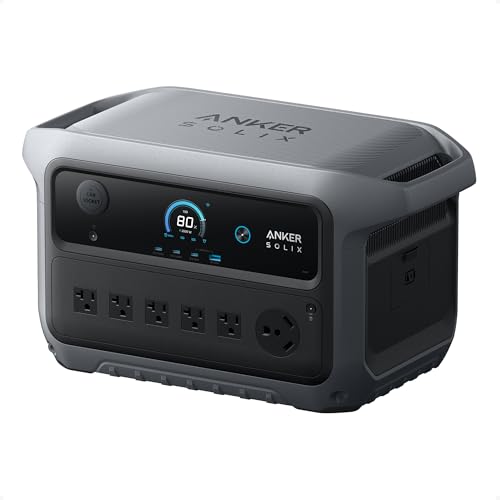 Anker Anker SOLIX C2000 Gen 2 Portable Power Station, 2,048Wh, 2,400W, Camping |
2,048Wh · 2,400W (4,000W peak) · LiFePO4 | $999.99 $1,499.00 |
4.7 ★ 679 ratings #12 in Generators |
33% OFF In Stock |
Why a battery station beats a fuel generator indoors
A power station and a fuel generator overlap in output but not in where you may use them. UL Standards & Engagement – the standards body behind the UL 2201 portable-generator standard – puts it plainly: carbon monoxide is the “silent killer,” undetectable by humans because it is colorless, odorless and tasteless, and “in high enough concentrations, CO can harm or kill a person within minutes.” UL 2201 exists because generators emit it: the standard limits active CO emissions and adds an automatic shutoff if a generator senses high CO output. A portable power station has no combustion and no exhaust at the point of use, which is why it can sit in a hallway, a kitchen or a bedroom while it works.
The trade-offs are real, though. A $500 station is a 1,000-1,150Wh battery; a $500 fuel generator can hold multi-kilowatt output for as long as you have gasoline, and neither these seven units nor any 120V station here can power a 240V well pump or a whole-house panel. We rank fuel generators separately in our portable generator guide; for everyone else, the battery wins on safety, silence and zero maintenance.
How to size one without wasting money
Two numbers matter and shoppers constantly swap them. Watts (W) measure flow – how big an appliance the station can run. Watt-hours (Wh) measure capacity – how long it can run it. CNET’s testing lab defines it cleanly: “a watt-hour – or Wh – is a unit of energy equal to one watt of power sustained for one hour.” So a 50W laptop for six hours is 300Wh, a 30-40W CPAP machine for one night is roughly 240-320Wh, and a refrigerator’s compressor cycling on and off for a day can take 1,000Wh or more. CNET sorts the market the same way we do: under 600Wh is small, 600-1,299Wh is medium, 1,300-2,199Wh is large, and anything over 2,200Wh is extra-large.
Here is the check most listings will not do for you. Divide the verified price by the claimed capacity and you get dollars per watt-hour across our seven picks: $0.89/Wh for the 292Wh Jackery Explorer 300, $0.97/Wh for the 288Wh BLUETTI Elite 30 V2, $0.43/Wh for the 1,152Wh AC180, $0.47/Wh for the 1,070Wh Explorer 1000 v2, $0.52/Wh for the C1000 Gen 2, $0.58/Wh for the Delta 3 and $0.49/Wh for the 2,048Wh C2000 Gen 2. The pattern is blunt: everything under 300Wh costs roughly twice as much per unit of energy, and the value cliff sits at about $500, where 1,000-1,150Wh LFP units land. Beyond roughly $1,000 you are no longer buying energy – you are buying surge watts, expansion batteries and recharge speed. Budget 60-90% of claimed capacity as actually deliverable through the AC outlets; OutdoorGearLab measured that exact range on the 14 stations it bought and tested.
One more sizing trap: output. A station rated 300W continuous (the Explorer 300) cannot start a fridge compressor that spikes past its limit, while the 2,400W C2000 Gen 2 can run a 1,500W space heater – see our space heater guide for why that 1,500W figure matters during an outage. Match the output rating to your single hungriest device first, then buy capacity for runtime.
The picks, reviewed
1. Jackery Explorer 300 – the #1 Best Seller to start small
This is the current #1 Best Seller in Amazon’s Outdoor Generators category, verified live through Amazon’s product API on September 22, and OutdoorGearLab independently rated it their Best Buy for phones and laptops out of the 14 stations they bought and tested. It is the cheapest honest battery in this roundup, and it is the one we would hand to a student, an apartment dweller or a CPAP user without a humidifier.
What we like:
- 292Wh of LiFePO4 capacity in a 7.5-pound body, which Jackery says is 17% lighter than the class average
- Runs up to six devices from two AC outlets, a 100W USB-C PD port, two USB-A ports and a 120W car port
- Jackery claims more than 4,000 charge cycles before the battery drops to 70% of original capacity
Flaws but not dealbreakers:
- 300W of continuous output is the hard ceiling here, so a full-size fridge compressor or a kettle is out of reach
- There is no battery expansion, and third-party solar panels need an adapter
Who should skip it: Skip the Explorer 300 if your outage plan is built around a refrigerator. It is a phone, laptop, router and light station, not a kitchen station.
2. BLUETTI Elite 30 V2 – the carry-everywhere budget pick
For $279 (38% off its $449 list at our verification), the Elite 30 V2 is the cheapest way to get real 600W-class output in a body you can actually carry. It is the station we would pack for a weekend campsite, a tailgate or a movie night in the yard.
What we like:
- 600W continuous and 1,500W surge in Power Lifting Mode, about twice the output of most 288Wh rivals
- 9.4 pounds with a 380W wall charge that reaches 80% in roughly 45 minutes
- Eight charging modes including solar, car, wall and USB-C
Flaws but not dealbreakers:
- 288Wh is a few hours of fridge runtime, not a day of it
- BLUETTI does not state a cycle-life figure on the listing we verified
Who should skip it: Skip the Elite 30 V2 if you are buying for multi-day outages. This is a car-camping and desk unit.
3. Jackery Explorer 1000 v2 – the 1,070Wh all-rounder
The Explorer 1000 v2 is the 1 kWh-class pick with the deepest buyer track record of its group (4.7 stars across 3,617 ratings at verification). It charges at up to 1,500W, survives an emergency one-hour top-up, and Jackery backs the LFP pack with a 10-year lifespan claim.
What we like:
- 1,070Wh LFP battery with 1,500W continuous and 3,000W surge output
- Emergency charging mode refills it from empty to full in about one hour
- Three pure-sine AC ports, two USB-C ports, a car port and a built-in LED light bar
Flaws but not dealbreakers:
- Stacking loads past 1,500W trips the AC limit
- Jackery’s solar input is tuned to its own panels, so third-party panels want an adapter
Who should skip it: Skip the Explorer 1000 v2 if you need 2,000W-class output for power tools. The C1000 Gen 2 below does that for $31 more at our verified prices.
4. BLUETTI AC180 – the capacity-per-dollar king
At $499 the AC180 buys more watt-hours than anything else in this roundup: 1,152Wh of LiFePO4, 1,800W of output and a genuine UPS mode. For a family that wants one box for outages, campsite fridges and the occasional power-tool session, this is the value anchor.
What we like:
- 1,152Wh LiFePO4 battery, the most capacity we verified under $500
- 1,800W output (2,700W peak) across eight outlets, managed from the BLUETTI app
- A one-hour full charge at 1,440W AC input plus a UPS mode for routers and desktops
Flaws but not dealbreakers:
- Solar input tops out at 500W, so a full solar refill takes roughly three hours of good sun
- No warranty term is stated on the Amazon listing we verified
Who should skip it: Skip the AC180 if you want a documented cycle-life number before buying. Anker and EcoFlow print theirs; BLUETTI does not on this listing.
5. Anker SOLIX C1000 Gen 2 – the value pick three testers agree on
This is the rare station where the professional consensus and the price tag point the same way: OutdoorGearLab made it their Best Value for Most People, Popular Science called it their Best budget, and Outdoor Life rated it Best for Solar Panels. It is also the only pick here whose 4,000-cycle claim is written down where you can hold the brand to it.
What we like:
- 1,024Wh LFP battery pushing 2,000W (3,000W peak) through ten ports
- HyperFlash recharging refills it in about 49 minutes at 1,600W
- Anker claims 4,000 cycles to 80% capacity, and OutdoorGearLab named it the best value power station for most people
Flaws but not dealbreakers:
- The 1,600W recharge rate wants a circuit you are not sharing with other appliances
- It costs about $31 more than the AC180 for roughly 130Wh less capacity
Who should skip it: Skip the C1000 Gen 2 if your only goal is maximum watt-hours per dollar. That is the AC180.
6. EF ECOFLOW Delta 3 – the station you can grow into
EcoFlow’s Delta 3 is the modular pick: 1,024Wh today, expandable toward 5kWh when the budget allows, with the fastest full-charge time here (56 minutes). OutdoorGearLab’s home-backup award went to EcoFlow’s larger Delta Pro 3, and Outdoor Life’s best-overall pick was the older Delta 2, which tells you the platform, not just one model, tests well.
What we like:
- 1,024Wh LiFePO4 with 1,800W output and a 56-minute full charge
- Expandable up to 5kWh with EcoFlow’s ecosystem batteries
- Runs up to 13 appliances at once, with X-Boost handling resistive loads
Flaws but not dealbreakers:
- Expansion batteries cost nearly as much as the station itself
- Same 1,024Wh capacity as the cheaper C1000 Gen 2 at our verified prices
Who should skip it: Skip the Delta 3 if you are not going to expand it. Its upgradability is the reason to pick it over the Anker.
7. Anker SOLIX C2000 Gen 2 – the 2,048Wh home-backup anchor
Both CNET and Popular Science crown BLUETTI’s Elite 200 V2 as their best overall large unit, at $1,449 as CNET prices it. At our verified Amazon price, the C2000 Gen 2 delivers 2,048Wh and 2,400W for $999.99 – three figures less for essentially the same job – with a 58-minute full charge and a 9W standby draw low enough to keep it permanently plugged in as outage insurance.
What we like:
- 2,048Wh LiFePO4 with 2,400W rated and 4,000W peak output
- Six recharge paths and a 100% charge in about 58 minutes
- 9W standby draw, with expandable capacity up to 4kWh
Flaws but not dealbreakers:
- It is the only pick here that costs four figures
- The expansion battery that takes it to 4kWh is sold separately
- No stated cycle-life figure on the listing we verified
Who should skip it: Skip the C2000 Gen 2 if you only need to top up phones, laptops and a router. You would be paying for capacity you will not touch.
Budget mentions: if even $259 is too much, two verified sub-$200 listings did not earn cards but are honest starter batteries: the GRECELL 500W (519Wh, 4.5 stars across 241 ratings, $179.97) at 57% off its $419.99 list, and the ALLWEI 300W (256Wh, 4.4 stars across 2,444 ratings, $128.99). CPAP users with humidifiers off can also look at the dedicated EASYLONGER ES960 CPAP backup (297.6Wh, $269.99), which ships the ResMed and Philips cables in the box.
Failure modes you should plan for
We did not buy-and-abuse these units ourselves, so we planned around the failure notes the testers who did publish. The recurring themes: fan noise under load (OutdoorGearLab logged “loud fan” against two of its 14 units); weight (CNET’s lab technician lists “it’s heavy” first among the drawbacks of the class-leading large unit); weather sealing (“not waterproof” is CNET’s other headline caveat); and proprietary solar ports, which OutdoorGearLab flags on multiple brands – one unit “needs adapter for 3rd party solar panels,” another “uses proprietary solar ports.” Finally, OutdoorGearLab warns that a budget unit can have grounded-plug surprises: on one tested station, “half the AC outlets are ungrounded.” Buy the adapter for third-party panels on day one, keep the unit out of rain, and expect a hum when you push past half load.
Spec-claim reality checks
Claimed capacity is not delivered capacity. OutdoorGearLab measured that “none of the products we tested actually delivers usable AC power output that matches their claimed capacity” – only 60% to 93% of the claimed watt-hours make it out of the AC outlets after inverter losses and conversion overhead. Size your runtime math on the low end of that band, not the label.
Fast-charge claims are wall-socket dependent. The C1000 Gen 2’s “49-minute” and the AC180’s “one hour” full charges require 1,600W and 1,440W of wall input respectively. That is within a single 15A/120V circuit’s limit (about 1,800W), but on a shared kitchen circuit it will trip a breaker – CNET’s charge-test method measures exactly this intake from a standard outlet, and their methodology page is worth reading before you believe any fast-charge figure.
Cycle-life claims are brand promises, not lab results. The chemistry is real – LFP (lithium iron phosphate) genuinely lasts longer than the lithium-ion packs in older units, and OutdoorGearLab’s comparison table lists claimed cycle lives from 800 cycles (lithium-ion) to 4,000 (LiFePO4). But a “4,000 cycles to 80%” figure is the manufacturer’s own claim; Outdoor Life’s tester makes the practical point on a budget unit, noting its 3,500-lifecycle rating outlasted its warranty term. Treat cycle counts as a tiebreaker between equal-price units, not a guarantee.
Where we disagree with the big testers
The professional boards disagree with each other and with us, and the disagreements are the useful part. CNET and Popular Science both crown BLUETTI’s Elite 200 V2 as best overall; CNET prices it at $1,449. Our large-unit pick is the Anker SOLIX C2000 Gen 2 instead, because at the $999.99 we verified on Amazon it delivers 2,048Wh and 2,400W of output – three figures less for the same job class – and OutdoorGearLab’s usable-capacity finding says the extra $450 is not buying extra runtime you can feel. We also part ways with Outdoor Life, whose best-overall pick is the older EcoFlow Delta 2; we went with the Delta 3 for its 56-minute charge and expansion path, and note that Outdoor Life themselves hedge their value pick (the Oupes Mega 1) with an explicit reliability warning – which is exactly why it is not in our lineup. Where we agree: the C1000 Gen 2 as the value pick (OutdoorGearLab, Popular Science and Outdoor Life all ranked it), and the Jackery Explorer 300 as the right first battery (it is OutdoorGearLab’s Best Buy for phones and laptops and Amazon’s #1 best seller in the category).
How we chose and what we verified
We started from the seven price-and-output classes that cover how people actually buy these units – ultralight, budget carry, 1 kWh all-rounder, capacity-per-dollar, consensus value, modular, and 2 kWh backup – then pulled live pricing, output, chemistry and best-seller rank for every candidate through Amazon’s product API on September 22, 2026, and confirmed every listing is a first-party brand product (brand matches the first token of the listing title) with an active buy box and a real rating pool. Our method, what we do and do not test, and our corrections route are on our How We Test page: we are not a lab, we do not run discharge curves, and we say so.
Sourcing transparency: the performance judgments in this guide are ours, built on the published measurements of the testers cited; the failure-mode section reuses only con-notes those testers actually published; and every price is a same-day API snapshot. Our rank order is chosen for dollars-per-delivered-watt-hour at verified prices, safety-relevant output, and cycle-life transparency – not for margin.
Key sources: UL Standards & Engagement – what UL 2201 requires of portable generators’ carbon-monoxide emissions; OutdoorGearLab – 14 stations bought and tested head-to-head, including the usable-capacity finding; CNET Testing Labs – watt-hour definition, charge/discharge test method and round-trip efficiency weighting; Popular Science and Outdoor Life – long-term portable-power coverage and current category picks.
FAQ
Can I use a portable power station indoors? Yes – that is the core advantage over a fuel generator. There is no combustion and no exhaust, so there is no carbon monoxide. Fuel generators need outdoor placement, distance from windows, and CO-conscious siting precisely because UL 2201 and the safety agencies treat generator CO as a lethal, silent hazard.
How long will a station run my refrigerator? A modern fridge draws 100-200W while the compressor runs but cycles on and off, so a 1,000-1,150Wh unit (Explorer 1000 v2, AC180, C1000 Gen 2, Delta 3) is a reasonable one-day fridge bridge. CNET’s lab adds the honest nuance: a refrigerator test measures less energy than a constant load because the compressor cycles, while the station’s own display and fans keep drawing – so expect less than the label math suggests.
LiFePO4 or lithium-ion? For a unit you will cycle hundreds of times, LFP. OutdoorGearLab’s table puts claimed cycle life at 4,000 for most current LFP units versus as low as 800 for lithium-ion, and every one of our seven picks is LFP. If a listing does not state its chemistry or cycles, treat that as a data point in itself.
Do the “one-hour” recharge claims work on any outlet? Only on a circuit that can supply them. 1,440-1,600W input is within a 15A/120V circuit’s ~1,800W ceiling but not while anything else meaningful shares it. Slower charge modes exist on every unit here – use them on shared circuits.
The bottom line
Buy the Jackery Explorer 300 if you want the category’s #1 best seller for phones, laptops and CPAP nights. Buy the AC180 or the C1000 Gen 2 if you want the best capacity-per-dollar or the best-tested value in the 1 kWh class. Buy the C2000 Gen 2 if a multi-day outage is the scenario you are actually planning for – at $999.99 verified, it is the most defensible four-figure station on Amazon right now.