Affiliate disclosure: We earn commission from qualifying purchases made through links on this page. This never affects our rankings or what we recommend.
A desk lamp is the cheapest eye-comfort upgrade in a home office — but not because LEDs are magic. The American Academy of Ophthalmology’s reviewed guidance on digital eye strain comes down to mechanics: “If your screen glows brighter than your surroundings, your eyes have to work harder to see.” A good desk lamp does exactly the job that advice implies — it throws a wide, dimmable, glare-free pool of light so your screen stops being the only bright thing in the room.
We verified six of the best LED desk lamps of 2026 on live Amazon listings — in stock, buybox present, brand confirmed as the first title token — and pulled their specs (color-temperature ranges, brightness steps, lumen ratings, power) from those listings rather than from marketing pages. Then we triangulated against two independent testing teams: TechGearLab, which ran 11 lamps past a laboratory-grade light meter, and Digital Trends’ editor-picked back-to-school desk lamp guide. Every health claim below is checked against ophthalmology guidance and the Sleep Foundation’s light-and-sleep research — and we say plainly where our ranking disagrees with the testers.
One honesty note before the picks: no lamp “protects” your eyes. The AAO is explicit that digital eye strain is uncomfortable but not damaging, and that the real fixes are brightness matching, glare reduction, and periodic breaks. What a good lamp buys you is a comfortable ambient level, less screen-to-room contrast, and a warm evening mode that does not fight your sleep. Everything below is chosen for that job.
Contents
- How We Chose These Desk Lamps
- Desk Lamp Comparison Table (2026)
- The 6 Best LED Desk Lamps of 2026
- What Actually Causes Eye Strain (and What a Lamp Can’t Do)
- What Changes at Each Price Tier
- Where We Disagree With Other Reviewers
- The Failure Modes Hiding in the Specs
- Evening Light, Warm Modes, and Sleep
- FAQ
How We Chose These Desk Lamps
We started with the live Amazon listings, not other roundups. That meant verifying every ASIN’s product page ourselves: in-stock status, buybox presence, rating counts, and a brand-first-token check that filters out the reseller listings that stuff famous names mid-title. We pulled the spec claims — color-temperature ranges, brightness levels, lumen output, power options — directly from those listings, and we left out products whose buybox we could not confirm during this run, including two famous premium lamps you will meet in the disagreement section.
Then we triangulated against the people who actually tested fleets of these lamps. TechGearLab bought 11 desk lamps and scored them with a laboratory-grade light meter plus usability and adjustability trials (their review was last updated January 5, 2024); their top awards went to the EppieBasic clamp lamp for raw brightness and the Lampat LED for value. Digital Trends’ back-to-school guide highlights flexible gooseneck positioning, multiple color and brightness modes, flicker-free illumination, and remote-control convenience. Where our conclusions differ, there is a dedicated section below rather than a quiet omission.
Full methodology, including what we do and do not claim to test ourselves, lives on our How We Test & Choose Products page. In short: we did not put a lux meter on these lamps. Our original work here is the listing verification, the spec-truth table, the price-tier analysis, and the ranking judgment — the hands-on brightness and usability impressions are credited to the named testers.
Desk Lamp Comparison Table (2026)
Specs below come from the live product listings we verified this week. Where a manufacturer does not publish a spec, the cell says so rather than guessing.
| Lamp | Style | Brightness & control | Color temperature | Power | Rating record |
|---|---|---|---|---|---|
| Airlonv Clamp | Clamp gooseneck, 17″ bar, 100 LEDs | Stepless 1–100% dimming | 2700K–6500K | Corded (USB adapter) | 4.5★ (2,300+) |
| Lampat Classic | Base, touch panel | 5 levels × 4 modes + 1-h timer | 4 named presets | AC + 5V/2A USB port | 4.7★ (1,600+) |
| Lepro 800LM Metal | Base, metal body | 800 lm, 5 levels × 5 modes | 5 modes (not published in K) | AC adapter | 4.7★ (2,600+) |
| Lepro Small Clamp | Clip gooseneck | 460 lm, 10 levels × 3 modes | 3 fixed modes | USB | 4.6★ (8,300+) |
| Verilux SmartLight | Base, gooseneck | Adjustable brightness; full-spectrum LED | Not published (K) | AC + USB port | 4.6★ (900+) |
| Verilux HappyLight Duo | Base, gooseneck + therapy panel | Up to 10,000 lux, adjustable | Adjustable color | AC + USB port | 4.6★ (9,000+) |
The 6 Best LED Desk Lamps of 2026
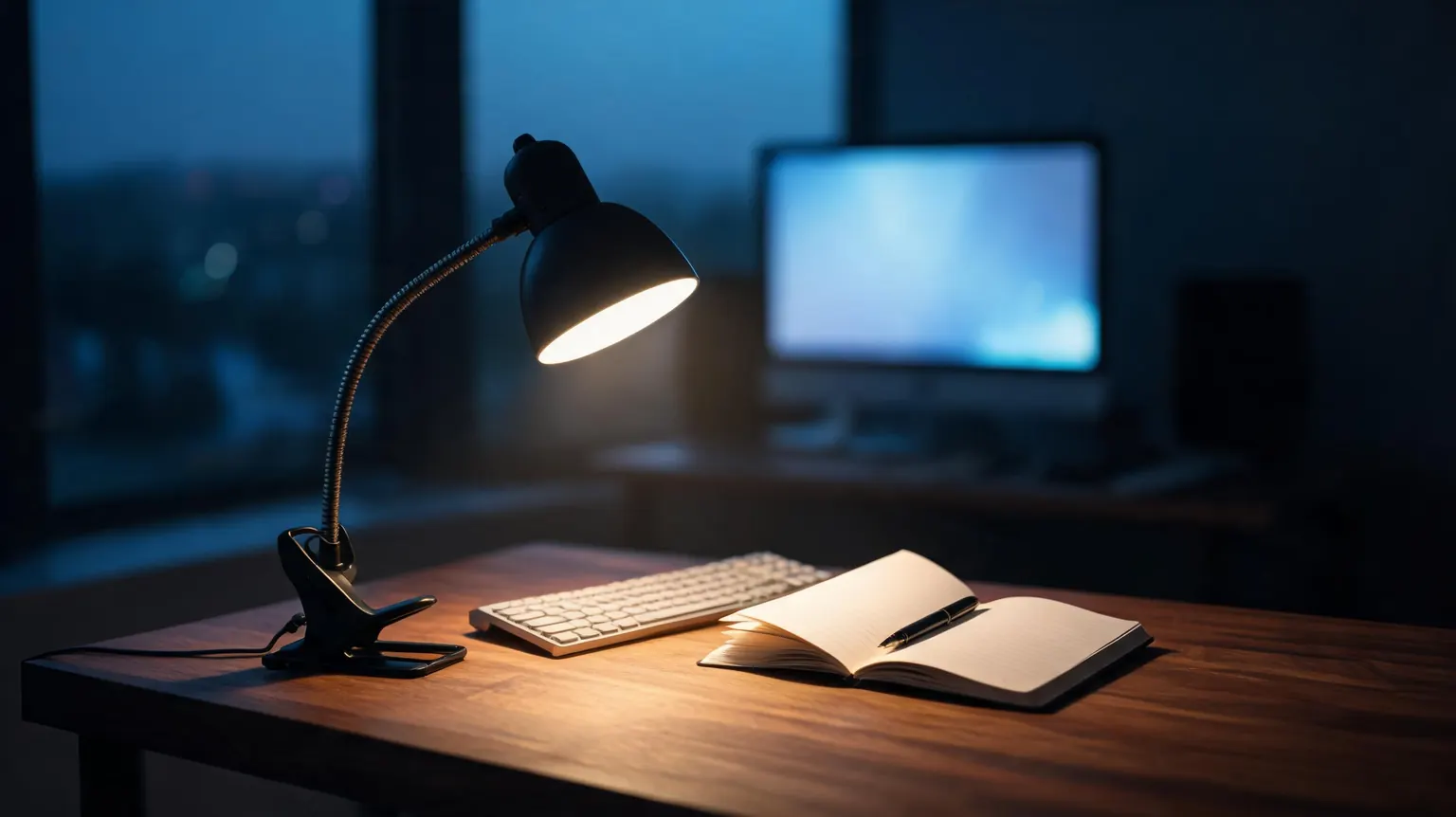
1. Airlonv LED Desk Lamp with Clamp — Best Overall for Eye Comfort
Rating: 4.5 stars from 2,300+ ratings · Style: clamp-on gooseneck with a 17-inch, 100-LED light bar · Control: stepless 1–100% dimming, 2700K–6500K

- Stepless Dimming Mode: The desk light offers effortless switching of color temperatures (2700K-6500K) and stepless dimmi…
- 360° Adjustable & Long Flexible Gooseneck: The long flexible gooseneck with 360° adjustable, easy adjustment to your pre…
- Big Size & Fit Models: Our table lamp features a 17-inch extra-wide lamp bar that can fully light up your workspace, pro…
The Airlonv wins this guide because it nails the exact mechanics ophthalmology guidance asks for: infinite adjustment. Stepless dimming means you can walk the brightness down until the screen and the desk reach parity instead of hopping between five fixed levels, and the full 2700K–6500K span gives you a genuinely warm evening mode and a neutral task light from the same head. The 17-inch bar is the wide-coverage form factor TechGearLab’s own brightness award went to — a long bar clamped above the desk throws an even pool across keyboard, mouse, and paperwork, which is precisely what reduces the bright-screen-versus-dark-room contrast that makes eyes work overtime. It is also Amazon’s #1 best seller in desk lamps as we publish this, which matters for a practical reason: the listing will be around, with parts and support, for years.
Pros: stepless dimming with no preset jumps; 2700K–6500K covers warm bedtime light through cool task light; 100-LED wide bar evens out screen-to-desk contrast; the clamp plus 360° gooseneck positions light over a monitor span up to 30 inches without eating desk space.
Flaws but not dealbreakers: it is corded, with no battery option, and the clamp demands a free desk edge — glass-topped or standing desks need a base-standing lamp instead. The bar is a single head, so multi-monitor cockpits that want two pools of light should compare the double-head designs in TechGearLab’s fleet. And one honesty flag: no tester in our pool has metered this exact model — our ranking rests on the verified listing specs plus the category-wide consensus on wide-bar clamps, which we weigh explicitly in the disagreement section. Who should skip it: anyone who cannot clamp — the Lampat and Lepro metal picks below stand on their own base.
2. Lampat Dimmable LED Desk Lamp — Best Classic Base-Standing Pick
Rating: 4.7 stars from 1,600+ ratings · Style: base-standing with touch panel · Control: 5 brightness levels × 4 modes, 1-hour auto timer

- Four Lighting Modes: Choose from Reading, Studying, Relaxation, and Bedtime modes to suit different activities and moods…
- Five-Level Dimmer: Adjust the brightness across five levels to find the perfect illumination for any task.
- Touch-Sensitive Control Panel: Easily switch between modes and adjust brightness with intuitive touch controls.
The Lampat is the lamp that a decade of roundups crowned, and TechGearLab still awards it “Best Bang for the Buck” at a $40 list price — their testers liked the light-up touch buttons and the fact that the designers “thought to include a 1-hour auto-off.” Four named modes (Reading, Studying, Relaxation, Bedtime) × five brightness levels is a preset system: instead of tuning Kelvin numbers, you tap Bedtime and get the dim, warm end of the scale that the Sleep Foundation’s evening-light advice calls for. The 5V/2A USB charging port on the base is genuinely useful — it is the difference between a lamp and a lamp that also replaces a wall wart on a crowded power strip.
Pros: the simplest interface in this guide — named modes do the thinking; Bedtime preset is the easiest warm-evening light here; USB port charges a phone; 1-hour auto timer; TechGearLab-tested pedigree going back years.
Flaws but not dealbreakers: five dimming steps are coarse — you cannot fine-walk the brightness the way the Airlonv allows, so pixel-perfect screen matching is out. The body is plastic in an era when the Lepro below sells metal at similar money, and the design dates to 2015 (the panel lighting up was charming then). Who should skip it: people who want stepless control or a premium finish — both exist one tier up.
3. Lepro LED Desk Lamp 800LM Metal — Brightest Budget Workhorse
Rating: 4.7 stars from 2,600+ ratings, 7,000+ bought in the past month · Style: base-standing, metal body · Output: 800 lumens, 9.5W

- [Multiple Lighting Choices] – This LED desktop lamp offers 5 lighting modes, each of which can be paired with one of 5 b…
- [Eye Care Diffused Non-Flickering Lighting] – 72 energy efficient LEDs provide natural, non-glaring light to help preven…
- [Sleek and Minimalist] – It takes up minimal space and fits nicely on any desk, workbench, sewing table, bedside nightst…
This is the volume pick of the category: 7,000+ bought in the past month per the live listing, which is the kind of velocity that keeps a product line, its parts, and its support alive. The metal body is the surprise at this price — most sub-$40 lamps are plastic — and 800 lumens from 9.5W gives you real headroom for paper-heavy work. A reality check on that number: lumens measure output, not the light landing on your desk. The Sleep Foundation notes that even bright office lighting rarely reaches about 500 lux, and TechGearLab’s meter readings on one full-size task lamp spanned 200–761 lux across its settings — so think of 800 lumens as headroom you dim from, not a number you sit under. Five color modes times five brightness levels gives 25 combinations, plenty for the brightness-matching job.
Pros: metal construction at a budget price; the deepest brightness headroom of the base-standing picks; 25 setting combinations; the strongest recent sales record here, which is its own kind of long-term support.
Flaws but not dealbreakers: the 5-brightness steps are coarse at the low end, which makes late-evening dimming feel abrupt; the colorway is white only; and the listing publishes modes rather than Kelvin figures, so you cannot dial an exact temperature. Who should skip it: anyone who wants a warm, low, bedroom-soft lamp as their primary — the Lampat’s Bedtime mode is better tuned for that.
4. Lepro Small Desk Lamp with Clamp — Best Clip-On for Small and Shared Desks
Rating: 4.6 stars from 8,300+ ratings — the deepest rating record in this guide · Style: clip gooseneck · Output: 460 lm, 5W

- ❌ AC Adaptor is NOT Included! ❌ Non-Rechargeable!
- 【Room-Saving】Comes with C-Clamp, this desk lamp is designed for limited space, like a small table, drawing board, bed he…
- 【Multiple Light Modes】 With 450LM brightness, 3 color modes each featuring 10 brightness levels, this desk lamp is suita…
The dorm, renter, and shared-desk pick. A 460-lumen, 5-watt gooseneck that clamps to a headboard, desk edge, or shelf covers a reading or laptop-work zone without fighting anyone for space, and it runs off USB — it will live happily on a laptop port or a power bank. Ten brightness levels is finer control than most full-size lamps in this guide offer, and 8,300+ ratings make it the most-proven product here by track record. TechGearLab’s clamp-category winners share this exact form factor; their quibbles were clip padding and fussy buttons, not the concept.
Pros: tiny footprint; 10-step brightness (finer than the big lamps’); flexible gooseneck aims light precisely; USB power works where outlets are scarce; the longest rating record in the guide.
Flaws but not dealbreakers: 460 lumens lights a work zone, not a whole desk — dual-monitor setups will want the Airlonv or the Lepro metal; three fixed color modes with no stepless temperature; and USB power means it dims or flickers on underpowered ports. Who should skip it: anyone lighting a full workstation — that is a job for a wide bar.
5. Verilux SmartLight — Best for Color-Accurate Work
Rating: 4.6 stars from 900+ ratings · Style: base gooseneck · Claim to fame: full-spectrum LED, integrated USB charging port

- Full Spectrum, LED Light – Long-lasting, LED light delivers better brilliance and truer color for reading and detail wor…
- Personalized Settings – Customize your experience by choosing between 8 light intensity levels and 3 color temperatures …
- Sleek, Modern Design with USB Charging Port – Contemporary take on the traditional gooseneck desk lamp with a USB chargi…
Verilux has been selling natural-spectrum lamps since the 1950s, and the SmartLight is their desk-scale take on the idea: a full-spectrum LED head on a flexible gooseneck with an integrated USB port, listed at $54.99. This is the pick for tasks where color fidelity matters — drawing, crafts, makeup, paint and fabric matching — where a neutral, daylight-ish rendering makes colors read true. The listing also touts glare reduction and improved visual clarity, the two comfort claims that actually align with ophthalmology’s mechanics.
Pros: full-spectrum positioning for color-critical tasks; decades-old lighting specialist behind it; gooseneck aims light exactly; USB port on the base; the only pick here marketed explicitly around glare reduction.
Flaws but not dealbreakers: the listing publishes no CRI figure, so “full spectrum” is a marketing claim you are trusting rather than a spec you can audit — our spec-truth policy says say so. It is brightness-adjustable but publishes no Kelvin range, and 900+ ratings is the smallest track record in this guide. Who should skip it: evening-first buyers who want warm presets — the Lampat and Lepro picks do warm light better.
6. Verilux HappyLight Duo — Best Light-Therapy Hybrid
Rating: 4.6 stars from 9,000+ ratings · Style: gooseneck task lamp + light-therapy panel · Output: up to 10,000 lux, UV-free

- UV-Free, LED, Full Spectrum Light: Delivers up to 10,000 lux for safe and natural light therapy and truer color for read…
- Improve Sleep, Mood, Focus, Energy – Bright light therapy improves sleep, boosts mood, increases energy, and enhances fo…
- Reduce Eye Strain and Eye Fatigue – Mimicking natural daylight, this table lamp is flicker-free and equipped with an Opt…
The Duo is two products sharing one base: a task lamp and a 10,000-lux therapy panel. For context on that number, the Sleep Foundation puts direct noon daylight at up to 10,000 lux and bright office lighting at a few hundred — this lamp can recreate, at your desk, the intensity of standing outside on a clear morning. That is the point: in dark winters, a bright-light session at the start of the workday is the documented use case for devices in this class, and folding it into the lamp you already need is cheaper and tidier than two devices. As a task lamp it adjusts brightness and color on a gooseneck, with a USB port for your desk.
Pros: replaces a therapy lamp and a desk lamp with one device; 10,000-lux output dwarfs everything else here; adjustable color and brightness; 9,000+ rating record; genuinely useful in dark-winter home offices.
Flaws but not dealbreakers: therapy-level brightness is harsh at close range — you angle it at your face from a distance, not at your keyboard, so it is not brighter-is-better for desk work; it costs more than any non-premium pick here; and this guide is not medical advice — if you suspect seasonal depression, that is a conversation for a clinician. Who should skip it: anyone who only wants ambient desk light — you would be paying for hardware you will not switch on.
What Actually Causes Eye Strain (and What a Lamp Can’t Do)
The fear that screens permanently damage vision is, per the AAO’s reviewed guidance, unfounded — hours of screen time can leave eyes blurry, achy, and dry, but that strain is discomfort, not damage. The causes are mechanical: prolonged close focus, reduced blinking, glare bouncing off the display, and the contrast mismatch between a glowing screen and a dim room. That last one is where lighting comes in: the AAO’s advice is to adjust your screen brightness to match the ambient light around you, bump screen contrast, and cut glare — a matte filter or, better, a lamp that raises the room’s ambient level.
So a desk lamp helps with eye strain the way good posture helps your back: it removes one of the stresses that accumulate. It does not treat anything, and no lamp “protects” or “heals” eyes — marketing copy that says otherwise is selling the wrong job. Note too that the AAO points out computer glasses for strain are not the same as blue-light-blocking glasses; by the same logic, an “eye-care LED” badge is not a feature, it is a label. Buy for adjustability, coverage width, and a warm evening mode — the three things that change the room’s light mechanics.
A word on the numbers game: lumens (a lamp’s output) and lux (the light actually landing on your desk) are different quantities, and beam geometry decides how the first becomes the second. A focused 460-lumen clip lamp can out-light a diffuse 800-lumen bar on one square foot of paper while losing everywhere else. This is why we weight stepless dimming above raw output — the lamp you can fine-tune to your room beats the lamp with the bigger number.
What Changes at Each Price Tier
Under $35 (Lepro Small Clamp, Airlonv Clamp, Lepro 800LM): the eye-comfort sweet spot. This tier buys the complete mechanics package — wide coverage or precise aiming, multi-step or stepless dimming, warm-to-cool color — because none of that requires expensive hardware. Our #1 pick lives here. What you give up: metal in some models, sensors, and brand pedigree.
$35–$60 (Lampat at a $40 list, Verilux SmartLight at $54.99): convenience and specialization. The Lampat trades stepless control for named presets and a timer; the SmartLight trades warm modes for full-spectrum color rendering. Neither is more comfortable for screen work than the tier below — you are paying for interfaces and special jobs.
$70+ (TechGearLab’s EppieBasic pick at a $71 list; BenQ’s e-Reading lamp at roughly $230): raw light volume, double-head coverage, and in BenQ’s case an ambient-light sensor that auto-dims for you. TechGearLab’s own meter data shows task-light needs landing in the hundreds of lux while this tier’s appeal is headroom and coverage width — the comfort curve flattens well before the price does. If you have a multi-monitor cockpit or a daylight-starved basement, the upgrade is real; for a single-screen desk, it is polish, not relief. We could not verify a live buybox on either premium lamp this cycle — see below.
Where We Disagree With Other Reviewers
TechGearLab crowned the EppieBasic clamp “Best Lamp for Tons of Light” and handed the Lampat the value award; Digital Trends’ back-to-school guide leans toward remote-controlled convenience. Our #1 is the Airlonv — a lamp none of them tested — and that is a deliberate disagreement, not an oversight.
The reasoning: TechGearLab’s award axis is brightness, but their own measurements show why brightness is the wrong axis for eye comfort. Their metered readings land in the 200–761 lux range, and the Sleep Foundation puts typical bright office lighting at around 500 lux — the difference between their winner and the value picks is headroom most screen workers will never use, because the actual job is matching the room, not out-shining it. Stepless dimming across 2700K–6500K does that job all day and all evening, at half the EppieBasic’s list price. We do agree with TechGearLab where it counts: the Lampat is in this guide for the same reason it holds their value award, and it is the only tester-awarded lamp we feature.
We also diverge on process, and it is worth being explicit. Test labs buy their units and test from a US bench; we rank from live listings, and this cycle both famous premium lamps — the BenQ e-Reading and the EppieBasic — failed our buybox verification (a delivery-location wall blocked the buybox from our vantage point, and one EppieBasic variant ships with a non-brand first title token). We will not rank a product we cannot confirm is purchasable this week. If you want the brightness king and can confirm the listing yourself, TechGearLab’s EppieBasic is the one to check first.
And the remote-control picks in Digital Trends’ guide? Convenience is real, but a remote is another battery, another dongle between you and the light, and one more thing to lose — for a device that sits within arm’s reach, we rank simplicity above it.
The Failure Modes Hiding in the Specs
Every category has recurring failure patterns that never make it into marketing copy. For desk lamps, these are the five worth knowing before you buy — grounded in what the testers documented and what the specs themselves admit.
Clamp pressure on bare desks. TechGearLab’s testers wanted more padding on the clip of their clamp pick to protect the desk — bare clamp jaws on soft wood leave marks and dents. If your desk is finished wood, put a felt or silicone pad in the jaws, or clamp to a desk mat’s edge.
Preset and button fatigue. Fixed 4- and 5-step dimmers cannot fine-match a screen’s brightness, and TechGearLab flagged hold-the-button power-off quirks on a tested model. This is the quiet argument for stepless dimming in our #1 pick: every added step is a compromise someone else chose for you.
Adapters before LEDs. LED panels age slowly; the little wall adapters and USB cables that feed them do not. When a lamp dies young, the fault is in the power path more often than the light engine — test with a known-good USB adapter before writing off the lamp. Every pick here runs on standard USB or replaceable-adapter power rather than a sealed unit, which is a quiet durability feature.
The “flicker-free” verification gap. The claim appears on listings across this category, including our #1 pick’s — and neither the listings nor the testers in our pool publish the modulation data that would audit it. Cheap drivers can show visible flicker at low brightness. If you are flicker-sensitive, buy from a seller with painless returns and test the lamp at its lowest settings first.
Corded-only reality. Every clamp and therapy pick in this guide is corded — verified from the listings. That is fine for a desk, but if you picture reading in bed or on a porch, you want the USB-powered clip lamp and a power bank, not a mains-corded bar.
Evening Light, Warm Modes, and Sleep
The Sleep Foundation’s light-and-sleep research explains why the warm modes on these lamps are not a gimmick: light regulates the circadian rhythm and the production of melatonin, and evening exposure matters as much as morning exposure. Their pages note that blue light — the short wavelengths many LEDs emit — has a significantly larger effect on melatonin and circadian timing than other light, and that screens and bright overheads close to bedtime can interfere with sleep for some people.
Their practical advice is almost embarrassingly cheap: when you are winding down, keep the room dim and use a small, low-power lamp with a warm color temperature — exactly what the 2700K end of the Airlonv or the Lampat’s Bedtime preset delivers. For the night side of the equation, our blackout curtains guide covers making the room properly dark.
The flip side deserves equal billing: in the morning, bright light is the point. The Sleep Foundation calls daylight — up to 10,000 lux — a profound influence on circadian timing, and notes office lighting rarely approaches it. A bright, cool desk lamp at 8 a.m. is legitimate circadian hygiene, and the HappyLight Duo exists for exactly the dark-winter mornings when even a sunny window is not coming.
FAQ
Do desk lamps actually help with eye strain?
They help with the conditions that cause it. Per the AAO’s mechanics, strain comes from glare, focus load, and screen-to-room contrast; a lamp that raises ambient light and lets you match brightness removes the contrast stress. It does not treat anything, and breaks from the screen matter more than any lamp.
How bright should a desk lamp be for computer work?
Bright enough that the screen is no longer the brightest thing in your field of view. For scale: bright office lighting rarely reaches about 500 lux (Sleep Foundation), and TechGearLab’s metered lamps spanned 200–761 lux. That is why stepless dimming beats big lumen numbers — you are matching, not maximizing.
Warm or cool light for a desk lamp?
Cool-to-neutral for daytime focus work, warm and dim for the last hour before bed — the Sleep Foundation’s evening guidance favors low, warm light as bedtime approaches. A lamp with a 2700K–6500K range does both; preset modes approximate the same thing.
Clip-on or standing desk lamp — which is better?
Clamp lamps free the desktop and can hang a light bar exactly over your monitor line, which is the best glare geometry. Standing lamps travel between rooms and work on glass or standing desks where nothing clamps. If your desk edge is clammable, clamp; if not, the Lampat and Lepro metal picks stand on their own.
Is a 10,000-lux light therapy lamp useful as a desk lamp?
As a hybrid, yes — that is the HappyLight Duo’s whole idea. But 10,000 lux is daylight-level intensity aimed at your face from a distance, not at your keyboard; as pure task lighting it is overkill. Buy it for dark-morning mood and let it moonlight as a lamp, and treat anything health-adjacent as a conversation with a clinician, not a purchase.
If your desk is more monitor than desk, our monitor light bar guide covers the screen-mounted way to kill glare, and our floor lamp guide handles the room-scale light a desk lamp cannot. Work screens hard after dark? The blackout curtains guide closes the loop on the sleep side.
As an Amazon Associate I earn from qualifying purchases.