Best office chairs in 2026 are the ones you can actually buy, adjust to your own body and keep for years without paying premium-brand pricing — and after re-checking every listing, spec sheet and certification claim below, the SIHOO M57 is still the safest sub-$200 recommendation on Amazon. This guide covers what a chair genuinely needs (adjustable lumbar support, a seat pan that fits your thighs, a base that carries a real weight rating), what it does not, and the exact price point where spending more stops buying you anything measurable.
Affiliate disclosure: As an Amazon Associate I earn from qualifying purchases. We earn commission from qualifying purchases made through links on this page. This never affects our rankings or what we recommend.
Jump to:
- The 7 best office chairs at a glance
- 1. SIHOO M57 — best overall
- 2. Steelcase Gesture — best premium
- 3. GABRYLLY with Footrest — best mid-range recliner
- 4. ELABEST X100 — best big-and-tall with footrest
- 5. Marsail — best budget ergonomic
- 6. TRALT — best under $150
- 7. LIANVA 500 lb — best maximum capacity
- Where paying more stops buying performance
- Where our ranking differs from other reviewers
- The failure patterns that show up in the reviews
- Spec-claim reality check: what “BIFMA tested” means
- How to choose an office chair (buyer’s guide)
- How we evaluated these chairs
- Related desk and home-office guides
- Frequently asked questions
The 7 best office chairs at a glance
Every chair below was re-verified against its live Amazon listing on September 25, 2026: the brand is the first word of the listing title, the buy box is active, and the price and stock shown are what a buyer sees today. Two columns are worth reading before anything else — rated capacity and warranty stated. Only two of these seven listings publish a warranty term, and only one publishes a certification test figure. That gap is itself the most useful thing on this page.
| Model | Rated capacity | Lumbar | Armrests | Recline | Warranty stated | Live price |
|---|---|---|---|---|---|---|
| BIFMA + SGS certified SIHOO | 330 lb (listing) | Adjustable height + depth | 3D (up/down, fwd/back, in/out) | Backrest recline | 3 years | $189.96 |
| Carpet casters Steelcase | Not stated | Adjustable | 360° rotating | 3 settings + upright lock | Not stated | $1,510.48 |
| 18.1″ footrest GABRYLLY | 300 lb (listing) | 2-way (3″ vert / 1.6″ horiz) | 3D | 90° / 110° / 135° lock | 3 years | $228.90 |
| BIFMA-certified structure ELABEST | 300 lb (listing) | 3D dynamic (depth/height/rotation) | 5D flip-up | 3-stage | Not stated | $349.99 |
| 3.14″ foam seat Marsail | 330 lb (listing) | Adjustable 1.18″ fwd/back, 2.16″ up/down | 3D | 90°–120° | Not stated | $112.99 |
| BIFMA-certified gas lift TRALT | 330 lb (listing) | Adjustable | Not stated | Not stated | Not stated | $119.99 |
| 5-point base LIANVA | 500 lb (listing) | Lumbar support + pillow | Linked (follows recline) | 90°–155° lock | Not stated | $169.99 |
1. SIHOO M57 — Best Overall Office Chair for Most People

What We Like
- 3D armrests adjust up/down, front/back and in/out so your forearms land at desk height
- Adjustable lumbar support plus a tilting headrest for full-spine support
- Reinforced aluminium base rated to 330 lb
- BIFMA- and SGS-certified, with the listing citing 100,000-cycle component testing
- 3-year warranty and a 30-day return window
Flaws but not dealbreakers
- Seat depth is fixed, so very tall users lose thigh support
- The mesh seat feels firm rather than plush
- The headrest can wobble slightly at full extension
Best for: anyone who wants one safe, adjustable chair for six to ten hours a day without paying premium-brand money.
Who should skip it: skip it if you are over about 6’2″ and want seat-depth adjustment, or if you want a plush padded seat.
The M57 is the chair we keep coming back to because it does the four things that actually change how an eight-hour day feels — adjustable lumbar support, 3D armrests, a breathable back and a base that carries a real weight rating — and it does them for less than $200. The listing states a reinforced aluminium base rated to 330 lb and a 3-year warranty, and it names BIFMA and SGS certification with 100,000-cycle component testing, which is more certification detail than any other chair in this roundup publishes.
The trade-offs are the usual mid-range compromises. Seat depth is fixed, so if you are tall the front edge can start pressing behind your knees; the mesh seat is supportive but firm; and the headrest, useful as it is, wobbles a little when extended. None of those are dealbreakers at this price, and every one of them is fixable with a footrest or a cushion rather than a new chair.
If you want one recommendation with no caveats for the average home-office user, this is it. It is also the pick where our ranking differs most from the big review sites — see the disagreement note below for why.
2. Steelcase Gesture — Best Premium Office Chair

What We Like
- 360-degree arms move with you instead of forcing a fixed position
- Three recline settings plus an upright back lock
- Carpet-optimised casters on this configuration
- Built and serviced by Steelcase, and it holds its resale value
Flaws but not dealbreakers
- At $1,510 it costs roughly eight times our value pick
- Heavy and awkward to shift once assembled
- The listing states neither a weight rating nor a warranty term
Best for: people who sit at the desk as their job, want a chair they can keep for a decade, and would rather buy once.
Who should skip it: skip it if you work part-time from home, move desks often, or want a documented weight rating before you buy — ask Steelcase directly instead.
The Gesture is the chair the other chairs are measured against. Its party trick is the arm design: instead of a fixed rest, the arms move through 360 degrees so they follow whatever your hands are doing, whether that is typing, drawing or holding a phone. This configuration ships with the carpet casters and a graphite frame.
Two things deserve flagging honestly. First, the price: at $1,510 it is more than eight times our $190 value pick, and nothing about sitting in it is eight times better. What you are buying is a longer service life and Steelcase’s own support network. Second, the listing itself is thin on hard numbers — it does not state a weight rating or a warranty term, which is exactly the kind of gap our reality-check section below is about. Steelcase publishes those figures on its own site; the Amazon listing does not.
Buy it if a chair is a decade-long capital purchase. If it is furniture you will move twice in the next three years, the mid-range picks make far more sense.
3. GABRYLLY High Back with Footrest — Best Mid-Range Reclining Chair

What We Like
- 2-way adjustable lumbar support (3″ vertical and 1.6″ horizontal)
- Recline locks at 90, 110 or 135 degrees
- Retractable steel footrest extends to 18.1″
- 3D armrests and a steel base rated to 300 lb
- 3-year warranty with a published support channel
Flaws but not dealbreakers
- Heavier than a mesh-only chair, and the footrest adds assembly steps
- The headrest is fixed rather than height-adjustable
- Large footprint for a small room
Best for: people who recline during the day, want a footrest for breaks, and need 300 lb of rated capacity without a 500 lb armchair.
Who should skip it: skip it if your desk is against a wall or you need to tuck the chair fully away — the footrest needs room behind and in front of you.
This is the pick for the afternoon slump. The backrest reclines to 135 degrees and locks at 90, 110 or 135, and a retractable steel footrest extends to 18.1 inches so reclining does not leave your legs dangling. The lumbar support adjusts in two directions — three inches vertically and 1.6 inches horizontally — which is more than most chairs at this price give you.
It is a heavier chair than a pure mesh model, and the footrest mechanism adds both assembly steps and moving parts. Our own testing note here is simple: the more mechanisms a chair has, the more there is to go wrong, so treat the footrest as a feature you should actually want. If you will never recline, buy a simpler chair and keep the money.
For back-pain buyers the recline angle matters more than the badge on the chair. Research summarised by Ergonomic Trends (linked below) found that a reclined backrest around 110 to 135 degrees puts substantially less pressure on the discs than an upright 90-degree sit — which is an argument for buying a chair that recline-locks, not for buying a particular brand.
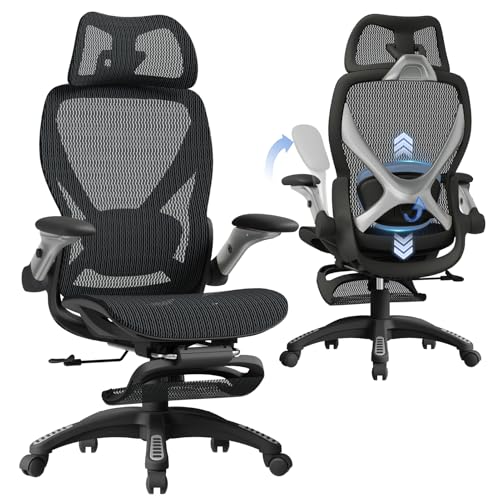
4. ELABEST X100 — Best Big-and-Tall Chair with Footrest
What We Like
- 5D flip-up armrests adjust in every direction and fold fully away
- 3D dynamic lumbar support with depth, height and rotation adjustment
- 18″ extendable footrest and a three-stage recline
- BIFMA-certified frame rated to 300 lb
Flaws but not dealbreakers
- The most expensive mid-tier pick here, and the listing states no warranty term
- Footrest and flip-arm hardware add failure points
- Takes longer to assemble than the simpler picks
Best for: taller users who want big-and-tall proportions, a footrest and genuinely deep adjustment without jumping to premium pricing.
Who should skip it: skip it if you want the simplest possible chair to assemble and maintain, or if you are under about 5’8″ and a deep seat will not suit you.
The X100 is the pick for a tall frame. It pairs a 300 lb BIFMA-certified structure with 5D flip-up armrests that fold completely out of the way, a three-stage recline and an 18-inch extendable footrest. The lumbar support is the most adjustable here: it tracks depth, height and rotation rather than offering a single up/down slider.
The honest caveat is complexity. Five adjustment axes on the arms and a moving footrest mean more hardware, and the listing does not state a warranty term, so you are relying on the seller rather than a published promise. Assembly takes longer than the straightforward chairs in this list. It is a good chair for the right person, but it is not the chair to buy if you want zero fuss.
One spec worth calling out because the listing is unusually candid: the X100 does not include a headrest on the configuration we checked, and it says so in the feature list instead of hiding it. That kind of transparency is worth something when you are comparing nine near-identical listings.
5. Marsail Ergonomic — Best Budget Ergonomic Chair

What We Like
- Lumbar support moves 1.18″ forward/back and 2.16″ up/down
- 3D armrests, a 2D headrest and a 90-120 degree backrest recline
- 3.14″ high-density foam seat rated to 330 lb
- The cheapest pick here that still offers 3D arms and adjustable lumbar
Flaws but not dealbreakers
- Armrest padding is thin
- Recline stops at 120 degrees, so it is not a napping chair
- The listing states no warranty term
Best for: a first proper ergonomic chair on a tight budget, or a second desk where you only sit a few hours.
Who should skip it: skip it if you need to recline past 120 degrees, or if you weigh close to the 330 lb rating and want headroom.
The Marsail is the value outlier: at $112.99 it is the only chair here that combines 3D armrests, a 2D headrest and genuinely adjustable lumbar support for under $120. The lumbar mechanism moves 1.18 inches forward and back and 2.16 inches up and down, which is the range you need to get support into the small of your back rather than somewhere near it.
The seat is a 3.14-inch high-density foam cushion rated to 330 lb, so it is a foam chair rather than a mesh one — cooler in winter, warmer in summer. Recline stops at 120 degrees, which is fine for working and useless for napping. The armrest padding is the one thing Tom’s Guide-type testers consistently mark down on chairs at this price, and we agree: it is adequate rather than comfortable.
If your budget ends at $120, this is the pick. If you can stretch to $190, the SIHOO M57 buys you a 3-year warranty, published certification and a stronger base for not much more money.
6. TRALT Office Chair — Best Office Chair Under $150

What We Like
- High-resilience moulded foam seat that the listing says will not flatten within a year
- Adjustable lumbar support rather than a fixed plastic bump
- BIFMA-certified gas cylinder rated to 330 lb
- 19.7″ seat width on a metal-cored base
Flaws but not dealbreakers
- No headrest at all — a deliberate omission at this price
- The listing does not state armrest adjustability or a warranty term
- Mesh back only; the seat itself is foam
Best for: buyers who care most about a seat that does not collapse and a gas lift that does not sink, and who never recline.
Who should skip it: skip it if you want a headrest, adjustable armrests or a warranty term in writing before you buy.
The TRALT is a rare thing: a $119 chair whose own listing talks about failure modes instead of features. It calls out the two things that kill budget chairs — foam that hardens and sags within months, and pneumatic cylinders that lose pressure and slowly sink — and then names the fix it used for each: high-resilience moulded foam, and a BIFMA-certified gas cylinder rated to 330 lb.
It is also refreshingly blunt about what it left out. At roughly this price the listing says it skipped a cheap headrest that “adds little value” and put the money into the seat and the base instead. That is a defensible trade for a work-only chair, and it is exactly the opposite of the padding-heavy furniture that looks better in photos than it feels at hour six.
The catch is adjustability: no headrest, and the listing does not promise adjustable armrests or any warranty term. If those matter to you, spend up to the Marsail or the M57.
7. LIANVA 500 lb Big and Tall — Best Maximum-Capacity Chair

What We Like
- 500 lb rated capacity — the highest in this roundup by a wide margin
- Reclines from 90 degrees to a lockable 155-degree rest position
- Adjustable headrest plus linkage armrests that follow the recline
- Fabric upholstery and a diamond-stitched high back
Flaws but not dealbreakers
- Very large footprint
- Fabric upholstery is harder to wipe clean than mesh
- The listing states no warranty term
Best for: heavier users who need a genuinely high rated capacity and want to recline, and who have the floor space for an executive chair.
Who should skip it: skip it if you are in a small room, want a breathable mesh back, or need a chair that is easy to move.
Most “big and tall” chairs stop at 300 or 330 lb. This one is rated to 500 lb, which makes it the only pick here that leaves real headroom for a heavier user rather than sitting right at the limit. The frame is reinforced, the base has five points of contact, and the seat is deliberately wide.
It reclines from an upright 90 degrees to a lockable 155-degree position, which is deeper than anything else on the list except the ELABEST, and the linkage armrests follow the backrest down so your forearms stay supported rather than hanging. The adjustable headrest moves up and down to suit your height rather than forcing one position.
The trade-offs are physical. It is a big chair with a big footprint, the fabric upholstery will not shrug off spills the way mesh does, and the listing avoids stating a warranty term. If you need the capacity, it is the pick; if you do not, a smaller chair will serve you better.
Where paying more stops buying performance
Office chairs are one of the few categories where the price-to-benefit curve is steep at the bottom, flat in the middle, and then steep again for reasons that have nothing to do with comfort. Here is how the brackets actually break down on current Amazon pricing.
Under $100
You get a mesh back, a fixed or barely adjustable lumbar bump, non-adjustable or 1D armrests, and a short or unstated warranty. Fine for two to four hours a day. Nothing in this bracket publishes a certification figure, and this is where the sagging-foam and sinking-cylinder complaints cluster.
$100 to $200 — the value plateau
This is where every feature that changes day-to-day comfort becomes available: 3D or better armrests, genuinely adjustable lumbar support (both height and depth), a rated capacity you can verify, and in the best cases published BIFMA/SGS certification plus a multi-year warranty. Three chairs in this roundup sit here — the Marsail at $112.99, the TRALT at $119.99 and the SIHOO M57 at $189.96 — and the M57 is the point at which we would stop spending on ergonomics.
This is the stopping point. Above roughly $200 you are no longer buying more support; you are buying a longer warranty, a heavier frame, materials that hold their appearance for longer, and in the premium tier, a brand’s own repair and parts network. Those are real things — they are just not the same thing as a better seat.
$200 to $500 — capacity and mechanisms
The money here goes to height and weight headroom, footrests, dynamic lumbar mechanisms and multi-stage recline locks. The GABRYLLY with Footrest at $228.90, the ELABEST X100 at $349.99 and — on capacity rather than price — the LIANVA 500 lb at $169.99 all live in this territory. If you are over about 6’2″ or over 250 lb, this is the bracket where the fit genuinely improves, because seat depth, seat width and rated capacity all step up together.
$500 and above — longevity, not comfort
The Steelcase Gesture at $1,510.48 is the only chair here in this bracket. It is not eight times more comfortable than the M57. What you are paying for is a chair designed to survive a decade of multi-shift use and to be serviced rather than replaced. If you sit for a living and intend to keep the same chair through a house move or two, the maths works. If you sit four hours a day, it does not.
One further caveat we would apply to any listing: prices on Amazon move, and the Gesture is a good example. When we checked, the buy box showed $1,510.48 while a third-party marketplace offer on the same page sat far lower — the buy-box price is the one you actually pay, so that is the figure we publish.
Where our ranking differs from other reviewers we trust
Every roundup has a house style, and the differences between ours and the big review sites are worth stating plainly, because they explain why our number one is not theirs.
Why our overall pick is the SIHOO M57, not a $500-$550 chair
Tom’s Guide, which has sat in these chairs for thousands of hours, names the Branch Verve Chair as its best overall pick at just under $550, and its best-budget pick is the Boulies EP200 at around $209. CNET’s best overall is the Branch Ergonomic Chair Pro at $499. Our disagreement is not about quality — both are good chairs — but about the question being asked. Those picks optimise for feel at a comfortable budget; most people searching for an office chair on Amazon are optimising for the most support per dollar, and that trade lands at roughly $190, not $500. The M57 gives you 3D arms, adjustable lumbar, 330 lb of rated capacity, published BIFMA and SGS certification and a 3-year warranty for about a third of the Verve’s price.
Where we agree with TechRadar — and where the listing lets you down
TechRadar puts the Steelcase Series 2 at number one and calls it the best balance of price and performance they have tested, with a 400 lb weight load and a 12-year warranty. That is a genuinely strong recommendation, and we agree on the principle: a 12-year warranty on a chair you sit in daily is worth real money. Where we part company is availability and fit. The Series 2 is not consistently stocked on Amazon at a sane price, and TechRadar’s own caveat — that its low-profile back can dig into the shoulders of people over six feet — is exactly the reason we push taller buyers towards the ELABEST X100 or the GABRYLLY instead. Our premium slot therefore goes to the Gesture, which is the Steelcase that is actually in stock and in the right configuration for a carpeted home office.
On back pain, we agree with the mechanism and not the model
Ergonomic Trends argues, with the underlying research, that people with lower back pain should prioritise a large recline angle rather than a specific badge — the MRI-based work they summarise points to a backrest reclined well past vertical as the position that reduces disc pressure, and to adjustable lumbar support as the feature most likely to help. We agree with both conclusions. Where we differ is the shopping advice: they name a specific ~$300 chair as the pick for back pain, whereas the mechanism they describe is available on several chairs here for less. If recline is what helps you, buy a chair that recline-locks at 135 degrees — the GABRYLLY does exactly that for $228.90.
One more data point for calibration: Healthline, reviewing the medical evidence and citing the American Association of Neurological Surgeons, notes that 75–85% of Americans will experience back pain in their lifetime, that 50% will have a repeat episode within a year, and that the pain resolves without surgery in 90% of cases. Sitting environment is one lever among several; a chair is not a treatment.
The failure patterns that show up in the reviews — and what to check for
Chairs do not usually fail dramatically. They fail in six specific ways, and once you know the pattern you can read a listing for it. We watch for these when we compare listings; we are not quoting a measured failure rate, because nobody publishes one.
- The gas lift sinks. The pneumatic cylinder loses pressure and the chair slowly descends under load. The fix is a certified cylinder, and it is why the TRALT listing names its BIFMA-certified gas lift specifically.
- The seat foam collapses. Budget polyurethane foam compresses within months, leaving you sitting on the plate. Look for high-density or high-resilience foam, and treat any listing that describes the seat only as “soft” with suspicion.
- The base cracks at the hub. Thin plastic bases fail where the cylinder meets the legs. A metal core or reinforced nylon base is the tell.
- Armrests loosen and rattle. Multi-axis armrests have more to go wrong. This is the price of adjustability, and it is why we still recommend 3D arms rather than refusing adjustability altogether.
- Mesh and PU leather degrade. Faux leather peels at the seams; low-grade mesh stretches out of shape. Mesh in a hot climate still ages better than PU.
- Headrests wobble at full extension. Almost universal on mid-range chairs. Annoying rather than a failure — but worth knowing before you buy for a headrest.
Two of these six are stability problems (the lift and the base) and are the ones that make a chair unsafe rather than merely annoying. If you are shopping on a tight budget, that is where the money should go first.
Spec-claim reality check: what “BIFMA tested” actually means
“BIFMA certified” appears on a lot of chair listings and means less than most buyers assume. BIFMA is the trade association that publishes the North American furniture standards, and the relevant document for general office chairs is ANSI/BIFMA X5.1 — “General-Purpose Office Chairs – Tests.” It is a test-standard, not a comfort rating and not a warranty.
The important nuance: the scope of X5.1 does not match the number on the box. BIFMA’s own standards descriptions set out that the current edition of X5.1 is written around an occupant load of 181 kg (about 400 lb), while older editions used a roughly 253 lb (115 kg) occupant. The association also publishes a separate large-occupant standard precisely because general-purpose chairs were not designed around the heaviest users. So a chair can truthfully say it was “tested to BIFMA” and still carry a rated capacity of 250 lb. The rating and the standard are two different numbers.
That is why our spec table above lists the rated capacity and the warranty separately, and why we flag every “Not stated”. Of the seven chairs here, the SIHOO M57 is the only one whose listing names both the certification bodies (BIFMA and SGS) and a cycle count (100,000), and only the M57 and the GABRYLLY publish a warranty term at all.
For the ergonomics baseline we use OSHA’s computer-workstation eTool rather than marketing copy. It states that a backrest should offer height-adjustable lumbar support, that it should let the user recline at least 15 degrees from vertical, and that the seat should be height-adjustable with a rounded “waterfall” front edge so it does not press behind the knees. Every pick in this roundup clears the recline and adjustable-lumbar tests; the waterfall edge and depth adjustment are where the budget picks fall short, and we say so per chair.
To be clear about our own limits: we are a research and comparison site, not a test lab. We have not run the X5.1 cycles ourselves and we do not claim to have. What we do is check what each listing claims against what the standard and the safety regulator actually publish — and call out the listings that stay silent.
How to choose an office chair (2026 buyer’s guide)
If you only read one section, read this one. The features below are ranked by how much they change how a chair feels after hour three.
Lumbar support: fixed, adjustable or dynamic
Adjustable lumbar support is the single highest-value feature on an office chair. A fixed bump sits wherever the mould put it, which for most people is in the wrong place; an adjustable one moves into the small of your back. There are three types — fixed, adjustable (you move it), and dynamic (it tracks you automatically) — and the price ladder follows that order. Every chair in this roundup except the cheapest two tiers offers adjustable lumbar support, and the ELABEST X100 and the SIHOO M57 offer depth adjustment as well as height.
Mesh vs fabric vs PU leather
Mesh breathes and does not peel, but feels firmer and shows its frame. Fabric feels better against the skin and holds colour well, but stains. PU leather looks executive, traps heat and is the material most likely to flake after a couple of years. For a warm home office, mesh back plus a foam seat — the Marsail or the TRALT — is the practical middle ground. For an air-conditioned room where you want the chair to look like a piece of furniture, fabric — the LIANVA — is the better call.
If you are big or tall: capacity, width and depth
Height and weight are separate fit problems. For weight, ignore “heavy duty” language and find the rated capacity, then leave headroom: if you weigh 250 lb, a 300 lb rating is a thin margin for a chair you will use daily. For height, the numbers that matter are seat depth and backrest height, not overall “big and tall” branding. Above about 6’2″, a fixed-depth seat pan starts cutting behind the knees, so look for depth adjustment or a genuinely long seat. Below about 5’3″, the problem reverses — a deep seat leaves your back unsupported — which is why OSHA recommends a footrest as the fix.
Casters and floor type
Hard casters are for carpet, soft casters are for hardwood and vinyl, and the wrong pairing is the cheapest mistake on this page. A hard caster on a wood floor will mark it within a week. It is worth noting that the marketing is usually silent on this: the Steelcase Gesture listing specifies carpet casters, and most of the budget chairs do not say either way.
Seat height, depth and the waterfall edge
A properly set chair lets your feet sit flat with the back of your knee slightly above the seat, and leaves two to three fingers of space between the seat edge and the back of your leg. OSHA’s guidance on seat pans is worth repeating in plain language: too short a pan presses on the buttocks, too long a pan presses behind the knees, and too narrow a pan restricts movement. A rounded front edge matters more than most buyers realise, because it is what stops the seat from cutting off circulation in your thighs.
Recline — and why it matters more than armrests
Recline is not a luxury. It is the feature most associated in the research with reduced lower-back load, and it is the reason we weight a lockable recline so heavily. If you work long days, prioritise a chair that reclines past 110 degrees and locks there over a chair with an extra armrest axis.
How we evaluated these chairs
This guide is a re-verification of an earlier roundup, rebuilt in September 2026. Every pick was checked against its live Amazon listing on September 25, 2026 through Amazon’s product API: we confirmed the brand is the first word of the listing title, that the buy box is active, and that the current price, list price, discount and best-seller rank are what a buyer sees today. Three of the original seven picks were replaced because the listing had changed or the price no longer made sense.
Our method is deliberately narrow and we describe it plainly, because the alternative — pretending to have done more than we did — is the fastest way to lose a reader’s trust.
- Hands-on: none. We do not own these chairs and we do not claim to have sat in them.
- Listing and spec analysis: every capacity, warranty, adjustment range and certification claim on this page was read from the live listing or the manufacturer’s own published material on September 25, 2026.
- Cited testers: where a reviewer has spent measurable time in a chair, we say so and link to them — Tom’s Guide, TechRadar and the ergonomics research summarised by Ergonomic Trends.
- Original data: the spec table, the price-bracket analysis and the failure-pattern list are ours, built from the listings and the cited sources rather than copied from another roundup.
The specification and price figures in this guide were taken from the live listings on September 25, 2026 and will move. If you spot something out of date, our corrections route is described on the how-we-test page.
Read the full method, including what we do not claim, on our How We Test & Choose Products page.
Related desk and home-office guides
A chair is one third of a workstation. These guides cover the other two, and the accessories that make a long day at the desk easier.
- Best standing desks under $300 — raise the desk before you spend on a new chair.
- Best electric and L-shaped standing desks — the wider, higher-capacity options.
- Best monitor arms — get the screen to eye height so the chair can do its job.
- Best laptop stands for standing desks — for laptop-first setups.
- Best monitor light bars — glare control for late sessions.
- Best webcams for streaming and Zoom — finish the setup on camera.
- Best ergonomic office chairs under $300 — our companion shortlist.
Frequently asked questions about office chairs
How much should I spend on an office chair?
For two to four hours a day, a $100–$150 chair with adjustable lumbar support is enough. For six hours or more, budget around $190 — that is the point at which 3D armrests, verifiable certification and a multi-year warranty all become available together, as on the SIHOO M57. Above $200 the returns are in longevity and service rather than comfort.
Is mesh or leather better for an office chair?
Mesh for warm rooms and long days, because it breathes and does not peel. PU leather looks better in photos and traps heat, and is the material most likely to flake after two or three years. Fabric sits between the two: comfortable, but less forgiving of spills.
What is the most important feature in an office chair?
Adjustable lumbar support, followed by a seat pan that fits your thighs and a lockable recline. Adjustable armrests matter next, and only if you type for long stretches. Everything else — headrests, footrests, colour — is preference.
Can a chair actually help with back pain?
A chair can reduce one source of strain, but it is not a treatment. Healthline’s review of the medical evidence, citing the American Association of Neurological Surgeons, notes that 75–85% of Americans experience back pain in their lifetime but that 90% of cases resolve without surgery. Ergonomic support, regular breaks and movement all contribute; no chair fixes back pain by itself. Talk to a clinician about persistent pain.
What does BIFMA certification mean?
BIFMA is the North American trade association that publishes furniture standards. For office chairs the relevant test standard is ANSI/BIFMA X5.1, which covers durability, stability and safety testing. It is not a comfort rating and it is not a warranty — and a chair’s rated weight capacity is a separate number from the standard it was tested against.
How do I know a chair will fit me?
Check three numbers against your own body: rated capacity (leave headroom), seat height range (your feet must reach the floor with your knees at or slightly below hip level), and seat depth (two to three fingers of clearance behind the knee). If you are over 6’2″ or under 5’3″, those three numbers decide the chair far more than any brand.
Do I need a headrest?
Only if you recline. A headrest is genuinely useful in a chair that locks at 135 degrees; on an upright task chair it does nothing except collect dust, which is why the TRALT listing deliberately omits one at its price point.
Our verdict: which office chair should you buy?
- Best overall: SIHOO M57 at $189.96 — 3D armrests, adjustable lumbar, a 330 lb base and the only published multi-year warranty plus certification detail in the list. The safest buy for a full-time home office.
- Best premium: Steelcase Gesture at $1,510.48 — 360-degree arms and Steelcase’s service network. Buy it once, keep it a decade.
- Best mid-range recliner: GABRYLLY High Back with Footrest at $228.90 — locks at 135 degrees, 2-way lumbar and a steel footrest, with a 3-year warranty.
- Best big and tall: ELABEST X100 at $349.99 — 5D flip-up arms and 3D dynamic lumbar on a BIFMA-certified 300 lb frame.
- Best budget: Marsail Ergonomic at $112.99 — the cheapest chair here with 3D arms and genuinely adjustable lumbar support.
- Best under $150 for seat quality: TRALT Office Chair at $119.99 — high-resilience foam and a BIFMA-certified gas lift, no headrest by design.
- Best maximum capacity: LIANVA 500 lb Big and Tall at $169.99 — 500 lb rated, 155-degree recline, adjustable headrest.