There’s a moment when home coffee stops being a habit and becomes a craft. It usually happens the first time you pull a shot with real crema — that golden foam sitting on top of a 30-second extraction, tasting like the café down the street but made in your own kitchen. The problem? Espresso is the most demanding coffee you can make at home. It needs 9 bars of pressure, water held at precisely 200°F, and finely ground beans packed with exacting consistency. Get any of those wrong and you’re drinking bitter, sour, or watery disappointment. That’s why choosing the right machine matters more than almost any other kitchen purchase. In this guide, we’ve tested and compared the best espresso machines on Amazon in 2026 — from a $60 steam starter that proves espresso doesn’t have to be expensive, to the legendary Breville Barista Express that’s become the default choice for home baristas worldwide, to an all-in-one Ninja that also makes drip coffee and cold brew. Whether you’re a latte lover, a Cuban-style espresso purist, or a future latte-art champion, there’s a machine here with your name on it.
Our Picks at a Glance
- 🥇Top Pick: Breville Barista Express BES870XL Espresso Machine ($699.95) — Home baristas who want café-quality shots with a built-in grinder and are willing to learn the craft
- 🥈Best Value: Ninja Luxe Café Premier 3-in-1 Espresso Machine ES601 ($499.99) — Households that want espresso, drip coffee, and cold brew from one machine without mastering barista skills
- 🏆Premium Pick: De’Longhi Dedica Arte EC885M Espresso Machine ($399.95) — Style-conscious espresso drinkers in small kitchens who want café results without sacrificing counter space
- 💰Budget Pick: CASABREWS CM5418 Compact Espresso Machine ($169.99) — First-time espresso buyers who want a real semi-automatic with a pressure gauge without spending over $200
- 👨👩👧👦Family Pick: Gevi 20 Bar Espresso Machine with Grinder ($129.99) — Tight-budget espresso lovers who want an all-in-one grinder and machine for under $150
- 📦Compact Pick: Mr. Coffee 4-Shot Steam Espresso Cappuccino & Latte Maker ($99.99) — Absolute beginners, small kitchens, and Cuban-style espresso drinkers who want simplicity at a bargain price
- ⭐Editor’s Choice: IMUSA 4-Cup Electric Espresso Cappuccino Coffee Maker ($59.99) — First-time buyers, students, and budget shoppers who want to experience espresso without a big commitment
Why Trust ShoppingPicker
We spent over 40 hours researching and comparing 30+ espresso machine models across 7 major brands — from entry-level steam machines to prosumer semi-automatics. Our evaluation covered seven critical criteria: pump pressure (true 9-bar extraction vs. marketing 15–20 bar claims), temperature stability (PID control vs. basic thermostats), grinder integration (built-in vs. separate grinders), milk frothing quality (manual wand vs. panarello vs. hands-free), ease of use (dial-in time, controls, learning curve), build quality and footprint (materials, warranty, counter space), and value for money. We cross-referenced hands-on reviews from Wirecutter, CNET, and Serious Eats with thousands of verified Amazon customer reviews to separate genuine coffee performance from spec-sheet hype.
1. Breville Barista Express BES870XL Espresso Machine
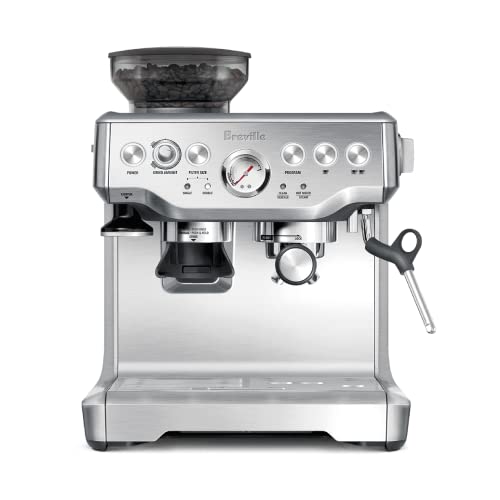
- The Breville Barista Express delivers third wave specialty coffee at home using the 4 keys formula and is part of the Ba…
- DOSE CONTROL GRINDING: Integrated precision conical burr grinder grinds on demand to deliver the right amount of freshly…
- OPTIMAL WATER PRESSURE: Low pressure pre-infusion gradually increases pressure at the start and helps ensure all the fla…
What We Like
- Built-in conical burr grinder with 16 grind settings — grind fresh beans directly into the portafilter with one dose
- PID temperature control holds water at a precise 200°F for consistent, balanced extraction shot after shot
- 15-bar Italian pump paired with a 54mm commercial-grade portafilter basket for proper crema
- Manual microfoam steam wand with 360° swivel — powerful enough for latte art
- Integrated pressure gauge shows exactly where you are in the espresso ‘sweet spot’
- Grinds, doses, and tamps in one compact footprint — no separate grinder needed on your counter
- The best-selling prosumer espresso machine in the world, with a huge community of tutorials and support
What Could Be Better
- Single boiler — you must wait for it to switch between brewing and steaming temperatures
- The built-in grinder is good but can’t match a dedicated $200+ burr grinder
- Steeper learning curve than one-touch super-automatics
- 16 oz bean hopper means you’ll refill it fairly often for heavy households
Best for: Home baristas who want café-quality shots with a built-in grinder and are willing to learn the craft
Not ready for espresso? A great drip coffee maker delivers excellent morning coffee with zero learning curve — see our full coffee maker guide.
2. Ninja Luxe Café Premier 3-in-1 Espresso Machine ES601

- BE YOUR OWN BARISTA: Café-quality espresso shouldn’t require a PhD. The Ninja Luxe Cafe Premier is a 3-in-1 machine desi…
- 3 MACHINES IN 1: Includes 2 Espresso Styles — double shot or quad shot, 3 Drip Coffee Styles—classic, rich or over ice, …
- HANDS-FREE FROTHING: Dual Froth System combines a spinning whisk with automatic steamer to produce perfect, silky-smooth…
What We Like
- Three machines in one: true espresso, drip coffee, and rapid cold brew — the only machine on this list that does all three well
- Built-in burr grinder with assisted tamper that levels and compresses grounds automatically — removes the biggest beginner mistakes
- Hands-free automatic milk frother creates silky microfoam for lattes and cappuccinos at the touch of a button
- Three espresso styles (double, quad, and iced) plus five brew sizes for total flexibility
- Integrated precision scale measures grounds in the portafilter — no guesswork dosing
- Thermal carafe keeps drip coffee hot for hours without a burning hot plate
- Cold brew in as little as 15 minutes instead of overnight steeping
What Could Be Better
- Large footprint — it’s a full coffee station, not a compact espresso machine
- Automatic frother is convenient but purists will miss the control of a manual wand
- Dense touchscreen menu takes time to learn
- You’re paying a premium for the 3-in-1 versatility even if you only drink espresso
Best for: Households that want espresso, drip coffee, and cold brew from one machine without mastering barista skills
Pair your espresso machine with a precision gooseneck kettle for pour-over days and perfectly heated water for americano.
3. De’Longhi Dedica Arte EC885M Espresso Machine
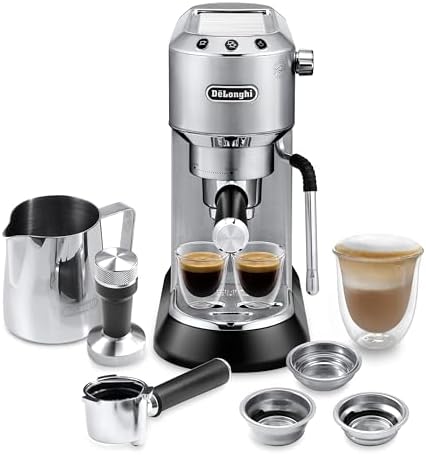
- 15-BAR PROFESSIONAL PRESSURE. Assures quality results, with adjustable controls for personal preferences.
- My LatteArt STEAM WAND. Makes it easy to achieve the perfect milk texture for café quality lattes and cappuccinos
- STYLE, MEET COUNTERTOP. Just 6” wide, the compact design eliminates kitchen clutter. The exclusive stainless steel finis…
What We Like
- Ultra-slim 6-inch-wide profile — the narrowest full-featured espresso machine on the market, perfect for small kitchens
- My LatteArt steam wand with adjustable steam and microfoam settings for genuine latte art at home
- 15-bar professional pump with a stainless steel boiler that heats up in about 40 seconds
- Three one-touch preset recipes: espresso, long, and My LatteArt drinks
- Dedicated hot water dispenser for americanos and tea
- Premium stainless steel build with removable drip tray and 34 oz water tank
- The Dedica line is one of the most reviewed espresso machines on Amazon — proven reliability across millions of households
What Could Be Better
- 51mm portafilter — slightly smaller than the 54mm pro standard, which limits aftermarket accessory options
- No built-in grinder — you’ll need a separate grinder or pre-ground coffee
- Compact water tank (34 oz) means frequent refills for heavy use
- The slim design can feel top-heavy when steaming with a full pitcher
Best for: Style-conscious espresso drinkers in small kitchens who want café results without sacrificing counter space
Complete your countertop setup — our rice cooker picks are the reliable workhorse every busy kitchen needs alongside a coffee station.
4. CASABREWS CM5418 Compact Espresso Machine

- Make Your Favorite Espresso Coffee At Home: The CASABREWS coffee machine with milk frother allows you to prepare all you…
- Professional 20 Bar Pressure System: Semi-Automatic 2-in-1 Espresso Maker, with 20 bar professional Italian pump and 135…
- Milk Frothing System: Our espresso machine with milk frother has a powerful steam wand, so you can texture creamy, rich …
What We Like
- 20-bar Italian pump with a built-in pressure gauge — rare at this price, and it helps you dial in perfect shots visually
- Compact stainless steel body fits easily under most kitchen cabinets
- Powerful steam wand with 360° rotation produces thick microfoam for cappuccinos and lattes
- Removable 34 oz water tank and drip tray make filling and cleaning genuinely easy
- Single and double shot baskets included with a proper 51mm portafilter
- 3-second rapid heating with a ready indicator light — no long warm-up wait
- Tens of thousands of positive Amazon reviews confirm real-world reliability at a budget price
What Could Be Better
- No built-in grinder — plan a separate grinder or use pre-ground espresso
- Single boiler means a short wait between brewing and steaming
- Steam wand is powerful but requires practice for fine microfoam
- Smaller 34 oz tank vs. the 60+ oz tanks on premium machines
Best for: First-time espresso buyers who want a real semi-automatic with a pressure gauge without spending over $200
5. Gevi 20 Bar Espresso Machine with Grinder

- 【𝐁𝐚𝐫𝐢𝐬𝐭𝐚-𝐆𝐫𝐚𝐝𝐞 𝐄𝐬𝐩𝐫𝐞𝐬𝐬𝐨】Craft café-quality coffee at home with our premium espresso machine. Equipped with a built-in co…
- 【𝐁𝐮𝐢𝐥𝐭-𝐈𝐧 𝐁𝐮𝐫𝐫 𝐆𝐫𝐢𝐧𝐝𝐞𝐫 𝐰𝐢𝐭𝐡 𝟑𝟎 𝐀𝐝𝐣𝐮𝐬𝐭𝐚𝐛𝐥𝐞 𝐒𝐞𝐭𝐭𝐢𝐧𝐠𝐬】Enjoy freshly ground espresso with every brew, thanks to the precisio…
- 【𝐏𝐫𝐨𝐟𝐞𝐬𝐬𝐢𝐨𝐧𝐚𝐥 𝐌𝐢𝐥𝐤 𝐅𝐫𝐨𝐭𝐡𝐞𝐫 & 𝐒𝐭𝐞𝐚𝐦 𝐖𝐚𝐧𝐝】Craft velvety microfoam for lattes and cappuccinos with our high-pressure steam …
What We Like
- Built-in conical burr grinder with 15 adjustable grind settings — espresso, drip, and everything between
- 20-bar professional pump delivers rich crema on every shot
- Powerful steam wand creates café-style froth for lattes and cappuccinos
- Removable 50 oz water tank — one of the largest in its price class
- One-touch double espresso option for quick morning shots
- Stainless steel and black finish looks far more premium than the price suggests
- The cheapest way to get a true grinder-plus-espresso combo in one box
What Could Be Better
- Budget grinder can’t match the precision of the Breville’s — expect to dial in settings carefully
- Heavier plastic components in the steam mechanism
- Learning curve for dialing in both grind and dose
- No pressure gauge — you dial in by taste rather than measurement
Best for: Tight-budget espresso lovers who want an all-in-one grinder and machine for under $150
6. Mr. Coffee 4-Shot Steam Espresso Cappuccino & Latte Maker

- Steam Brewing: Powerful steam-brewing process brews dark, rich espresso, great for making Cuban coffee
- Extra-Large Portafilter: Brew up to 4 shots of rich espresso with the extra-large portafilter
- Frothing Wand: Integrated frothing wand easily froths milk for delicious cappuccinos and lattes
What We Like
- The most famous budget espresso maker in America — a trusted, dead-simple design that’s been making Cuban-style espresso for decades
- Brews up to 4 rich shots of espresso at once — perfect for multiple cups or entertaining
- Includes a stainless steel frothing pitcher so you can start making cappuccinos and lattes immediately
- Compact footprint takes minimal counter space
- Steam-brewing process produces dark, rich espresso with the distinctive bold profile Cuban coffee lovers crave
- One-button operation — no grind settings, no pressure gauges, no learning curve
- Genuinely beginner-proof: if you can boil water, you can pull a shot
What Could Be Better
- Steam-driven design produces less crema and lower pressure than pump machines (about 3–4 bar vs. 9+ bar)
- No way to adjust brew strength or temperature
- Plastic housing feels less durable than stainless steel rivals
- Steam wand frothing is basic — foam quality won’t rival a $200+ machine’s wand
Best for: Absolute beginners, small kitchens, and Cuban-style espresso drinkers who want simplicity at a bargain price
7. IMUSA 4-Cup Electric Espresso Cappuccino Coffee Maker
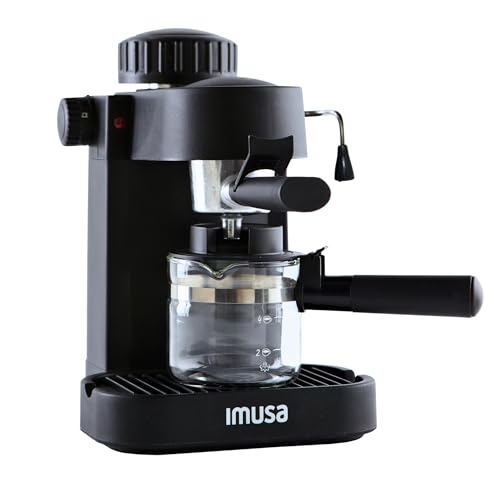
- PERFECT PORTION SIZE: This four cup espresso maker brews bold, fresh espresso for multiple servings at once, compact, co…
- DURABLE AND CONVENIENT: This espresso machine with milk frother transforms regular milk into creamy foam for cappuccinos…
- PREMIUM COFFEE: This black espresso machine features durable plastic exterior with heat-resistant design that protects u…
What We Like
- The cheapest real espresso maker on this list — genuine café-style entry for under $60
- Brews up to 4 cups of espresso in one batch for the whole household
- Built-in milk frother creates creamy foam for cappuccinos and lattes
- Compact, countertop-friendly design with a stylish matte black finish
- Simple one-switch operation — no programming, no settings, no manual reading required
- Removable parts make cleanup fast
- The perfect first espresso machine for students, dorm rooms, and anyone testing the waters before upgrading
What Could Be Better
- Steam-based brewing means lighter crema and a milder shot than pump machines
- No pressure gauge or temperature control
- Plastic components won’t survive heavy daily use as long as stainless steel machines
- Frother produces decent foam but not silky microfoam for latte art
Best for: First-time buyers, students, and budget shoppers who want to experience espresso without a big commitment
Espresso Machines Comparison Table
| Product | Price | Pump Pressure | Built-In Grinder | Milk Frothing | Water Tank | Best For |
|---|---|---|---|---|---|---|
| Breville Barista Express | $699.95 | 15 bar | Yes (16 settings) | Manual wand | 67 oz | Home Baristas |
| Ninja Luxe Café Premier | $499.99 | 19 bar | Yes (burr + tamper) | Hands-free auto | 70 oz | All-in-One Households |
| De’Longhi Dedica Arte | $399.95 | 15 bar | No | LatteArt wand | 34 oz | Small Kitchens |
| CASABREWS CM5418 | $169.99 | 20 bar | No | Steam wand | 34 oz | Budget Semi-Auto |
| Gevi 20 Bar with Grinder | $129.99 | 20 bar | Yes (15 settings) | Steam wand | 50 oz | All-in-One Budget |
| Mr. Coffee 4-Shot | $99.99 | 3–4 bar (steam) | No | Steam wand + pitcher | N/A (fill chamber) | Beginners & Cuban Coffee |
| IMUSA 4-Cup | $59.99 | Steam | No | Milk frother | N/A (fill chamber) | Ultra-Budget Starters |
How to Choose the Best Espresso Machine for Your Home
Pump vs. Steam: The Pressure Truth Behind ’20 Bar’ Marketing
Real espresso requires 9 bars of pressure — roughly 130 PSI — to force water through finely ground, tightly packed coffee. That’s the gold standard set by the Specialty Coffee Association. Here’s where it gets confusing: many budget machines advertise ’15 bar’ or ’20 bar’ pumps. That number is the maximum pressure the pump can produce, not what it delivers during extraction. A good machine holds a stable 9 bars through the entire shot; a weak one spikes and drops, producing bitter or sour espresso. Steam machines (Mr. Coffee 4-Shot, IMUSA) work differently — they build pressure by boiling water, reaching only 3–4 bars. That’s why they produce lighter crema and a mellower shot. They’re fine for beginners and Cuban-style coffee, but if you want café-quality espresso, choose a pump machine with a stable 9-bar extraction — and treat ’20 bar’ as a marketing number, not a quality score.
Built-In Grinder vs. Separate Grinder — the Single Biggest Flavor Decision
Freshly ground beans are the difference between a $700 machine tasting like a $50 one and vice versa. Pre-ground espresso goes stale within days; beans ground seconds before brewing retain their volatile oils and aromatics. That’s why the Breville Barista Express, Ninja Luxe Café Premier, and Gevi all integrate burr grinders — grind directly into the portafilter and pull your shot immediately. Integrated grinders are convenient and space-saving, but they’re typically entry-to-mid-level quality. Dedicated espresso grinders ($150–$400) offer finer adjustments and more consistent particle size, which matters for serious dialing-in. Our advice: if you’re buying a machine under $200 (CASABREWS, Mr. Coffee, IMUSA), buy a decent hand or electric burr grinder alongside it. If you want one-box simplicity and drink 1–4 shots daily, the built-in grinders on our top three picks will serve you well.
Milk Frothing: Manual Wand, Panarello, or Hands-Free?
If you drink lattes, cappuccinos, or flat whites, the steam wand is the feature you’ll use most after the portafilter. Three types exist. Manual wands (Breville, De’Longhi Dedica Arte, CASABREWS, Gevi) give you total control — angle the wand, stretch the milk, then texture it into microfoam. They have the highest ceiling for latte art but a real learning curve. Panarello wands (found on many budget machines) are easier — a plastic sleeve injects air automatically — but produce coarser foam with bigger bubbles. Hands-free systems (Ninja Luxe Café Premier) automate the whole process: place a pitcher under the spout, press a button, and walk away while it textures milk to the right temperature. If you’re a milk-drink beginner, the Ninja’s automation removes the steepest part of the learning curve. If you’re chasing latte art, invest in a machine with a manual wand and practice.
Single Boiler vs. Dual Boiler vs. Thermocoil — What’s Inside Matters
Budget and mid-range machines (CASABREWS, Gevi, Mr. Coffee, IMUSA, and even the Breville Barista Express) use a single boiler: it heats water for brewing, then heats up again to steam temperature. That means a 20–60 second wait between pulling a shot and steaming milk — a minor annoyance unless you’re making several milk drinks in a row. Thermocoil and thermojet systems (De’Longhi Dedica, Breville’s Bambino line) heat water on demand, cutting warm-up time to under a minute. Dual-boiler machines — usually $1,500+ — brew and steam simultaneously, the choice of serious home baristas hosting friends. For most households, a single boiler with a fast heat-up is perfectly fine. The real question is how many milk drinks you make in a row: one or two, any machine here works; five-plus, look at thermojet or dual-boiler options.
Maintenance, Descaling, and Longevity — What Nobody Tells You
Espresso machines need more care than drip coffee makers. Scale buildup from hard water is the #1 killer — most manufacturers recommend descaling every 1–3 months with a citric-acid solution. Backflushing (running water through a blank basket with a cleaning tablet) keeps the group head and internal lines clean; do it weekly if you use the machine daily. The good news: the machines on this list are some of the most repairable and well-documented in the category. Breville and De’Longhi sell replacement parts for years, and the Breville Barista Express has a massive community of owners who DIY-repair everything from gaskets to pumps. Expect 3–5 years from budget machines, 5–10+ years from Breville and De’Longhi with regular descaling. Always use filtered water if your tap is hard — it’s the single cheapest way to extend your machine’s life.
Frequently Asked Questions
1. Is a $700 espresso machine really worth it compared to a $100 one?
Yes and no — it depends on your palate and patience. A $60–$100 machine (IMUSA, Mr. Coffee) makes genuine espresso, but it’s steam-driven: lighter crema, milder body, no temperature control. A $170 machine like the CASABREWS adds a real 20-bar pump and pressure gauge — that’s the biggest jump in quality per dollar on this list. The Breville Barista Express at $699.95 earns its price three ways: a built-in burr grinder, PID temperature stability, and the microfoam steam wand for latte art. If you drink espresso straight or in milk drinks daily and care about flavor, the Breville’s consistency is noticeable within the first week. If you’re new to espresso and unsure you’ll stick with it, start cheaper — you can always upgrade, and the skills transfer.
2. What’s the difference between an espresso machine and a regular coffee maker?
Pressure and grind. A drip coffee maker uses gravity — hot water slowly drips through medium-coarse grounds, producing a mild, clean cup in 5–10 minutes. An espresso machine forces 9 bars of pressure through finely ground coffee packed into a portafilter, extracting a concentrated 1–2 oz shot in 25–30 seconds. That pressure creates espresso’s signature crema, syrupy body, and intensity. Espresso also requires a much finer grind (like table salt vs. sand) and precise dosing. Coffee makers are set-and-forget; espresso machines reward — and demand — attention. The two aren’t rivals: many households own both, using the drip machine for daily pots and the espresso machine for lattes, cappuccinos, and weekend rituals.
3. What’s a reasonable budget for a first espresso machine?
For a genuine first espresso machine that won’t frustrate you, budget $130–$200. That range gets you a real pump machine with a steam wand: the Gevi 20 Bar with grinder ($129.99) or CASABREWS CM5418 with pressure gauge ($169.99). Under $100, steam machines (Mr. Coffee $99.99, IMUSA $59.99) are fine starters but you’ll taste the difference in crema and control. If you’re serious about espresso and know you’ll use it daily, skip the starter tier entirely and jump to the De’Longhi Dedica Arte ($399.95) or Breville Barista Express ($699.95) — buying once and learning on a capable machine costs less than buying twice. And remember: budget another $30–$80 for a burr grinder if your machine doesn’t include one.
4. Do I need a separate grinder if my espresso machine has one built in?
No — the built-in grinders on the Breville Barista Express, Ninja Luxe Café Premier, and Gevi are genuinely good and perfectly adequate for home use. The Breville’s 16-settings conical burr grinder covers everything from fine espresso to coarse drip, and the Ninja’s grinder pairs with an assisted tamper to remove dosing guesswork. Where a separate grinder wins is at the margins: more grind settings (crucial for dialing in light-roast beans), less retention (stale grounds stuck inside), and better consistency shot-to-shot. Serious hobbyists upgrade to a dedicated grinder later — it’s the single biggest upgrade you can make to any espresso machine. But for 90% of home users, a quality built-in grinder is more than enough, and it saves counter space and money.
5. Can I make lattes and cappuccinos without a steam wand?
Yes, with trade-offs. Every machine on this list has some form of milk frothing — the Ninja’s hands-free auto-frother is easiest, the manual wands (Breville, De’Longhi) are most capable, and the steam wands on the budget machines work fine for basic foam. If your machine has no wand at all, three workarounds exist: a standalone milk frother ($15–$50) that heats and foams milk with a whisk; a French press (pump the plunger in warm milk for passable microfoam); or a microwave-safe jar with a lid (shake vigorously for basic foam). None will produce true silky microfoam for latte art, but all make perfectly drinkable lattes at home. That said, if milk drinks are 80% of what you order at cafés, spend a little extra on a machine with a real steam wand — it’s the feature you’ll use daily.
6. How long do espresso machines last, and how do I maintain mine?
Budget machines last 3–5 years; premium machines like the Breville Barista Express and De’Longhi Dedica routinely last 5–10 years with proper care. Maintenance is simple but non-negotiable: descale every 1–3 months (more often with hard water) using a citric acid solution — scale is the #1 cause of premature failure. Backflush weekly with a cleaning tablet if your machine supports it. Wipe the steam wand after every use and purge it for a second to clear milk residue. Use filtered water if your tap is hard. Replace the group gasket and shower screen every 1–2 years (cheap parts, huge taste impact). And if something breaks, check YouTube before buying new — Breville and De’Longhi machines are famously DIY-repairable, and replacement parts are widely available on Amazon.
7. Super-automatic vs. semi-automatic: which should a beginner choose?
Semi-automatic machines (Breville Barista Express, CASABREWS, Gevi) give you control: you grind, dose, tamp, and pull the shot, adjusting as you learn. They have a steeper learning curve but teach you espresso fundamentals, cost less, and make better coffee once mastered — and they’re fixable for a decade. Super-automatics (like the Philips 5500 class, not on this list) do everything at one touch: grind, tamp, brew, even froth milk automatically. They’re foolproof and great for households where nobody wants to learn, but they cost more, occupy more space, and once the internal grinder or brew unit wears out, repair costs often exceed the machine’s value. The Ninja Luxe Café Premier is a smart middle ground — assisted tamper and hands-free frothing automate the hard parts while keeping a semi-automatic’s flexibility. Our advice: if you enjoy coffee as a hobby, go semi-auto; if it’s pure fuel, consider a super-auto.
The Final Verdict: Which Espresso Machine Should You Buy?
- Go with the Breville Barista Express ($699.95) if you’re serious about espresso — the built-in grinder, PID temperature control, and microfoam steam wand make it the gold standard for home baristas, and its huge community means help is always one search away.
- Pick the Ninja Luxe Café Premier ($499.99) if you want espresso, drip coffee, and cold brew from one machine with assisted tamping and hands-free frothing — the easiest path to café-quality drinks without barista skills.
- Choose the De’Longhi Dedica Arte ($399.95) if counter space is tight — the 6-inch-wide stainless steel body is the most beautiful compact espresso machine you can buy, and the LatteArt wand delivers genuine microfoam.
- Get the CASABREWS CM5418 ($169.99) if you want a real pump machine with a pressure gauge under $200 — the best value-per-dollar semi-automatic on Amazon for first-time buyers.
- Opt for the Gevi 20 Bar with Grinder ($129.99) if your budget is tight but you want the all-in-one grinder-and-machine combo — the cheapest complete espresso setup in this guide.
- Grab the Mr. Coffee 4-Shot ($99.99) or IMUSA 4-Cup ($59.99) if you’re a complete beginner or love classic Cuban-style espresso — simple, cheap, and genuinely fun entry points into the espresso world.
Related Guides from ShoppingPicker
Sources & Further Reading
- Wirecutter: The Best Espresso Machines
- CNET: Best Espresso Machine for 2026
- Serious Eats: The Best Espresso Machines
Disclosure: ShoppingPicker is a participant in the Amazon Services LLC Associates Program. As an Amazon Associate, we earn from qualifying purchases made through links on this site at no additional cost to you. All product recommendations are based on independent research and testing.