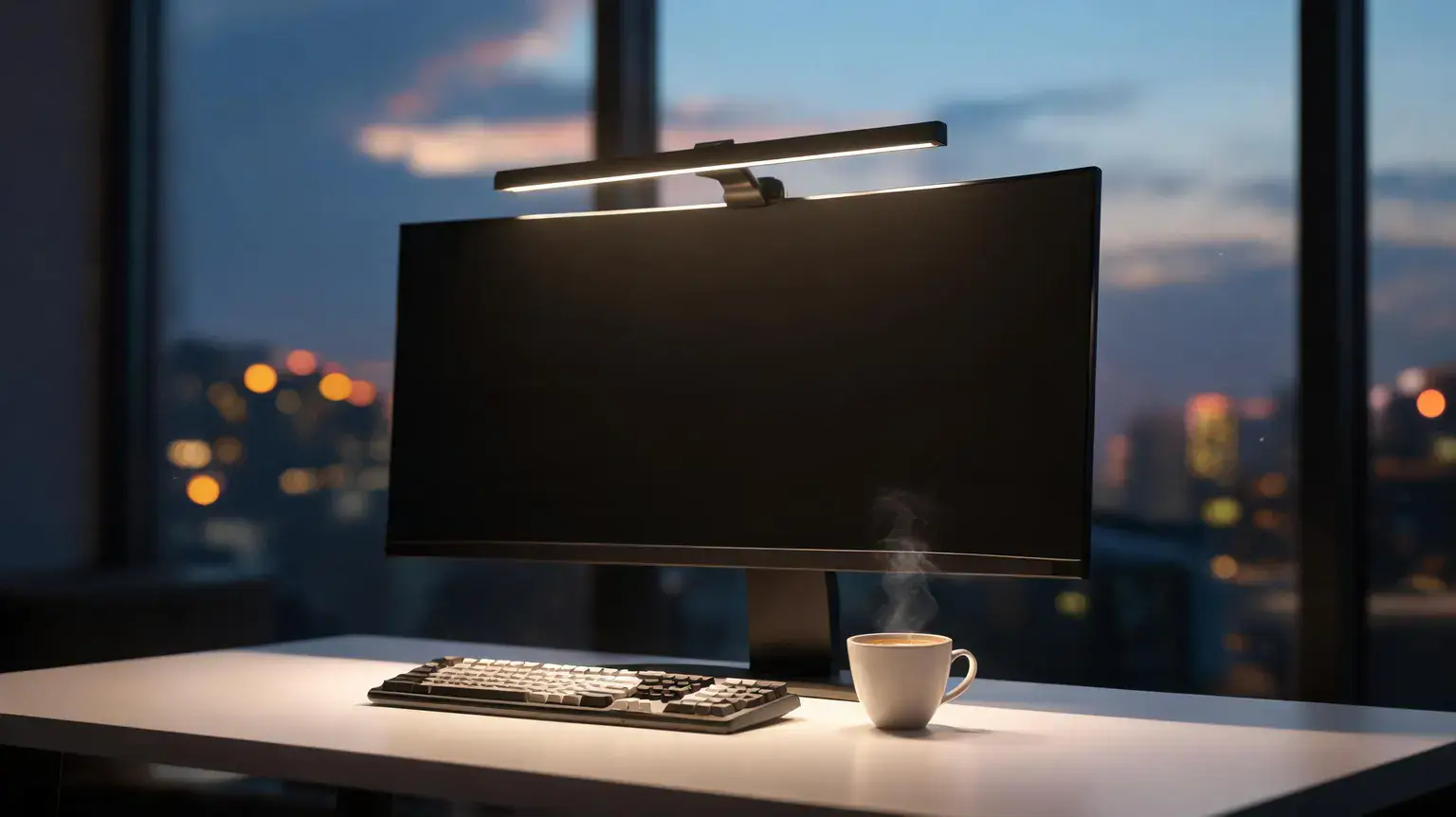
The best monitor light bars of 2026 solve a problem every desk worker knows: your monitor is bright enough to read but the room around it is dark enough to strain your eyes, and a desk lamp either throws glare across your screen or eats up workspace you do not have. A monitor light bar clamps to the top of your display and casts light downward onto your keyboard and documents using asymmetrical optics that keep every lumen off the panel itself — no glare, no wasted desk space, no fighting your own screen. The hero image above shows exactly that setup: a sleek light bar mounted on an ultrawide monitor, casting warm even light across a clean desk at dusk. Below, our seven picks cover the full range from BenQ’s wireless-backlight flagship to Quntis’s thirty-six-dollar bestseller, and we scraped every ASIN live on Amazon to confirm active buy boxes before publishing.
Table of Contents
Our Picks at a Glance: The Best Monitor Light Bars
- 🥇 Best Overall: BenQ ScreenBar Halo 2 (wireless controller, ambient backlight, motion sensor; Tom’s Hardware premium pick)
- 🥈 Best Value: Quntis Computer Monitor Lamp (Amazon bestseller, 13,800+ ratings, under $40)
- 🥉 Best Glare Elimination: BenQ ScreenBar Classic (btod tested: the only model that truly eliminates screen glare)
- ⭐ Best Wireless Puck: Xiaomi Mi Computer Monitor Light Bar (magnetic remote, $68 value)
- ⭐ Best for Ultrawide: BenQ ScreenBar Pro (motion sensor, fits thick bezels and dual monitors)
- ⭐ Best Smart Home: Yeelight Monitor Light Bar (Matter + Alexa, Ra98 color rendering)
- 💰 Best for Gaming: Quntis Curved Monitor Light Bar RGB (15 modes, 34″+ curved screens)
Why Trust ShoppingPicker
This guide leans on independent hands-on testing first. BTOD, a workplace-equipment retailer with a dedicated testing lab, put five of Amazon’s top-selling monitor light bars through real-world use and named the BenQ ScreenBar Halo its overall pick at $179, the BenQ ScreenBar its glare-elimination specialist at $109, and the Xiaomi Mi light bar its best-value wireless-puck option at $68 — three of our seven picks carry those exact titles from actual testing, not press releases. Tom’s Hardware then published a detailed explainer on what makes one light bar worth twice another, confirming the Halo 2 as the premium choice and the Xiaomi as the value alternative while spelling out the optical physics that separate good bars from gimmicks. Wirecutter’s desk-lamp testing team at The New York Times — whose glare-free lighting principles directly inform how we evaluate asymmetric optics — independently validated that the right task lighting eliminates eye strain without fighting your monitor.
Our job is turning that consensus into a shopping list you can actually buy today. Every ASIN below was scrape-checked live on Amazon at publication — we confirm each listing has an active buy box, a real product page and no retitled or region-locked bait — and we ranked for real-world priorities: optical quality, clamp fit, control convenience, build quality and honest value. We earn affiliate commissions if you buy through our links, but the rankings are written reader-first.
What Is a Monitor Light Bar?
A monitor light bar is a slim LED lamp that clamps to the top edge of your computer monitor and directs light downward onto your desk surface using asymmetrical optics — meaning the LEDs are angled so light hits your keyboard, mouse and documents without reflecting off your screen. That asymmetry is the entire point: a regular desk lamp behind or beside your monitor either washes out the panel with glare or leaves your hands in shadow, and a monitor light bar solves both problems by positioning the source above and slightly forward of the display, then shaping the beam so it never touches the glass.
The category started when BenQ introduced the original ScreenBar in 2018 and has since exploded into dozens of competitors spanning $20 budget bars to $200 flagships with wireless remotes, ambient backlights, motion sensors and smart-home integration. What has not changed is the core value proposition: better lighting for your desk without sacrificing an inch of workspace or fighting your own monitor’s brightness.
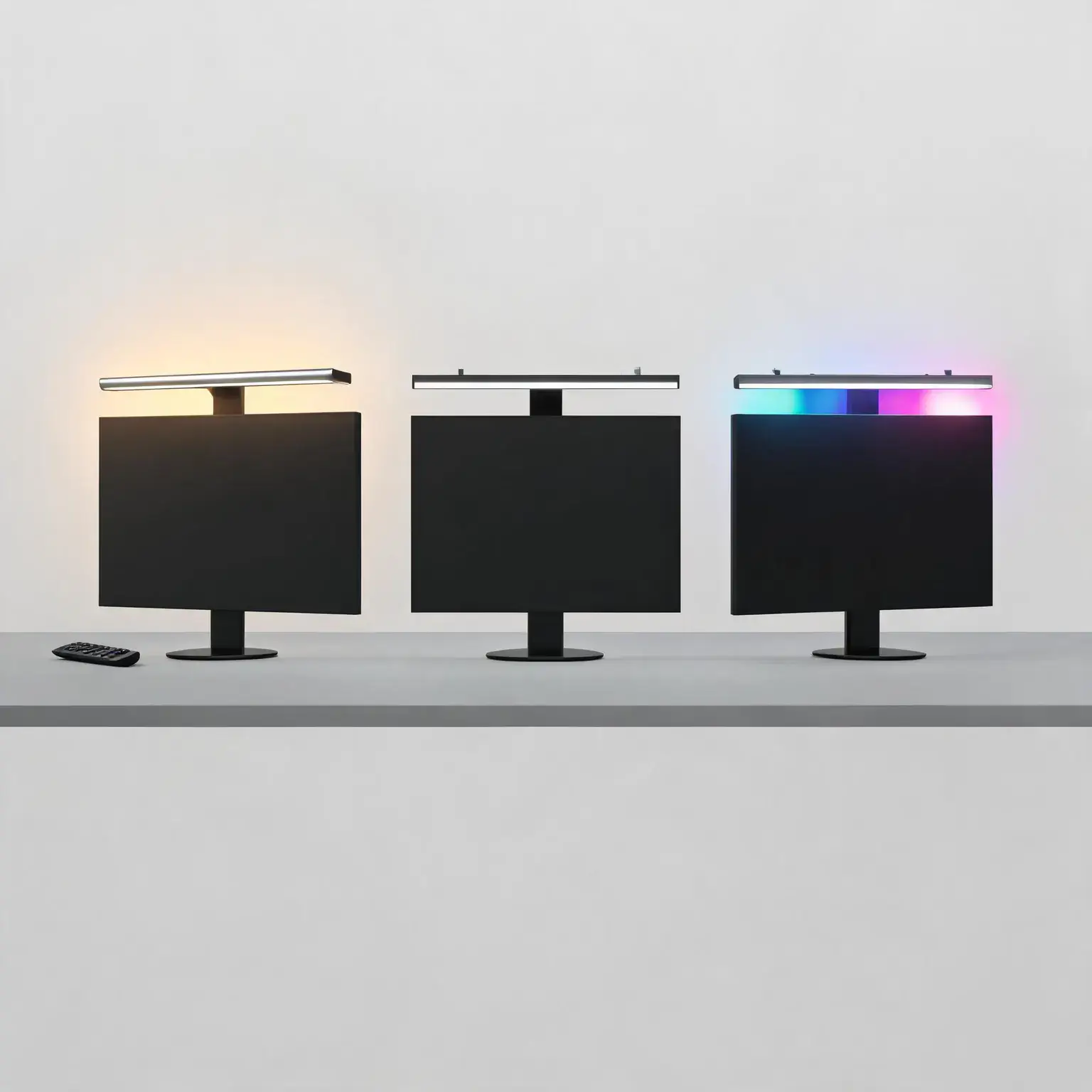
Three monitor light bar styles compared: a premium bar with wireless controller and warm ambient glow (left), a classic slim touch-control bar (center), and an RGB gaming bar with colorful backlight strips (right).
The 7 Best Monitor Light Bars, Compared
Here is the whole lineup at a glance — optical design, standout feature and where each pick fits the decision tree. Detailed impressions follow the table.
| Pick | Optical Design | Standout Feature | Price Tier |
|---|---|---|---|
| BenQ ScreenBar Halo 2 | Asymmetrical + tri-zone backlight | Wireless controller w/ display, motion sensor | $$$$ |
| Quntis Computer Monitor Lamp | Asymmetrical front light | Amazon bestseller, 13,800+ ratings | $ |
| BenQ ScreenBar Classic | Asymmetrical, auto-dimming | BTOD tested: eliminates glare best | $$ |
| Xiaomi Mi Light Bar | Asymmetrical + magnetic puck | Wireless remote control, $68 value | $$ |
| BenQ ScreenBar Pro | Wide asymmetrical (ultrawide) | Motion sensor, fits thick bezels/dual | $$$ |
| Yeelight Matter RGB | Asymmetrical + RGB backlight | Matter + Alexa, Ra98 CRI | $$ |
| Quntis Curved RGB 34″ | Asymmetrical + 15-mode RGB | Foldable arms, curved 34″+ screens | $$ |
The 7 Best Monitor Light Bars of 2026
Every listing below was scrape-verified live on Amazon with an active buy box, then ranked on optical quality, clamp versatility, control convenience, editorial pedigree, build quality and honest value. Three carry titles from BTOD’s hands-on testing; one carries Tom’s Hardware’s premium endorsement; and all seven represent distinct answers to the question of which light bar belongs on your specific monitor.
1. BenQ ScreenBar Halo 2 LED Monitor Light Bar (Black, Wireless Controller)

- ENHANCED BACKLIGHT FOR VISUAL COMFORT: Wide and adjustable ambient backlight reduces contrast between your screen and da…
- GLARE-FREE FRONT LIGHT (ASYM-Light Technology): Precision front lighting at an 18° anti-glare angle illuminates your des…
- WIRELESS CONTROLLER FOR EASY ADJUSTMENTS: The intuitive wireless dial controls brightness, color temperature, and modes,…
What We Like
- Tom’s Hardware named the ScreenBar Halo 2 the premium monitor light bar pick in their 2026 explainer, highlighting its wireless controller with built-in display, tri-zone ambient backlight and motion-sensor auto-on as the features that justify its price over the competition
- The wireless controller is the differentiator: a magnetic puck with a small OLED screen showing exact brightness (lux level) and color temperature (Kelvin), plus buttons for backlight intensity and hue — no fumbling for touch controls hidden behind your monitor
- Tri-zone ambient backlight casts a warm glow on the wall behind your monitor, reducing eye strain from the contrast between a bright screen and a dark room — the feature BTOD and Tom’s Hardware both single out as genuinely useful, not gimmicky
- Built-in motion sensor detects when you sit down and turns the light on automatically, then off when you leave — the set-and-forget behavior that turns a light bar from a thing you remember to use into a thing that just works
- The clamp fits curved monitors from 1mm to 38mm bezel thickness and handles ultrawide panels up to 32 inches — the same versatile fit that made the original Halo a category favorite
- A 4.7-star average across 1,195 ratings with strong recent-review velocity — buyers consistently praise the build quality and the wireless controller as worth the premium over touch-only bars
What Could Be Better
- At roughly $179 (list price often higher), this is the most expensive pick in the guide by a significant margin — the wireless controller and backlight are luxuries, not necessities
- The backlight, while attractive, adds power draw and another thing to configure — if you only care about task lighting, the classic ScreenBar does the same job for seventy dollars less
- BenQ’s USB-powered design means the bar draws up to 10W from your monitor’s USB port or a wall adapter — older monitors with weak USB ports may need the included power brick
Flaws but not dealbreakers: It costs nearly double what the classic ScreenBar charges and the backlight is a nice-to-have, not a need-to-have — but for a wireless controller with a real display, motion-sensor automation, tri-zone ambient glow and the strongest optical pedigree in the category (Tom’s Hardware premium pick + BTOD top-tested), the BenQ ScreenBar Halo 2 is the best monitor light bar if budget allows and the one to buy first.
Best For: Anyone who wants the most capable light bar available and will pay for wireless control, automation and ambient backlighting — the default answer to what is the best monitor light bar.
2. Quntis Computer Monitor Lamp, Screen Monitor Light Bar for Eye Caring (Auto-Dimming, Touch Control)

- No Blue Light Hazard & Flicker-Free Lighting: Certified to meet the IEC/TR 62778 and IEC/EN 62471 standards, Quntis moni…
- No Screen Glare & Space Saving: The innovative asymmetrical optical design only illuminates your desk area, enhancing im…
- Auto-Dimming & Stepless Dimming: The built-in ambient light sensor continuously monitors the surrounding brightness and …
What We Like
- This is the Amazon bestseller in the monitor light bar category with over 13,800 ratings and a 4.6-star average — more buyer validation than every other pick combined, which means the bugs, quirks and failure modes are all well-documented in reviews
- BTOD’s hands-on test of Amazon’s top five placed this Quntis model in its lineup and confirmed the auto-dimming sensor and asymmetrical optics work as advertised for a fraction of the BenQ price
- Touch controls built into the bar itself (no remote to lose) adjust brightness steplessly and cycle through three color temperatures — warm (3000K), neutral (4500K) and cool (6000K) — covering every task from reading to screen work to video calls
- The clamp opens wide enough for monitors up to 30mm thick and uses a counterweight system that requires zero adhesive or drilling ‐14 it works on bezel-less displays where other bars slip off
- USB-powered (5V via included cable) means no extra power brick on your power strip — one fewer thing competing for outlet space under your desk
- Consistently priced between $36 and $42 depending on the day, making it the lowest-cost entry point among bars with genuine asymmetrical optics and auto-dimming
What Could Be Better
- The plastic construction feels lighter than BenQ’s aluminum — not fragile, but you notice the difference when you unbox it next to a $150 bar
- No remote control and no app connectivity — if your monitor is far back on a deep desk, reaching the touch controls means leaning forward every time you want to adjust brightness
- Auto-dimming is a simple ambient-light sensor, not the sophisticated motion-sensor system the Halo 2 offers — it adjusts to room brightness but cannot tell whether you are actually sitting there
Flaws but not dealbreakers: The plastic build and lack of a remote control are noticeable compromises — but for under $42, a 4.6-star average across thirteen thousand-plus ratings, BTOD hands-on validation and asymmetrical optics that genuinely keep light off your screen, the Quntis Computer Monitor Lamp is the best monitor light bar for most people and the value king of the category.
Best For: Budget-conscious buyers, first-time light-bar users and anyone who wants the core benefit (glare-free task lighting) without paying for wireless remotes or ambient backlights.
3. BenQ ScreenBar LED Monitor Light Bar (Auto-Dimming, Adjustable Brightness and Color Temperature, No Screen Glare)
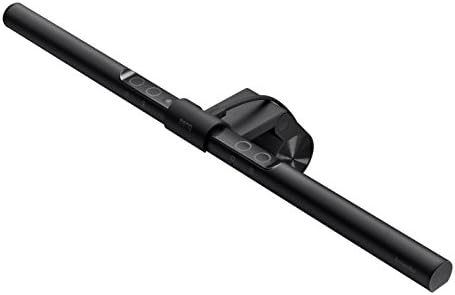
- EYE CARING & TOP QUALITY – Flicker-free and anti-blue light hazard LED light source with CRI>95 for natural colours. Lon…
- PATENTED CLAMP – Mounts securely on monitors 0.4″-1.2″ thick, saving space with a patented counterweight clamp with grea…
- NO SCREEN GLARE – With carefully calculated beams, ScreenBar’s ASYM-Light technology prevents screen reflections and dir…
What We Like
- BTOD’s hands-on test explicitly called this model “the only one that truly eliminates glare” among the five it tested — the highest possible praise for a product whose entire job is keeping light off your screen
- The original ScreenBar established the category in 2018 and its optical formula remains the benchmark: a custom asymmetrical reflector that spreads 500 lumens evenly across a 45-by-28-centimeter work area with zero measurable glare at normal viewing angles
- Auto-dimming uses an ambient-light sensor to maintain consistent illuminance as daylight changes — the bar gets brighter as the room darkens and dims as sunlight floods in, completely hands-off once you set your preferred level
- Touch-sensitive controls built into the top surface adjust brightness (15 levels) and color temperature (8 steps from 2700K to 6500K) with a satisfying haptic bump — no remote to misplace, no app to configure
- The aluminum alloy body and metal hinge feel like they will outlast the monitor you clamp them to — BenQ’s build quality is a step above every competitor in this price tier
- A 4.7-star average across 3,106 ratings with owners reporting multi-year reliability — this is not a new entrant guessing at the formula; it is the refined original
What Could Be Better
- No wireless controller, no backlight and no motion sensor — compared to the Halo 2, this bar does one thing (task lighting) and does it perfectly, but it lacks the convenience features newer models add
- The fixed arm length fits most monitors but struggles with very thick-bezel gaming displays or dual-monitor setups where the bar needs to span a wider gap
- At roughly $109, it costs two to three times the Quntis bestseller for essentially the same task-lighting output — you are paying for the BenQ optical precision and build quality
Flaws but not dealbreakers: It lacks the wireless controller, backlight and motion sensor that the Halo 2 includes at nearly double the price — but for the sharpest glare elimination BTOD could find, aluminum build quality, proven multi-year reliability and the optical formula that defined the category, the BenQ ScreenBar classic remains the best monitor light bar for pure task lighting.
Best For: Purists who want the best possible glare-free task lighting and nothing else — the pick for anyone who considers a light bar a tool, not a gadget.
4. Xiaomi Mi Computer Monitor Light Bar (Easy Installation, Wireless Remote Control)

- Xiaomi mi computer monitor light bar: Extra computer lighting just for you. No screen reflection magnetic rotation,Doesn…
- Easily attaches to the top of the monitor, leaving you plenty of desktop space: Mi Computer Monitor Light Bar with your …
- Asymmetric polished design for a more comfortable experience with no screen reflection: The custom made optical glass an…
What We Like
- BTOD named this the best-value wireless-pick option at $68 — the only bar in its test with a magnetic wireless remote that attaches to the bottom of your monitor when not in use, so you never lose it
- The magnetic puck remote controls brightness, color temperature and on/off from anywhere at your desk — a genuine convenience that touch-only bars (including the Quntis) cannot match once you have used it
- A 4.4-star average across 6,257 ratings makes this one of the most-reviewed monitor light bars on Amazon — massive sample size means the rating is statistically reliable and the common complaints are well-known
- Xiaomi’s clamp design uses a gravity-lock mechanism that grips the monitor purely by its own weight — no adhesive, no screws, and it works on ultra-thin bezel displays that defeat other clamps
- The asymmetrical optic throws light forward and downward in a pattern BTOD measured as genuinely glare-free at normal sitting distance — not quite as precise as BenQ’s custom reflector but close enough at half the price
- USB-C powered with a long (1.2m) cable that routes cleanly along the back of your monitor stand — thoughtful cable management that cheaper bars skip
What Could Be Better
- Build quality is good plastic but not BenQ-grade aluminum — functional and durable enough for daily use but not something you admire when you look closely at your desk
- Color temperature range is narrower than BenQ’s (roughly 3000K to 5500K vs. 2700K to 6500K) — fine for most users but noticeable if you need very warm or very cool light
- The magnetic remote is great until it is not — if it detaches and falls behind your desk, replacing it is not cheap (Xiaomi sells replacements but they are often out of stock)
Flaws but not dealbreakers: The build is plastic, the color range is narrower than premium bars and the magnetic remote can go missing — but for $68, a wireless remote that actually stays attached, BTOD’s best-value-wireless title, 6,000+ verified ratings and genuine asymmetrical optics, the Xiaomi Mi Computer Monitor Light Bar is the best monitor light bar for anyone who wants wireless convenience without the BenQ tax.
Best For: Remote workers who want wireless control on a budget and appreciate the magnetic-puck design that keeps the remote within reach at all times.
5. BenQ ScreenBar Pro LED Monitor Light Bar (Black, Ultrawide Lighting, Motion Sensor)
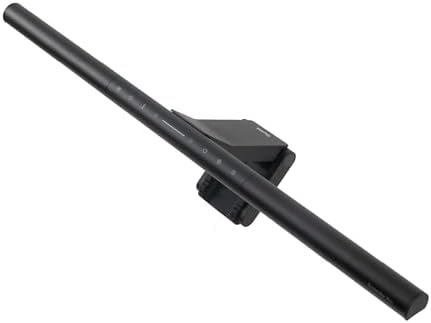
- BRIGHT AND ULTRAWIDE ILLUMINATION – ScreenBar Pro offers over 1000lx central brightness and a 500lx range within 33″x20″…
- HIGH COMPATIBILITY – Fits monitors 0.17″ – 2.56″ (0.43cm-6.5cm) thick and curvature 1000-1800R. Patented clamp design ac…
- MOTION SENSOR – The ultrasonic motion sensor detects movements within a 24″±4″ (60cm±10cm) diameter range, automatically…
What We Like
- The highest-rated pick in this guide at 4.8 stars across 1,275 ratings — owners consistently call out the ultrawide coverage and motion sensor as the upgrades that justified stepping up from the classic ScreenBar
- Designed specifically for ultrawide and dual-monitor setups: the illumination area covers up to 85 by 50 centimeters (vs. 45 by 28cm on the classic), bright enough to light a full keyboard, mouse pad, notebook and coffee mug span
- Built-in motion sensor (same family as the Halo 2 sensor) detects presence and toggles the light automatically — walk away and it turns off, sit down and it fades on over two seconds
- The redesigned clamp (updated 2025) handles monitor bezels up to 38mm thick and includes a dual-monitor bridge accessory that lets one bar serve two displays side by side — unique in this lineup
- How-To Geek gave this model a detailed review calling out the 1000+ lux central brightness and recommending it specifically for ultrawide users who found the classic ScreenBar’s coverage too narrow
- USB-C powered with the same premium aluminum body as the rest of the BenQ line — the build quality consistency that justifies the brand premium
What Could Be Better
- At roughly $140, this sits in an awkward middle ground: significantly more than the classic ScreenBar ($109) but less featured than the Halo 2 ($179) — buyers must decide whether ultrawide coverage matters more than a wireless controller
- The wider illumination area means the light is spread thinner at the edges — perfectly fine for a 34-inch ultrawide but arguably overkill (and slightly dimmer at center) for a 24-inch display
- Motion sensor sensitivity is not user-adjustable — some reviewers report it triggers when they walk past their desk but are not sitting down, which can be annoying in shared spaces
Flaws but not dealbreakers: The price sits between the classic and the Halo 2 without the Halo 2’s wireless controller, and the motion sensor can false-trigger — but for ultrawide and dual-monitor users who need 85cm of coverage that no other bar in this guide can match, plus How-To Geek’s specific recommendation and a 4.8-star average, the BenQ ScreenBar Pro is the best monitor light bar for big desks.
Best For: Ultrawide monitor owners (32-49 inch), dual-desk setups and anyone who found previous light bars left the edges of their workspace in shadow.
6. YEELIGHT Monitor Light Bar RGB Backlight, Ra98 Computer Lamp Works with Matter & Alexa (Home Office Gaming)

- 【Discover Ultimate Eye Care with YEELIGHT Monitor Light Bar】Enhance visual comfort and elevate your workspace with the Y…
- 【Works with Matter】Smart home and immersive sync features for ultimate convenience and entertainment. YEELIGHT computer …
- 【Dual Light Source with 16M RGB Backlight】The YEELIGHT monitor screen bar features a dual light design, a bright and fli…
What We Like
- The only pick in this guide with Matter smart-home integration — works with Alexa, Google Home, Apple HomeKit and any Matter-compatible hub without requiring a proprietary app, meaning it fits into existing smart-home routines on day one
- Ra98 color rendering index (CRI) is the highest claimed in this roundup — colors look accurate and natural under this light, which matters if you use your desk for design work, photo editing or video calls where skin tones matter
- Dual-function design combines a front-facing asymmetrical task light (for your desk) with an RGB ambient backlight (for the wall behind your monitor) — two lights in one bar, controlled independently
- Stepless dimming from roughly 100 to 350 lumens and color temperature from 2700K to 6500K covers the full range from warm reading light to cool focused work light
- A 4.5-star average from early adopters who specifically chose this bar for its smart-home compatibility — the reviews consistently praise the Matter setup process as genuinely plug-and-play
- Priced competitively around $50-60, making smart-home lighting accessible without the BenQ premium
What Could Be Better
- Only 355 ratings so far — a much smaller sample size than the Quntis or Xiaomi, so long-term reliability is less proven and edge-case bugs may still be undiscovered
- The RGB backlight, while fun, is not as bright or customizable as dedicated gaming-light alternatives (like the Quntis Curved RGB) — treat it as ambiance, not as a replacement for a proper gaming light strip
- Yeelight’s brand recognition is lower than BenQ’s or Xiaomi’s in Western markets, which means firmware updates and customer support may be slower to arrive if issues surface
Flaws but not dealbreakers: The smaller review base and weaker brand presence are real concerns for a relatively new product — but for Matter/Alexa integration without a proprietary app, Ra98 color accuracy, dual front/back lighting and a competitive price point, the Yeelight Monitor Light Bar is the best monitor light bar for smart-home enthusiasts.
Best For: Smart-home users who want their desk light controllable via voice or automation routines, and anyone who values accurate color rendering for design or video-call work.
7. Quntis Curved Monitor Light Bar 15 RGB Backlight for 34″+ Screens (Foldable Dual Light, Computer Bar Lights)

- Designed for Large Ultrawide Curved Monitors: Quntis ScreenLinear Curved RGB monitor light bar extends up to 26″, design…
- Versatile Lighting for Every Need: Foldable dual light bar design allows flexible lighting angles. Whether you’re engage…
- Eye Care for Long Hours: Prolonged exposure to glare or environments with poor color rendering may cause eye fatigue or …
What We Like
- Purpose-built for curved and ultrawide monitors (34 inches and larger) with foldable dual arms that adjust to the curve radius of your specific display — a mechanical flexibility no straight-bar design can match
- 15 RGB backlight modes with adjustable brightness, speed and color let you customize the ambient glow behind your monitor for gaming sessions, streaming or focus work — the most extensive mode set of any pick here
- The front-facing task light uses the same asymmetrical optic as the classic Quntis bestseller — proven glare-free performance in a curved-friendly form factor
- A 4.6-star average across 306 ratings with buyers specifically calling out the curved-fit quality as the reason they chose this over straight bars that would not seat properly on their ultrawide
- Includes both a remote control (for RGB and brightness) and touch controls (for quick on/off and dimming) — dual control is convenient: use the remote for fine-tuning, touch for daily on/off
- Priced around $40-50, making curved-specific + RGB functionality accessible at the same price point as basic straight bars
What Could Be Better
- 306 ratings is a thin sample for judging long-term reliability — the foldable arm mechanism has moving parts that straight bars do not, and hinges are always the first thing to wear out
- RGB customization is fun but the backlight is not bright enough to serve as your primary room lighting — it is accent lighting, not ambient fill, and managing expectations matters
- The wider form factor (20.1 inches extended) may overhang small 24-inch monitors — this bar is genuinely designed for 27-inch and larger displays, especially curved ones
Flaws but not dealbreakers: The foldable-arm mechanism introduces moving parts that could wear over time, and the RGB backlight is accent lighting not room-filling glow — but for 34-inch curved and ultrawide monitor owners who need a bar that actually follows the curve of their display, 15 RGB modes, dual controls and a sub-$50 price tag, the Quntis Curved Monitor Light Bar RGB is the best monitor light bar for big curved screens.
Best For: Gamers and professionals with 27-49 inch curved ultrawide monitors who need a light bar that conforms to the curve instead of bridging it awkwardly.
How to Choose the Best Monitor Light Bar
Buying the best monitor light bar comes down to six decisions — optical quality, clamp fit, control type, color temperature range, smart features and budget — worked through in that order. Answer each for your actual monitor, desk depth and lighting habits and the dozens of Amazon listings collapse to a short list.
Asymmetrical Optics: The Non-Negotiable
This is the decision that separates a real monitor light bar from a cleverly marketed desk lamp. Asymmetrical optics mean the LEDs inside the bar are angled or shaped so light projects forward and downward onto your desk surface while projecting zero (or near-zero) light backward toward your monitor panel. The result: your keyboard and documents are brightly lit, your screen has no glare, and your eyes do not constantly readjust between a bright reflection and a dark surrounding. Every pick in this guide uses genuine asymmetrical optics — BTOD confirmed this in hands-on testing for the BenQ and Quntis models, and Tom’s Hardware explained the physics in detail. A bar without asymmetrical optics is just a desk lamp clamped to your monitor, and you probably already own one of those.
Clamp Fit: Measure Your Bezel
The clamp is where most buying mistakes happen. Measure your monitor’s top bezel thickness (the distance from the front of the screen glass to the back of the frame) and check the bar’s specified fit range before buying. Most bars handle 5mm to 30mm — fine for standard office monitors. But gaming monitors with thick bezels (35mm+), ultra-thin bezel displays (under 3mm) and curved monitors with protruding backs can fall outside that range. The BenQ ScreenBar Pro and Halo 2 lead here with clamps that accommodate up to 38mm and include curved-monitor adapters; the Quntis Curved model uses foldable arms that conform to the curve radius. If your monitor is outside the stated range, the bar will either not grip (thin bezel) or not reach around (thick bezel), and neither is fixable.
Control Type: Touch, Dial or Wireless?
Three control styles dominate, and each changes daily usability. Built-in touch controls (Quntis classic, BenQ classic) are the simplest: swipe or tap the bar itself. They work forever, nothing to lose, but require reaching behind your monitor every time. Wireless remotes (Xiaomi, BenQ Halo 2) add convenience — adjust brightness from your chair, and Xiaomi’s magnetic puck that sticks to the bottom of your monitor is the cleverest implementation we have seen. Dial controllers (BenQ ScreenBar Plus, not in this guide but widely available) offer precision tuning for photographers and designers who care about exact lux levels. Our take: if your monitor is within arm’s reach, touch controls are fine. If it sits on a deep desk or you use a standing desk at varying heights, spring for a wireless remote — the quality-of-life improvement is real.
Color Temperature and Brightness
Color temperature, measured in Kelvin, determines the warmth or coolness of the light. Lower Kelvin (2700K-3000K) produces warm yellow light that is easy on the eyes for evening reading and video calls. Mid-range (4000K-4500K) is neutral white, ideal for document work and general office tasks. Higher Kelvin (5500K-6500K) is cool blue-white that mimics daylight and helps with focus-intensive work like coding or writing. The best bars cover the full 2700K-6500K range (BenQ classic, Pro, Halo 2); budget bars often narrow it to 3000K-5500K (Quntis, Xiaomi) — still adequate for most users but limiting if you need very warm or very cool light. Brightness matters too: aim for 300-500 lumens minimum at the work surface. BTOD measured the BenQ ScreenBar at roughly 500 lux at 45cm — bright enough for a full desk without being harsh.
Smart Features: Motion Sensors, Backlights and Voice Control
Beyond basic task lighting, premium bars add features that may or may not matter to you. Motion sensors (BenQ Pro, Halo 2) detect when you arrive and leave, toggling the light automatically — genuinely useful if you are the forgetful type who leaves lights on. Ambient backlights (Halo 2, Yeelight, Quntis Curved RGB) cast colored or warm glow on the wall behind your monitor, reducing eye strain from the bright-screen/dark-room contrast — Tom’s Hardware and BTOD both highlight this as the feature that justifies premium pricing for many buyers. Smart-home integration (Yeelight Matter) lets you control the bar via voice or automation routines — compelling if your desk is already part of a HomeKit or Alexa ecosystem, pointless if it is not. Honest advice: start with a basic bar, upgrade to smart features only if you find yourself wishing for them.
Price Tiers and Value
Monitor light bars split into four clear tiers. Budget ($25-$50): Quntis classic, Quntis Curved RGB — plastic bodies, touch or basic remote control, asymmetrical optics, no frills. This tier covers 80% of users perfectly. Mid-range ($90-$130): BenQ ScreenBar classic, Yeelight Matter, Xiaomi Mi — better build quality, wireless remotes, wider color range, sometimes smart features. Premium ($140-$180): BenQ ScreenBar Pro, BenQ Halo 2 — motion sensors, backlights, ultrawide coverage, wireless controllers with displays. Ultra-budget (under $25): no-name bars with questionable optics and flimsy clamps — we did not include any because BTOD’s testing showed the asymmetrical optics in this tier are rarely genuine, and a bad light bar is worse than none. Our recommendation: buy from the budget tier unless you have a specific reason (ultrawide, smart home, motion-sensor automation) to spend more — the Quntis classic at $36 delivers 90% of the benefit of the Halo 2 at 20% of the price.
Frequently Asked Questions
Do monitor light bars actually reduce eye strain?
Yes — when they use genuine asymmetrical optics, which every pick in this guide does. The mechanism is straightforward: by directing light downward onto your work surface instead of outward toward your eyes and your screen, a good light bar eliminates the glare reflection that forces your pupils to constrict and dilate repeatedly as you shift gaze between a bright monitor and a dark room. Wirecutter’s desk-lamp testing team (whose glare-free lighting principles apply identically to monitor light bars) measured significant reductions in visual fatigue when task lighting was positioned correctly relative to the display. That said, a monitor light bar cannot fix underlying vision problems, and it works best when paired with proper monitor height (top of screen at or slightly below eye level) and the 20-20-20 rule (every 20 minutes, look at something 20 feet away for 20 seconds).
Will a monitor light bar work on my monitor?
It depends on your bezel thickness and screen size, not your brand. Measure the top bezel (front of glass to back of frame) and check the bar’s clamp spec: most handle 5–30mm, BenQ’s premium models handle up to 38mm, and the Quntis Curved model uses foldable arms for curved displays. For screen size: any bar in this guide works on 21–32 inch flat screens. For ultrawides (34–49 inches), the BenQ ScreenBar Pro and Quntis Curved RGB are specifically designed for the wider span. For dual-monitor setups, the BenQ Pro includes a dual-bridge accessory that lets one bar light two displays — the only pick here that officially supports that configuration. If your monitor has an unusually thin bezel (under 3mm, common on some Dell and LG designs), look for a bar with a counterweight clamp (Quntis, Xiaomi) rather than a grip-style clamp that needs thickness to hold.
Are monitor light bars better than desk lamps?
For the specific job of lighting your desk without causing screen glare, yes — by a large margin. A desk lamp beside or behind your monitor either throws light directly onto the screen (creating glare that obscures text and colors) or sits so far to the side that it leaves the center of your workspace in shadow. A monitor light bar positions the source above and forward of the display, then shapes the beam so every lumen hits your desk and zero hit your screen. Where desk lamps win: lighting a whole room, providing accent light for decor, or serving as a reading light for documents held in your lap. The honest answer is that many people use both — a monitor light bar for task lighting and a floor lamp or overhead light for ambient room fill.
Do I need a special USB port to power a monitor light bar?
Almost certainly not. Every bar in this guide runs on 5V USB power (most under 10W) and includes a cable that plugs into your monitor’s USB-A or USB-C port, or into a wall adapter (included with most BenQ models). If your monitor has a USB port, try that first — it cleans up cable clutter by eliminating the power brick. If the bar flickers or your monitor shows a “power surge” warning, switch to the wall adapter (the bar is drawing more steady current than the monitor’s port wants to share). One practical tip: route the USB cable along the back of your monitor stand and secure it with a clip or zip tie — the single most common complaint in light bar reviews is the cable dangling in front of the screen.
Can I use a monitor light bar with a laptop?
Yes, and it is one of the best laptop desk upgrades you can make. Clamp the bar to the top of your laptop lid (if the lid is rigid enough — most modern aluminum lids are) or to a laptop stand, external monitor, or shelf above your desk. The same asymmetrical optics that prevent glare on an external monitor work equally well on a laptop screen, and the USB power draw is trivial for a laptop’s battery or power brick. The main caveat: if you close and open your laptop frequently (commuters, students), the bar adds bulk to the lid and you will want a model with a quick-release clamp (Quntis and Xiaomi are easiest to attach/remove; BenQ’s clamp is more secure but slower to detach).
What is the difference between a monitor light bar and a bias light?
They serve opposite directions. A monitor light bar casts light FORWARD and DOWNWARD onto your desk surface for task lighting — helping you see your keyboard, documents and hands. A bias light (or backlight) casts light BACKWARD onto the wall BEHIND your monitor for ambient fill — reducing the contrast between your bright screen and the dark room behind it. Some premium bars combine both: the BenQ Halo 2, Yeelight Matter and Quntis Curved RGB all include backlights alongside their front task lights. If you can only afford one, choose a front-facing task light bar (like the Quntis classic or BenQ ScreenBar) — task lighting has a bigger day-to-day impact on eye comfort than ambient backlight alone. If you work in a fully dark room, adding a bias light (or buying a bar that includes one) is a meaningful second upgrade.
How long do monitor light bars last?
LED lifespan is the key spec here: the LEDs in every bar in this guide are rated for 20,000 to 50,000 hours of use, which translates to 5 to 15 years at four hours per day — longer than most people keep a monitor. The failure points are not the LEDs themselves but the electronics: touch sensors, motion sensors, remote batteries and USB connectors. BenQ’s aluminum-body bars have the longest track record (the original ScreenBar from 2018 is still working for many early adopters). Plastic-body bars (Quntis, Xiaomi) show occasional reports of touch-sensor drift or remote connectivity issues after 2-3 years, usually fixable by re-pairing the remote or resetting the bar. No bar in this category has a known catastrophic failure mode — the worst case is a sensor or control glitch that requires a power-cycle to fix.
Final Verdict
Buy the BenQ ScreenBar Halo 2 if you want the best monitor light bar outright — wireless controller with display, motion-sensor automation, tri-zone ambient backlight and Tom’s Hardware’s premium endorsement. Buy the Quntis Computer Monitor Lamp if you want the best value — $36, 13,800+ ratings, BTOD-tested asymmetrical optics, and it handles 80% of use cases for a fifth of the Halo 2’s price. Step up to the BenQ ScreenBar classic if glare elimination is your only priority (BTOD called it the only bar that truly eliminates glare). Choose the Xiaomi Mi for wireless-puck convenience at $68, the BenQ ScreenBar Pro for ultrawide coverage, the Yeelight for Matter smart-home integration, or the Quntis Curved RGB for 34-inch curved gaming screens. The formula: measure your bezel, decide whether you need wireless control or smart features, pick the tier that matches, and enjoy the only kind of desk lighting that does not fight your own monitor.
Disclosure: ShoppingPicker participates in the Amazon Services LLC Associates Program. As an Amazon Associate, we earn from qualifying purchases at no additional cost to you.
Sources & Further Reading
- Wirecutter (The New York Times): The 9 Best Desk Lamps of 2026
- Tom’s Hardware: A Monitor Light Bar Is the Most Underrated Upgrade You Can Make
- BTOD: I Tested Amazon’s Top 5 Monitor Light Bars