Fresh pasta is one of the fastest upgrades you can make in the kitchen: a simple egg-and-flour dough becomes silky fettuccine, delicate tagliolini or lasagna sheets in under an hour — and it cooks in about a minute. A good pasta maker turns that from a rolling-pin workout into a relaxing ritual. The category splits into three clear camps: classic hand-crank roller machines (the Italian gold standard), electric rollers and extruders that mix and shape dough automatically, and stand-mixer attachments that use a KitchenAid’s motor so you never touch a crank. We analyzed 30+ listings across 12 brands, drew on the published hands-on testing from Bon Appetit’s test kitchen and the tested picks at Food & Wine, and checked the owner-review track record on each listing to choose the 7 best pasta makers on Amazon in 2026 — from the $33.99 starter machine to the Marcato Atlas 150 Classic Italian kitchens have relied on for generations.
Published August 14, 2026 · Last updated September 11, 2026
Affiliate disclosure: We earn commission from qualifying purchases made through links on this page. This never affects our rankings or what we recommend.
Jump to:
Our 7 Picks · Spec-Truth Table · Price Tiers · Where We Disagree · Buyer’s Guide · Fresh Pasta Food Safety · Common Complaints · Who Should Skip Each Pick · FAQs · Verdict
Our Picks at a Glance
- 🥇Top Pick: Marcato Atlas 150 Classic Manual Pasta Maker ($119.95) — Beginners and pasta obsessives who want smooth, uniform sheets from a machine that lasts decades
- 🥈Best Value: KitchenAid KSMPRA 3-Piece Pasta Roller & Cutter Set ($199.99) — KitchenAid owners who want hands-free, motor-driven rolling and cutting
- 🏆Premium Pick: WICHEMI Electric Pasta Maker Machine 3-in-1 ($139.99) — Home cooks who want automatic rolling and cutting without owning a stand mixer
- 💰Budget Pick: Imperia iPasta Classic Pasta Maker Machine ($129.99) — Traditionalists who want heavy-duty Italian steel and an easier-on-the-hands wooden crank
- 👨👩👧👦Family Pick: VEVOR Electric Pasta Maker, 150W Automatic with 8 Shapes ($89.99) — Budget shoppers who want extruded shapes like penne, rigatoni and fusilli automatically
- 📦Compact Pick: Nuvantee Pasta Maker with Adjustable Thickness Settings ($33.99) — First-time pasta makers who want a solid, cheap hand-crank machine to learn on
- ⭐Editor’s Choice: Sailnovo 3-in-1 Pasta Maker with 9-Setting Roller & Cutters ($49.99) — Budget buyers who want rust-resistant stainless steel and extra-thin settings for silky pasta
How We Chose These Pasta Makers
We are not a lab, and we do not pretend to be one. Here is exactly how this page was built. 1. We pulled the specs in our table — thickness range, cutters, materials, dimensions — straight from the live Amazon listings for each machine on September 11, 2026. 2. We read the published hands-on testing from Bon Appetit’s test kitchen, which rolled and cut several of these machines, and cross-checked the tested picks from Food & Wine, folding in their findings (and saying so where we disagree). 3. We used university food-safety guidance from Iowa State University Extension and Illinois Extension to set the storage and drying rules in this guide. 4. We weighed the owner-review track record on each listing — rating average and review volume — to separate proven machines from brand-new listings. 5. We re-verified that every machine listed here is still available before publishing. What we do not claim: we did not test every machine ourselves, we do not invent measurements or scores, and we do not publish a fake composite rating. Read our How We Test & Choose Products page for the full method, our affiliate disclosure, and how to send corrections.
1. Marcato Atlas 150 Classic Manual Pasta Maker ($119.95) — The Gold-Standard Hand-Crank Machine, Made in Italy

- Material Type: Nickel-Plated Steel, Chrome-Plated Steel, ABS
- Included Components: User Manual
What We Like
- 10 thickness settings from paper-thin to 4.8mm
- Solid chrome-plated steel body and rollers
- Made in Italy by a family-run company since 1930
- Clean fettuccine and tagliolini cuts owners praise
- Clamp locks securely to most countertops
- Optional motor attachment upgrades it to electric later
- Includes pasta cutter and full instructions
What Could Be Better
- Hand cranking takes a little practice with two hands
- Spaghetti strands sometimes need gentle separation after cutting
- Not dishwasher-safe — dry brushing only
- Optional motor and extra cutters cost extra
Flaws but not dealbreakers: hand cranking takes real practice and often two hands, the spaghetti strands occasionally need separating, and it must never be washed with water — dry brushing only.
Best for: Beginners and pasta obsessives who want smooth, uniform sheets from a machine that lasts decades
Pair your new Marcato with one of our best stand mixers of 2026 — or add the KitchenAid KSMPRA attachment to the mixer you already own for motor-driven pasta rolling.
2. KitchenAid KSMPRA 3-Piece Pasta Roller & Cutter Set ($199.99) — The Perfect-Score Attachment for KitchenAid Stand Mixers
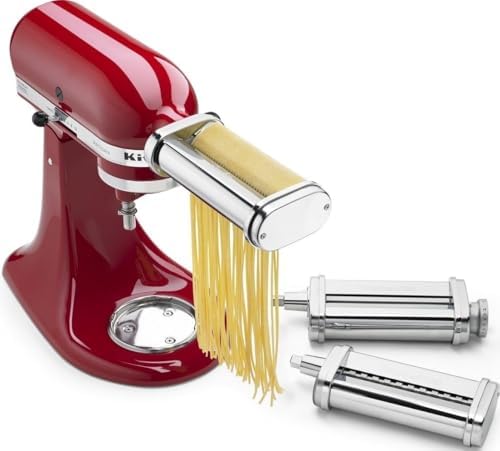
- Genuine KitchenAid Stand Mixer Attachment – Designed and engineered by the manufacturers of the KitchenAid Stand Mixer, …
- Powered by your KitchenAid Stand Mixer to make quick and easy work of fresh homemade pasta in your kitchen using the 3-P…
- Stainless steel rollers and cutters for consistent smooth rolling and clean cutting of pasta dough. Hand Wipe only – cle…
What We Like
- Uses your stand mixer’s motor — no hand crank required
- 8 roller thickness settings for everything from ravioli to pappardelle
- Stainless steel roller and cutters resist rust
- Clean, even spaghetti and fettuccine cuts
- Fits all household KitchenAid stand mixers
- Frees both hands to guide the dough through the rollers
- Comes with cleaning brush and detailed instructions
What Could Be Better
- Requires a KitchenAid stand mixer you may not own
- Roller and cutters are sold as pieces to swap during use
- Metal parts are not dishwasher-safe
- No extruder discs for tubular shapes
Flaws but not dealbreakers: it only makes sense if you already own a KitchenAid stand mixer, there are no extruder discs for tubular shapes, and the metal parts are not dishwasher-safe.
Best for: KitchenAid owners who want hands-free, motor-driven rolling and cutting
The KitchenAid attachment set only makes sense with a mixer, so check our best stand mixers of 2026 guide to see which models the KSMPRA fits and which bowl sizes suit a pasta-focused kitchen.
3. WICHEMI Electric Pasta Maker Machine 3-in-1 ($139.99) — The Best Electric Roller for Hands-Free Noodles

- 3-IN-1 ELECTRIC PASTA MAKER: WICHEMI Automatic pasta maker machine features 3-in-1 functions to press dough and cut nood…
- HIGH-GRADE STAINLESS STEEL MACHINE: Electric family noodles maker machine features 304 food grade stainless-steel body, …
- MULTIFUNCTIONAL NOODLE MAKER SPECS: Rated voltage: 110V US Plug; Power: 135W; Weight: 8kg/17.6lbs; Efficiency: 22lb/h; M…
What We Like
- 135W motor rolls and cuts pasta automatically
- 3-in-1: dough pressing plus 2.5mm round and 4mm/9mm flat noodles
- 8 thickness settings for precise sheets
- Stainless steel body and durable components
- Hands-free operation frees both hands to guide dough
- Compact footprint fits small kitchens
- Makes fresh noodles in minutes with no hand cranking
What Could Be Better
- Electric parts must be hand-washed, never submerged
- Only flat and round noodles — no penne or rigatoni
- Motor is louder than manual models
- Cleanup takes longer with disassembly
Flaws but not dealbreakers: the motor is louder than a manual machine, the electric parts must be hand-washed and never submerged, and it only makes flat sheets and two noodle widths — no penne or rigatoni.
Best for: Home cooks who want automatic rolling and cutting without owning a stand mixer
A food processor is the fastest way to mix pasta dough before it hits the rollers — our best food processors of 2026 guide covers the models that handle stiff dough best.
4. Imperia iPasta Classic Pasta Maker Machine ($129.99) — The Italian-Made Runner-Up with a Comfortable Wooden Handle

- 100% MADE IN ITALY: IPasta is a designer machine made entirely in Italy with high-quality materials.
- 3 PASTA SHAPES: Equipped with high-quality chromed steel cutting rollers, it easily produces dough sheets with a maximum…
- COMPATIBLE WITH ELECTRIC MOTOR: The pasta machine features a clamp slot on the side that allows the attachment of the Pa…
What We Like
- 100% made in Italy with heavy-duty steel construction
- Wooden handle is far more comfortable than metal knobs
- Nickel-plated rollers move dough smoothly without sticking
- 6 thickness settings plus spaghetti and fettuccine cutters
- Feed tray helps guide sheets and rest finished pasta
- Clamps firmly without wobbling during use
- Long-standing favorite of Italian pasta makers
What Could Be Better
- Handle can occasionally slip out during cranking
- Spaghetti cuts weren’t quite as clean as the Marcato’s
- Not dishwasher-safe — dry cleaning only
- Accessories like ravioli molds sold separately
Flaws but not dealbreakers: the wooden handle can occasionally slip during cranking, the spaghetti cut is not quite as clean as the Marcato’s, and the machine is dry-clean-only.
Best for: Traditionalists who want heavy-duty Italian steel and an easier-on-the-hands wooden crank
Fresh pasta deserves a great pot — our best cookware sets of 2026 guide includes the stockpots and stainless sets that boil noodles evenly without sticking.
5. VEVOR Electric Pasta Maker, 150W Automatic with 8 Shapes ($89.99) — The Best Budget Automatic Extruder — Mixes, Kneads & Shapes

- User-Friendly Operation: Designed for ease of use, this pasta maker machine comes with recipes and simple ratios to foll…
- Versatile for Many Tastes: With a generous 500g flour capacity, you can whip up enough noodles for about 4 people in jus…
- Authentic Kneading Technology: Our pasta extruder employs a two-way kneading rod and four-dimensional mixing to mimic th…
What We Like
- 150W motor mixes, kneads and extrudes dough automatically
- 8 pasta shape discs: spaghetti, penne, rigatoni, fusilli and more
- 4 intelligent modes plus 500g flour capacity
- Fresh pasta ready in about 14 minutes
- Digital controls are genuinely beginner-friendly
- Includes measuring cups and cleaning brush
- Far cheaper than other automatic extruders
What Could Be Better
- Mostly plastic housing and dies feel less premium
- Extruder dies need careful hand cleaning
- No flat sheet or lasagna function
- Dough hydration needs to be precise to avoid jamming
Flaws but not dealbreakers: the plastic housing and dies feel less premium, there is no flat-sheet or lasagna function, and hydration has to be precise or the extruder jams.
Best for: Budget shoppers who want extruded shapes like penne, rigatoni and fusilli automatically
Electric extruders like the VEVOR mix dough in the chamber, but if you prefer making dough separately, our best food processors of 2026 guide has you covered.
6. Nuvantee Pasta Maker with Adjustable Thickness Settings ($33.99) — The Best Budget Pasta Maker Under $40
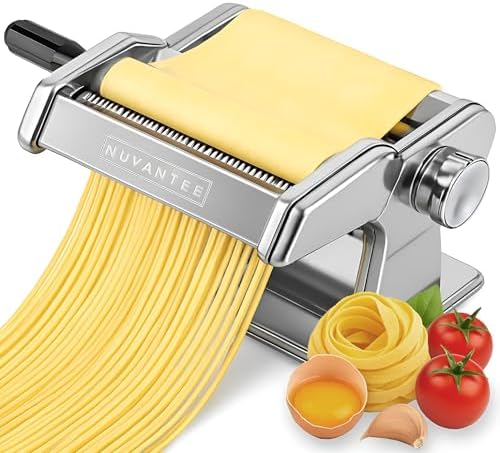
- PREMIUM GRADE STAINLESS STEEL: Say goodbye to pasta machines with unpleasant metal or plastic odors. The Nuvantee pasta …
- ADJUSTABLE PASTA THICKNESS SETTINGS: With 7 adjustable thickness settings, the Nuvantee pasta machine lets you roll doug…
- CREATE DIFFERENT TYPES OF PASTAS: Craving a certain type of pasta? This machine comes with a specialized cutter that sli…
What We Like
- Unbeatable price for a full 3-in-1 pasta setup
- 7 thickness settings from 3mm to a delicate 0.5mm
- Aluminum alloy rollers with 2 width cutters
- Makes spaghetti, fettuccine, lasagna and dumplings
- Secure clamp holds firmly to counters
- Washable rollers and cutter for easy cleanup
- Lightweight and easy to store
What Could Be Better
- Aluminum body is lighter and less durable than steel
- Rollers can stick if dough isn’t floured properly
- Cutters are narrower than premium machines
- No electric or extruder option
Flaws but not dealbreakers: the aluminum body is lighter and less durable than steel, the rollers can stick if the dough is not floured properly, and there is no electric or extruder option.
Best for: First-time pasta makers who want a solid, cheap hand-crank machine to learn on
Budget machines like the Nuvantee shine with a good drying rack and a big pot — see our best cookware sets of 2026 guide for the right pans to complete your pasta setup.
7. Sailnovo 3-in-1 Pasta Maker with 9-Setting Roller & Cutters ($49.99) — The Best Value Stainless Steel Machine with 9 Thickness Settings

- 【FOODS GRADE MATERIAL & CLEANING METHOD】 Tired of those pasta machines that smell of metal or plastic? Sailnovo pasta ma…
- 【9 ADJUSTABLE THICKNESS SETTINGS】Pasta Maker customized adjustment knob with 9 thickness dough roller settings allows yo…
- 【DIFFERENT WIDTH SETTINGS SUIT VARIOUS PASTA】Choose different pasta with your mood at this moment! A specific cutting ma…
What We Like
- 9 thickness settings from 0.3mm to 3mm for precise sheeting
- Stainless steel body resists rust and corrosion
- 3-in-1 roller plus 2 width cutters
- Makes spaghetti, fettuccine, lasagna and more
- 180mm wide roller handles larger batches
- Solid clamp and smooth crank operation
- Excellent price-to-build-quality ratio
What Could Be Better
- No motorized version available
- Cutters can need a little extra separation effort
- Not dishwasher-safe — wipe clean only
- Crank requires two-handed operation for best results
Flaws but not dealbreakers: there is no motorized version to upgrade to, the cutters can need extra separation effort, and the crank needs two-handed operation for the best results.
Best for: Budget buyers who want rust-resistant stainless steel and extra-thin settings for silky pasta
Upgrading later? The Sailnovo is a perfect backup machine, while our best stand mixers of 2026 guide helps you plan the step up to motor-driven attachments.
Spec-Truth Table: What Each Machine Actually Offers (Verified September 11, 2026)
Everything below comes from the live Amazon listing for each machine, checked on September 11, 2026 — not copied from another roundup. The “Owner rating” column is the star average shown on the listing. Amazon prices move constantly, so treat the dollar figures as a snapshot and confirm on the product page; rating counts are approximate because Amazon groups them by variant.
| Product | List price (9/11/26) | Type | Thickness settings | Pasta shapes | Material | Owner rating |
|---|---|---|---|---|---|---|
| Marcato Atlas 150 Classic | $119.95 | Manual hand-crank | 10 | Spaghetti, fettuccine, tagliolini, lasagne | Chrome-plated steel | 4.6 (3,000+) |
| KitchenAid KSMPRA 3-pc Set | $199.99 | Stand mixer attachment | 8 | Spaghetti, fettuccine, lasagne | Stainless steel | 4.8 (15,000+) |
| WICHEMI Electric 3-in-1 | $139.99 | Electric roller | 8 | Round, 4mm/9mm flat noodles | Stainless steel | 4.1 (170) |
| Imperia iPasta Classic | $129.99 | Manual hand-crank | 6 | Spaghetti, fettuccine, lasagne | Chrome steel + wood | 4.5 (27,000+) |
| VEVOR 150W Automatic | $89.99 | Electric extruder | Automatic | 8 shapes: penne, rigatoni, fusilli | Stainless + plastic | 4.2 (58) |
| Nuvantee 3-in-1 | $33.99 | Manual hand-crank | 7 | Spaghetti, fettuccine, lasagna | Aluminum alloy | 4.3 (3,000+) |
| Sailnovo 3-in-1 9-Setting | $49.99 | Manual hand-crank | 9 | Spaghetti, fettuccine, lasagna | Stainless steel | 4.4 (6,000+) |
Spec and rating note: two of these listings — the WICHEMI electric roller and the VEVOR extruder — are relatively new, with review pools of roughly 170 and 58 ratings. That is enough to spot a pattern, not enough to match the confidence we have in a machine with 27,000 ratings, and we say so rather than paper over it.
Price Tiers: Where Paying More Actually Helps — and Where It Stops
The pasta-maker category sorts into three real price bands, and the differences between them are less about “quality” than about who does the cranking.
- Under $50 — hand-crank rollers (Nuvantee $33.99, Sailnovo $49.99). This band buys a genuinely working machine: 7-9 thickness settings, two cutters, a clamp that holds. What it does not buy is the longevity of a fully chromed steel body or the last few percent of rolling smoothness. For a first machine, it is the smartest money in the category.
- $90-$140 — the inflection point. Here you are choosing between an Italian steel manual machine (Marcato Atlas 150, Imperia iPasta) and an automatic electric roller or extruder (VEVOR, WICHEMI). Moving up from $50 buys durability, automation, or both — and for most home cooks this is the ceiling of worthwhile spend.
- $200 and up — attachment and motor territory (KitchenAid KSMPRA $199.99). You are paying for a motor you already own or for hands-free operation. Past this point the money goes into motorization and brand, not into better pasta.
Where paying more stops buying performance: around $140. Bon Appetit’s testers found the manual Marcato Atlas 150 — the machine that anchors our list at $119.95 — produces evenly rolled sheets without a motor, and their own top pick, the motorized Atlasmotor, costs $330 mainly to remove the hand-cranking, not to improve the sheet. If a machine above $140 is tempting you, ask whether you are buying a better pasta or simply buying convenience.
Where We Disagree With Other Reviewers
Two respected test kitchens rank this category differently from us, and it is worth saying exactly where and why.
Bon Appetit ranks motor-first; we rank manual-first. Their testers put the motorized Marcato Atlasmotor ($330) at the top of their list and named the manual Atlas 150 their best manual pick — but the same tester also wrote that, using the manual machine, “I couldn’t do it by myself,” and listed “Might require an extra hand to help” as its con. We still rank the $119.95 manual Atlas 150 first. Our reasoning: the motor alone costs nearly twice the price of the machine, and the one-hand problem it solves is a technique issue most cooks fix in two or three batches. Paying $330 to avoid learning a 10-minute skill is not the value play for a first pasta maker.
On the best manual machine, we agree with Food & Wine. Their tested roundup named the Marcato Atlas 150 Classic its top pick for its sturdy build, which lines up with our #1. Where we part ways is the electric category: Bon Appetit’s electric pick is an extruder, and extruders only make shaped pasta — no lasagna sheets, no ravioli, no fettuccine. Our electric pick, the WICHEMI 3-in-1 roller, makes flat sheets and long noodles, which is what most people actually want from a first electric machine.
A disagreement we could not resolve: the two cheapest machines here (Nuvantee and VEVOR) also have the smallest verified review pools in our lineup, and VEVOR’s is genuinely new. We kept both because their listed specs are real and their prices are honest — but a buyer who wants a proven track record should start with the Marcato instead.
How to Choose the Best Pasta Maker — Buyer’s Guide
Manual vs. Electric vs. Stand Mixer Attachments
Manual hand-crank machines are the classic choice: they’re cheaper, simpler, and with all-metal construction they can outlive every other appliance in your kitchen. The tradeoff is labor — you crank with one hand while feeding dough with the other, which takes practice but is genuinely meditative once you find a rhythm. Electric rollers do the cranking for you, which makes them far easier for solo cooking, but they cost more and take longer to clean. Stand-mixer attachments like the KitchenAid KSMPRA sit in the middle: they use a motor you already own, deliver perfect, even sheets, and free both hands — but only make sense if you have a compatible mixer.
Roller Machines vs. Extruders: What Shapes Can You Make?
Roller machines (manual or electric) flatten dough into sheets and cut flat noodles — spaghetti, fettuccine, tagliolini, lasagna — and are the right tool for egg-based doughs and stuffed pasta like ravioli. Extruders squeeze dough through metal dies to create tubular and shaped pasta — penne, rigatoni, fusilli, macaroni — which requires a firmer semolina-and-water dough. If you mostly make long noodles and lasagna, a roller is the better value; if you want variety of shapes, an extruder (or a roller plus a separate extruder attachment) covers more ground.
Materials: Chrome Steel, Stainless Steel, Aluminum, Plastic
Steel is the gold standard. Chrome-plated steel (Marcato, Imperia) is what Italian manufacturers have used for decades — durable, corrosion-resistant and smooth. Stainless steel (KitchenAid, WICHEMI, Sailnovo) resists rust best and is easy to keep clean. Aluminum (Nuvantee and most budget machines) is lighter and cheaper but dents more easily and feels less premium. Plastic parts, common on extruders like the VEVOR, are dishwasher-friendly and light but less durable. For a machine you’ll keep for 10+ years, buy steel — for a first machine you’re unsure about, aluminum is fine to learn on.
Thickness Settings Explained
Most manual machines offer 6-10 thickness settings. Lower numbers (0-2) produce paper-thin sheets for ravioli and delicate tagliolini; middle settings (3-5) are ideal for fettuccine, pappardelle and lasagna; the thickest settings are for initial kneading passes. The universal technique is to start at the thickest setting, fold the dough and re-roll it a few times to develop gluten, then step down one number at a time until you reach the target thickness. Machines with more settings (9-10) give you finer control over the final texture.
Cleaning, Maintenance and Getting Started
Never wash metal pasta machines with water — it causes rust. Let leftover dough dry for about an hour, then brush it off with a dry pastry brush or wipe with a dry cloth, and use a wooden skewer to clear any dough stuck in the rollers. Electric machines need disassembly and hand-washing of removable parts per the manual. For your first batch: use 1 egg per 100g of 00 flour (or all-purpose), knead 8-10 minutes, rest the dough 30 minutes wrapped, and dust with semolina flour while rolling. Fresh pasta cooks in 1-3 minutes — start tasting early.
Fresh Pasta Food Safety: What the Standards Actually Require
This is the section most pasta-maker roundups skip, and it matters more than thickness settings. Homemade egg pasta is a raw-egg food, and U.S. food-safety guidance treats it differently from dried pasta.
Iowa State University Extension’s AnswerLine explains why the rules are stricter for noodles: the FDA defines a “noodle” as a product with at least 5.5% of its total solids as egg solids, which is precisely what makes the raw-egg handling rules apply. Their guidance is specific — “Fresh homemade noodles should be used right away or refrigerated for up to three days,” and “to prevent possible salmonella growth, drying time should not exceed two hours at room temperature.” Illinois Extension gives the same two-hour counter-drying ceiling and adds the safe alternative: dry in a food dehydrator at 135°F for two to four hours, then freeze, where noodles keep for three to six months.
The practical buying takeaway: if your plan is to make a big batch of egg pasta and hang it in the pantry, that plan is not food-safe, and no machine on this list changes that. Count on refrigerating fresh egg pasta for no more than three days, or drying it fast and freezing it. Any roundup that tells you a pasta maker lets you stock the pantry with homemade egg noodles is giving you bad advice.
The Most Common Owner Complaints — and How to Avoid Them
The same handful of complaints recur across this category. None is a dealbreaker, and each has a fix.
- “The cutter strands stick together.” The most common frustration on manual machines, including the Marcato, Imperia and Sailnovo. Fix: dust the sheet with semolina or 00 flour before the final pass and separate the strands the moment they come off the cutter.
- “The rollers grab or tear the dough.” Usually a hydration problem rather than a machine problem — dough that is too dry shatters and dough that is too wet sticks. It shows up most on the Nuvantee and the VEVOR. Weigh your flour instead of scooping it; dough ratios are far more reliable by weight.
- “The clamp wobbles.” A recurring note on lighter aluminum-bodied machines. Fix: clamp over the structural edge of the counter rather than an overhang, and keep downward pressure even while you crank.
- “Cleaning takes forever.” Electric machines and extruder dies are the worst offenders — dough dries hard inside the dies. Note that the metal manual machines should never touch water at all: let the residue dry, then brush it out.
- “The crank is tiring or the handle slips.” Reported on the Imperia and the budget machines. Two hands — one to crank, one to feed — is normal for manual machines, and it is the single biggest reason people eventually upgrade to a motor.
Who Should Skip Each Pick
- Skip the Marcato Atlas 150 if you already know you will never enjoy hand-cranking — go straight to an electric roller. Bon Appetit’s own tester admitted the manual machine was a two-person job for her.
- Skip the KitchenAid KSMPRA if you do not own a KitchenAid stand mixer. The attachment is useless without one, and buying a mixer just for pasta is a four-figure mistake.
- Skip the WICHEMI electric roller if you want tubular pasta — it makes flat sheets and two noodle widths only, with no penne or rigatoni.
- Skip the Imperia iPasta Classic if the cleanest possible spaghetti cut is your priority — the Marcato edges it, and Imperia’s handle can slip mid-crank.
- Skip the VEVOR extruder if you want lasagna or ravioli. Extruders make shapes, not sheets.
- Skip the Nuvantee if you plan to make pasta weekly for years. The aluminum body is a starter tool, not a lifetime one.
- Skip the Sailnovo if you think you will want motorization later — there is no motor option, so upgrading means buying a second machine.
Frequently Asked Questions
1. Is a pasta maker worth it?
If you eat pasta more than once a week, yes. Fresh pasta is a completely different dish from dried — silky, tender and quick-cooking. A $34 machine like the Nuvantee pays for itself after a handful of batches, and a $120 Marcato Atlas 150 is built to last decades, making it one of the best cost-per-use kitchen purchases you can make.
2. What’s the difference between a pasta roller and a pasta extruder?
A roller flattens dough into sheets and cuts flat noodles like spaghetti, fettuccine and lasagna — ideal for egg dough and stuffed pasta. An extruder pushes dough through dies to create tubular and shaped pasta like penne, rigatoni and fusilli, which needs a firmer semolina dough. Most home cooks start with a roller; extruders add shape variety but cost more and are harder to clean.
3. Do I need a KitchenAid attachment or a standalone pasta machine?
If you already own a KitchenAid stand mixer, the KSMPRA attachment set is the best value — it uses the mixer’s motor, frees both hands, and is the same 3-piece set Bon Appetit’s testers named their favorite stand-mixer pasta attachment. If you don’t own a mixer, buy a standalone manual machine like the Marcato or Imperia instead of buying a mixer just for pasta.
4. What’s the best flour for homemade pasta?
For egg pasta (tagliatelle, ravioli, lasagna), use Italian 00 flour or all-purpose flour — both produce silky, pliable dough. For extruded shapes like penne and rigatoni, use semolina flour (durum wheat), which holds tubular shapes better and gives a firmer bite. A kitchen scale helps: pasta dough ratios are much more reliable measured by weight than by volume.
5. Can I make gluten-free pasta with a pasta maker?
Yes, but with caveats. Gluten-free doughs are crumbly and lack the elasticity of wheat dough, so they need more hydration and careful handling. Extruders generally handle gluten-free doughs better than rollers because they push dough through dies under pressure. Expect to use a dedicated gluten-free pasta blend and follow the manufacturer’s recipe closely.
6. How do you clean a pasta machine without ruining it?
For metal manual machines: never use water. Let dough remnants dry for about an hour, then brush them off with a dry pastry brush or cloth and clear the rollers with a wooden skewer. For electric machines, disassemble and hand-wash removable parts per the manual — never submerge the motor housing. Store in a dry place, and your machine will last for decades.
7. How thin should I roll pasta dough?
It depends on the shape: lasagna sheets and pappardelle are best at medium settings (about 1.5-2mm), fettuccine and tagliatelle thinner (about 1mm), and ravioli or delicate noodles at the thinnest settings (0.5-0.8mm). Remember pasta puffs up when cooked, so err on the thin side — most machines’ third- or fourth-thinnest setting is the sweet spot for long noodles.
The Verdict: Which Pasta Maker Should You Buy?
- Best Overall: Marcato Atlas 150 Classic ($119.95) — the gold-standard Italian machine with 10 thickness settings, all-steel build and decades of rave reviews. If you buy one pasta maker, make it this one.
- Best for KitchenAid Owners: KitchenAid KSMPRA 3-Piece Set ($199.99) — perfect-score motor-driven rolling and cutting if you already have a stand mixer.
- Best Electric: WICHEMI 3-in-1 ($139.99) — automatic rolling and cutting for hands-free fresh pasta without a mixer.
- Best Budget Automatic: VEVOR 150W ($89.99) — mixes, kneads and extrudes 8 pasta shapes for less than half the price of premium extruders.
- Best Budget: Nuvantee 3-in-1 ($33.99) — the ideal starter machine; learn fresh pasta for less than the cost of a nice dinner.
- Best Value Stainless: Sailnovo 9-Setting ($49.99) — rust-resistant steel and 9 thickness settings at a budget price.
- Best Italian-Made Alternative: Imperia iPasta Classic ($129.99) — a close runner-up to the Marcato with a comfortable wooden handle and heavy-duty steel.
Related Guides from ShoppingPicker
Sources & Further Reading
- Iowa State University Extension & Outreach (AnswerLine) — “Homemade Egg Noodles Made Safe” (reviewed and updated February 2026; FDA 5.5% egg-solids definition, three-day refrigeration limit, two-hour counter-drying ceiling)
- University of Illinois Extension — “Homemade Noodles: Easier than You Think” (two-hour counter-drying limit and food-dehydrator method)
- Bon Appetit — “The Best Pasta Makers for Enjoying Restaurant-Worthy Noodles at Home” (Alexis Berger, May 2025; tested picks, Atlas 150 pros and cons)
- King Arthur Baking — “How to make homemade pasta” (test-kitchen dough ratio and rolling guidance)
- Food & Wine — “The 5 Best Pasta Makers of 2026, According to Our Tests” (article title cited; the site blocks automated access, so no quotes are reproduced)
Disclosure: ShoppingPicker is a participant in the Amazon Services LLC Associates Program. As an Amazon Associate, we earn from qualifying purchases made through links on this site at no additional cost to you. All product recommendations are based on independent research and testing.