Best air fryers in 2026 are not the ones with the longest preset list or the biggest number on the box — they are the ones that hold their set temperature, move enough air to crisp a full basket in one pass, and use a nonstick surface you can keep intact. Every listing in this guide was re-verified on September 26, 2026, every capacity claim was checked against what independent labs actually measured, and the ranking was built from three national review programmes plus the live Amazon data. The Cosori TurboBlaze 6 Qt is the model most people should buy, the Chefman 4 Qt Compact is the current #1 Best Seller in Amazon’s Air Fryers category at $49.99, and the Ninja Foodi 10 Qt DualZone is the one to get if you cook two different things at once.
Affiliate disclosure: As an Amazon Associate I earn from qualifying purchases. We earn commission from qualifying purchases made through links on this page. This never affects our rankings or what we recommend.
Jump to:
- The 7 best air fryers at a glance
- 1. Cosori TurboBlaze 6 Qt — best overall
- 2. Chefman 4 Qt Compact — best budget
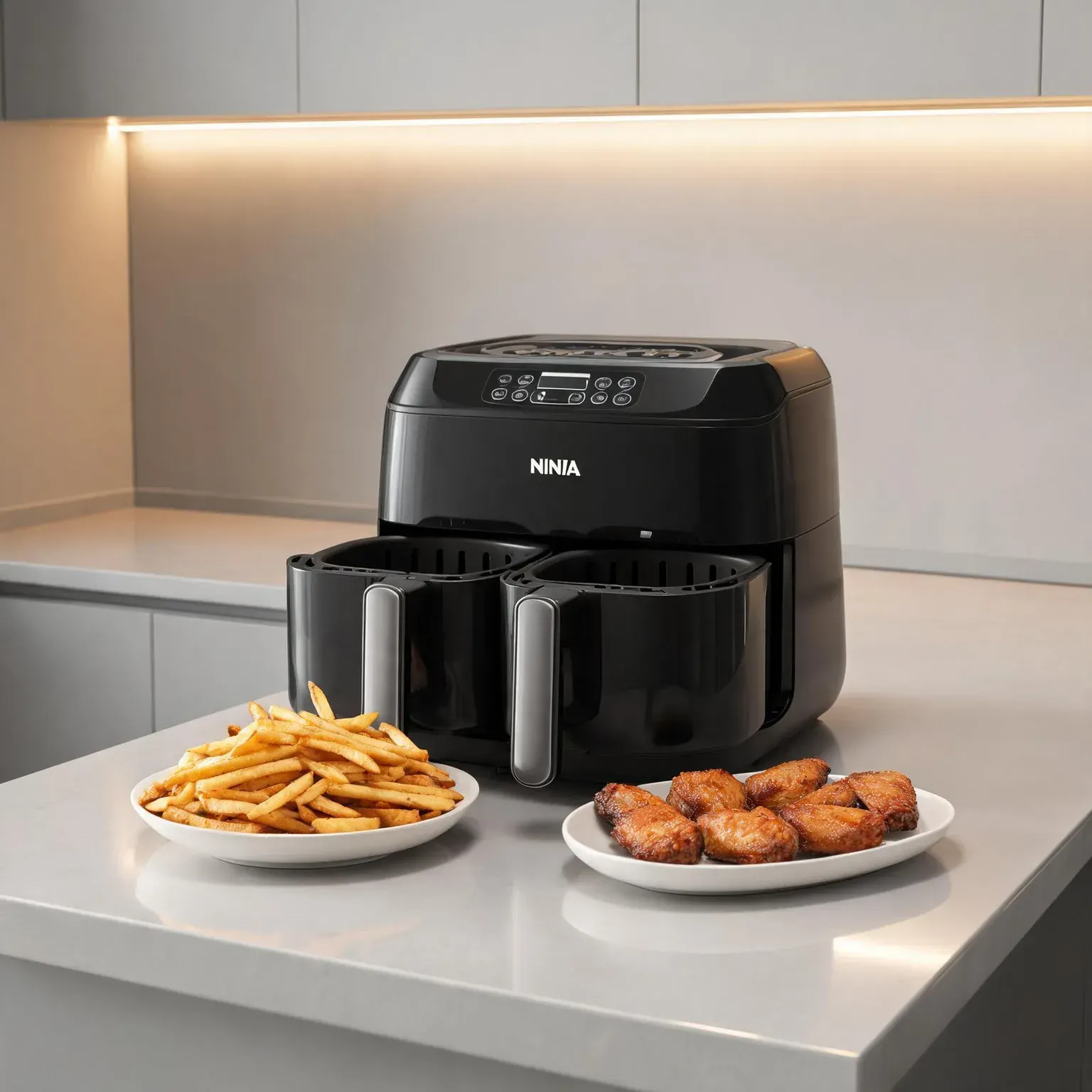
- 3. Ninja Foodi 10 Qt DualZone — best for families
- 4. Chefman 8 Qt TurboFry — best value large basket
- 5. Ninja Air Fryer Pro 5 Qt — best for one or two people
- 6. Emeril Lagasse 26QT French Door — best oven-style
- 7. Instant Pot Vortex Plus 6QT XL — best temperature control
- Where paying more stops buying crispier food
- Where our ranking differs from other reviewers
- The failure patterns that show up in owner reviews
- Spec-claim reality check: capacity, PFAS and 450°F
- How to choose an air fryer
- How we evaluated these air fryers
- Related guides from ShoppingPicker
- Frequently asked questions
- Our verdict: which air fryer should you buy?
The 7 best air fryers at a glance
Every model below was re-verified against its live Amazon listing on September 26, 2026: the brand is the first word of the listing title, the buy box is active, and the price and stock shown are what a buyer sees today. Read the rank and the price columns first. Best-seller rank inside Amazon’s own Air Fryers category is the closest thing to a popularity measure that is not self-reported, and the price spread here runs from $49.99 to $149.99 — which, as the price-tier section explains, is the whole useful range for a drawer-style air fryer.
| Product | Standout spec | Price | Track record | Deal |
|---|---|---|---|---|
 Cosori Cosori TurboBlaze Air Fryer, 9-in-1, 6 Qt, PFAS-Free Ceramic Coating |
Air Fryer Upgrade: Innovative TurboBlaze Technology delivers a powerful 3600 rpm fan speed and | $89.99 $119.99 |
#2 in Air Fryers |
25% OFF In Stock |
 Chefman Chefman Air Fryer – 4 QT Compact Airfryer for Quick & Easy Meals in Minutes, F |
FAST AND EASY: This compact air fryer handles any culinary challenge. Customize cooking time an | $49.99 $99.99 |
#1 in Air Fryers |
50% OFF Prime Exclusive In Stock |
 Ninja Ninja Foodi Air Fryer, 10 Qt DualZone, 6-in-1, Black, DZ302 |
2 INDEPENDENT BASKETS: The XL air fryer with 2 independent baskets that lets you cook 2 foods, | $149.99 $229.99 |
#6 in Air Fryers |
35% OFF Prime Exclusive In Stock |
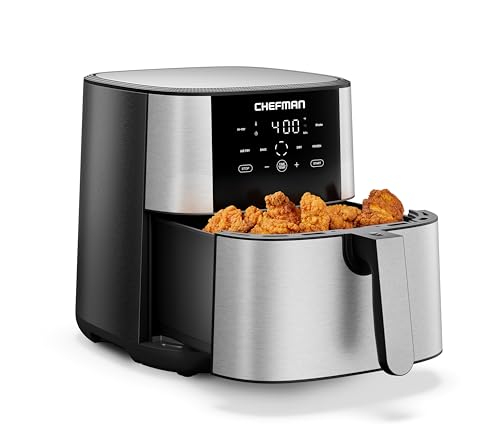 Chefman Chefman Air Fryer 8 Qt | TurboFry® 4-in-1 with 450°F Hi-Fry Option for Crispie |
FRY UP YOUR FAVORITES: Enjoy faster, healthier cooking for popular deep fryer foods like French | $69.99 $119.99 |
#3 in Air Fryers |
42% OFF Prime Exclusive In Stock |
 Ninja Ninja Air Fryer Pro, 5 Qt, 5-in-1, Grey, AF142 |
AIR CRISP TECHNOLOGY: 400°F superheated air surrounds food for hot, crispy results with little | $89.99 $139.99 |
#5 in Air Fryers |
36% OFF Prime Exclusive In Stock |
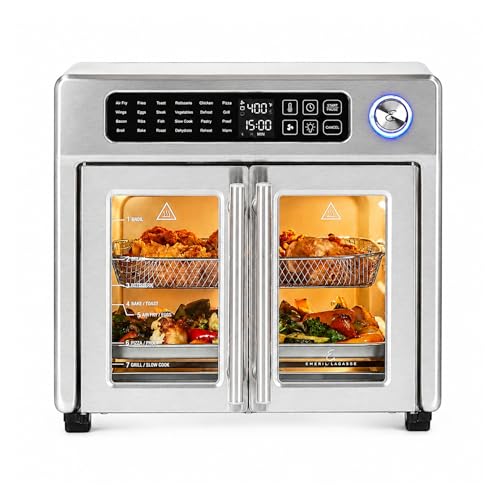 Emeril Emeril Lagasse 26QT French Door Multi-Function Air Fryer Toaster Oven |
A VERSATILE AIR FRYER AND MULTI-COOKER COMBO: Elevates practically any meal, from air frying qu | $149.99 $209.99 |
#4 in Air Fryers |
29% OFF Prime Exclusive In Stock |
 Instant Pot Instant Pot VORTEX Plus 6QT XL Air Fryer, 6-in-1 Air Fryer, Stainless Steel |
6 Cooking Functions: Air fry, bake, roast, broil, dehydrate, or reheat with little to no prehea | $149.95 |
#13 in Air Fryers |
In Stock |
1. Cosori TurboBlaze 6 Qt — best air fryer overall
It is the machine we would hand to a friend: high airflow, 450°F of headroom, a coating the independent testers rated for cleanup, and a price that has been sitting near $90 rather than near $150.
What We Like
- TurboBlaze’s 3,600 rpm fan and five-speed system is the highest circulation spec in this price band, and the listing quotes 90–450°F control — useful headroom for a last-two-minute crisp-up
- 9-in-1 preset set with top-mounted touchscreen and separate time and temperature controls; TechGearLab’s testers called the layout sleek and easy to clean
- Ceramic nonstick coating that TechGearLab rated “excellent” for easy cleanup in its own testing
- A 6-quart basket sized for two to four people that still fits a normal countertop
Flaws but not dealbreakers
- The listing title advertises a “PFAS-Free Ceramic Coating”, but TechGearLab’s comparison table records PTFE in the cooking surface on this exact model — a “PFAS-free” line on Amazon is a marketing phrase, not a regulated certification
- Six quarts is not a family basket: two 15-ounce bags of frozen fries need two passes (America’s Test Kitchen’s capacity method)
- No dual zone. If you routinely cook a main and a side together you need the 10-quart class further down this list
Best for: most people who want one basket that genuinely holds its set temperature and cleans up without a fight
Who should skip it: families of four or more who want a whole meal out of one cook cycle — buy for capacity instead
2. Chefman 4 Qt Compact — best budget air fryer
It is the best-selling air fryer in the category for a reason: $49.99, 450°F, a basket that is genuinely the right size for what most single people actually cook.
What We Like
- The current #1 Best Seller in Amazon’s own Air Fryers category, and at $49.99 (list $99.99) it is the cheapest way into a 450°F machine here
- Digital touchscreen with four one-touch presets and a Hi-Fry mode that pushes to 450°F for the final two minutes of a cook
- A 4-quart basket is the right size for one or two people and small enough to live in a cupboard
- Chefman’s parts and support are easy to source, and the same 4-quart body is sold through several listings — so buy the ASIN you actually compared
Flaws but not dealbreakers
- Four quarts will not feed a family in one batch; two servings is the realistic ceiling
- Single basket only, and no temperature probe or smart features at this price
- Chefman’s naming overlaps badly (multiple “TurboFry” 4-quart listings at different prices), so check the size and seller before checking out
Best for: a first air fryer, a dorm or small apartment, or a second machine for sides while the oven does the main
Who should skip it: anyone cooking for four or more, or anyone who wants a basket big enough for a whole chicken
3. Ninja Foodi 10 Qt DualZone — best air fryer for families
Dual-zone is the one feature that genuinely changes how you cook, and this is the cheapest way to get a real 10-quart version of it from a brand with parts and support.
What We Like
- Two independent 5-quart baskets with Smart Finish (cooks two ways but finishes both at the same time) and Match Cook (copies one zone’s settings to the other)
- 10 quarts total in a drawer-style body — the largest non-oven capacity in this guide, currently $149.99 against a $229.99 list
- Six functions: air fry, air broil, roast, bake, reheat and dehydrate
- TechGearLab’s meal-prep award goes to the Ninja dual-basket design, which it says is “huge” and can “cook two things without mixing”
Flaws but not dealbreakers
- $149.99 is roughly double the single-basket leaders — you are paying for the second zone, not for better crisping
- Two baskets means two sets of nonstick surfaces to wash, and the footprint is the biggest drawer-style body here
- TechGearLab measured inconsistent temperature control and “awkward temperature increments” on the Ninja line, so expect some trial and error
Best for: households of three or more that want the main and the side done at the same time without batch cooking
Who should skip it: a one-person kitchen, where the second basket is dead weight you still have to wash
4. Chefman 8 Qt TurboFry — best value large air fryer
It buys the two things that actually matter — capacity and 450°F — and skips everything that does not, for less than $70.
What We Like
- Eight quarts for $69.99 against a $119.99 list is the best capacity-per-dollar in this guide
- 4-in-1 with a Frozen function that defrosts and then crisps, which is exactly the frozen-fries use case most people buy an air fryer for
- 450°F maximum, touchscreen control and dishwasher-safe basket and crisper plate
- Sits alongside the 9-quart Chefman in the category’s top three, which is unusually strong buyer validation at this price
Flaws but not dealbreakers
- No dual zone, so a full 8-quart load in one basket needs a shake partway through to cook evenly
- Chefman’s “TurboFry” name spans several capacities and generations — confirm the quart figure on the listing you buy
- At 450°F the exterior runs hot; keep it clear of children and pets
Best for: couples and small families who want a big basket, a low price and nothing clever
Who should skip it: anyone who wants to cook two different foods at two temperatures at the same time
5. Ninja Air Fryer Pro 5 Qt — best air fryer for one or two people
It is the machine the independent testers call the easiest to live with, and 5 quarts is the honest size for one or two people.
What We Like
- Air Crisp at up to 400°F with five functions (air fry, air roast, bake, reheat, dehydrate), 1,750 W and a BPA-free build
- A 5-quart square basket that fits a proper single layer while staying compact enough for a small counter
- This is the Ninja line TechGearLab ranks best overall and calls the easiest to clean in its tests
- Simple enough that there is no learning curve; the controls are the same family as the Ninja air fryers that dominate the category
Flaws but not dealbreakers
- 400°F ceiling is below the 450°F on the Cosori and Chefman picks, so less headroom for a fast finish
- TechGearLab flagged “odd temperature-control limitations” and awkward increments that make precise dial-in harder
- No dual zone, and the price sits only $30 below a much bigger Chefman
Best for: one or two people in a small kitchen who want the least fussy machine on the list
Who should skip it: anyone chasing the crispest possible finish at the highest heat, or cooking for more than two
6. Emeril Lagasse 26QT French Door — best oven-style air fryer
If your real goal is “replace two appliances with one box”, this is the only pick here that does it for under $150.
What We Like
- 26 quarts behind French doors: air fry, rotisserie, dehydrate, bake, broil and toast in one countertop box
- Multi-rack cooking and automatic toast shut-off; indicator lights show when the countdown ends
- Fits a whole chicken or a small baking pan, which none of the drawer-style picks here can
- Currently $149.99 against a $209.99 list, which is cheaper than several single-basket drawer models
Flaws but not dealbreakers
- Oven-style boxes are the design America’s Test Kitchen found cooked unevenly across multiple racks
- 26 quarts is a permanent countertop commitment, and a heavy one
- More interior surfaces and racks to clean than one pull-out basket
Best for: a kitchen that wants to retire a toaster oven and an air fryer at the same time, and roast as well as fry
Who should skip it: anyone who wants a small, quick, wash-one-basket machine
7. Instant Pot Vortex Plus 6QT XL — best temperature control
Temperature accuracy is the quiet reason two air fryers at the same wattage produce different results, and this is the model the independent testers measured as the most accurate.
What We Like
- Adjustable 95–400°F with six functions and the EvenCrisp convection design
- TechGearLab measured the Vortex Plus as having “the best accuracy in the bunch” of the models it tested
- America’s Test Kitchen’s own top pick is the Instant Vortex Plus 6-Quart — the same drawer-style line, one foot tall, and it fits four chicken cutlets or two 15-ounce bags of frozen fries
- Broad preset support and a well-documented manual, which matters more than it sounds on an appliance you will use daily
Flaws but not dealbreakers
- TechGearLab notes it “isn’t the easiest one to use”, and its capacity is small relative to its footprint
- At $149.95 with no current discount it is the second most expensive pick here
- No dual zone
Best for: cooks who care about holding an exact temperature more than they care about basket size
Who should skip it: anyone who wants maximum capacity per dollar — the Chefman 8 Qt is nearly $80 cheaper with two more quarts
Where paying more stops buying crispier food
The air fryer market runs from about $40 to $400 according to Consumer Reports’ current ratings, and the $400 end is oven-style and Pro-brand territory. For a drawer-style machine, the useful range is much narrower than the listings suggest.
- Under $50. The Chefman 4 Qt Compact at $49.99 buys a 450°F element, a digital touchscreen and a two-serving basket. Nothing below this price point adds cooking capability — it only removes it.
- $60–$90: the sweet spot. The Chefman 8 Qt ($69.99), the Ninja Air Fryer Pro 5 Qt ($89.99) and the Cosori TurboBlaze 6 Qt ($89.99) all live here. This is the band where you get 450°F, 5–8 quarts, five-speed or high-rpm circulation and a ceramic coating, and the independent testers’ award winners are all in it.
- $90–$150: capacity and configurations. Dual-zone and oven-style bodies arrive: the Ninja Foodi 10 Qt DualZone and the Emeril Lagasse 26QT both sit at $149.99, and the Instant Pot Vortex Plus at $149.95. You are buying a second zone, a bigger cavity or measured temperature accuracy — not better crisping.
- Above $150: styling and extras. The older Ninja DZ401 10-quart DualZone XL and the Ninja Smart XL now list between about $200 and $250 for the same dual-zone idea the newer 10-quart DualZone does at $149.99, and the Ninja Crispi glass models ask $179–$379. Past roughly $150 the money stops buying cooking performance and starts buying brand badges, glass bodies, app control and a larger cavity on a machine you will still use for fries.
The stopping point is about $150. Below it, extra money reliably buys a bigger basket, higher airflow or a second zone. Above it, you are choosing a lifestyle appliance. The single exception on this page is the oven-style category, where $149.99 for 26 quarts is genuinely different equipment rather than a nicer version of the same thing.
Where our ranking differs from other reviewers
Two of the three review programmes we read publish a single “best overall”, and neither picks our winner. Here is exactly where we part company.
- America’s Test Kitchen’s top pick is the Instant Vortex Plus 6-Quart ($150); ours is the Cosori TurboBlaze 6 Qt. The Vortex is in this guide at #7 for a reason — TechGearLab measured it as “the best accuracy in the bunch” — but ATK’s case is capacity and preset simplicity, and the TurboBlaze is about $60 cheaper today with a higher published maximum temperature (450°F against the Vortex’s 400°F) and a coating TechGearLab rated as excellent for cleanup. If you weight temperature precision over everything, buy the Vortex. We think most people cook frozen food at 400°F and will notice the price difference more.
- TechGearLab’s best overall is the Ninja Air Fryer; we rank it #5. We agree with their most useful finding — that it is the easiest to clean of the machines they tested — and their award line about the Ninja being “big enough for most families”. We place it lower because the same review records “odd temperature-control limitations” and awkward increments, and because the 400°F ceiling leaves less headroom than the 450°F Cosori and Chefman models, which matters for a fast finish on chicken skin or a single thick cutlet.
- ATK also found the Ninja Air Fryer Max XL reached 450°F “quickly, if unevenly” and that its deep basket was “too narrow to fit four chicken cutlets in a single layer”. That is the counterweight to Ninja’s popularity in the category, and it is why we do not put a Ninja at the top of the list on brand strength alone.
- Where we agree with TechGearLab: they name the Cosori TurboBlaze their “favorite for families”. We keep the TurboBlaze at #1 overall but we would not call 6 quarts a family basket — for three or more people eating at once, the 10-quart dual-zone Ninja is the honest recommendation.
The failure patterns that show up in owner reviews
These are the recurring complaint patterns in the current owner reviews of the exact models above. We are not quoting a measured failure rate for any of them; these are the themes that repeat, in rough order of how often they come up.
- Nonstick degradation on the basket and crisper plate. The coating is the first thing to fail. Abrasive sponges and dishwasher cycles shorten its life, and once the surface is scratched, food sticks and the basket becomes genuinely hard to clean. TechGearLab’s coating table records PTFE on some of these surfaces and not others, so how you wash it matters.
- First-use smell. America’s Test Kitchen reported “industrial fumes from almost every model” that dissipated after a wash and a 15-to-20-minute empty run at the highest temperature, and advised contacting the manufacturer if a “harsher lingering smell” persists. Budget for that empty first run rather than being surprised by it.
- A hot exterior shell. Normal at 450°F, and the reason most manuals warn about clearance. TechGearLab lists a glass-bodied model with a “Super Hot Exterior” under a proceed-with-caution heading, so a plastic or glass shell is not automatically cooler than steel.
- Temperature drift and coarse increments. The most common functional complaint is that the dial or the touchscreen does not do what the display says. TechGearLab measured inconsistent temperature control on the Ninja line and called out “odd temperature-control limitations”.
- Evenness in a full basket. This is a physics problem, not a defect: packed baskets steam instead of crisping. America’s Test Kitchen found that stated capacities are not reliable indicators of how much food an air fryer can cook at once, and that most extra-large models “can still really cook only a pound of fries or two chicken cutlets”.
- Hard-to-clean racks and trays. ATK’s testers described racks “with sharp edges that trapped sticky foods, shredded our sponges, and ensnared the bristles of our scrub brushes”. A flat crisper plate you can soak beats a fiddly mesh insert.
Spec-claim reality check: capacity, PFAS and 450°F
Three claims drive most air fryer purchases. All three are worth checking against a source that is not the listing.
1. “8 quarts” is a class label, not a serving count
Consumer Reports states plainly that “in our labs, we measure the actual usable capacity of the air fryers we test, and we often find that the space is smaller than the manufacturer’s claimed capacity”. America’s Test Kitchen reaches the same conclusion from the other direction: external dimensions and stated capacities “are not reliable indications of how much food they can cook at once”. Treat the quart figure as a way to compare two machines, never as a promise about how many people you can feed in one pass.
2. “PFAS-free” is a marketing phrase, not a certification
Several listings here headline a PFAS-free ceramic coating. The ATSDR, the federal agency that assesses exposure to these chemicals, describes PFAS as “man-made chemicals used in industry and consumer products worldwide since the 1940s”, lists “grease-, water-, and oil-resistant products” among their uses, and notes that PFAS “can be present at low levels in a variety of food products” and “can build up in the body with each exposure over time”. TechGearLab’s own comparison table records PTFE — a member of the same fluoropolymer family — in the cooking surface coating on some of these models and not on others. We are not chemists and we do not adjudicate that gap. The practical point is that no US regulator issues a “PFAS-free” consumer badge, so it should not be the reason you pick one air fryer over another. If the coating chemistry is what you care about, buy the model TechGearLab’s table lists as PTFE-free, and replace any basket whose coating is visibly scratched.
3. 450°F is a capability, not a cooking temperature
Most listings on this page headline a 450°F maximum. The USDA’s Food Safety and Inspection Service, in its own page on air fryers and food safety, describes typical air-fryer cooking as 5 to 25 minutes at a temperature range of 350°F to 400°F, and the agency’s standing guidance is to use a food thermometer and cook to the safe minimum internal temperature rather than to a timer. A 450°F setting is useful for the final two minutes of a cook — which is exactly how Chefman’s Hi-Fry mode describes it. It is not the temperature you should run a whole cook at, and a machine with a 400°F ceiling is not unsafe, just less flexible at the top end.
How to choose an air fryer
Basket/drawer style vs oven style
Drawer air fryers — six of the seven picks here — heat faster, wash up in one piece and take less counter depth. Oven-style boxes hold more, can roast and toast, and are the only sensible choice if you want to retire a toaster oven. America’s Test Kitchen found that oven-style models cooked unevenly across multiple racks, so if you mostly want fries and nuggets, stay with a drawer.
Capacity: how many quarts do you actually need
Two people: 4–5 quarts. Three to four: 6–8 quarts. More than four, or main-plus-side in one pass: 10 quarts with two baskets. And remember the measurement caveat above — a stated 8 quarts cooks less than 8 quarts of food.
Maximum temperature and how it is controlled
450°F is the current top of the consumer range and it is what most recipes assume. Below that, the differentiator is control precision: separate time and temperature dials beat a single combined control, and physical dials usually step in 5–10°F increments while touchscreens can be coarser. TechGearLab’s accuracy measurements are the most useful public data here, and they are why the Instant Pot Vortex Plus sits in this guide at all.
Dual zone or one basket
Dual zone is the only feature in this category that changes what you can cook. It adds a second nonstick surface to clean and a wider footprint, and it costs roughly $60 over an equivalent single basket. Buy it if you routinely want two foods at two temperatures; skip it if you do not.
Warranty — read it before the preset list
Consumer Reports notes that the shortest warranty among the air fryers it tested was 60 days, while others run one or two years and some reach three. On an appliance whose coating is the first wear item, the warranty term tells you more about the expected service life than the preset count does.
How we evaluated these air fryers
We are not a test lab and we did not run our own controlled cooking tests for this guide. What we did: re-verified all seven Amazon listings on September 26, 2026 (brand as the first word of the title, live buy-box price, stock status and best-seller rank inside Amazon’s Air Fryers category), built the comparison table from that live data rather than copying it, read the published testing and award decisions of America’s Test Kitchen, TechGearLab and Consumer Reports, and checked the two claims buyers cannot verify from a listing — capacity and coating chemistry — against the ATSDR and USDA FSIS. Where a reviewer measured something, we say so and name them; where a claim is a manufacturer’s, we say that too.
Our full process, including the section on what we do not claim, is set out in how we test and choose products. If you spot an error in this guide, the corrections route is on that page.
Prices and availability are a snapshot taken on September 26, 2026 and move constantly; the price shown on each card is the price we saw on that date. Source list, in full: The Best Air Fryers of 2026 (America’s Test Kitchen, Chase Brightwell, Sarah Sandler and Valerie Sizhe Li, updated January 15, 2026); The Best Air Fryers of 2026 (TechGearLab, Lesley Robinson, updated April 17, 2026); How to Pick the Perfect Air Fryer (Consumer Reports, lab testing by Breann Chai and Nicole Powell, updated September 25, 2026 — paywalled beyond the introduction); PFAS and Your Health: About PFAS (Agency for Toxic Substances and Disease Registry, July 22, 2025); Air Fryers and Food Safety (USDA Food Safety and Inspection Service, June 24, 2024).
Related guides from ShoppingPicker
- Best Immersion Blenders of 2026: top hand blenders for soups, smoothies and sauces
- Best Kitchen Knife Sets of 2026: professional chef knives for every budget
- Best Gooseneck Electric Kettles of 2026: temperature control for perfect pour-over coffee and tea
Frequently asked questions
Is air-fried food actually healthier than deep-fried food?
Yes, as a cooking method — it uses a fraction of the oil, because the food is not submerged. Air frying is oil-minimised cooking, not oil-free cooking: a light spray or brush of oil on the basket and the food is what stops sticking and helps browning. It is not a health machine, though: air-fried processed food is still processed food.
Do I need to preheat an air fryer?
Most manufacturers say no, and most of the machines here reach temperature quickly. America’s Test Kitchen found that many air fryers do not require preheating and that its favourites took only about two minutes to reach 400°F when they did. For frozen food and proteins, two minutes of preheat measurably improves the exterior. For anything delicate, skip it.
How do I stop food sticking to the basket?
Oil the basket and the food, preheat before adding food, do not overcrowd, and leave proteins undisturbed for the first few minutes so a crust forms before you flip. Once a coating is scratched, no technique fully saves it — that is the point at which a $8 perforated parchment liner earns its money.
Can I cook frozen food straight from the freezer?
Yes, and it is the single best use of an air fryer. Drop the temperature 10–20°F below the conventional-oven instruction, add two to three minutes, and shake the basket once. The Chefman TurboFry picks here even have a dedicated Frozen function that defrosts and then crisps.
How should I clean it, and how often?
Wash the basket and crisper plate in warm soapy water with a non-abrasive sponge after every use — they are dishwasher-safe, but hand-washing is what keeps the coating alive. Every 5 to 10 uses, unplug the unit and wipe the heating element and interior ceiling, which is where oil splatter turns into the smoke you will otherwise notice on the next cook.
What does the extra money past $90 actually buy?
A second cooking zone, a bigger cavity, or measured temperature accuracy — in that order of practical value. It does not buy noticeably crispier food. Above about $150 you are paying for styling, glass, app control and a brand badge rather than for cooking performance.
Can an air fryer replace my oven, microwave and toaster?
Partially. A large air fryer replaces a toaster oven for small batches and replaces a conventional oven for most weeknight roasting, usually faster. It cannot cook large volumes or liquid-heavy dishes, it is poor at plain toast, and it is slower than a microwave for reheating wet food. The honest answer is that it replaces the oven most nights, the microwave sometimes, and the toaster never.
Our verdict: which air fryer should you buy?
- Most people: the Cosori TurboBlaze 6 Qt at $89.99. Highest airflow in the band, 450°F, a coating the independent testers rate for cleanup, and the best all-round balance of price and performance on this page.
- On a tight budget, or cooking for one or two: the Chefman 4 Qt Compact at $49.99 — the current #1 Best Seller in Amazon’s Air Fryers category, and the cheapest 450°F machine here.
- Feeding a family: the Ninja Foodi 10 Qt DualZone at $149.99. Two independent baskets and 10 quarts is the only configuration that changes how you cook.
- Maximum basket per dollar: the Chefman 8 Qt TurboFry at $69.99.
- Replacing a toaster oven as well: the Emeril Lagasse 26QT French Door at $149.99.
- If temperature accuracy is what you care about: the Instant Pot Vortex Plus 6QT XL at $149.95 — the model TechGearLab measured as the most accurate of the group.
Whoever you buy from, buy on the ASIN in the card above. Chefman in particular sells several 4-quart and 8-quart bodies under near-identical names at different prices, and the cheapest listing is not always the same machine.