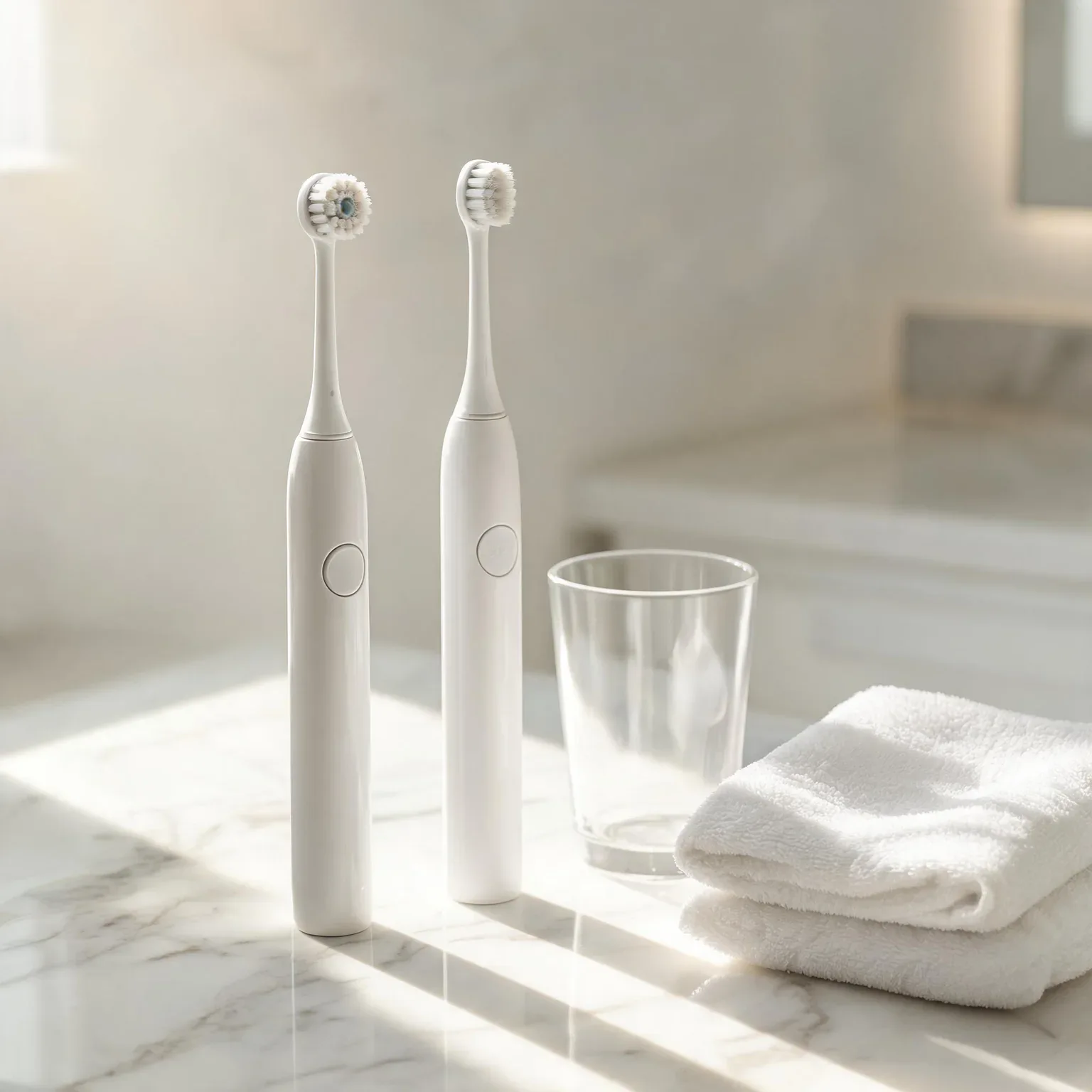
If you want the short answer to the best electric toothbrushes question, it is the Philips Sonicare 5950: a sonic handle with a pressure sensor, six settings, a 21-day battery and a travel case for $64.96, about half its list price. The longer answer is that most of what separates these seven brushes is not cleaning power. Every pick below removes plaque, and the pooled trial evidence says the average advantage of any powered brush over a manual one is modest. What actually changes between $19.96 and $169.99 is whether the handle tells you when you are pressing too hard, how long it runs on a charge, and how much the brush heads cost you every three months.
As an Amazon Associate I earn from qualifying purchases. We earn commission from qualifying purchases made through links on this page. This never affects our rankings or what we recommend.
What this guide covers
- The seven picks compared at a glance
- 1. Philips Sonicare 5950 – Best Overall
- 2. Oral-B iO Series 9 Genius – Best Premium Smart Brush
- 3. Oral-B iO5 Customizable Clean – Best Mid-Range Smart Brush
- 4. Philips Sonicare 4100 – Best Value Sonic Brush
- 5. Oral-B Pro 1000 – Best Classic Rotating Brush
- 6. Aquasonic Black Series – Best Value Bundle
- 7. Philips Sonicare 1100 – Best Ultra-Budget Brush
- What the listings actually claim: a spec-truth table
- What you get as you pay more
- Where our ranking disagrees with the testers
- The failure patterns owners report
- Spec claims checked against the guidance
- How to choose an electric toothbrush in 2026
- Frequently asked questions
- Our verdict
- How we research and verify this guide
- Related guides
The seven picks compared at a glance
| Product | Standout spec | Price | Track record | Deal |
|---|---|---|---|---|
 Philips Sonicare Philips Sonicare 5950 Rechargeable Electric Toothbrush, 2 Brush Head, Black |
Deep Clean Technology: Equipped with Sonicare Fluid Action, this Philips Sonicare 5950 Series E | $64.96 $109.99 |
#1 in Sonic |
41% OFF Prime Exclusive In Stock |
 Oral-B Oral-B Rechargeable Electric Toothbrush, iO Series 9 Genius, Black, 4 Replacem |
#1 Dentist recommended Oral B io: This Oral-B Braun electric toothbrush removes up to 100 %* mo | $169.99 $329.99 |
— | 48% OFF Only 7 left in stock – order soon. |
 Oral-B Oral-B Rechargeable Electric Toothbrush, iO5 Customizable Clean, 5 Cleaning Mo |
HEALTHIER GUMS: For healthier gums in just 1 week, remove 100% more plaque and even 2.5X in bet | $99.99 $119.99 |
— | 17% OFF In Stock |
 Philips Sonicare Philips Sonicare 4100 Rechargeable Electric Toothbrush, 1 Brush Head, White |
The C2 Optimal Plaque brush head with soft, flexible, stain-removal bristles helps whiten and p | $48.50 |
#2 in Sonic |
In Stock |
 Oral-B Oral-B Pro 1000 Rechargeable Electric Toothbrush, Pink |
REMOVE UP TO 100% MORE PLAQUE* along the gumline whilst PROTECTING GUMS with our dentist-inspir | $49.94 |
#1 in Rotating |
In Stock |
 Aquasonic Aquasonic Black Series Ultra Whitening Toothbrush – ADA Accepted Electric Toot |
40,000 VPM Smart Toothbrush – Beauty, brains and power. The Black Series is a world class moder | $39.95 $49.95 |
#1 in Ultrasonic |
20% OFF In Stock |
 Philips Sonicare PHILIPS Sonicare 1100 Rechargeable Electric Toothbrush, 1 Brush Head, White |
The C1 Simply Clean brush head with soft, flexible bristles removes more plaque than a manual t | $19.96 |
#5 in Sonic |
In Stock |
All seven cards in this guide were rebuilt from live Amazon listing data on September 27, 2026: price, list price, discount, stock message, best-seller rank and the listing’s own feature list. Where a listing publishes no figure for something – pressure sensor, water resistance, heads in the box – we say so rather than fill the gap.
1. Philips Sonicare 5950 — Best Overall
Best Overall. The 5950 is the pick that covers the most ground for the least money. It is a sonic brush with a pressure sensor that pulses in your hand when you press too hard, six settings built from two modes (Clean and Gum Health) plus three intensity levels, a 21-day battery claim that is the longest on this page, two C3 two-in-one heads and a travel case in the box. Its live listing ranks it #1 in Sonic Toothbrushes with a 4.6 rating across about 1,493 reviews, and when we checked it was $64.96 against a $109.99 list price.
What We Like
- Six settings from two modes plus three intensity levels, with a pressure sensor that pulses when you press too hard
- Up to 21 days of brushing on one charge – the longest published battery claim on this page
- Two C3 two-in-one brush heads and a travel case in the box, so you are not buying heads in week one
- The live listing shows it at #1 in Sonic Toothbrushes, with a 4.6 rating across about 1,493 reviews
Flaws but not dealbreakers
- The C3 heads are the expensive part: budget roughly $10-15 per head every three months
- Its plaque claim is footnoted against a manual brush, not against rival electric brushes
- Charging stand only – there is no charging travel case at this price
Who should not buy it. Skip it if you have already decided you want tooth-by-tooth coaching: the 5950 tells you when you press too hard, not which teeth you missed.
2. Oral-B iO Series 9 Genius — Best Premium Smart Brush
Best Premium Smart Brush. The iO Series 9 is the most capable handle here and the only one that maps your brushing. AI position detection tracks where you brush across all three tooth surfaces, the visible pressure sensor lights red when you push too hard, and the colour display runs seven cleaning modes. It ships with four brush heads and a charging travel case, and the listing carries a 30-day money-back guarantee. At $169.99 against a $329.99 list price it is still the most expensive pick on this page, and stock was down to six units when we checked.
What We Like
- AI position detection tracks where you brush across all three tooth surfaces
- Visible pressure sensor plus seven cleaning modes on a colour display
- Four brush heads and a charging travel case are included, which offsets part of the price
- The listing carries a 30-day money-back guarantee
Flaws but not dealbreakers
- By far the most expensive pick here, and the 48% discount is the only reason it lands under $170
- Amazon’s own review summary says some owners find it expensive and report failures around the six-month mark
- The app is a headline feature and the same summary says owners split on how usable it is
Who should not buy it. Skip it if you will not use the app – the position coaching is most of what you are paying for over the $89.99 iO5, and the pressure sensor is not.
3. Oral-B iO5 Customizable Clean — Best Mid-Range Smart Brush
Best Mid-Range Smart Brush. The iO5 is the sensible halfway house if you want the iO pressure system without the flagship price. Five cleaning modes, the same visible pressure sensor that signals too hard, too soft or just right, the Oral-B app for real-time tracking, a light-ring two-minute timer and a travel case. It was $89.99 against a $119.99 list price when we checked, roughly $80 below the iO Series 9. What you give up is the AI position map.
What We Like
- Five cleaning modes with the same iO pressure sensor that signals too hard, too soft or just right
- About $80 cheaper than the iO Series 9 while keeping the round iO head and the app
- Travel case included, and a light-ring timer that shows when you have done your two minutes
Flaws but not dealbreakers
- No AI position detection – you get the pressure sensor and the app, not the tooth-by-tooth map
- Amazon’s review summary reports the same battery and durability split as the rest of the iO line
- Brush heads are the most expensive per head of any pick on this page
Who should not buy it. Skip it if you want the simplest possible brush: the iO5 asks you to pair an app to get its best features, and the $49.94 Oral-B Pro 1000 cleans without any of that.
4. Philips Sonicare 4100 — Best Value Sonic Brush
Best Value Sonic Brush. The 4100 is the cheapest way to get a pressure sensor from one of the two big brands. It is a two-setting sonic handle – Clean and Sensitive – with the SmarTimer and QuadPacer coaching that also appear on the pricier Sonicares, a brush-head replacement reminder, and a 14-day battery claim. At $48.50 it undercuts every other brush with a pressure sensor here, and its listing ranks it #2 in Sonic Toothbrushes with about 21,000 ratings at 4.2 stars.
What We Like
- $48.50 for a genuine Sonicare with a pressure sensor – the cheapest way to get that feature from either big brand
- Fourteen-day battery claim plus a brush-head replacement reminder
- Ranked #2 in Sonic Toothbrushes on its live listing, with about 21,000 ratings at 4.2 stars
Flaws but not dealbreakers
- Two settings only – Clean and Sensitive – and just one brush head in the box
- Ships with a USB cable and no wall adaptor, which is the single most repeated complaint in its review summary
- Amazon’s own summary reports charging failures starting as early as a month for a minority of owners
Who should not buy it. Skip it if you want multiple modes or a travel case: this is a deliberately plain handle, and the 5950 adds both for about $16 more when it is discounted.
5. Oral-B Pro 1000 — Best Classic Rotating Brush
Best Classic Rotating Brush. The Pro 1000 is the brush the evidence fits best. Cochrane’s review found the strongest body of trial evidence for rotation-oscillation brushes, which is the round-head design this uses, and its gum pressure control goes a step further than a warning: it stops the pulsations when you press too hard. Three modes, a quadrant timer and an LED charge indicator, at $49.94, with about 105,894 ratings at 4.5 stars – the most reviewed brush on this page.
What We Like
- The strongest published evidence base in the category belongs to rotation-oscillation brushes, which is what this is
- Gum pressure control stops the pulsations rather than simply warning you
- About 105,894 ratings at 4.5 stars make it the most reviewed brush on this page
Flaws but not dealbreakers
- Three modes and no Bluetooth, no app and no travel case
- The on/off button sits flush enough that some owners say they struggle to find it
- This listing is the pink colourway – the white and black versions sell from separate listings that were unavailable when we checked
Who should not buy it. Skip it if you want a battery read-out or app feedback – this is a mechanical-feeling brush with three modes and an LED light.
6. Aquasonic Black Series — Best Value Bundle
Best Value Bundle. The Black Series is the value play on consumables. Eight DuPont brush heads and a hard travel case come in the box – at the three-month replacement cadence the dental guidance recommends, that is about two and a half years of heads before you buy anything else. It is an IPX7 waterproof sonic handle with a 40,000 vibrations-per-minute motor, four modes and a wireless charging base, at $39.95 against a $49.95 list price. The listing also states that it carries American Dental Association acceptance, and it ranks #1 in Ultrasonic Toothbrushes with about 138,416 ratings at 4.5 stars.
What We Like
- Eight DuPont heads and a hard travel case in the box – about two and a half years of heads at the three-month cadence
- The listing states that it carries ADA acceptance, and it is the cheapest way to get a brush with that claim
- IPX7 waterproof with a 40,000 vibrations-per-minute motor and a wireless charging base for $39.95
- Ranked #1 in Ultrasonic Toothbrushes on its listing, with about 138,416 ratings at 4.5 stars
Flaws but not dealbreakers
- 40,000 vibrations per minute is roughly a third above the 24,000-30,000 range the Oral Health Foundation describes for sonic brushes, and nothing shows the extra speed cleans better
- Owners split on durability – its review summary notes some units stopped working after about six months
- No pressure sensor, so nothing stops you scrubbing too hard
Who should not buy it. Skip it if you need a pressure sensor: this brush has modes, speed and heads, but it will not tell you when you are pressing too hard.
7. Philips Sonicare 1100 — Best Ultra-Budget Brush
Best Ultra-Budget Brush. The 1100 is the entry point. At $19.96 it is the cheapest genuine Sonicare we could verify, with the same SmarTimer and QuadPacer coaching as its more expensive siblings and a 14-day battery claim. What you do not get is the feature the dental guidance actually singles out: the listing never claims a pressure sensor, so there is nothing to stop you scrubbing. It is a light handle for a travel bag or a second bathroom, and its listing ranks #5 in Sonic Toothbrushes with about 9,713 ratings at 4.4 stars.
What We Like
- $19.96 is the cheapest genuine Sonicare we could verify, and the cheapest way into a rechargeable brush
- Fourteen-day battery claim with the same SmarTimer and QuadPacer coaching as the pricier Sonicares
- Light handle that suits a travel bag or a second bathroom
Flaws but not dealbreakers
- No pressure sensor is claimed anywhere on the listing – the one feature the dental guidance says protects your gums
- Owners report the head feels small and that the vibration intensity divides people
- One brush head in the box and no travel case
Who should not buy it. Skip it if your dentist has already told you that you brush too hard: without a pressure sensor this brush will not train that habit out of you.
What the listings actually claim: a spec-truth table
| Brush | Live price | Type | Modes / settings | Pressure sensor | Battery claim | Heads in the box | Case |
|---|---|---|---|---|---|---|---|
| Philips Sonicare 5950 Rechargeable Electric Toothbrush, 2 Brush Head, | $64.96 | Sonic | 2 modes + 3 intensities | Yes – handle pulses | Up to 21 days | 2 C3 heads | Travel case included |
| Oral-B Rechargeable Electric Toothbrush, iO Series 9 Genius, Black, 4 | $169.99 | Rotating-oscillating (round iO head) | 7 modes | Yes – visible red light | Not stated on the listing | 4 heads | Charging travel case included |
| Oral-B Rechargeable Electric Toothbrush, iO5 Customizable Clean, 5 Cle | $99.99 | Rotating-oscillating (round iO head) | 5 modes | Yes – visible light ring | Not stated on the listing | 1 head | Travel case included |
| Philips Sonicare 4100 Rechargeable Electric Toothbrush, 1 Brush Head, | $48.50 | Sonic | 2 settings (Clean, Sensitive) | Yes – handle pulses | Up to 14 days | 1 C2 head | No – USB cable only, no wall adaptor |
| Oral-B Pro 1000 Rechargeable Electric Toothbrush, Pink | $49.94 | Rotating-oscillating (round head) | 3 modes | Yes – pulsations stop | Not stated on the listing | 1 head | No travel case |
| Aquasonic Black Series Ultra Whitening Toothbrush – ADA Accepted Elect | $39.95 | Sonic (listing says ultrasonic) | 4 modes | No pressure sensor claimed | About 4 weeks | 8 DuPont heads | Hard travel case included |
| PHILIPS Sonicare 1100 Rechargeable Electric Toothbrush, 1 Brush Head, | $19.96 | Sonic | 1 mode (EasyStart) | No pressure sensor claimed | Up to 14 days | 1 C1 head | No travel case |
Two things stand out once the marketing is stripped out. First, three of the seven listings never publish a battery figure at all, and the ones that do range from 14 days to about four weeks – a reminder that these numbers are claims, not measurements we took. Second, the pressure sensor is not a premium feature any more: it is present on four of the seven, including the $48.50 Sonicare 4100, and absent from the cheapest two. If you only buy one feature, buy that one.
What you get as you pay more
Moving up the price ladder here buys three different things, and only one of them is cleaning performance.
- Under $25: the Sonicare 1100 gets you a real sonic motor, a two-minute timer and a 14-day battery. What it does not get you is a pressure sensor or a second brush head.
- $40 to $50: this is the value band and the most interesting part of the page. The Oral-B Pro 1000 ($49.94) sits on the mechanism with the strongest trial evidence – rotation-oscillation – and adds gum pressure control. The Sonicare 4100 ($48.50) is the cheapest pressure-sensor brush from a major brand. The Aquasonic ($39.95) buys you eight heads and a case instead of a sensor.
- About $65: the stopping point for performance per dollar. The Sonicare 5950 adds a pressure sensor, six settings, a 21-day battery, two heads and a travel case over the 4100 – and at $64.96 against a $109.99 list it costs the same as the 4100 did before its own discount disappeared.
- $90 and up: you leave performance and buy coaching. The iO5 ($89.99) and the iO Series 9 ($169.99) are reminders that the extra money goes on the app, the position map and the charging case. The Series 9 is genuinely the most capable handle here, but the roughly $105 gap from the 5950 is not a gap any trial we can cite says you will feel in your mouth.
Then there is the cost nobody puts on the price tag: heads. The Oral Health Foundation recommends changing the head every three months, and Oral-B prints the same three-month cadence on its own iO listing. At roughly $10 to $15 a head, a single brush costs you $40 to $60 a year in consumables – which means the $39.95 Aquasonic with eight heads in the box can work out cheaper over two and a half years than a $48.50 Sonicare with one head, even though it has no pressure sensor. That trade-off, sensor versus heads, is the real decision on this page.
Where our ranking disagrees with the testers
Being straight about this: two independent outfits test this category harder than we can, and neither of them puts our #1 first.
- T3 spent weeks trialling brushes and crowns the SURI 2.0 as its best overall, with the Oral-B iO2 as its best affordable pick and the Sonicare 9900 Prestige as its premium choice. Two of those three are absent from this page on purpose: the SURI is a subscription-first brush that is not sold on Amazon at list price, and the 9900 Prestige costs roughly three times our top pick. If money is no object and you want the premium flagship the testers keep naming, that is the class to shop in – we are not going to pretend the $64.96 Sonicare 5950 out-cleans a brush that costs triple.
- Which? is the outfit that actually buys its brushes at retail and lab-tests plaque removal and battery life, reporting 17 brushes tested plus a panel of trialists rating comfort and noise. Its scores sit behind a member paywall, so we cannot check – and will not guess – whether its Best Buy matches ours. What we can say is that the iO Series 9 appears in its tested table, and our own take on that brush is the same one we would give a friend: excellent hardware, the hardest price on the page.
- Our own disagreement with the evidence. Cochrane found the strongest body of trial evidence for rotation-oscillation brushes, and our #1 pick is a sonic brush. We are flagging that rather than hiding it. Our reasoning is that the measured differences between brush types are small – an 11% plaque difference against a manual brush at one to three months, of unclear clinical importance – while the price and consumables differences between these seven are large and certain. If you want the pick that best matches the evidence base, it is the $49.94 Oral-B Pro 1000 at #5, and we say so on the card.
The failure patterns owners report
These are the recurring themes in the review summaries Amazon publishes on each listing – quoted as summaries, not as measured failure rates. We have not run a longevity test, and no manufacturer publishes one. What the summaries do show is a pattern that repeats across brands and price points: the motor rarely fails first, the battery does.
- Batteries that stop holding a charge are the most common complaint on every one of the seven listings, from the $19.96 Sonicare 1100 to the $169.99 iO Series 9.
- Both Oral-B iO listings carry the same line in their summaries: a minority of owners report the handle stopping working at around the six-month mark. That theme appears at both the $89.99 and the $169.99 price points.
- The Sonicare 4100’s summary reports charging faults starting as early as one month for some owners – and separately, that a lot of buyers were surprised to receive a USB cable instead of a wall adaptor. Budget for an adaptor.
- The Aquasonic’s 138,416 ratings include a durability split: some units run for years, others were reported dead at about six months. Its 40,000 VPM motor is also the loudest thing on this page.
- The cheapest Sonicare draws two opposite complaints: the head feels too small, and the vibration is too intense. Neither is a defect, but both are worth knowing before you buy a brush you cannot try first.
- Physical wear shows up as brush-head cost rather than handle failure. Because heads are proprietary per brand – Sonicare heads do not fit Oral-B handles and vice versa – the brand you buy locks in the price you pay for consumables.
- Charging habits matter more than owners expect. The Oral Health Foundation advises against leaving a brush permanently on its charger, which is worth remembering given how many summaries describe batteries dying early.
Spec claims checked against the guidance
Every listing on this page makes a big percentage claim. Here is what the published evidence and the guidance actually support.
- "1000% more plaque removal" and "700% more plaque removal" (Sonicare 5950 and 4100). Both figures carry a footnote on the listing, and both footnotes compare the brush with a manual toothbrush. That is the same comparison Cochrane studied – and Cochrane measured an 11% reduction in plaque at one to three months, and 21% at three months or more, across 56 trials and 5,068 participants. A tenfold claim and an 11-21% pooled result are describing different things: one is a best-case bench comparison, the other is what happens when real people brush unsupervised.
- "40,000 VPM" (Aquasonic) and the vibration arms race. The Oral Health Foundation’s electric toothbrush guide describes sonic brushes at roughly 24,000 to 30,000 brush movements per minute, and oscillating-rotating brushes at 1,300 to 8,800. Nothing we can find connects a higher number to cleaner teeth, and Cochrane’s best-supported mechanism was rotation-oscillation – the slower design. Movement counts sell brushes; they do not appear in the outcome data.
- 5 to 7 cleaning modes. The same guide is blunt: a basic daily clean mode is enough for most people, and the extra modes are optional. We still list the modes because they are real features, but the one setting we do weight is the pressure sensor, because the guidance says brushing too hard can damage teeth and gums.
- The three-month head cadence. This one checks out across both sides of the fence: the Oral Health Foundation says to change the head every three months or sooner if the bristles splay, and Oral-B’s own iO listing footnote says to replace the head every three months. When a manufacturer and a professional body agree, it is usually because the claim is real.
- What no brush here fixes. NIDCR’s tooth decay page is a good reality check on the whole category: it advises brushing twice a day with a fluoride toothpaste and regularly cleaning between teeth with floss or another interdental cleaner. No handle on this page gets between your teeth. If you are choosing between a $170 brush and a $65 brush plus a water flosser, the guidance points at the second basket.
How to choose an electric toothbrush in 2026
Sonic or oscillating-rotating?
The Oral Health Foundation splits the market in two: oscillating-rotating brushes with a small round head that spins back and forth at roughly 1,300 to 8,800 movements per minute, and sonic brushes that vibrate at roughly 24,000 to 30,000. Its conclusion is that both types clean teeth well when used properly – and Cochrane’s 12-year review of 56 trials found the strongest evidence for the rotating design, with the caveat that the clinical importance of the differences is unclear. In practice: the round-head brushes (Oral-B here) have the better paper trail; the sonic brushes (Sonicare and the Aquasonic) tend to have longer battery claims and a gentler feel on the gums.
Buy the sensor before you buy the features behind a paywall
Our ranking weights three things, in this order: a pressure sensor, a battery claim you believe, and the cost of heads. Everything else – modes, apps, displays, AI coaching – is a preference. That is why a $48.50 Sonicare outranks a $39.95 brush with eight heads, and why the $89.99 iO5 sits below the $64.96 5950 on this page.
Do the head math
Heads are proprietary and they are the subscription of the category. Two heads a year at roughly $10-$15 each is $20-$30 a year; the Aquasonic’s eight-head box pushes that cost two and a half years into the future. If you are on a strict budget and buy one thing today, buy the handle whose replacement heads you can actually afford to keep buying.
Travel, batteries and the small stuff
Two to three weeks per charge is normal, per the guidance, and doing better is a genuine convenience rather than a health benefit. A travel case matters mainly if you fly. And on the two Sonicares here the box contains a USB cable but no wall adaptor, which is a $5 problem that a surprising number of buyers discover after unboxing.
Frequently asked questions
Are electric toothbrushes actually better than manual ones?
Slightly, on average, and not as much as the marketing implies. The Cochrane Oral Health review pooled 56 studies and 5,068 participants and found an 11% reduction in plaque at one to three months and a 21% reduction at three months or more with a powered brush, with smaller reductions in gingivitis – while noting that the clinical importance of those differences remains unclear. The Oral Health Foundation puts it plainly: teeth can be cleaned well with either type, and technique and brushing twice a day matter most.
How often do I need to replace the brush head?
Every three months, or sooner once the bristles splay. That figure comes from the Oral Health Foundation’s electric toothbrush guide and it matches what Oral-B writes on its own iO listing, which is a useful cross-check: the brush and the guidance agree on the cadence, and that cadence is what makes heads – not the handle – the real cost of ownership.
Do more brush movements per minute clean better?
Nothing in the guidance or the trials connects a higher movement count to cleaner teeth. The Oral Health Foundation describes oscillating-rotating brushes at 1,300 to 8,800 brush movements per minute and sonic brushes at roughly 24,000 to 30,000, and Cochrane’s better-supported mechanism was rotation-oscillation, not raw speed. That is why we rank brushes on sensor, battery and head cost rather than on vibration numbers.
Are smart features and apps worth paying for?
The Oral Health Foundation calls Bluetooth and app features nice to have but not essential, and the strongest evidence in the Cochrane review is about plaque and gingivitis reduction – not about coaching. We still include app brushes because position tracking genuinely helps some people build a habit, but we rank them below a pressure sensor, which the guidance treats as a real safety feature.
Can an electric toothbrush damage my gums?
It can, and the fix is already in the guidance: brushing too hard can damage teeth and gums, so a pressure sensor is the one smart feature worth prioritising. On the Oral-B brushes here the sensor cues you; on the Pro 1000 the handle stops pulsating; on the Sonicares the handle pulses at you. The Aquasonic and the Sonicare 1100 have no pressure sensor, which is the honest reason they sit lowest on this page.
How long should the battery last between charges?
Two to three weeks is typical across the category according to the Oral Health Foundation, and the listings here claim 14 days on the 4100 and 1100, 21 days on the 5950, and about four weeks on the Aquasonic. The guidance also suggests not leaving a brush permanently on its charger, which is worth remembering given how many of the review summaries we read describe batteries that stopped holding a charge.
Our verdict
Buy the Philips Sonicare 5950 if you want one brush and no misgivings. It has the pressure sensor, the longest battery claim here, six settings, two heads and a case, and at $64.96 it sits $45 below the next real step up. Buy the Oral-B Pro 1000 if you want the pick with the strongest evidence behind its mechanism – rotation-oscillation – and you do not care about apps; it is also the most reviewed brush on the page by a wide margin. Buy the Aquasonic Black Series if the budget has to stretch two and a half years, because eight heads and a case for $39.95 is the only true price-per-year winner here – just accept the missing pressure sensor. Buy the iO Series 9 only if you will use the app, because the position map is what the extra $105 over the 5950 buys. And whatever you buy, the guidance is more important than the handle: twice a day, two minutes, and something that reaches between your teeth.
How we research and verify this guide
This page was rebuilt on September 27, 2026. Every product card and every figure in the comparison table was re-pulled from the live Amazon listing for that exact ASIN – price, list price, discount, stock message, best-seller rank and the listing’s own feature list – and the review themes quoted in the failure-pattern section are taken from the review summaries Amazon publishes on those listings, dated the same day.
Sourcing transparency: we are not a dental lab and we are not dentists. We did not measure plaque removal, battery endurance or motor life ourselves, and we did not run a long-term durability test. What this guide does is verify live listing facts, then set the marketing claims against published research and professional guidance. The evidence we lean on is the Cochrane Oral Health review of powered versus manual toothbrushes (56 trials, 5,068 participants), the Oral Health Foundation’s electric toothbrush guide, NIDCR’s guidance on preventing tooth decay, and – for what the independent testers say – Which?, which buys its brushes at retail and lab-tests them behind a member paywall, and T3, which trials each brush for weeks. Where those sources disagree with our ranking, we say so above rather than bury it. Our full process is documented on how we test and choose products, and corrections go to our contact page. Prices and stock are a snapshot from September 27, 2026 and change frequently; our affiliate disclosure explains how this site is funded.
Related guides
- Best Water Flossers of 2026 – What a brush cannot reach between your teeth.
- Best Water Flosser for Braces and Gums – The interdental cleaner NIDCR keeps pointing you toward.
- Best Electric Shavers of 2026 – The same pressure-sensor logic applied to shaving.
- Amazon Dental Finds: Best Oral Care – Picks around the brush rather than the brush itself.