The best chamber vacuum sealers are the only machines that can pull a hard vacuum on a bag of soup without sucking the liquid out of it. That single difference – removing air from the whole chamber instead of from the mouth of the bag – is why restaurant kitchens, hunters and small food businesses pay three to ten times what a countertop edge sealer costs.
Affiliate disclosure: As an Amazon Associate I earn from qualifying purchases. We earn commission from qualifying purchases made through links on this page. This never affects our rankings or what we recommend.
What this guide covers
- Our picks at a glance
- The nine best chamber vacuum sealers
- How a chamber sealer works – and why it handles liquids
- What $350, $500, $1,000 and $2,000 buy
- Where we disagree with America’s Test Kitchen
- The failure modes owners report
- Vacuum sealing is not canning: the safety line
- How we chose
- Who should not buy a chamber sealer
- FAQ
Our picks at a glance
Every price, category rank, seal-bar length and stock status below was pulled from Amazon’s product API on October 19, 2026. The table and the product cards are generated from the same data, so the numbers match exactly. Category rank is the position Amazon reported in its Vacuum Sealers node; it changes daily and measures sales velocity, not quality.
| Product | Standout spec | Price | Track record | Deal |
|---|---|---|---|---|
 Vacmaster VacMaster VP320 Chamber Vacuum Sealer – Commercial Vacuum Sealer Machine for F |
IDEAL FOR COMMERCIAL USE: This ETL-compliant commercial vacuum sealer machine is designed for m | $1,949.95 $2,450.00 |
#1262 in Vacuum Sealers |
20% OFF Only 4 left in stock – order soon. |
 Vacmaster VacMaster VP230 Chamber Vacuum Sealer – Commercial Vacuum Sealer Machine for F |
EASY-TO-USE CONTROL PANEL AND PRESSURE INDICATOR: Perfect vacuum and seal with minimal effort u | $1,249.00 |
#217 in Vacuum Sealers |
In Stock |
 Vacmaster VacMaster VP215 Chamber Vacuum Sealer – Commercial Vacuum Sealer Machine for F |
EASY-TO-USE CONTROL PANEL AND PRESSURE INDICATOR: Perfect vacuum and seal with minimal effort u | $995.99 |
#254 in Vacuum Sealers |
In Stock |
 VEVOR VEVOR Chamber Vacuum Sealer 1200W Sealing Power Packing Machine 23.62" L | for |
-100KPa Vacuum Power: This vacuum sealer nearly removes all air to block oxidation and slow spo | $2,499.90 |
#1626 in Vacuum Sealers |
In Stock |
 Avid Armor Avid Armor JARMAX Chamber Vacuum Sealer Machine for Mason Jars & Sous Vide |
Seal Multiple Mason Jars Simultaneously: Engineered with a deep 12L chamber to fit 4 quart jars | $547.00 |
#791 in Vacuum Sealers |
Only 3 left in stock – order soon. |
 Avid Armor Avid Armor USV32 Chamber Vacuum Sealer Machine for Foods, Soups & Liquids | Pr |
A Fortress for Professional-Grade Sealing: True chamber technology equalizes pressure to lock i | $529.00 |
#179 in Vacuum Sealers |
|
 Wevac Wevac 12" Chamber Vacuum Sealer, 8.5 Qt, Auto Vacuum Sensing for Food | Detach |
No Guesswork with Auto Vacuum Time: Manual timers often lead to under- or over-vacuuming. This | $424.10 $499.00 |
#145 in Vacuum Sealers |
15% OFF In Stock |
 Gasbye Gasbye Chamber Vacuum Sealer – 5.3QT Large Chamber, Replaceable 11.5" Sealing |
[Removes Nearly All Air – Even from Ground Meat, Chunky Foods, and Liquids] Unlike traditional | $369.99 |
#6 in Vacuum Sealers |
In Stock |
 VEVOR VEVOR Chamber Vacuum Sealer 2.2 Gal Chamber 12" Seal Bar Packing Machine | For |
Wider Seal for Leak Reduction: The chamber vacuum sealer quickly extracts air before sealing. I | $356.90 |
#101 in Vacuum Sealers |
In Stock |
How a chamber sealer works – and why it handles liquids
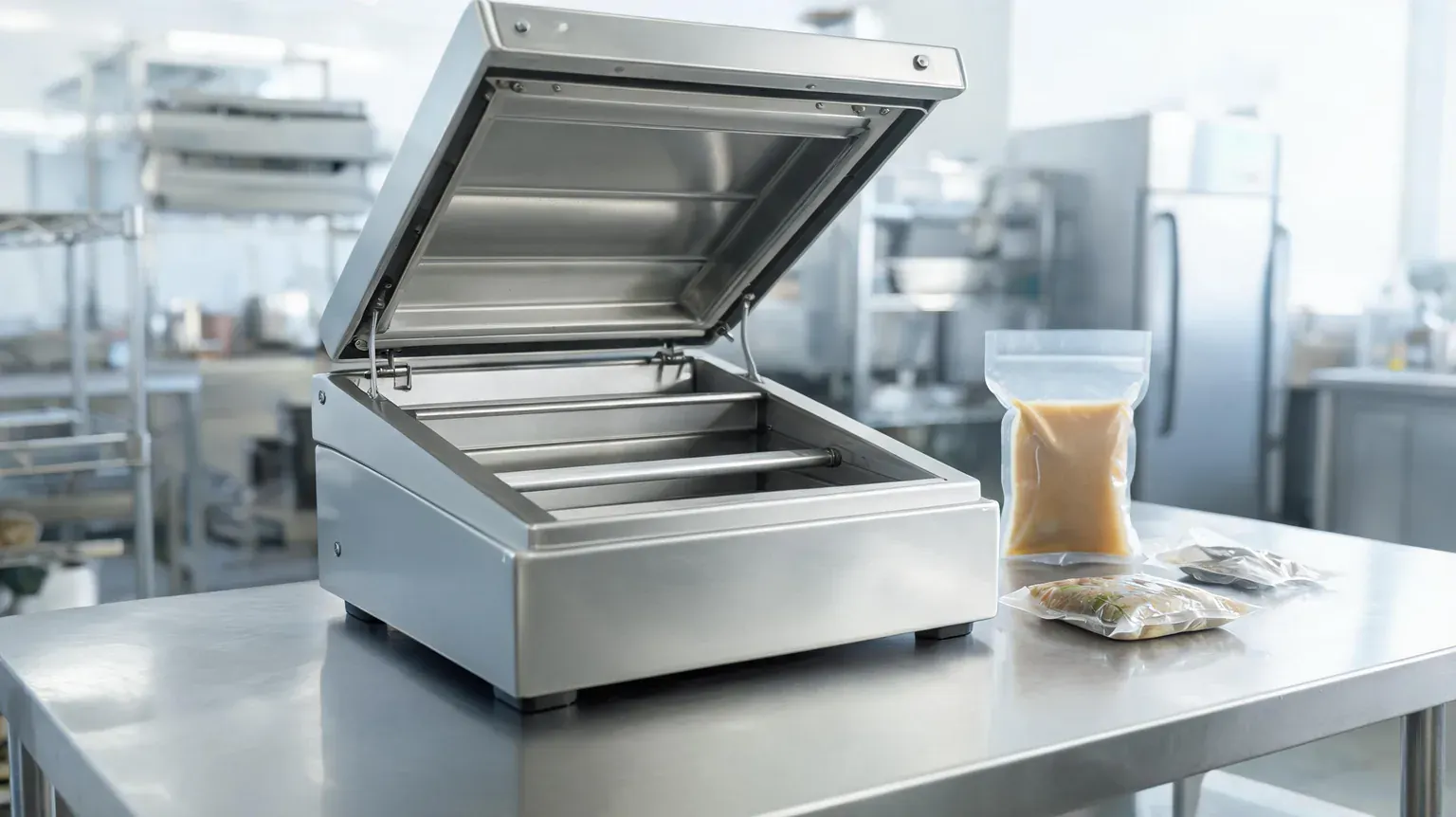
An external vacuum sealer, sometimes called an edge sealer, sits the open end of a bag over a seal bar and sucks air out of the bag. A chamber sealer puts the entire bag inside a box, closes the lid and removes air from the whole box at once. America’s Test Kitchen describes the result plainly: because the pressure outside the bag equals the pressure inside it, liquid stays put instead of being forced out through the opening.
That is why chamber machines can seal tomato sauce, soup, marinades and juicy meat without pre-freezing. It is also why they can infuse or quick-pickle in minutes: the same pressure change pulls marinade into the food. An external sealer can handle a damp steak; it cannot handle a quart of stock without a mess and a failed seal.
The trade-offs are size and price. ATK notes that retail-grade chamber sealers start around $300 and that even the compact home units are the size of a printer – and that their usable chamber is often much smaller than the footprint suggests. Commercial units are larger still. The nine machines below span that whole range, from a 5.3-quart countertop unit to a 398-pound floor model.
One accessory is worth understanding before you shop: the filler plate. A chamber has to evacuate all the air inside it, so a small bag in a big chamber wastes cycle time. A filler plate occupies the empty volume, which shortens the cycle and holds the bag flat against the seal bar. WebstaurantStore recommends them for exactly that reason, and most experienced operators use one.
The nine best chamber vacuum sealers
Prices are the live Amazon prices on October 19, 2026. We ranked on chamber size, seal-bar length, pump type, duty cycle, serviceability and price per usable quart – not on the number of programmes on the keypad.
1. VacMaster VP320 – best overall for production
The VP320 is the machine this category is built around: a 16-inch seal bar that takes bags up to 16 x 18 inches, a 1/2 HP oil pump, a stainless steel body and ETL compliance. The double seal gives you two heat lines per bag, which matters when a single seal line on a wet bag is the difference between a clean freeze and a freezer-burned failure.
It is $1,949.95 and it weighs enough that you will want a permanent place for it. That is the point. The oil pump is designed for continuous duty, the chamber is large enough for whole primals and family-sized batches, and VacMaster has a parts and service network behind it. For a small butcher, a farm operation or a serious hunter processing a season at once, this is the last sealer you buy.
What we like
- 16-inch seal bar accepts bags up to 16 x 18 inches
- 1/2 HP oil pump for continuous duty
- ETL-compliant stainless steel construction
- Double seal for a stronger closure
What could be better
- $1,949.95 before you buy bags
- Heavy, permanent-footprint machine
- Only four units in stock at the time of writing
Flaws but not dealbreakers: The chamber is deep enough that small bags need a filler plate to seal efficiently, and the machine is heavy enough that moving it alone is not sensible.
Skip it if: Skip it if you seal fewer than a few dozen bags a week – the 10-inch VacMaster below does the same job in a smaller footprint for half the price.
2. VacMaster VP230 – best mid-size commercial
The VP230 is the VP320’s smaller sibling: the same 1/2 HP oil pump and one-touch control panel, but a 12.25-inch seal bar sized for 12 x 15-inch bags. At 89 pounds and 19 inches long, it fits on a sturdy counter or a dedicated prep table without becoming a floor machine.
This is the sweet spot for a home business. It handles liquids, marinades and sous vide bags with the same chamber vacuum method as the flagship, and the oil pump gives it a duty cycle that the $300-$500 imports cannot match. If you are sealing stock, soups and portioned meat several times a week, the extra $250 over the VP215 buys a wider bar and a bit more room.
What we like
- 1/2 HP oil pump rated for prolonged operation
- 12.25-inch seal bar for 12 x 15-inch bags
- One-touch controls and pressure indicator
- Compact enough for a countertop
What could be better
- 89 lb – a two-person lift
- No double seal on this model
- No stated NSF certification
Flaws but not dealbreakers: The pressure gauge is the useful part of the panel; the rest is a single button. There is no timer or preset memory, so repeatability comes from watching the gauge rather than programming a cycle.
Skip it if: Skip it if your bags are longer than 12 inches – step up to the 16-inch VP320.
3. VacMaster VP215 – best compact oil-pump sealer
The VP215 is the machine that made chamber sealing practical for small kitchens. It uses a 10.25-inch seal bar for 10 x 13-inch bags, an oil pump, one-touch controls and a pressure indicator, and it weighs 84 pounds. It is small enough to live on a counter and strong enough to pull a hard vacuum on a bag of braising liquid.
At $995.99 it is the entry point to real commercial construction. The trade-off is bag size: a 10-inch bar limits you to roughly 10 x 13-inch pouches, which is fine for portions, stocks and sous vide, but not for a whole brisket or a large salmon fillet. If your work fits that envelope, this is the most machine per dollar in the guide.
What we like
- Oil pump at a sub-$1,000 price
- 10.25-inch seal bar for 10 x 13-inch bags
- Compact 20-inch footprint
- One-touch operation and pressure gauge
What could be better
- Bag length capped at about 13 inches
- 84 lb
- No double seal or programmable presets
Flaws but not dealbreakers: The lid gasket is the wear item. Keep it clean and dry, and order a spare before it starts leaking, because a tired gasket shows up as a weak vacuum rather than an obvious tear.
Skip it if: Skip it if you regularly seal whole cuts larger than 10 x 13 inches.
4. VEVOR 1200W – best for very large batches
This is a floor-standing packing machine, not a countertop appliance: a 23.62-inch sealing length, a 1200W heater, a 12 mm seal strip and a chamber big enough for bulk bags. It is rated for wet foods, meats and marinades, and the dual-lock seal is designed to survive freezer swelling and handling.
At 398 pounds and 57 inches long, it belongs in a dedicated packing room. The payoff is throughput: a 23.6-inch bar seals bags that the 10- and 12-inch machines cannot touch, and the heater is sized for back-to-back cycles. If you process whole animals or pack cases of product, the capacity is the point. If you are sealing leftovers, it is absurd.
What we like
- 23.62-inch sealing length for bulk bags
- 1200W heater and 12 mm seal strip
- Rated for wet foods and marinades
- Built for continuous packing sessions
What could be better
- 398 lb floor-standing machine
- $2,499.90
- Requires dedicated floor space and a sturdy circuit
Flaws but not dealbreakers: The machine’s own listing gives shipping dimensions rather than a usable counter footprint, so measure the doorway and the floor area before ordering – this is not a lift-and-store unit.
Skip it if: Skip it unless you are packing bulk product; a 12-inch countertop model handles normal family and small-business volumes.
5. Avid Armor JARMAX – best for mason jars
Most chamber sealers are bag machines. The JARMAX is built around jars: a deep 12-liter chamber holds four quart jars or six or more pint jars on its stainless wire shelf, and the removable silicone basket liner has handles and a pour spout for moving stocks and brines without spilling.
It also seals Mylar pouches up to 7 mil with a twin-wire 10.5-inch bar and a heat setting from 3 to 9, so it covers dry goods and freezer bags as well as jars. Avid Armor is explicit that this is not a canner and does not make fresh food shelf-stable – which is the honest way to sell a vacuum sealer. For pantry storage, dry goods and infusion, it is the most versatile machine here.
What we like
- 12 L chamber fits four quart or six-plus pint jars
- Twin-wire 10.5-inch bar with 3-9 heat control
- Removable silicone basket liner with pour spout
- Handles Mylar pouches up to 7 mil
What could be better
- Only three units in stock
- 10.5-inch bar limits bag width
- Not a canner – no shelf-stable claims
Flaws but not dealbreakers: Jar sealing is slower than bag sealing because each jar needs its lid ring positioned and the cycle is longer; this is a batch tool, not a one-jar-at-a-time convenience.
Skip it if: Skip it if you only seal bags – the USV32 below is cheaper and has a wider bar.
6. Avid Armor USV32 – best glass-lid countertop
The USV32 pairs a stainless steel chamber with a tempered glass lid, an 11.5-inch dual-wire sealing bar and a rapid-infusion marinate mode. The glass lid is not cosmetic: being able to watch the vacuum pull and the bag collapse is the fastest way to learn how much cycle time a wet bag needs.
At 26.4 pounds it is one of the lighter machines here, and at $529 it sits in the value band where most home businesses should start. The dual-wire bar handles thick pouches, and the marinate mode pulls seasoning into meat in minutes instead of hours. The chamber is small enough that a large roast still needs a bigger machine, but for portions, soups and sous vide it is the right size.
What we like
- Tempered glass lid for watching the cycle
- 11.5-inch dual-wire seal bar
- Rapid infusion marinate mode
- 26.4 lb – manageable on a counter
What could be better
- Chamber too small for large roasts
- No oil pump – dry pump duty cycle
- No stated certification
Flaws but not dealbreakers: The glass lid adds weight and one more surface to clean; the gasket under it needs drying after every wet-food session or it will smell.
Skip it if: Skip it if you need to seal whole primals or run hundreds of bags a day.
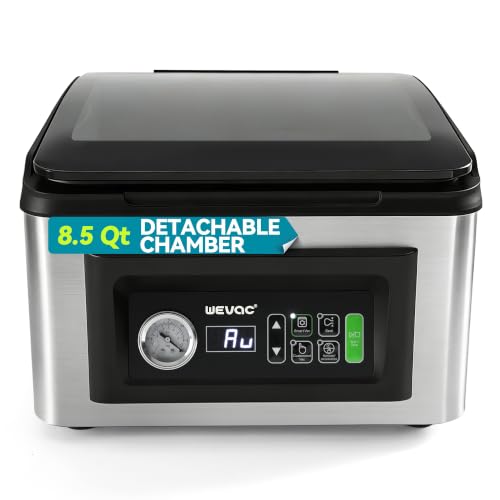
7. Wevac CV12 Pro – best easy-clean design
The CV12 Pro solves the least glamorous problem in chamber sealing: cleaning. The chamber tray is fully detachable and the seal bar is washable, so a bag of soup that bursts does not turn into a 20-minute cleanup with a damp cloth and a flashlight. The 12-inch bar and 8.5-quart chamber handle standard pouches, and auto vacuum sensing sets the cycle from the food volume instead of asking you to guess a timer.
It also ships with a mason jar kit, which makes it a cheaper way into jar sealing than the JARMAX. The pump is described as commercial-grade, but this is a dry-pump countertop machine rather than an oil-pump production unit. For a home kitchen or a small farm business that seals a few times a week, the cleaning design is worth more than a slightly wider bar.
What we like
- Detachable tray and washable seal bar
- Auto vacuum sensing sets the cycle
- 12-inch bar and 8.5-quart chamber
- Mason jar kit included
What could be better
- Dry pump, not continuous-duty oil
- 29.4 lb
- No stated certification
Flaws but not dealbreakers: The removable tray is a great idea with one catch: it must seat perfectly before the cycle starts, or the chamber will not pull a full vacuum. It is a 10-second check, not a fault.
Skip it if: Skip it if you need a 16-inch bar or oil-pump duty cycle for daily production.
8. Gasbye 5.3QT – best value compact
The Gasbye is the highest-charting chamber model we could verify in Amazon’s Vacuum Sealers category – it sat at #6 when we pulled the data – and it earns that position with a simple proposition: a 5.3-quart chamber, an 11.5-inch replaceable double-seal bar, 30 pre-cut bags in the box, and a 25-pound body for $369.99.
It handles meats, soups, sauces and liquids, and the replaceable seal bar means the wear part is a $20 swap rather than a service visit. The chamber is small: a whole chicken fits, a whole brisket does not. For a household that cooks in bulk, a hunter packing portions, or a small business selling sauces and soups, this is the value pick that gets you into true chamber sealing without a $1,000 commitment.
What we like
- Lowest-priced true chamber sealer in this guide at $369.99
- Replaceable 11.5-inch double-seal bar
- 30 pre-cut bags included
- 25 lb – easy to move and store
What could be better
- 5.3-quart chamber is small
- No oil pump
- No certification stated
Flaws but not dealbreakers: The small chamber is the limiting factor, not the pump: a bag that is too long will fold at the seal bar and leak, so buy bags sized to the chamber rather than trimming standard rolls.
Skip it if: Skip it if you need to seal anything larger than a whole chicken or a 2-gallon bag.
9. VEVOR 2.2 Gal – best budget entry
The VEVOR 2.2-gallon model is the cheapest way to get a real chamber, a 12-inch seal bar, a 180W oil pump and a -100 kPa vacuum rating. It also supports external vacuum sealing for large embossed bags, which extends its reach to long fish and turkey without a bigger chamber.
At $356.90 it is a legitimate entry machine: stainless steel chamber, 10 mm seal, 62 pounds, and an oil pump rather than the dry pump used by most sub-$400 units. The trade-offs are noise, weight and a chamber that is small enough to need filler plates for little bags. If you want to test whether chamber sealing fits your workflow before spending four figures, start here.
What we like
- 180W oil pump at $356.90
- 12-inch seal bar and -100 kPa vacuum
- External vacuum mode for large bags
- Stainless steel chamber
What could be better
- 62 lb – heavier than it looks
- Small chamber needs filler plates
- No certification stated
Flaws but not dealbreakers: The oil pump needs an oil change eventually, and the manual is thin on how to do it. Budget for one service a year if you run it hard.
Skip it if: Skip it if you need a 14-inch bar or a chamber that takes full-size bags.
What $350, $500, $1,000 and $2,000 buy
The chamber market has four honest price bands. The differences between them are not cosmetic: they change the pump, the duty cycle and the largest bag you can seal.
Around $350-$400. This is entry-level true chamber sealing. You get a 5- to 8-quart chamber, an 11.5- to 12-inch seal bar and usually a dry pump – VEVOR’s 2.2-gallon model is the exception with a 180W oil pump. The machines weigh 25-62 lb and handle portions, soups, sauces and small roasts. They are the right first chamber sealer for a household, a hunter or a market stall testing the workflow.
$420-$550. This is the value sweet spot. The Wevac CV12 Pro adds a detachable tray and a washable seal bar; the Avid Armor USV32 adds a glass lid, a dual-wire bar and a marinate mode; the JARMAX adds a 12-liter chamber and mason-jar capacity. You are paying for usability and chamber volume, not for a bigger pump. For most home businesses, one of these three is the correct buy.
$900-$1,250. Production territory. The VacMaster VP215 and VP230 use 1/2 HP oil pumps, 10.25- and 12.25-inch bars, and 84-89 lb steel bodies built for prolonged operation. You are buying duty cycle and a parts network, not features. If you seal several times a week and cannot afford a mid-batch failure, this is where the money goes.
$1,900-$2,500. Floor-standing production. The VacMaster VP320 gives you a 16-inch bar and a double seal; the VEVOR 1200W gives you a 23.6-inch bar and a 1200W heater in a 398-pound frame. These are packing-room machines. They are not better at sealing a single steak – they are better at sealing a hundred bags without stopping.
The point where paying more stops buying performance is around $550 for a home kitchen and around $1,250 for a small business. Above that, you are buying throughput, bag width and service – which are real, but only if your volume needs them.
Where we disagree with America’s Test Kitchen
America’s Test Kitchen tested countertop vacuum sealers for its 2025 review and named the Anova Precision Chamber Vacuum Sealer as its favourite chamber model. It called the machine powerful and versatile, able to seal fragile cereal and dense chicken legs as well as liquids, and it praised the infusion and quick-pickling capability. We agree with every one of those points.
We disagree with the conclusion that follows for a buyer who is scaling up. ATK’s own review notes that the Anova’s usable chamber is only about two inches high at its tallest and has a large slope eating into the space, so it cannot seal a large roast or a side of salmon. That is an acceptable limitation for a home cook sealing small batches. It is a disqualifying one for a small business whose orders include whole cuts, stock in quart bags or 12-inch pouches.
Our ranking therefore weights chamber volume and seal-bar length more heavily than ATK does. The Avid Armor USV32 and Wevac CV12 Pro occupy the same “compact chamber” lane as the Anova, but with 11.5- and 12-inch bars and larger usable chambers; the VacMaster VP215 and VP230 move into oil-pump duty cycle; the VP320 and VEVOR 1200W are production tools ATK does not cover at all.
Where we fully agree is the warning about size. ATK says chamber sealers are heavier and larger than external models and that their real capacity is often smaller than the footprint suggests. That is the single most useful thing to understand before buying: measure the chamber opening and the seal bar, not the machine’s exterior.
The failure modes owners report
Chamber sealers fail in predictable ways, and almost none of them is the motor. These are the patterns worth checking before you buy – and the maintenance that prevents them.
- Gasket and lid seals. A tired lid gasket shows up as a weak vacuum and a bag that will not tighten, not as a visible tear. Wipe the gasket dry after every wet cycle and keep a spare.
- Seal-bar damage from wet bags. Liquid that crosses the seal bar leaves residue that burns, wrinkles the Teflon tape and produces a channel leak. The machines with washable or replaceable bars are worth the premium for this reason alone.
- Oil-pump maintenance. Oil-pump machines are the durable choice, but the oil has to be changed. A manual that does not explain how is a service cost waiting to happen – budget one service a year under heavy use.
- Control boards and sensors. Auto vacuum sensing and digital panels are convenient until they fail; a board replacement can cost a third of the machine. Buy from a brand with a parts path, or accept the risk on a $350 import.
- Chamber size versus bag size. The most common “failure” is a bag that is too long for the chamber, folds at the seal bar and leaks. Buy bags sized to your chamber and use a filler plate for small loads.
- Weight and clearance. These machines run from 25 to 398 lb. Check the counter rating, the doorway and the storage height before delivery – a 398-pound floor model does not go back in a cupboard.
Vacuum sealing is not canning: the safety line
A vacuum sealer removes oxygen. It does not sterilise food, and it does not make fresh food shelf-stable. In food-service law, vacuum packaging is a form of reduced oxygen packaging, or ROP, and the FDA Food Code 2022 treats it as a process with specific controls: section 3-502.12 requires a HACCP plan for time/temperature control for safety foods, storage at 5°C (41°F) or less, and a refrigerated shelf life of no more than 30 calendar days from packaging to consumption, among other conditions.
For a home cook, the practical version is simpler. Keep vacuum-sealed perishables in the refrigerator or freezer, not the pantry. Follow the same use-by dates you would use without the bag. And do not vacuum-seal raw garlic, mushrooms or soft unpasteurised cheeses: WebstaurantStore’s commercial guide warns that these can harbour anaerobic bacteria, and removing oxygen creates exactly the environment those bacteria prefer. Blanch vegetables before sealing if you plan to store them.
This is also why the JARMAX listing is honest about not being a canner. A vacuum-sealed jar of dried beans is a storage method; a vacuum-sealed jar of fresh tomato sauce is a botulism risk unless it is refrigerated and eaten within the safe window. No machine at any price changes that.
How we chose
This is a research-based ranking, not a lab test. We did not seal food in these machines. What we did: pulled live prices, stock, category rank, dimensions and stated chamber and seal-bar sizes for nine ASINs from Amazon’s product API on October 19, 2026; read each manufacturer listing in full; compared the mechanics against America’s Test Kitchen’s published chamber-sealer testing and WebstaurantStore’s commercial vacuum-sealer guide; and checked the food-safety requirements against the FDA Food Code 2022, including section 3-502.12 on reduced oxygen packaging.
We ranked on five things: usable chamber volume, seal-bar length, pump type and duty cycle, ease of cleaning, and price per usable quart. We did not rank on the number of preset programmes, because a chamber sealer with a good gasket and a clean bar outperforms a machine with twelve presets and a tired seal. Where a manufacturer claim could not be verified, we say so in the product section instead of repeating it as fact. Our full testing and sourcing policy is on the How We Test & Choose Products page.
For related buying advice, see our guide to the best vacuum sealers for external edge-sealing machines, our sous vide cooker picks for meal prep, and our freezer storage container guide.
Key sources
- FDA Food Code 2022 – section 3-502.12 on reduced oxygen packaging, HACCP plans and the 30-day refrigerated limit.
- America’s Test Kitchen, The Best Countertop Vacuum Sealers (June 2025) – chamber versus external mechanics, liquid sealing and chamber-size limits.
- WebstaurantStore, Types of Vacuum Sealers (updated July 2026) – commercial chamber construction, seal bars, filler plates and foods unsafe to vacuum-seal.
- Serious Eats, The 7 Best Vacuum Sealers of 2026 (February 2026) – independent testing of 27 models, including chamber and mason-jar-compatible units.
Who should not buy a chamber sealer
A chamber sealer is the wrong purchase in five situations.
- You seal a bag of leftovers once a week. A $100 external sealer does that job; a chamber machine costs three times as much and takes up three times the counter.
- You only seal dry goods. External sealers handle dry rice, coffee and nuts perfectly well. The chamber premium buys liquid handling and bag cost, not dry-goods performance.
- You need shelf-stable food. No vacuum sealer is a canner. If you want pantry-stable preserves, you need a pressure canner and a tested recipe, not a stronger vacuum.
- You have no permanent space. These machines weigh 25-398 lb and several need a dedicated table. A countertop edge sealer that lives in a drawer is better than a chamber sealer that lives in a box.
- You need a 14-inch or wider bag and a $400 budget. The bar length is the price driver; buy the machine that fits your bag rather than trimming every bag to fit the machine.
Frequently asked questions
What is a chamber vacuum sealer?
It is a vacuum sealer that places the entire bag inside a sealed chamber and removes air from the whole chamber at once. Because the pressure on the outside of the bag equals the pressure inside it, liquids stay in the bag and the seal is more consistent than an external edge sealer.
Is a chamber sealer worth it over a regular vacuum sealer?
Yes if you seal liquids, wet foods, marinades or sous vide bags, or if you seal often enough that bag cost and cycle consistency matter. No if you mainly seal dry goods or freeze portions occasionally – a $100 external sealer is the better value there.
Can a chamber vacuum sealer seal liquids?
Yes. That is its main advantage. Soups, sauces, stocks and marinades can be sealed without pre-freezing because the bag is not being sucked from the inside. External sealers require liquids to be frozen first.
What size chamber do I need?
Match it to the largest bag you actually use. A 5- to 8-quart chamber handles portions, soups and small roasts; a 12-liter chamber handles mason jars and larger cuts; a 16-inch seal bar takes 16 x 18-inch bags. Measure the chamber opening and bar, not the machine’s exterior.
Do I need an oil pump or a dry pump?
An oil pump is the durable choice for frequent or continuous use, and it is what the $900+ commercial machines use. A dry pump is fine for occasional home use and costs less. If you seal several times a week, pay for the oil pump.
Can I use regular vacuum sealer bags in a chamber machine?
Chamber machines can use smooth chamber bags, and they can also use textured external bags if the bag fits inside the chamber. Smooth chamber bags are usually cheaper in bulk because they do not need the mesh pattern that external sealers rely on.
Is vacuum-sealed food shelf-stable?
No. Vacuum packaging is a reduced oxygen packaging method, not a sterilisation process. Perishable food still needs refrigeration or freezing, and the FDA Food Code limits refrigerated ROP storage to 30 calendar days under a HACCP plan. Vacuum sealing is not canning.