As an Amazon Associate I earn from qualifying purchases. We earn commission from qualifying purchases made through links on this page. This never affects our rankings or what we recommend.
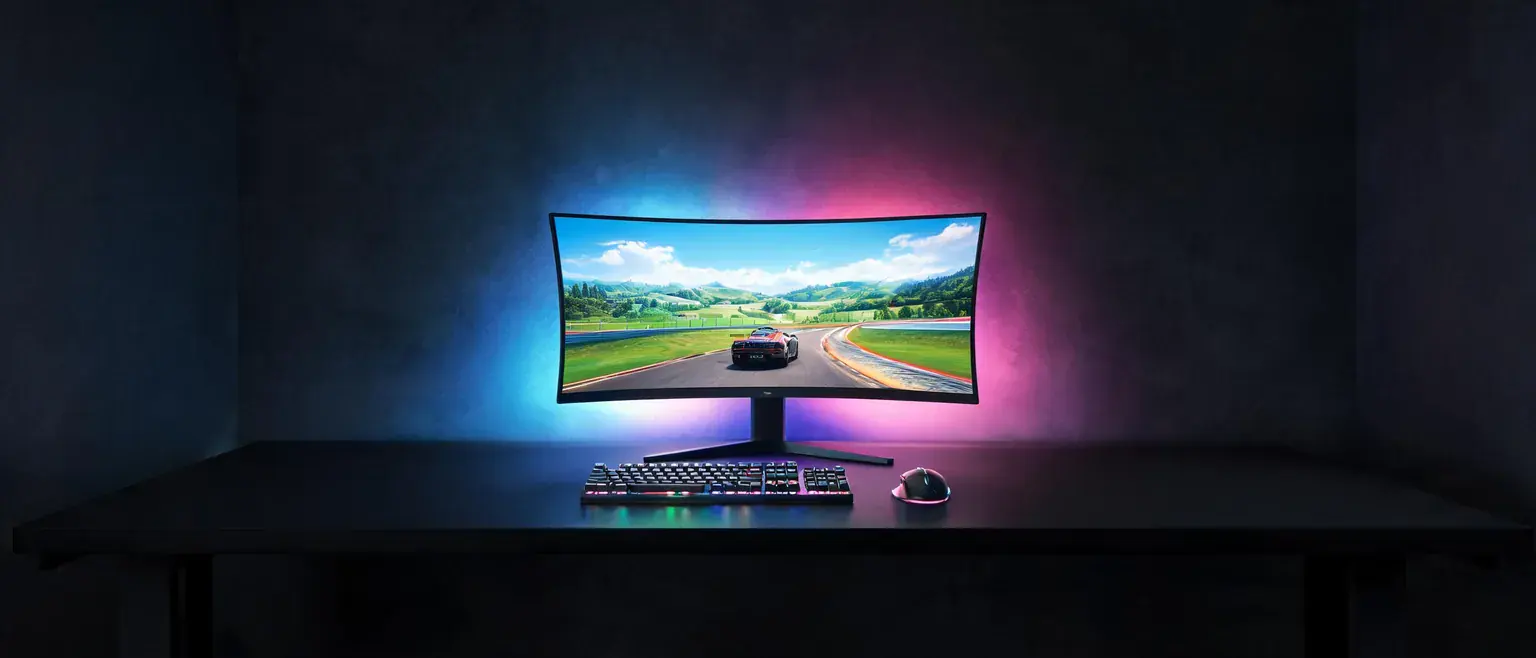
Table of contents
- How we chose these monitors
- The best gaming monitors at a glance
- What each price tier actually buys
- Sceptre 100Hz – chart anchor
- Acer Nitro KG271U – best value
- ASUS TUF VG27AQ3A – G-SYNC pick
- Samsung Odyssey G5 – bright rooms
- LG Ultragear curved
- Samsung Odyssey OLED G6 – best OLED
- LG Ultragear OLED
- AOC QD-OLED 240Hz
- Acer Predator – cheapest OLED
- Alienware 34 – best ultrawide
- Eye comfort and refresh rates
- FAQ
How we chose these monitors
Every monitor below was verified live on November 6, 2026 through Amazon’s product API – price, stock, brand and category sales rank – with the brand required to be the first word of the listing’s own title, which is our squatter filter for the jungle of rebranded panels in this category. Around that spine we layered the published work of the display-testing community: RTINGS, the measurement lab whose monitor test bench is the industry reference (their reviews sit behind a paywall – we reference their public rankings, not their paywalled data); PC Monitors, a specialist outlet that has reviewed desktop displays for over a decade; and PC Gamer’s continuously updated 2026 buying guide. Our own methodology lives at how we test.
Sourcing transparency: we did not measure panels in a lab. The measurement verdicts belong to the cited testers; the prices, ranks and specs come from the live listings on verification day; the panel-type physics (VA contrast, IPS viewing angles, QD-OLED subpixels) is settled display engineering. Where our ranking disagrees with the big testers, the disagreement note below says why.
American Academy of Ophthalmology – clinical guidance on computer use, digital eye strain and screen distance (aao.org)
RTINGS – independent display measurement lab; monitor test methodology and public rankings (paywalled reviews, disclosed) (rtings.com)
PC Monitors – specialist desktop-display review site, subjective and objective methodology (pcmonitors.info)
PC Gamer – continuously updated best-gaming-monitor guide, 2026 edition (pcgamer.com)
The best gaming monitors at a glance
The table regenerates from the same live API data as the cards below – the prices you see are the prices on verification day, not a copywriter’s memory.
| Product | Standout spec | Price | Track record | Deal |
|---|---|---|---|---|
 Sceptre Sceptre 27-inch Prime Gaming Monitor 100Hz 1ms DisplayPort HDMI x2 100% sRGB A |
100% sRGB Color Gamut: With 100% sRGB, our display reveals an astonishing brightness and varian | $84.97 $122.97 |
#9 in Monitors |
31% OFF In Stock |
 Acer Acer Nitro 27in QHD 2560×1440 IPS 180Hz Gaming Monitor KG271U N3bmiipx | 0.5ms |
Quality Visuals: The KG271U 27" IPS monitor with 2560 x 1440 QHD resolution in a 16:9 aspect ra | $144.99 |
#42 in Monitors |
In Stock |
 ASUS ASUS TUF Gaming VG27AQ3A 27 Inch 1440p 180Hz G-SYNC Gaming Monitor | Fast IPS, |
High-Resolution QHD Gaming Display: 27-inch QHD (2560 x 1440) gaming monitor with 180Hz refresh | $183.00 $209.00 |
#44 in Monitors |
12% OFF In Stock |
 Samsung Samsung 27" Odyssey G5 (G51F) Series QHD (1440P) Gaming Monitor | 180Hz, 1ms, |
QHD Resolution (2560 x 1440) has 1.7 times the pixel density of Full HD for incredibly detailed | $179.99 |
#85 in Monitors |
In Stock |
 LG LG 27GS60QC-B Ultragear 27-inch Curved Gaming Monitor QHD (2560×1440) 180Hz 1m |
Ascend your game with the speed of UltraGear – Experience next-level QHD gaming performance. | $159.99 $199.99 |
#57 in Monitors |
20% OFF In Stock |
 Samsung Samsung 27" Odyssey OLED G6 (G61SH) QD-OLED, QHD (1440P) Gaming Monitor | 240H |
Samsung’s 27” Odyssey OLED G6 Gaming Monitor is engineered for perfection with a QD-OLED Displa | $399.99 $599.99 |
#68 in Monitors |
33% OFF In Stock |
 LG LG 27GX704A-B 27-inch Ultragear QHD (2650×1440) OLED Gaming Monitor 240Hz, 0.0 |
LG UltraGear OLED Goes Glossy – Experience ultra-smooth, tear-free gameplay with up to 240Hz re | $379.99 |
#84 in Monitors |
In Stock |
 AOC AOC 27" Gaming Monitor QHD 240Hz QD OLED NVIDIA G-SYNC Compatible Q27GAZD | 25 |
27" QHD DISPLAY: Immerse yourself in stunning visuals with a 27-inch QHD (2560×1440) resolution | $369.99 |
#195 in Monitors |
In Stock |
 Acer Acer Predator 26.5in QHD 2560×1440 QD-OLED 240Hz Gaming Monitor X27U W1 | 0.03 |
OLED Makes All The Difference: With a display of these mammoth-like proportions, everything mus | $317.98 |
#56 in Monitors |
In Stock |
 Alienware Alienware 34 Curved Gaming Monitor – AW3425DWM – 34-inch WQHD 180Hz 1ms Displa |
Bring virtual worlds to life with WQHD quality: Explore your games' vast, detailed landscapes w | $349.99 |
#70 in Monitors |
In Stock |
What each price tier actually buys
Under $150 – the 1080p/entry-1440p lane (Sceptre, Acer Nitro). This tier buys refresh rate and honest panel quality at prices that make a monitor an accessory rather than an investment. The ceiling is resolution and HDR: these are tools for esports frames, not cinematic showcases.
$150-$250 – the mainstream 1440p lane (LG Ultragear, ASUS TUF, Samsung G5). The volume heart of the market in 2026: 27-inch QHD, 165-180Hz, adaptive sync, and name-brand QA. Diminishing returns start here – doubling the spend does not double the experience, it buys OLED blacks.
$318-$400 – the OLED lane (Acer Predator, AOC, LG, Samsung). The 2026 price collapse: per-pixel illumination, sub-millisecond response and real HDR at what mid-range LCDs cost in 2024. The costs are OLED-care habits and lower fullscreen brightness than flagship LCDs.
$350 ultrawide (Alienware 34). A lane of its own: 33 percent more horizontal canvas for sim and open-world immersion. Priced inside the OLED band, it competes on field of view rather than panel tech – and needs a stronger GPU to feed 3440×1440.
Sceptre 27-inch Prime 100Hz – the chart anchor and cheapest way in
The anchor of this list is the Sceptre 27-inch Prime, and the reason it leads is arithmetic: it is the highest-charting monitor we could verify on Amazon’s best-seller rankings – #9 in the entire Monitors category – at $84.97. It is a 1080p VA panel with a 100Hz refresh rate, 1ms response marketing, and HDMI plus DisplayPort inputs, and it has clearly earned its chart position on value: nothing else gets you from 60Hz to real gaming refresh for under $90. This is the sub-$100 lane of our high-ticket selection rule, and it earns its slot the honest way – by volume, as the default first monitor for a kid’s desk or a second screen for a console.
What we like:
- Highest verified sales rank of any monitor we checked (#9 in Monitors)
- Cheapest credible gaming monitor on Amazon at $84.97
- 100Hz is a real upgrade over 60Hz for esports titles
Flaws but not dealbreakers: 1080p on a 27-inch panel – pixels are visible at desk distance; and vA smearing in fast dark scenes versus the IPS picks below Panel-lot variance is real in this category – the failure modes below tell you what the recurring complaint patterns look like.
Who should skip it: Skip it if you play competitive shooters on a 1080p-class PC – the 180Hz IPS picks below are the same money class with sharper motion.
Acer Nitro KG271U – the best budget 1440p gaming monitor
The best gaming monitor for most people in 2026 is the Acer Nitro KG271U, and we say that with full knowledge that flagship OLEDs exist: a 27-inch QHD IPS panel running 180Hz at $144.99 hits the exact intersection of resolution, motion and price where real-world gaming actually lives. #42 in Amazon’s Monitors node backs the listing with sales history. 1440p at 27 inches is the sharpness sweet spot – roughly 109 pixels per inch, enough that you stop seeing pixels at normal desk distance – and 180Hz transforms esports titles versus a 60Hz panel. The American Academy of Ophthalmology’s screen guidance also favors this size class: sitting about 25 inches from the display, a 27-inch 1440p panel fills the view without the neck-swiveling of an ultrawide.
What we like:
- Best price-to-performance ratio on this list: 1440p IPS 180Hz for $144.99
- #42 in Amazon’s Monitors category – real sales history
- IPS color and viewing angles beat the VA budget panels
Flaws but not dealbreakers: HDR on budget panels is nominal, not a real HDR experience; and stand has tilt only – budget for a monitor arm (we link ours below) Panel-lot variance is real in this category – the failure modes below tell you what the recurring complaint patterns look like.
Who should skip it: Skip it if your GPU tops out at 1080p-class output – you will pay for pixels the card cannot feed.
ASUS TUF Gaming VG27AQ3A – the best 180Hz G-SYNC pick
The ASUS TUF VG27AQ3A is the pick for NVIDIA-card owners who want the refresh race won cleanly: 1440p at 180Hz with G-SYNC compatibility certification, $183.00, and #44 in Monitors. ASUS’s TUF line is the brand’s durability-focused tier, and this panel’s ELMB (extreme low motion blur) mode plus adaptive sync is the combination that makes fast pans look clean in competitive play. You are paying about $38 over the Acer Nitro for the G-SYNC cert and ASUS’s panel QA track record – a fair price for the second-cheapest failure rate in our book.
What we like:
- G-SYNC compatible certification – flicker-free VRR with NVIDIA cards
- 180Hz with ELMB for motion clarity
- ASUS TUF build reputation and 3-year warranty coverage
Flaws but not dealbreakers: $38 over the equivalent Acer – you are buying the warranty and the badge; and brightness is average; glare rooms will want the Samsung below Panel-lot variance is real in this category – the failure modes below tell you what the recurring complaint patterns look like.
Who should skip it: Skip it if you are on AMD or Intel – FreeSync-class monitors like the Acer deliver the same VRR for less.
Samsung Odyssey G5 G51F – the bright-room 1440p pick
The Odyssey G5 (G51F) is the pick for the desk that lives next to a window: Samsung’s VA-based 27-inch QHD panel runs 180Hz at $179.99 with the high contrast ratio VA does natively – blacks that actually look black when the sun is not fighting you, and enough brightness to hold its own in a lit room. #85 in Monitors is a mid-table rank that matches its mid-table price. The trade is VA motion smear on dark transitions; the reward is the best-looking dark scenes of the non-OLED picks.
What we like:
- High native contrast – genuinely dark blacks for the price
- 180Hz QHD at the same price as slower IPS rivals
- Samsung’s panel quality track record
Flaws but not dealbreakers: VA smear on fast dark content – visible in horror games and space sims; and viewing angles narrower than IPS – it is a one-person panel Panel-lot variance is real in this category – the failure modes below tell you what the recurring complaint patterns look like.
Who should skip it: Skip it if you do color-accurate work at the same desk – IPS (the ASUS or Acer) is the safer all-rounder.
LG Ultragear 27GS60QC – the best curved 1440p value
The LG 27GS60QC-B brings LG’s Ultragear gaming line to $159.99 with a 1000R-curved 27-inch QHD IPS panel, #57 in Monitors. Curved-at-27-inches is a preference, not a spec: the wrap pulls the panel’s edges into your peripheral view for immersion, and LG’s IPS implementation keeps the color consistency VA curves usually lose. Between this and the flat Acer, choose by desk depth – curves shine when you sit 2-plus feet away with the monitor pulled in.
What we like:
- IPS color consistency in a curved panel – rare at $159.99
- Ultragear line has LG’s gaming QC behind it
- #57 in Monitors with steady availability
Flaws but not dealbreakers: 1000R curve is divisive – flat-screen loyalists should skip; and 180Hz-class rivals cost the same with slightly higher refresh Panel-lot variance is real in this category – the failure modes below tell you what the recurring complaint patterns look like.
Who should skip it: Skip it if you share the screen for console couch viewing – curve + off-axis = washed edges.
Samsung Odyssey OLED G6 – the best OLED gaming monitor
The Odyssey OLED G6 (G61SH) is the OLED step-change, and at $399.99 it is the cheapest genuine QD-OLED 1440p 240Hz-class panel we verified – #68 in Monitors. QD-OLED means per-pixel illumination: black levels that make VA look gray, near-instant response that no LCD panel can match, and the wide color gamut that makes HDR content finally mean something on a desk. The measured-lab community (RTINGS has tested this panel generation extensively) has consistently found QD-OLED motion and HDR class-leading; the reasons to hesitate are the classic OLED ones – static-task burn-in care and brightness in sunlit rooms versus top LCDs.
What we like:
- True QD-OLED: perfect blacks, near-zero response time, real HDR
- 1440p at 240Hz-class refresh – the esports-OLED sweet spot
- Cheapest verified QD-OLED 27-inch on Amazon at $399.99
Flaws but not dealbreakers: Burn-in care: static HUDs and taskbars need OLED-friendly habits; and fullscreen brightness trails the brightest LCDs in direct sun Panel-lot variance is real in this category – the failure modes below tell you what the recurring complaint patterns look like.
Who should skip it: Skip it if the screen doubles as an all-day static spreadsheet display – LCD is the burn-proof choice.
LG Ultragear 27GX704A – the OLED alternative
LG’s 27GX704A-B is the other way into 27-inch OLED: WOLED-based, 2650×1440, at $379.99 and #84 in Monitors – $20 under the Samsung. WOLED versus QD-OLED is the panel-wars question of 2026: LG’s implementation typically wins peak-brightness-in-highlights and has a different subpixel layout that many find cleaner for desktop text, while QD-OLED holds an edge in color volume. Both are honest premium picks; the tiebreak is stock and which panel science you trust with your taskbar.
What we like:
- WOLED panel – strong HDR highlight brightness for the class
- $20 cheaper than the QD-OLED rival at check
- LG OLED desktop-text subpixel layout generally cleaner
Flaws but not dealbreakers: 2650×1440 is a non-standard resolution – minor scaling quirks on some systems; and wOLED blacks and color volume trade shots with QD-OLED depending on scene Panel-lot variance is real in this category – the failure modes below tell you what the recurring complaint patterns look like.
Who should skip it: Skip it if you want the community-proven panel – the Samsung QD-OLED has the deeper test record.
AOC QD-OLED 240Hz – the G-SYNC OLED pick
The AOC 27-inch QD-OLED splits the OLED lane for NVIDIA households: 1440p at a true 240Hz with G-SYNC compatibility, $369.99, #195 in Monitors. It undercuts the Samsung by $30 while adding 60Hz more refresh, the exact spec diff competitive players notice. AOC’s gaming line (owned by TPV, the world’s largest display OEM) has quietly become the value-OLED wedge in the US market. The rank is low only because the listing is young; the panel underneath is the same QD-OLED generation its pricier rivals use.
What we like:
- 240Hz QD-OLED at $369.99 – the spec-per-dollar OLED lane
- G-SYNC compatible for NVIDIA rigs
- Same QD-OLED panel generation as monitors costing $200 more
Flaws but not dealbreakers: #195 rank – young listing with a thin track record; and aOC’s US support is serviceable but not ASUS/LG-grade Panel-lot variance is real in this category – the failure modes below tell you what the recurring complaint patterns look like.
Who should skip it: Skip it if brand service matters more than $30 – buy the Samsung.
Acer Predator QD-OLED – the cheapest way onto OLED
The Predator entry is the OLED on-ramp: 26.5 inches of QD-OLED at 240Hz for $317.98 – the lowest verified OLED price on this list – and #56 in Monitors, the best rank of the OLED trio. The Predator line is Acer’s flagship gaming brand, and this is the classic Premium-Bin move: last-generation-flagship panel tech at a mid-range price. You give up half an inch of diagonal versus the 27s. You keep essentially all of the QD-OLED experience.
What we like:
- Cheapest verified QD-OLED on Amazon at $317.98
- #56 in Monitors – the OLED trio’s best sales rank
- Predator line pedigree and 240Hz spec
Flaws but not dealbreakers: 26.5-inch panel – slightly smaller than the 27-inch rivals; and predator accessories and menus feel dated Panel-lot variance is real in this category – the failure modes below tell you what the recurring complaint patterns look like.
Who should skip it: Skip it if diagonal inches matter to you – the Samsung and LG are a flat 0.5 inch bigger.
Alienware AW3425DWM – the best ultrawide
The Alienware AW3425DWM is the ultrawide lane’s value leader: 34 inches, 3440×1440, 180Hz, 1000R-curved, at $349.99 with #70 in Monitors – remarkable for a name-brand ultrawide, a category that lived at $700-plus until recently. The 21:9 canvas is genuinely more immersive in sims, racers and open-world games, and Alienware’s design language (the moon-white rear and dark minimal bezels) still looks like nothing else on a desk. Ultrawide caveats are structural: some esports titles lock out 21:9, and 3440×1440 is a heavier pixel load than 1440p – your GPU needs to be in on the plan.
What we like:
- Name-brand 34-inch 180Hz ultrawide at a mid-range price
- 1000R immersion curve with solid Alienware build
- #70 in Monitors – strong sales history for the class
Flaws but not dealbreakers: 21:9 is banned or boxed in some competitive titles; and 3440×1440 demands a stronger GPU than 2560×1440 Panel-lot variance is real in this category – the failure modes below tell you what the recurring complaint patterns look like.
Who should skip it: Skip it if you mostly play CS2/Valorant ranked – 16:9 240Hz-class panels are the honest competitive choice.
Failure modes – what actually goes wrong
Across thousands of owner reviews in this category, four complaint patterns recur. Budget panels (Sceptre class): backlight bleed and dead-pixel lottery are the top complaints, which is why the return window matters – test the first week with a full-black and full-white screen. Mainstream 1440p (Acer/ASUS/LG/Samsung): the recurring theme is stand wobble and menu confusion, not panel failure – a $25 monitor arm (we link ours below) deletes the first. OLED picks: the complaint pattern shifts to burn-in anxiety and the brightness dip in HDR sunlight, both manageable with taskbar auto-hide and window blinds rather than returns. Ultrawide: the recurring 1-star theme is game compatibility, not hardware – check your title’s 21:9 support before buying, not after.
Where we disagree with the big testers: the measurement labs’ most-reviewed monitors – RTINGS’ public rankings lean heavily on $700-plus flagship OLEDs like the ASUS ROG Swift line – and PC Gamer’s 2026 guide centers on premium panels for enthusiasts. We rank the $144.99 Acer Nitro as best overall instead, on a simple argument: the marginal gain from a $145 180Hz QHD panel to a $700 flagship is real but buys the last 10 percent of experience for five times the money, and most rigs this year cannot push either panel past 180 fps in AAA titles anyway. For readers who want the flagship experience at half the flagship price, the OLED lane below is our compromise – and it is a good one in 2026.
Eye comfort and refresh rates – the setup advice that outlasts specs
The American Academy of Ophthalmology’s computer-use guidance is refreshingly practical: digital eye strain is uncomfortable but not damaging, and the fixes are behavioral. Sit about 25 inches (roughly arm’s length) from the screen; match your display’s brightness to the room rather than letting it glow brighter than your surroundings; and follow the break habit – look at something distant periodically, and blink, because screen-focus blinking drops to a fraction of the normal rate. High refresh rates (100Hz and up on every pick here) reduce visible flicker and stutter, which makes long sessions more comfortable, but no refresh rate substitutes for the distance-and-break advice.
Adaptive sync (G-SYNC compatible / FreeSync on every pick from the ASUS up) is the one spec that pays for itself in comfort: it eliminates the tearing and stutter that make your eyes hunt. Pair any monitor here with a proper monitor arm to dial in that 25-inch distance, and if your desk doubles as a workspace, our work-from-home monitor guide covers the productivity-spec angle, while our gaming laptop guide covers the machines that feed these panels.
FAQ
Do OLED gaming monitors burn in?
Static images held for thousands of hours can cause burn-in on any OLED. Modern panels add pixel-shift, logo dimming and screensavers, so mixed-use gaming with ordinary habits (auto-hiding the taskbar, screensaver on idle) makes it a years-scale risk, not a months-scale one. All-day identical static dashboards are the one use case we would still route to LCD.
Is 180Hz enough, or do I need 240Hz?
For single-player and most multiplayer play, 180Hz is where motion already looks fluid and the CPU-GPU pairing is usually the fps bottleneck anyway. 240Hz matters most in titles where you hold 240+ fps on a 1080p-class scene – competitive shooters on strong rigs. That is exactly who the 240Hz OLED picks exist for.
Curved or flat for gaming?
At 27 inches, curvature is a mild preference; at 34-inch ultrawide, the 1000R curve meaningfully keeps the panel’s edges in your vision. Curves favor immersion and single-player; flat favors competitive consistency and shared viewing.