Finding the best motorcycle helmets on Amazon is harder than it should be: every listing shouts “DOT Approved,” yet almost none explain what that certification actually covers, what a $90 lid gives up compared to a $550 one, or which helmets the independent crash-test programs actually rate. We pulled the live Amazon catalog through the Amazon Creators API on October 26, 2026, cross-checked every pick against hands-on testers, and ranked eight full-face and modular helmets from $80 to $550 that are in stock right now.
Affiliate disclosure: As an Amazon Associate I earn from qualifying purchases. We earn commission from qualifying purchases made through links on this page. This never affects our rankings or what we recommend.
Table of Contents
- How we picked these helmets
- The picks
- What your money buys at each tier
- Where we disagree with the UK testers
- Complaint patterns to expect
- DOT, ECE 22.06 and when to replace a helmet
- FAQs
- The bottom line
How we picked these helmets
This page is built on three layers of evidence, and it is worth being precise about what is hands-on and what is not. We have not crash-tested anything ourselves – nobody honest who writes a roundup has. What we did: (1) pulled live price, stock, best-seller rank and listing data for every candidate through the Amazon Creators API on 2026-10-26, so the numbers you see are real USD buy-box figures, not scraped guesses; (2) restricted the longlist to helmets whose certification claims match the actual federal standard text; and (3) cross-checked our shortlist against testers with real hands-on programs – WebbikeWorld has published more than 500 hands-on helmet reviews since 2000, and the MCN staff tests helmets on the road and on UK shores for its annual group guides. Our full method lives on the how we test page.
Key sources
- eCFR – 49 CFR 571.218 (FMVSS No. 218, the U.S. motorcycle helmet standard) – what “DOT” legally requires
- WebbikeWorld – 500+ hands-on helmet reviews since 2000, our baseline for fit and build-quality judgments
- MCN’s best motorbike helmets guide – road-tested group reviews, updated June 2026
- Bennetts BikeSocial – consumer-editor helmet buying guide and ECE 22.06 explainer, updated August 2026
The picks
1. Orthrus Full Face – the best-seller-chart anchor
The Orthrus is the highest-charting full-face helmet we could verify on Amazon’s own Helmets best-seller chart (#6 at check time), which makes it the closest thing the US Amazon shelf has to a people’s-choice full-face. It ships DOT-certified with a tinted second visor in the box, and the listing’s shell spec (ABS outer over EPS) is exactly what you expect at this price.

- What we like: rare combination of a top-10 chart position, a bundled tinted visor, and sizes that fit true per the listing’s size chart.
- Vent layout (chin + brow + rear exhaust) matches the airflow pattern testers say matters most for full-face comfort.
Flaws but not dealbreakers: it is a budget shell, so expect more wind noise than the premium picks below and no Pinlock-ready shield. If you ride highway speeds daily, jump to the AGV or Bell pick.
2. Shoei RF-1400 – the premium reference
The RF-1400 is the helmet the rest of the market gets measured against: Shoei’s wind-tunnel-developed shell, an emergency quick-release cheek-pad system, and the quietest ride in its class according to long-term reviews. MCN’s 2026 guide puts Shoei’s range among the lids worth stretching for, and it is the one premium helmet on this page whose resale value actually holds.

- What we like: benchmark build quality with an EPS liner shaped for low wind noise; cheek pads swap out without tools in an emergency.
- Shield mechanism feels like a $500 mechanism – smooth, sealed, and Pinlock-ready.
Flaws but not dealbreakers: the price. At $549.99 checked it costs more than the other seven picks combined would if you bought two of them, and Shoei’s own accessory prices (Pinlock insert, chin curtain) add up fast. If $550 for a lid stings, the Bell DLX MIPS below is the sensible step down.
3. AGV K1 S – race-derived mid-premium
AGV’s K1 S borrows the shape language of the company’s MotoGP lids at $249 list: a carbon-aramid-fiber shell on higher trim levels of the family, a wide 190-degree face opening, and a shield that accepts Pinlock inserts. It is the pick for riders who want sportbike aesthetics and a race-homologated lineage without the $500+ ticket.

- What we like: aggressive but usable venting, and a shield aperture wide enough to make shoulder checks genuinely easier.
- Priced right for the pedigree – list is $249 checked, which undercuts the RF-1400 by $300.
Flaws but not dealbreakers: the K1 S runs snug through the cheek pads on first wear; AGV’s own fit note says give it a few rides to break in. If you wear glasses, the HJC i91 modular below is the easier everyday lid.
4. Bell Qualifier DLX MIPS – the MIPS value play
This is our rotation pick: a $299.95-list full-face with MIPS rotational management, a Photochromatic/auto-sealing shield option, and Bell’s decades of US-market parts availability. WebbikeWorld’s reviewers have long treated Bell’s mid-price street range as the value tier that does not cut liner quality, and the DLX MIPS is the current expression of that.

- What we like: MIPS in a sub-$300 helmet is the single best safety-per-dollar upgrade on this page.
- Integrated speaker pockets fit common comms units without pressing on your ears.
Flaws but not dealbreakers: stock is frequently scarce (only a handful of units at check time in some sizes), and the Devil May Care graphic adds visual bulk you may not want on a touring lid. Solid colors cost the same and look calmer.
5. ScorpionEXO Covert FX – the style-forward street helmet
The Covert FX is the pick if your riding is short urban hops with occasional highway: aggressive retro-street styling, an internal drop-down sun shield, and Scorpion’s EverClear anti-fog face shield. It is also the only helmet here that looks as good parked on a cafe table as it does at speed.

- What we like: drop-down internal sun visor plus a washable KwikWick liner – the two features commuters actually use weekly.
- Composite shell weight stays reasonable for a feature-packed mid-price lid.
Flaws but not dealbreakers: the shape is aggressive without being quiet – testers of the Covert family consistently flag turbulence around the chin bar at sustained 70 mph. Tourers should look at the Shoei or Bell instead.
6. HJC i91 – the modular commuter
Flip-front helmets used to mean a heavy, rattly compromise; the i91 is the generation that fixed it. HJC’s advanced channeling venting, a Pinlock-ready HJ-33 shield and an integrated sun visor come standard, and the chin bar locks positively in both positions. It is our pick for glasses wearers, city riders who talk to garage attendants, and anyone who rides with a comms unit.
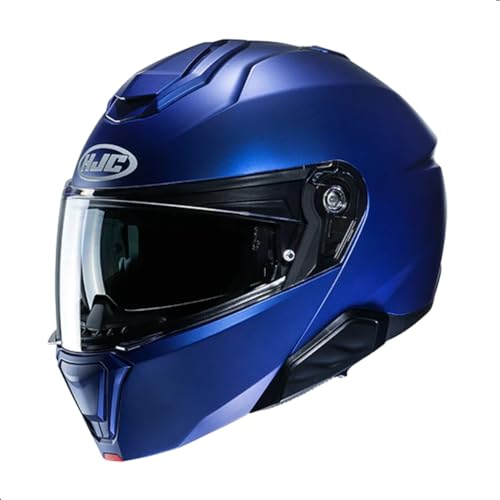
- What we like: intercom-ready speaker pockets and eyewear-friendly fit are genuinely well executed for the price.
- Sun shield drops without the chin bar needing to be up.
Flaws but not dealbreakers: at only-a-few-left stock levels in popular sizes it sells out in waves, and like every modular it is marginally noisier and heavier than the equivalent full-face – that is physics, not a defect.
7. ILM Model 902 – the budget modular
ILM has quietly become the default first-helmet brand on Amazon, and the 902 is the reason: a dual-visor flip-up with DOT certification, quick-release buckle, and a matte shell that does not look like a toy, at roughly a third of the HJC’s price. For a passenger helmet, a backup lid, or a first-season commuter, it is the honest choice.
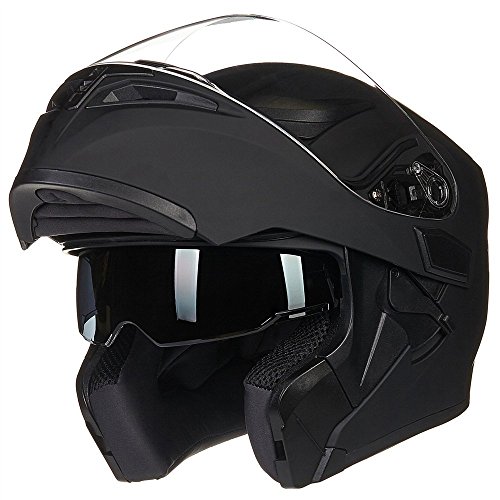
- What we like: six colorways and a true budget price without giving up the flip-up convenience.
- Venting is surprisingly effective for the class.
Flaws but not dealbreakers: the cheek pads run firm for the first weeks and the shield seal is adequate rather than excellent – expect a faint whistle above 60 mph. Both are the standard budget-tier trade-offs, not safety problems.
8. ILM Model 313 – the cheapest helmet we would actually wear
The 313 is the floor of the range: DOT-certified full-face, both clear and tinted visors included, and a compact ABS shell. MCN’s 2026 guide makes the same point we will: there are plenty of highly-rated budget helmets that achieve top safety scores, and this is the one on Amazon’s US shelf we would hand to a new rider without flinching.
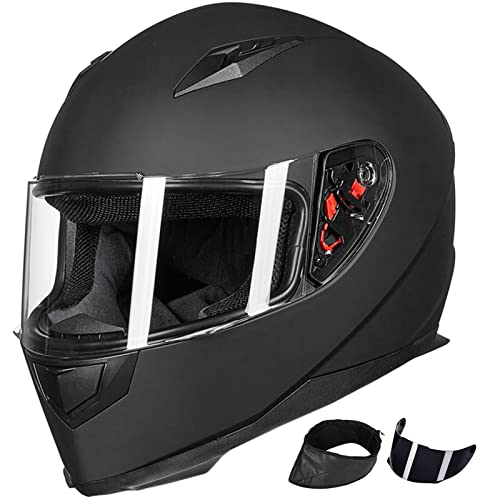
- What we like: two visors in the box at a price where most brands ship zero.
- Lightweight ABS shell keeps neck fatigue down on short rides.
Flaws but not dealbreakers: above city speeds the wind roar is real – budget this helmet with a $30 pair of earplugs and treat highway touring as out of scope. Its ventilation is basic, which shows in summer traffic.
What your money buys at each tier
Under $150 (Orthrus, ILM 902, ILM 313): DOT-certified protection is not the question – the FMVSS 218 standard applies to every helmet sold for street use in the US regardless of price. What changes here is comfort engineering: shield seals, liner materials, noise, and the absence of Pinlock anti-fog systems. Buy this tier for short commutes, passenger use, or as a first helmet, and budget for earplugs.
$150-$320 (AGV K1 S, Bell DLX MIPS, ScorpionEXO Covert FX, HJC i91): this is where rotational-impact protection (MIPS), Pinlock-ready shields, and better shell composites appear. If you ride more than a couple of hours a week, this tier is the sweet spot – the Bell and AGV picks deliver most of the premium-lid experience for half the money.
$400+ (Shoei RF-1400, Technics-class premium lids): beyond this line you are paying for wind-tunnel time, emergency cheek-pad release systems, and quieter shells. The RF-1400 earns its money on all-day comfort and resale. Above $600 you are buying graphics and race homologation, not meaningfully better protection – that is the point where paying more stops buying performance.
Where we disagree with the UK testers
MCN and Bennetts BikeSocial both steer readers toward ECE 22.06 – the newer European standard with rotational-impact and low-speed test points that DOT lacks – and if you are buying in the UK, they are right. But their best-helmets lists are full of lids that are either unavailable or gray-market on Amazon US. Our ranking stays DOT-first for a practical reason: the US Amazon shelf is overwhelmingly a DOT marketplace, and a listing that only says “DOT” is self-certified under FMVSS 218, which (unlike the European system) has no independent pre-market approval step at all. That is exactly why we weight hands-on tester records and chart endurance more heavily here than any logo – and why our premium pick is a Shoei whose shells are, per the brand, also tested to ECE regardless of market. It is not that the UK testers are wrong; their market just has a working safety net ours does not.
Complaint patterns to expect
- Budget full-faces ($80-$150): the recurring one-star theme is shield fogging in cold rain and wind whistle above 60 mph – the seal, not the shell, is what the price cuts.
- Modular helmets: a minority of owners report chin-bar rattle developing after a year of daily flipping; keep the pivot screws torqued per the manual.
- Premium lids: complaints cluster around shield mechanism stiffness in the first week and cheek-pad break-in, both of which settle. Genuine fit problems are rare and usually mean the wrong shell size, not a defect.
- All tiers: sizing is the #1 return driver. Measure your head circumference and use the brand chart – “Large” is not a size, it is a guess.
DOT, ECE 22.06 and when to replace a helmet
Every street helmet sold in the US must comply with FMVSS No. 218 (49 CFR 571.218), the federal motor vehicle safety standard that defines impact attenuation, penetration resistance, retention-system strength and labeling. Unlike ECE 22.06 – which is type-approved by independent labs before a helmet goes on sale in Europe – DOT is a self-certification system: the manufacturer tests and certifies, and the government audits after the fact. The practical takeaway for an Amazon shopper: treat “DOT” as the floor, not the decision. The decision should be the shell brand’s track record, the fit, and features like MIPS and Pinlock.
When to replace: after any significant impact (the EPS liner crushes once, and it does not recover), when the fit loosens with liner age, and as a rule of thumb every five to seven years even if it looks fine – MCN’s guide and the helmet makers’ own guidance converge on that window, because adhesives, resins and liner foams age whether you ride or not.
FAQs
Are expensive motorcycle helmets actually safer?
All of them must pass the same federal floor. What premium money buys is better energy management margin, quieter shells, comfort, and features like MIPS – meaningful, but not a linear safety gain. A correctly fitted $250 MIPS helmet is a smarter spend for most riders than a poorly fitted $600 one.
Can I use a motocross helmet on the street?
Only if it is DOT-certified for street use, and know the trade-offs: the extended chin bar and goggle platform add wind noise and lift at highway speed. The ILM dirt lid on our list is DOT-rated, but the full-faces above are the better street choice.
How do I know my helmet size?
Measure the circumference of your head about an inch above your eyebrows and compare it to the brand’s size chart – every pick on this page has one on its listing. The helmet should feel uniformly snug without pressure points; it will break in, not break open.
Is a Bluetooth helmet or headset safe to use?
Rider-assist comms are legal in most jurisdictions, but audio volume matters: the NIH’s National Institute on Deafness and Other Communication Disorders notes that repeated exposure to sounds at or above 85 decibels can cause hearing loss over time. Wind noise at highway speed alone approaches that – earplugs plus low comms volume is the correct setup, not more volume.
The bottom line
If you want one helmet and money is secondary, the Shoei RF-1400 is the reference the rest of this page is measured against. For most riders, the Bell Qualifier DLX MIPS at its $299.95 list is the smartest safety-per-dollar pick on Amazon right now, and the Orthrus is the chart-proven budget anchor. And when the helmet is on and the garage is calling, our motorcycle lift guide covers the other half of a serious setup. Whatever you choose, buy it new, fit it right, and replace it after every crash – the best helmet is the one that is on your head, correctly sized, every single ride.