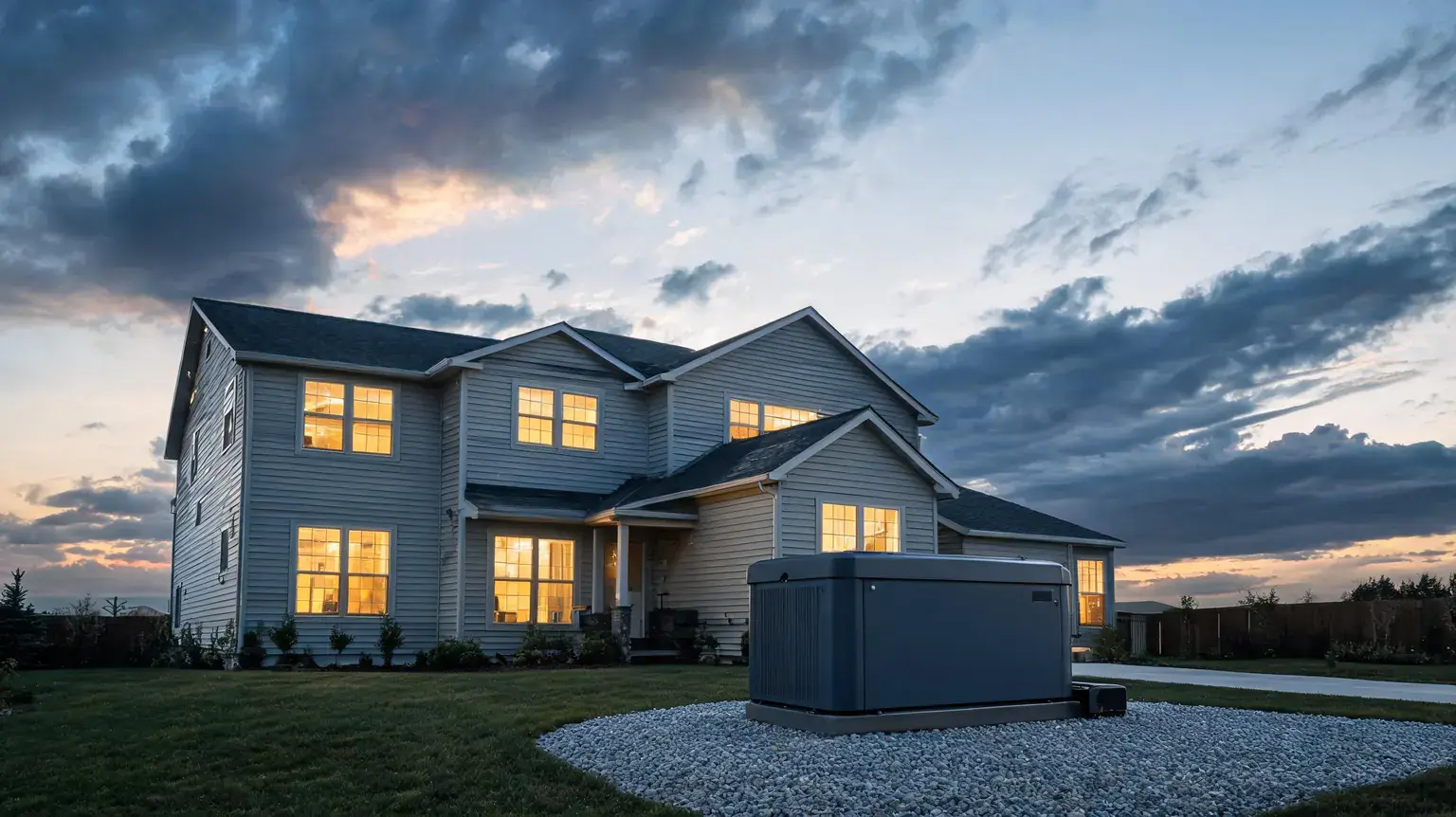
The best whole house generators on Amazon right now split into two different philosophies: automatic standby cabinets that start themselves when the grid drops, and tri-fuel portables that pair with a transfer switch for a fraction of the price. This guide ranks nine of both — a $1,499 Westinghouse that is currently the highest-ranked whole-home-capable unit in Amazon’s Generators chart, a Generac 22kW standby bundle with the transfer switch in the box, and a DuroMax workhorse at 40% off list. Every price, stock flag, and best-seller rank below was pulled live from Amazon’s product API on October 17, 2026, and every pick is cross-checked against two independent testing teams plus the federal guidance on running a generator without endangering your household.
As an Amazon Associate I earn from qualifying purchases. We earn commission from qualifying purchases made through links on this page. This never affects our rankings or what we recommend.
- How we picked and tested
- The nine picks at a glance
- The nine whole-house generators, reviewed
- What size generator actually runs your house
- What your money buys at each price tier
- Where we disagree with the other testers
- Standby vs. portable
- Transfer switches and installation
- Generator safety rules that matter
- Failure modes: what breaks and what buyers hit
- FAQ
- The bottom line
How we picked and tested
Every unit on this page is sold, stocked, and buy-boxed on Amazon as of October 17, 2026 — we pulled each candidate through Amazon’s own product API, confirmed the buy-box price and stock status, checked that the brand matches the listing (no squatted or mismatched listings made the cut), and recorded each unit’s live best-seller rank inside the Generators category. Where the API returned no star-rating payload, the cards below simply ship without stars rather than with invented numbers.
Here is what is hands-on and what is not: we do not operate a generator test bench, so every mechanical judgment in this guide rests on three kinds of ground — the manufacturers’ published specifications, the two independent testing teams cited below, and an installer-side guide for the realities only dealers see. The sizing math, the price-tier analysis, the disagreement notes, and the failure-mode patterns are our own analysis, built from that data plus the live listings. Our full process lives on our how we test page.
· Ready.gov — Power Outages: the federal 20-foot generator placement rule and carbon-monoxide detector guidance (fetched in full for this guide).
· Consumer Reports — 5 Best Whole-House Generators of 2026, Lab-Tested and Reviewed: load and voltage-spike bench testing of standby units; the ratings tables themselves sit behind a CR membership, which we disclose rather than paraphrase.
· Popular Mechanics — The 9 Best Home Generators of 2026, Tested: first-start, assembly, and load testing across portable and standby classes.
· M.T. Ruhl — Best Whole House Generators for Home Standby Power: an installing Generac dealer’s comparison of Generac, Kohler, and Cummins — the installer-side view of reliability and transfer switches.
One more honesty note: CR’s full ratings are paywalled and we will not pretend otherwise — we use their published testing description, not their ordering. Popular Mechanics’ testing, per its own methodology section, weights “the difficulty of unboxing, assembling, and starting each generator for the first time,” and its testers verified that each unit “can handle the load it’s designed for” — that description informed our what-we-like calls but every ranking decision here is ours.
The nine picks at a glance
The table below is generated from the same live API pull as the cards — prices, discounts, stock, and category ranks move, and the table and cards are refreshed together on a regular schedule.
| Product | Standout spec | Price | Track record | Deal |
|---|---|---|---|---|
 Generac Generac 22kW Whole Home Generator, Transfer Switch & Cellular Capability | Who |
Whole House Protection: Keep your family comfortable and connected during power outages. Avoid | $6,506.10 $7,229.00 |
#128 in Generators |
10% OFF Only 6 left in stock – order soon. |
Generac Generac 14kW Whole Home Generator, Transfer Switch & Cellular Capability | Who |
Whole House Protection: Keep your family comfortable and connected during power outages. Avoid | $5,255.10 $5,839.00 |
#128 in Generators |
10% OFF |
Generac Generac 24kW Whole Home Generator, Transfer Switch & Cellular Capability | Who |
Whole House Protection: Keep your family comfortable and connected during power outages. Avoid | $6,875.10 $7,639.00 |
#128 in Generators |
10% OFF Only 2 left in stock – order soon. |
 Generac Generac Guardian 22kW Home Generator, Transfer Switch & WiFi Monitoring | Whol |
Remote Monitoring Anywhere: With Generac 7043 22kW Mobile Link Wi-Fi connectivity, effortlessly | $8,145.01 |
#513 in Generators |
Only 16 left in stock – order soon. |
 Champion Power Equipment Champion Power Equipment 100837 14kW Home Standby Generator System, 200-Amp aX |
Whole House Power: The aXis ATS200 Whole House Automatic Transfer Switch provides managed power | $5,499.00 |
#1608 in Generators |
Only 2 left in stock – order soon. |
 Westinghouse Westinghouse 14500 Peak Watt Tri-Fuel Home Backup Portable Generator, Remote E |
Automatic Home Backup Made Portable: Pair with the Westinghouse WATS200 Automatic Transfer Swit | $1,499.00 |
#66 in Generators |
In Stock |
 DuroMax DuroMax XP13000HXT 13,000-Watt 500cc Tri Fuel Gas Propane Natural Gas Portable |
With 13,000 watts of power, the XP13000HXT Tri Fuel generator will keep your whole home running | $1,499.00 $2,499.00 |
#48 in Generators |
40% OFF |
 Westinghouse Westinghouse 28000 Peak Watt Tri-Fuel Home Backup Portable Generator, Remote E |
Automatic Home Backup Made Portable: Pair with the Westinghouse WATS200 Automatic Transfer Swit | $3,899.00 |
#180 in Generators |
Only 15 left in stock (more on the way). |
 DuroMax DuroMax XP28000iHT 28,000-Watt Tri Fuel Portable Digital Inverter Generator – |
28,000 Watts of Quiet, Clean, Sine Wave Power — Powers your whole home quietly and with ease. | $7,999.00 |
#374 in Generators |
In Stock |
The nine whole-house generators, reviewed
1. Generac 22kW — best standby overall
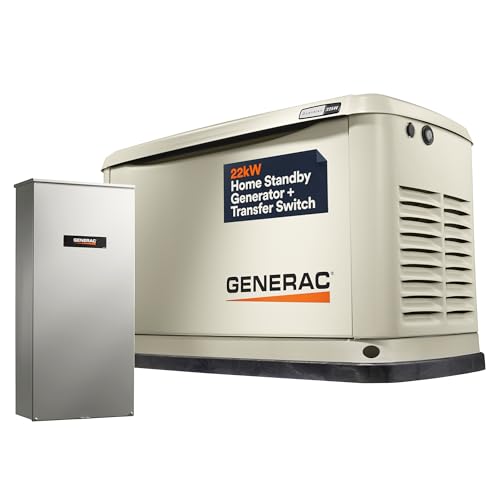
This is the generator most whole-house buyers should price first. Twenty-two kilowatts covers the starting surge of a five-ton central AC, the well pump, the fridge, the freezer, the water heater, and the rest of a typical 3,000-4,000 sq ft home without load-shedding gymnastics, and this trim ships with the automatic 200-amp transfer switch and cellular monitoring in the box. The newer “Whole Home” cellular hardware has effectively replaced the older Guardian Wi-Fi trim in Generac’s own lineup at a lower price with the same output — which is exactly why it takes our top standby slot rather than its pricier sibling below.
What we like:
- Ships with the automatic 200-amp transfer switch and cellular connectivity included — no second box to buy
- 22kW covers the AC start-up surge plus essential circuits for most 3,000-4,000 sq ft homes
- 10% below list at publish (October 17, 2026) and the exact class Popular Mechanics names its Best Standby for Automatic Backup
Flaws but not dealbreakers: at $6,506.10 before installation, this is a four-figure appliance bolted to a four-figure install — pad, gas or propane line, switch wiring, and permits are separate line items, and only six units were in stock at publish. The cellular monitoring requires a subscription after the trial period, and standby ownership itself is a maintenance commitment: exercise cycles, battery checks, and annual service are on you. Skip it if your home is under roughly 2,500 sq ft without central air — the 14kW below covers that house for $1,250 less.
2. Generac 14kW — best value standby
Fourteen kilowatts is the honest entry point to true whole-home standby, and this trim is the cheapest way to get a name-brand unit with the transfer switch bundled rather than bolted on later. It will not run a five-ton AC and an electric dryer at the same time — nothing in the 14kW class will — but for essential circuits plus one or two big loads, it is the value pick in Generac’s current range. The same cellular monitoring and 200-amp automatic switch from the 22kW carry over unchanged.
What we like:
- Cheapest Generac that still includes the automatic 200-amp transfer switch and cellular monitoring
- The right size for essential circuits plus one large load in mid-size homes
- Currently 10% off list ($5,255.10 vs $5,839.00) — the softest standby entry price on this page
Flaws but not dealbreakers: 14kW demands load discipline in bigger homes — run the AC and the electric water heater together and the unit will shed or trip, so households that want to forget the outage is happening should step up to the 22kW. The install cost is nearly identical to the bigger unit’s, which means the percentage overhead is worse, and stock has been choppy on this trim all fall. Skip it if you already know your load calc exceeds about 12,000 running watts — you would be buying the wrong size to save $1,000.
3. Generac 24kW — best standby for large homes
The 24kW sits deliberately between the 22 and 26kW classes for houses whose load calc lands just above what 22kW comfortably carries — big footprint, two AC zones, an electric range, or a large shop load. It carries the same bundle as the rest of the Whole Home line: automatic 200-amp switch, cellular monitoring, weather-activated self-testing. In practice it is the “stop doing math and buy headroom” pick.
What we like:
- Headroom for two AC zones, electric range, and shop loads without load management hardware
- Same cellular monitoring and automatic 200-amp switch bundle as the rest of the Whole Home line
- Weather-activated exercise means the unit self-tests under storm watch, not just on a timer
Flaws but not dealbreakers: at $6,875.10 (10% off list at publish) it sits within about $400 of the 26kW class — check that price gap before committing, because the calculus flips if the bigger unit goes on sale. Only two units were in stock at publish, and every extra kilowatt here buys comfort, not efficiency: fuel burn at half load is meaningfully higher than the 14kW’s. Skip it if your load calc fits the 22kW — headroom you never use is money idling in the yard.
4. Generac Guardian 22kW — the established name, Wi-Fi flavor
This is the Guardian 22kW — the long-running line that built Generac’s dealer reputation and the model class Popular Mechanics spotlights as its Best Standby for Automatic Backup. Mobile Link Wi-Fi monitoring, natural gas or propane, automatic transfer, and a parts-and-accessories ecosystem built over a decade of production. For buyers who want the unit every local service tech already knows, this is the one — it is simply no longer the smartest dollar-for-dollar pick, which is why the newer cellular trim outranks it here.
What we like:
- The established Guardian platform: a decade of production, huge parts and service ecosystem
- Mobile Link Wi-Fi monitoring included — the exact class Popular Mechanics names Best Standby for Automatic Backup
- Runs on natural gas or propane with automatic transfer via the included 200-amp switch
Flaws but not dealbreakers: at $8,145.01 it is the most expensive 22kW on this page — roughly $1,600 more than the newer Whole Home cellular trim with the same core output, and only 16 units were in stock at publish. The Wi-Fi monitoring depends on your home network staying up, which is exactly what an outage takes down unless you back it up. Skip it if price matters: you are paying for brand familiarity and service-network comfort, not additional watts.
5. Champion 14kW aXis — the lab-tested challenger
Champion’s 14kW system is the credible alternative to the Generac value pick, and it matters that Consumer Reports lab-tests Champion standby units by name — its whole-house generators piece opens with Champion, Generac, and Kohler as the brands on the bench. The aXis 200-amp all-home transfer switch handles managed power with Wi-Fi setup, and the package price undercuts the equivalent Generac bundle by a hair at publish. For buyers who want standby without paying the category-leader premium, this is the challenger worth quoting to your installer.
What we like:
- Consumer Reports lab-tests Champion standby units by name — real bench data behind the brand
- aXis 200-amp all-home transfer switch with managed power and Wi-Fi setup included
- Package price undercuts the equivalent Generac 14kW bundle at publish
Flaws but not dealbreakers: only two units were in stock at publish — this trim cycles through stock and shipping is freight-class, so timing is luck. Champion’s installer network is thinner than Generac’s in some regions, which matters because standby is an install-first product, and the Amazon review pool on this specific system is small next to the category leader’s. Skip it if your installer quotes you a week of labor to adapt a non-native switch — the bundle advantage evaporates the moment compatibility work begins.
6. Westinghouse 14,500W tri-fuel — best budget whole-home backup
Here is the chart reality of whole-home backup on Amazon: this Westinghouse is the highest-ranked unit on this page in Amazon’s own Generators category — #66 among thousands of generators — and it costs $1,499, roughly a quarter of the standby picks. It is a portable, not a cabinet in the yard: 14,500 peak watts, tri-fuel out of the box (gasoline, propane, and a natural-gas hose included), remote electric start, and transfer-switch-ready 240V output. Westinghouse’s own listing is explicit that pairing it with the WATS200 automatic transfer switch converts it to automatic home backup — that switch is sold separately. For a handy homeowner, this is the cheapest legitimate path to backing up a furnace, fridge, freezer, lights, and a mid-size AC.
What we like:
- #66 best seller in Generators — the highest chart position of any pick on this page
- Tri-fuel with the natural-gas hose included, remote electric start, 14,500 peak watts for $1,499
- Transfer-switch-ready 240V output — pair with the WATS200 (sold separately) for automatic backup
Flaws but not dealbreakers: it is loud in the way open-frame portables are — an enclosed standby this is not — and “transfer switch ready” means you budget another few hundred dollars and an electrician for the switch. Between outages you roll it out, fuel it, and start it yourself unless you invest in the WATS200. Skip it if you want zero hands-on steps during an outage or your HOA forbids portable units outdoors — that buyer is the standby customer, and no $1,499 portable will change that.
7. DuroMax XP13000HXT — best mid-size portable
DuroMax’s XP13000HXT is the deal of the portable field at publish: $1,499 against a $2,499 list — 40% off — for 13,000 peak watts of tri-fuel power with a CO Alert shutdown sensor and 240V transfer-switch output. Popular Mechanics named the sibling XP11000iH its Best Overall home generator; the HXT trim carries the same tri-fuel DNA with 2,000 more peak watts for $1,000 less than the iH’s price at publish. When two trims of the same family sit on the same shelf, we rank the value trim and say so — that is the whole logic of this slot.
What we like:
- 40% off list at publish: $1,499 for 13,000 peak watts — the deepest verified discount on this page
- Tri-fuel (gas, propane, natural gas) with CO Alert shutdown and 240V transfer-switch output
- Same tri-fuel family Popular Mechanics named Best Overall, with more wattage for less money
Flaws but not dealbreakers: open-frame 500cc-class engines are loud — plan placement at least 20 feet from the house per the safety rules below — and the transfer switch is still a separate purchase. Deep-discount pricing on big generators moves fast; verify the current tag before you order. Skip it if noise-sensitive neighbors are close by or if you will not wire a transfer switch or interlock — running extension cords through a window is not whole-house backup, it is camping with extra steps.
8. Westinghouse 28,000W tri-fuel — best big portable
Twenty-eight thousand peak watts in a wheeled package — the Westinghouse 28000 is what you buy when the house is big, the well is deep, and the shop has machines that pull like a decade ago’s service panel. It is tri-fuel like its smaller sibling, transfer-switch ready, remote start, and rated for the kind of loads — five-ton AC, well pump, electric everything — that make 14kW owners shed circuits. Only 15 units were in stock at publish (with more on the way), which tells you how niche — and how demanded — this class is.
What we like:
- 28,000 peak watts — the largest verified peak rating of any pick on this page
- Tri-fuel with remote electric start and transfer-switch-ready 240V output
- Runs five-ton AC, well pump, and electric appliances without load-shedding math
Flaws but not dealbreakers: this is a heavyweight freight-class unit — placement, fuel line, and switching are professional-work territory, and at $3,899 it overlaps Generac standby money (compare picks 1-3 before choosing portability). It is still an open-frame portable acoustically; do not expect standby silence. Skip it if your home is under roughly 3,000 sq ft with standard electric service — you would be paying for capacity you cannot use.
9. DuroMax XP28000iHT — the portable that thinks it is a standby
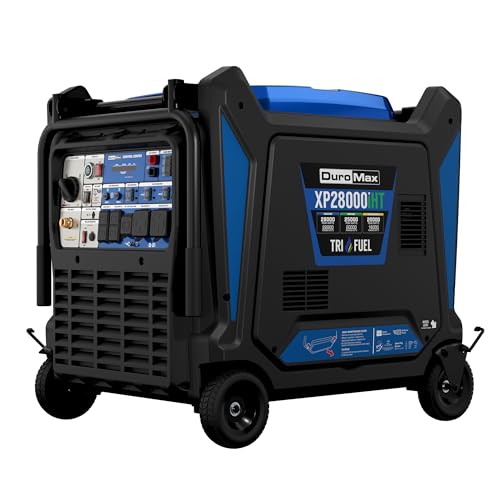
DuroMax’s XP28000iHT is the ceiling pick: 28,000 watts of digital-inverter sine-wave power, tri-fuel, remote start, and clean enough output for the sensitive electronics that make cheaper open-frame units nerve-racking. This is the portable for buyers who genuinely need standby-class capacity — large properties, outbuildings, small farms — but want the option to load it on a trailer. At $7,999 In Stock at publish, it costs about as much as the Generac 22kW with its switch; the choice between them is a lifestyle choice, not a spec choice.
What we like:
- 28,000 watts of clean digital-inverter sine-wave power — safe for sensitive home electronics
- Tri-fuel flexibility with remote electric start and transfer-switch-ready output
- The only pick on this page that combines standby-class capacity with portability
Flaws but not dealbreakers: at $7,999 you are inside standby money — if the unit will never leave the pad, buy pick 1 and pocket the portability premium. It is heavy enough that “portable” means wheels and a strong helper or a trailer hitch, and fuel consumption at high load is substantial in any fuel. Skip it if your total load calc sits under 15kW — the XP13000HXT above does the same job at one-fifth the price.
What size generator actually runs your house
Whole-house sizing is watt math, not square-foot guessing. Add up the running watts of what must stay on, then add the single largest motor start (an AC compressor or well pump) on top, because motor start-up draws two to three times running power. A fridge needs 600-800 running watts but about 2,000 to start; a five-ton central AC can demand 5,000+ watts at compressor start; an electric water heater alone pulls 4,000-4,500 continuously. That is why two houses with identical footprints can need wildly different generators — the electric-everything house is a 22kW-plus customer, and the gas-heat house may live happily on 14kW.
| Pick | Output | Fuel | Transfer switch | Price |
|---|---|---|---|---|
| Generac 14kW | 14 kW (standby rating) | Natural gas / propane | 200A automatic switch included | $5,255.10 |
| Generac 22kW | 22 kW (standby rating) | Natural gas / propane | 200A automatic switch included | $6,506.10 |
| Generac 24kW | 24 kW (standby rating) | Natural gas / propane | Automatic switch included | $6,875.10 |
| Generac Guardian 22kW | 22 kW (standby rating) | Natural gas / propane | 200A automatic switch included | $8,145.01 |
| Champion 14kW aXis | 14 kW (standby rating) | Natural gas / propane | 200A aXis switch included | $5,499.00 |
| Westinghouse 14,500W | 14,500 peak / 11,500 running* | Gas / propane / natural gas | WATS200 sold separately | $1,499.00 |
| DuroMax XP13000HXT | 13,000 peak / 10,500 running* | Gas / propane / natural gas | Sold separately | $1,499.00 |
| Westinghouse 28,000W | 28,000 peak / 20,000 running* | Gas / propane / natural gas | Sold separately | $3,899.00 |
| DuroMax XP28000iHT | 28,000 peak / 22,000 running* | Gas / propane / natural gas | Sold separately | $7,999.00 |
One spec-claim reality check the marketing blurs: “transfer switch ready” on the portable picks means ready, not included — Westinghouse’s own listing states the WATS200 switch is what converts its 14,500W unit to automatic backup, and that switch is a separate purchase. The standby picks, by contrast, put “Transfer Switch” in the title because the automatic switch is in the box. Read that line on every listing you compare; it is a four-figure difference dressed up as a bullet point.
What your money buys at each price tier
$1,499-$2,600 — the portable tier. The Westinghouse 14,500W and the discounted DuroMax XP13000HXT live here, and this is the tier where your labor is the hidden cost: you supply the transfer switch or interlock, the placement, the fueling, and the starts. What you get is genuine whole-home-capacity backup (11,500-10,500 running watts) and fuel flexibility no standby offers — plus the ability to move the unit to a worksite or RV.
$3,899-$5,500 — the crossover tier. The Westinghouse 28,000W and the two 14kW standby systems sit here. This is where the portable-versus-standby decision actually gets made: a big portable buys capacity and flexibility, a 14kW standby buys automation and silence. Paying more stops buying raw performance somewhere in this band and starts buying autonomy.
$6,300-$8,400 — the full-automation tier. Generac’s 22-24kW bundles and the XP28000iHT occupy it. Above roughly 22kW with the switch included, you are paying for a house that does not notice outages: automatic start, self-testing, cellular monitoring, and coverage of electric-everything homes. The point where paying more stops buying anything real is the Guardian trim — its $8,145 price buys brand comfort, not additional output, which is why it ranks below its own cheaper sibling.
Where we disagree with the other testers
Popular Mechanics’ Best Overall is not on this page — on purpose. PM named the DuroMax XP11000iH ($2,499 at its testing) its overall winner. We do not disagree with the pick; we disagree with paying its price when the same family’s XP13000HXT trim was $1,499 at publish with 2,000 more peak watts. When two trims of one family share a shelf, the value trim wins our slot and the premium trim gets named, not ranked.
We agree with PM’s standby call — and still rank its model class second. PM’s Best Standby for Automatic Backup is the Generac 22-kilowatt class, and our own #1 is that same 22kW output class. But PM tested the platform; we rank listings, and the newer Whole Home cellular trim undercuts the legacy Guardian Wi-Fi unit by about $1,600 for the same watts and switch. Our disagreement is with the price, not the machine.
And against the installer consensus, our portable-heavy list looks radical — deliberately. An installing dealer like M.T. Ruhl compares Generac, Kohler, and Cummins because an installer sells permanence: buried gas lines, automatic switches, maintenance contracts. That is the right answer for a house you never want to think about. It is not the right answer for the renter-of-generators economics — half the buyers searching this category cannot or will not fund a $2,000-plus install on top of the unit. Portables are what Amazon stocks in depth, what renters and worksite users actually buy, and what our chart leader (a $1,499 Westinghouse at #66 in the category) proves the market wants.
Standby vs. portable: which one is the whole-house pick for you
A standby generator is plumbed and wired permanence: it sits on a pad, feeds on natural gas or a propane tank, starts on its own within seconds of an outage via the automatic transfer switch, and exercises itself weekly. You never touch it. You pay for that automation in the unit price, a professional install, and ongoing maintenance — and you choose output once, for that house, forever.
A tri-fuel portable like our Westinghouse chart leader is a different contract: cheaper by thousands, movable, and fuel-agnostic in a crisis (gasoline, propane, or a natural-gas line), but manual — you roll it out, start it, and either run cords or wire a manual transfer switch or interlock so it can backfeed selected circuits safely. Pair it with a compatible automatic switch like the WATS200 and the gap narrows considerably, at the cost of a few hundred dollars and an electrician. The honest decision rule: if the words “I will just go start it” sound fine to you, buy portable; if the outage must be invisible, buy standby.
Transfer switches and installation: the second invoice
Every standby pick on this page includes its automatic transfer switch; every portable pick requires one, and the switch plus install is where budgets break. An installing dealer’s guide — like the M.T. Ruhl piece cited above — treats the transfer switch as the first decision of the whole project, not an accessory, because the switch determines what the generator can carry and how automatically it carries it. A manual switch or interlock on a portable is a few hundred dollars of hardware plus an electrician visit; an automatic 200-amp standby install adds the concrete pad, the gas or propane run, permits, and a day or two of licensed labor.
Two rules protect you here. First, never backfeed a house through a dryer outlet or a suicide cord — the practice is illegal in most jurisdictions for good reason and it can electrocute a line worker down the street. Second, get the load calc done before you buy, not after: any licensed electrician or dealer will size the switch and unit to your actual panel in an hour, and that hour is the cheapest insurance in this entire purchase.
Generator safety rules that matter
Ready.gov’s power-outage guidance is blunt about placement, and we quote it verbatim because it kills people when ignored: “Generators and fuel should always be used outdoors and at least 20 feet away from windows, doors and attached garages.” Popular Mechanics’ testers frame the same rule from the fuel side: regardless of fuel, a generator “must always be operated 5 to 20 feet away from the home or any window or door, because the carbon monoxide exhaust is deadly.”
The rest of the federal checklist costs almost nothing: Ready.gov advises you to “install carbon monoxide detectors with battery backup in central locations on every level of your home” — detector batteries outlive the grid, which is the whole point. Never run a generator in a garage, even with the door open; let the unit cool before refueling; and store fuel in approved containers away from living spaces. The CO Alert sensors on the DuroMax picks are a backstop, not a strategy — the 20-foot rule is the strategy.
Failure modes: what breaks and what buyers hit
Standby units fail by neglect, not by breaking. The recurring failure pattern across the category is the sit-and-forget battery and skipped exercise cycles — a standby that never self-tests is a $6,000 paperweight with a fuel line. Install quality is the other failure source: an undersized or badly wired switch causes more callbacks than the engine side, which is why the installer-first framing above matters. Stock volatility is real too — at publish, six of our nine picks carried low-stock or freight-queue flags, so ordering ahead of storm season is not a sales tactic, it is logistics.
Portables fail by fuel and storage. Ethanol-blended gasoline left in a carburetor between seasons is the classic portable killer — run the carb dry or use fuel stabilizer, and the unit starts next spring. Popular Mechanics’ reviewers also note that Generac recalled a number of portable generators over a potentially faulty carburetor last year (their reviewed model was unaffected) — check any generator against the CPSC recall list before buying used. And the CO shutdown sensors on modern units will stop the engine in enclosed or upwind-wrong placements; that is the sensor doing its job, not the unit failing.
Tri-fuel conversion is professional work. Both Westinghouse portables and both DuroMax picks include or support natural-gas hoses, but tying into a home gas line is a licensed-plumber job in most codes. The hoses make the unit tri-fuel-capable; they do not make the hookup DIY.
FAQ
Can a portable generator really power a whole house? Yes — with a transfer switch and load discipline. The Westinghouse 14,500W carries 11,500 running watts, which covers the essentials plus a mid-size AC start in most homes; the 28,000W class covers genuinely everything. What it cannot do is make the handoff invisible — you (or your WATS200 switch) are the automation.
What size whole house generator do I need? Do the watt math in the sizing section: running watts of everything essential, plus the largest motor start. If the total lands under ~12,000 running watts, the 14kW class covers you; if a five-ton AC plus electric water heater and range all must run simultaneously, you are in the 22-24kW class. When in doubt, pay the electrician for the load calc — not the guess.
Do I need a transfer switch? For anything wired into the house, yes — both legally and physically. A transfer switch or interlock isolates your house from the grid so the generator cannot energize the line a worker is repairing, and it is what turns “extension cords through the window” into actual whole-home backup. Every standby pick includes one; every portable pick needs one purchased and installed.
How much does installation add to the price? More than buyers expect, honestly: the switch hardware, pad, gas or propane line, permits, and licensed labor on a standby install are a separate four-figure invoice from the unit price — which is precisely why our budget pick and disagreement section take the portable path seriously. Get the install quote before buying the unit; dealers quote both together.
How long can a generator run the house? A natural-gas standby runs as long as the utility gas flows — days to weeks with maintenance stops. Propane versions burn tank-dependent math (a 500-gallon tank feeds a 22kW unit at half load for roughly two to three days of continuous running). Portables refuel every 8-12 hours at heavy load — which is why the tri-fuel picks here matter: switching to a 20-pound propane tank or a gas line multiplies your run time without gasoline-run hunts.
The bottom line
If the outage must be invisible, the Generac 22kW bundle (pick 1) is the buy: automatic switch in the box, whole-home coverage, and the class the testers keep picking. If the budget is real and your hands are willing, the Westinghouse 14,500W tri-fuel at $1,499 — the chart leader of this entire category — plus a transfer switch delivers genuine whole-home backup for a quarter of standby money. And if you need maximum watts that can also travel, the XP28000iHT ends the argument. Prices and stock above are the live snapshot from October 17, 2026; check the cards for the current numbers before you order.
Related guides, verified the same way: if the outage kit needs rounding out, our best dishwashers guide covers the appliance side of outage recovery (and why Energy Star efficiency matters when the power bill comes back), our best portable generators roundup is the sibling guide to this page’s portable lane with smaller loads and lower prices, and our best wood stoves review is the fuel-based backup alternative for multi-day outages where gas lines run dry.