Best telescopes are the ones you will actually take outside again next weekend — which is why this guide ranks nine live-verified scopes by how fast they pay off their learning curve, not by magnification claims. We pulled prices, stock and best-seller ranks from Amazon’s product API for every pick on October 10, 2026, read the aggregated review-sentiment data on each listing to map recurring failure modes, and grounded the optics advice in NASA’s own skywatching guidance and two independent review teams that mount and look through these scopes. The nine scopes below run from a $44.99 kids’ gift scope to a $1,199 Schmidt-Cassegrain, and every one is in stock with verified pricing at build time.
Affiliate disclosure: As an Amazon Associate we earn from qualifying purchases. We earn commission from qualifying purchases made through links on this page. This never affects our rankings or what we recommend.
What’s in this guide
The nine picks at a glance
The set below deliberately covers four buying intents. If you’re shopping for a child, the NASA Lunar scope is the current #1 Best Seller in Telescopes and costs less than a video game. If you’re a beginner adult who doesn’t know the sky yet, the StarSense Explorer LT 114AZ points at objects using your phone. If you want the most aperture per dollar, the Sky-Watcher Heritage 150 and StarSense 8-inch Dobsonian are the classic light-bucket answers. And if you want the scope to find, track and shoot for you, the Dwarf Mini and NexStar 6SE bracket that lane. All nine were in stock (three running low) with verified pricing when this guide was built; the full data snapshot follows.
| Product | Standout spec | Price | Track record | Deal |
|---|---|---|---|---|
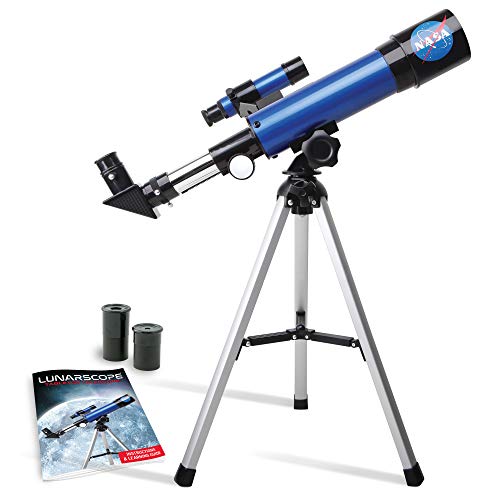 Blue Marble NASA Lunar Telescope for Kids Ages 8-12 with Tripod and Finder Scope |
Kids' refractor with tripod and finder scope, ages 8-12 | $44.99 |
#1 in Telescopes |
In Stock |
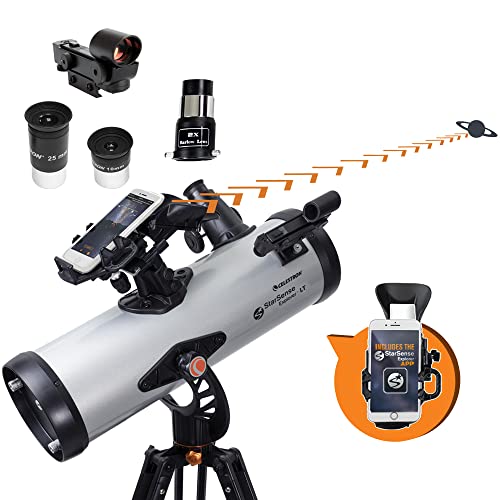 Celestron Celestron StarSense Explorer LT 114AZ Newtonian Smartphone Guided Telescope |
114AZ Newtonian with StarSense smartphone sky tours | $239.99 $259.95 |
#11 in Refractors |
8% OFF In Stock |
 Sky-Watcher Sky-Watcher Heritage 150 Tabletop Dobsonian Telescope – Perfect for Beginners, |
150mm tabletop Dobsonian (S11710), packs small | $309.00 $355.00 |
#5 in Reflectors |
13% OFF Only 3 left in stock – order soon. |
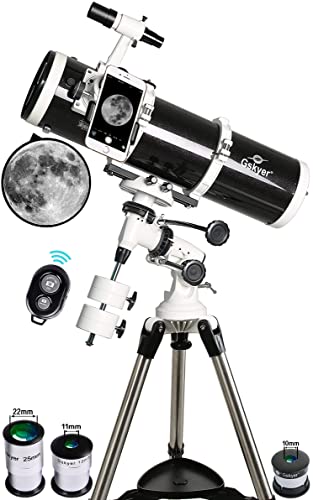 Gskyer Gskyer 130EQ Professional Astronomical Reflector Telescope |
130EQ equatorial reflector for Moon and deep sky | $329.99 |
#4 in Reflectors |
In Stock |
 DWARFLAB DWARFLAB Dwarf Mini Smart Telescope – 1.85lb Portable Astronomy Telescope |
1.85 lb smart astrophoto scope, app-controlled | $419.00 |
#1 in Reflectors |
In Stock |
 Celestron Celestron StarSense Explorer 150mm App-Enabled Tabletop Dobsonian Telescope |
150mm app-enabled tabletop Dobsonian | $509.99 $599.95 |
#4 in Telescopes |
15% OFF In Stock |
 Celestron Celestron NexStar 127SLT Maksutov-Cassegrain Computerized GoTo Telescope |
127mm Maksutov-Cassegrain, computerized GoTo | $679.99 $749.95 |
#12 in Reflectors |
9% OFF Only 7 left in stock – order soon. |
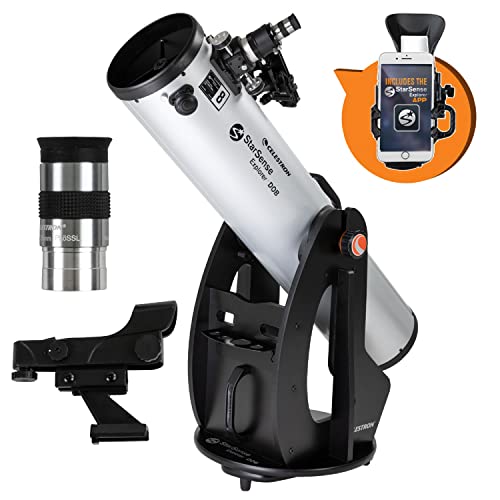 Celestron Celestron StarSense Explorer 8" Dobsonian Telescope with Smartphone App |
8-inch app-enabled Dobsonian with smartphone app | $879.00 |
#10 in Reflectors |
Only 3 left in stock – order soon. |
 Celestron Celestron NexStar 6SE Schmidt-Cassegrain Telescope – Computerized |
8-inch Schmidt-Cassegrain, computerized GoTo | $1,199.00 |
#1 in Catadioptric |
In Stock |
How we chose these nine telescopes
We don’t run an observatory, and we won’t pretend otherwise — our testing methodology page explains exactly what is hands-on, what is spec and listing analysis, and what we aggregate from reviewers who do mount and look through the hardware. For this guide: we pulled live pricing, stock, best-seller ranks and review averages from Amazon’s product API for every scope on October 10, 2026; we read the aggregated review-sentiment summaries on each listing to map recurring failure modes; and we leaned on NASA’s skywatching guidance plus two independent review teams for the optics claims. Every ASIN was verified live — title, brand match, price, availability — before it earned a slot, and each card below carries the date its price was checked. Review counts on Amazon’s pages disagreed between page regions at scrape time for several picks, so where we quote a count we treat it as approximate.
Key sources
NASA Science — Skywatching — the agency’s skywatching hub, our source for what’s observable in October 2026 and for honest expectations of beginner instruments. Live Science — the 2026 edition of its best-telescopes guide, with hands-on observations of the NexStar 8SE and Inspire 100AZ. Popular Science — expert-consulted telescope recommendations including the Amateur Astronomers Association of New York. Sky & Telescope — the stargazing-basics resource we cite for beginner setup guidance (article pages bot-walled; hub cited by title only).
A note on honesty: where we quote a source, we quote what they actually published. Where a claim comes from a manufacturer’s listing — a magnification figure, an app feature — we say so. Sky & Telescope’s deep article pages sit behind a bot-wall we could not fetch, so their stargazing-basics hub is cited by title with no quoted claims; the beginner-guidance in this piece comes from sources we could read in full.
Why October 2026 is a genuinely good month to buy
Timing a telescope purchase to the sky’s calendar is the cheapest upgrade there is, and NASA’s Skywatching hub hands you three reasons this month: Saturn at opposition (the ringed planet at its brightest and biggest in the eyepiece), the Orionid meteor shower, and the Moon passing close to the Pleiades — also known as the Seven Sisters. NASA’s page also settles the “which instrument first” question in a way that surprises many shoppers: in its How-To tips it calls binoculars “an excellent first instrument for skywatching because they are generally easy to use and more versatile than most telescopes,” and notes that “often the answer to the question, ‘What is the best telescope for a beginning observer?’ is ‘A pair of binoculars.'” We agree with the logic and made the same call in our best binoculars guide — but binoculars show you a wide, faint patch of sky, while “a telescope shows only a tiny patch,” as NASA puts it. If planets, Saturn’s rings and lunar craters are the goal, the telescope is the tool, and every pick below shows all three.
NASA’s guidance also sets the right expectation about what beginners can see without any instrument at all: “Five planets in our solar system are easily observed without a telescope: Mercury, Venus, Mars, Jupiter and Saturn.” A telescope’s job is to turn those naked-eye dots into disks with detail — Jupiter’s cloud bands and moons, Saturn’s rings, the Moon’s terminator craters — and that transformation starts at surprisingly small apertures, which is why the $44.99 pick below can still deliver a real Saturn moment for a child.
The magnification lie — and what actually matters
Every cheap telescope listing screams magnification: “600x!” “15x-150x!” Here’s the spec-claim reality check the whole industry deserves: magnification is the easiest number to inflate and the least connected to what you’ll see. Useful magnification is capped by aperture — a scope with a 50mm lens tops out around 100-150x in the real world, and pushing past that just makes a dim blurry disk bigger. The number that actually predicts views is aperture: the 203mm mirror in an 8-inch Dobsonian collects roughly 840 times more light than the dark-adapted human eye’s ~7mm pupil (our arithmetic: 203² ÷ 7²), which is why it shows galaxies that no amount of magnification on a 60mm toy will ever reveal. Live Science’s review team says the same thing in spec form — its best-overall NexStar 8SE wins on its “8-inch aperture” and “extremely bright and sharp views,” not its zoom.
Three practical rules follow from that. First, treat any listing that leads with “magnification” over “aperture” as marketing-first. Second, the Moon, Saturn and Jupiter are reachable targets for every scope in this guide — the failure mode that actually kills beginner enthusiasm is finding things, not seeing them, which is why app-guided scopes (three picks below) earn their premiums. Third, expect the first night to be setup, not discovery: align the finder, let the scope reach outside temperature, start with the Moon. Sky & Telescope’s beginner setup guidance — “How To Start with Your New Telescope” by Alan MacRobert, updated December 2025 on their stargazing-basics hub — is the free second opinion on this exact point.
The picks, reviewed
Each review states what the scope is, what live data shows, what owners consistently praise, where it fails — the “Flaws but not dealbreakers” line at the end of every review is where the recurring 1-star themes live — and one concrete disqualifying scenario. Every card’s price was verified via Amazon’s product API on 2026-10-10.
1. NASA Lunar Telescope — the current #1 Best Seller in Telescopes, and the right gift for the right kid
Amazon’s #1 Best Seller in the Telescopes category right now is this licensed NASA kids’ scope from Blue Marble — and that rank is live-verified from Amazon’s category data, not a listing badge. At $44.99 it costs less than a month of streaming, and it ships with the two things every kids’ scope actually needs: a stable tripod and a finder scope to aim it. It is a 50mm-class refractor built for ages 8-12, and its job is exactly two targets — the Moon’s craters and, with patience, Saturn — at a price where a fleeting interest doesn’t become a garage-sale regret. At verification it held a 4.1-star average across roughly 246 ratings.
What we like:
- The current #1 Best Seller in the exact category this guide targets — the market’s default kid-gift answer, verified live.
- Includes tripod and finder scope at a price where “trying the hobby” is the whole point.
- The NASA license is real and the Moon-target framing is honest — its best target is the one always in the sky.
Our score: 3.5/5. As an adult instrument it’s a toy; as a $45 gateway for an 8-year-old it does its job.
Flaws but not dealbreakers: the aggregated review data is blunt — some buyers report they “can’t see anything through it,” and assembly and ease-of-use split sharply, with some finding it easy and others struggling to operate it with a child. That’s the classic cheap-kids-scope failure mode: the finder isn’t aligned out of the box, so the child aims at nothing but blur. Spend ten minutes aligning the finder scope on a distant rooftop object before handing it over, start on the full Moon, and set the expectation that planets are small disks, not Hubble shots.
Who should skip it: any adult beginner, or a child under 8 — the fine aiming and eye positioning will frustrate both. Adults should start with the LT 114AZ below.
2. Celestron StarSense Explorer LT 114AZ — the beginner scope that solves the finding problem
The single biggest killer of beginner telescopes isn’t optics — it’s the twenty minutes of failed star-hopping that end with the scope back in its box. The StarSense Explorer LT 114AZ attacks exactly that failure: Celestron’s app uses your phone’s camera to plate-solve the stars above you, then walks you, with on-screen arrows, to whatever’s up tonight. Under the hood it’s a proper 114mm Newtonian reflector at $239.99 (8% off the $259.95 list), holding a 4.1-star average across about 3,445 ratings at #11 among refractors at verification. Owners describe it as a great starter scope with clear views of the Moon and good value for money.
What we like:
- StarSense app guidance removes the #1 beginner failure mode: not being able to find anything.
- 114mm of aperture at $239.99 beats the light-gathering of comparably priced beginner refractors.
- About 3,445 ratings — the deepest owner track record among the sub-$400 picks here.
Our score: 4.5/5. Our best-for-most pick: the fastest route from box to Saturn.
Flaws but not dealbreakers: the app splits opinion — most owners are happy, but a recurring minority report app connectivity or functionality issues, so have the manual star chart as a fallback. More substantively, stability and alignment draw real complaints: some owners report the tripod “doesn’t stay stable” and that vibrations knock objects out of view immediately. Observe from solid ground (not a deck), extend the tripod legs only as far as you must, and let the scope settle between nudges. It’s also a manual alt-az mount — tracking is by hand.
Who should skip it: anyone who already knows the sky — you don’t need the app’s help, and the Heritage 150 below gives you more aperture for the same money.
3. Sky-Watcher Heritage 150 — the most aperture per dollar, and it packs into a closet
Dollar-for-aperture, nothing in amateur astronomy beats a tabletop Dobsonian, and the Heritage 150 is the proof: a 150mm (6-inch) parabolic reflector at $309.00 (13% off the $355 list), sitting at #5 among reflectors at verification with a 4.2-star average. The design is a tube short enough to carry one-handed and set on a picnic table, balcony rail or car hood — owners praise the ease of setup (“ready to use right out of the box,” per the aggregated review data), image quality with “great views of both planets and deep space objects,” and the way it packs up small. One collector’s note at publish time: Amazon shows Only 3 left in stock — this design sells through and restocks on its own schedule.
What we like:
- 150mm of aperture at $309 — more light than any other scope near this price.
- Tabletop Dobsonian simplicity: no tripod legs, no electronics, no app required, sets up in minutes.
- Owners confirm planets and deep-sky objects, and it genuinely packs small for a 6-inch scope.
Our score: 4.5/5. The pick if you can point at the sky already and want the biggest usable aperture under $350.
Flaws but not dealbreakers: the review sample skews positive in the data we decoded; the recurring tabletop-Dobsonian caveat across the class is that the optics can arrive needing a collimation check — owners of the sibling 8-inch StarSense Dobsonian below describe that five-minute mirror-tweak as straightforward, and it’s a one-time skill, not a nightly chore. You’ll also need something sturdy to put it on — a wobbly card table transfers every wobble into the eyepiece — and the open tube benefits from a shroud under bright suburban lights.
Who should skip it: anyone with no stable surface outdoors and no interest in learning manual star-hopping — the app-guided 150mm StarSense below is the same aperture with training wheels.
4. Gskyer 130EQ — the equatorial classic for learners who want to learn
For the buyer who wants to understand how telescopes and sky coordinates actually work — the telescopes-as-a-hobby path rather than the app path — the Gskyer 130EQ is the value answer: a 130mm Newtonian on a German equatorial mount at $329.99, #4 among reflectors at verification with a 4.4-star average. The EQ mount is the honest selling point: aligned to Polaris once, it tracks the sky’s rotation with a single slow-motion knob, the skill every serious mount later builds on. Owners call it a good starter model that’s easy to set up — “less than an hour to build,” per the aggregated data — and praise its value.
What we like:
- Real equatorial mount at a beginner price — the skill-transfer pick.
- 130mm aperture handles Moon, planets and brighter deep-sky targets.
- 4.4 stars and a #4 reflector rank: the community’s quiet favorite in this lane.
Our score: 4.0/5. The pick for the buyer who wants to learn the mount, not just use the app.
Flaws but not dealbreakers: the aggregated review data flags three recurring items. Clarity splits — several owners see clear lunar views while others find images “too small and not clear,” usually a collimation-and-expectation issue in this aperture class. The instructions are criticized as “not very good,” so budget an evening with video tutorials instead of the manual. And owners disagree about the weight — it’s portable for a reflector, but the tripod-plus-tube combo is a two-trip carry. The EQ mount also takes its first-alignment session before it feels magical.
Who should skip it: buyers who want instant gratification with zero learning curve — that’s what the StarSense scopes are for.
5. DWARFLAB Dwarf Mini — the 1.85-pound smart scope that shoots galaxies from a balcony
The Dwarf Mini is the smallest honest telescope in this guide by weight (1.85 pounds) and the most interesting by architecture: instead of an eyepiece it’s a smart astrophoto camera — point it, and its app stacks live exposures of galaxies, nebulae and the Moon into images you keep, with the scope handling the tracking. At $419.00 and #1 among reflectors in Amazon’s rank data at verification, it holds a 4.5-star average — the highest in this guide — with owners praising setup “in minutes,” easy packing for camping trips, and “decent pictures of galaxies, nebulas, the moon, and the sun with sunspots” (solar use requires the proper filter — never eyeball the Sun through any scope).
What we like:
- 1.85 lb — genuinely take-it-everywhere, the only packable smart scope we verified.
- 4.5 stars: the highest owner rating in this guide, with setup praise across reviews.
- Delivers astrophotography results no eyepiece scope at this price can match.
Our score: 4.0/5. The pick for image-curious buyers and travelers; not a classic eyepiece experience.
Flaws but not dealbreakers: two things recur in the negatives. A minority of owners report activation issues — the app-pairing step stumbles for some, so do your first-light indoors where Wi-Fi is solid. Field-of-view opinions split as well; it’s framed as “particularly good for deep space photography” by one owner, which means wide lunar-and-planet viewing is not its strength — this is a camera first. And the tiny aperture means faint eyeball targets are off the menu: you see the sky through the app, not through glass.
Who should skip it: anyone who wants the classic eyepiece moment with their own eye at the glass — buy the Heritage 150 instead.
6. Celestron StarSense Explorer 150mm — the app-guided light bucket
This is the merger of the two ideas this guide keeps returning to: the Heritage 150’s 150mm of aperture with the StarSense app’s phone-guided navigation, in a tabletop Dobsonian body. At $509.99 (15% off the $599.95 list) it sits at #4 in the Telescopes category itself at verification with a 4.4-star average, and owners call it suitable for beginners and “well worth the money,” praising stability (“a solid Dobsonian frame and base”) and functionality — one noting “the moons of Jupiter appear as clear points of light.” If you want the biggest aperture that still uses an app to find things, under $600, this is the shortlist of one.
What we like:
- 150mm aperture plus StarSense guidance — the finding problem and the light-gathering problem, solved together.
- #4 in the Telescopes category, verified live from Amazon’s rank data.
- Owners confirm the Dobsonian stability that the tripod-mounted LT 114AZ sometimes lacks.
Our score: 4.5/5. The premium beginner pick if the budget reaches $500.
Flaws but not dealbreakers: the aggregated review data is largely clean — assembly is called easy, though some owners note “the instructions could be better,” which is a recurring Celestron theme across this guide. It inherits the tabletop rule: you supply the stable surface. And like every smartphone-dependent scope, the experience pauses if your phone battery does — carry a power bank on long nights.
Who should skip it: hands-on learners who’d rather spend the $200 difference on eyepieces — the Heritage 150 is the same glass without the app.
7. Celestron NexStar 127SLT — GoTo tracking for the price of a good bicycle
The 127SLT is the entry point into Celestron’s computerized NexStar line: a 127mm Maksutov-Cassegrain on a motorized GoTo mount at $679.99 (9% off the $749.95 list), #12 among reflectors at verification with a 4.2-star average. Pick targets from the hand controller’s database and the mount finds and tracks them — the feature that turns a quick look at Jupiter into a half-hour family session, because the planet stays in the eyepiece while you chat. The Maksutov design packs a long focal length into a short tube, which is why it reads “compact and portable” in its own title.
What we like:
- Motorized GoTo find-and-track — the feature ladder’s first real rung.
- 127mm Maksutov: crisp lunar and planetary contrast in a travel-sized tube.
- 9% discount verified live at build time, with the NexStar resale pedigree behind it.
Our score: 4.0/5. The first-computerized-scope pick for planetary observers.
Flaws but not dealbreakers: the negatives are unusually specific in the aggregated data. Optics split — while it “provides clear images of the moon and Saturn,” some owners find it “not suitable for viewing Jupiter and Saturn” detail-wise, which tracks with user error and aperture honesty: 127mm shows planets well but small. Alignment and tracking draw mixed reports (“relatively simple” vs “issues with mount alignment and tracking accuracy”), and sturdiness is the consistent negative — the SLT tripod is the known weak link in this line. Budget patience for the two-star alignment, treat the tripod gently, and consider a power supply: GoTo mounts drain AAs fast.
Who should skip it: deep-sky-first buyers — at this price the 8-inch StarSense Dobsonian below gathers dramatically more light.
8. Celestron StarSense Explorer 8-inch Dobsonian — the serious light bucket, now with the app
An 8-inch Dobsonian is the telescope experienced amateurs recommend when someone asks what to buy to stay in the hobby, and Celestron’s app-guided version modernizes the recipe: a 203mm parabolic mirror on a stable Dobsonian base with StarSense navigation, at $879.00 and #10 among reflectors at verification, holding a 4.4-star average. Owners describe it as “a nice beginner model that’s easy to assemble and use, with clear instructions and straightforward collimation,” and the image-quality feedback names “planets and star clusters in great detail.” This is the scope that shows galaxy structure, Saturn’s ring gap and Jupiter’s Great Red Spot — targets the smaller picks can only suggest. At publish time Amazon shows Only 3 left in stock.
What we like:
- 203mm of aperture — the classic “keep-the-hobby” recommendation, with app guidance bolted on.
- Owner praise covers the whole onboarding chain: assembly, instructions, even collimation.
- Dobsonian base stability — the complaint class that plagues tripod scopes barely exists here.
Our score: 4.5/5. The pick if aperture is the mission and $879 fits.
Flaws but not dealbreakers: the aggregated data splits on function and value — most owners are delighted, but a minority report units that “don’t work” (almost always collimation or finder alignment on arrival) and call it “overpriced” if their expectations were set by marketing photos of galaxies. App compatibility divides as well: some praise the StarSense app while others find it near-useless on their phone model. It’s also a 40-plus-pound two-piece carry, and it demands dark-sky trips to earn its deep-sky keep under suburban light pollution.
Who should skip it: apartment dwellers without a car or storage — the Heritage 150 exists precisely for you.
9. Celestron NexStar 6SE — the catadioptric benchmark two test teams agree on
The NexStar 6SE is the scope both of our cited review teams put at the top of their charts: Live Science’s 2026 guide calls the 8SE sibling “the best telescope on the market” family and rates this series “legendary,” while Popular Science names the NexStar 8SE best overall and notes its automated mount locates “more than 40,000 objects.” We verified the 6-inch version at $1,199.00 — the sensible entry to the orange-tube dynasty: a 150mm Schmidt-Cassegrain with full GoTo tracking, #1 among Catadioptrics at verification with a 4.3-star average. Owners call it “an amazing instrument that provides great views of the moon and planets, including Jupiter’s moons,” and praise setup and use.
What we like:
- Two independent test teams converge on this series as the category benchmark.
- Full GoTo database with tracking — the family-observing feature money actually buys here.
- #1 rank among Catadioptrics, live-verified; Schmidt-Cassegrain versatility from Moon to planets to clusters.
Our score: 4.0/5. The prestige pick; you’re paying for the mount, the brand and the upgrade path.
Flaws but not dealbreakers: the aggregated review data flags alignment and reliability splits — while many say it’s easy to align and works well, others report alignment difficulties and “issues with the star finder stopping after a few days,” and tracking performance splits too. The single-fork arm design, beloved for portability, carries a smaller aperture-per-dollar than any Dobsonian here: $1,199 buys 150mm where the 8-inch Dobsonian charges $879 for 203mm. The premium buys compactness, tracking and the Celestron ecosystem — make sure those are the things you want.
Who should skip it: pure aperture value hunters, and anyone whose budget is still deciding — the 127SLT delivers 80% of this experience for 57% of the price.
What more money actually buys: the four price tiers
Under $100 — the gift tier (NASA Lunar scope). This tier exists to test a child’s interest safely. You give up aperture, mount quality and any real planets; you keep the Moon, Saturn-at-a-push, and a $45 lesson in whether the kid asks for more. The failure mode is expectation-setting, which the buyer controls — and if this scope is the opening move of your holiday shopping, our best artificial Christmas trees guide is the natural next stop for the same budget.
$200–$350 — the beginner sweet spot (LT 114AZ, Heritage 150, Gskyer 130EQ). Every serious beginner purchase lives here. The tier’s internal choice is really about navigation: app-guided (LT 114AZ at $239.99), manual-but-maximum-aperture (Heritage 150 at $309), or learn-the-mount (Gskyer 130EQ at $329.99). All three show the Moon, Saturn’s rings and Jupiter’s moons on a clear night. Above roughly $350 you stop buying “a telescope that works” and start buying specialization.
$400–$550 — the specialization tier (Dwarf Mini, StarSense 150mm). Money buys either a new capability — computational astrophotography, in the Dwarf Mini’s case — or a bigger aperture with premium navigation (150mm StarSense). The honest analysis: neither shows dramatically brighter planets than the $300 tier; the Dwarf Mini changes what you keep (images instead of memories) and the 150mm StarSense changes how effortless finding feels. Specialize only when you know which itch you’re scratching.
$650–$1,200 — the commitment tier (127SLT, 8-inch StarSense, 6SE). Here the buy is tracking, aperture or prestige, in that price order: the 127SLT ($679.99) is the cheapest computerized option, the 8-inch Dobsonian ($879) is the most light per dollar in the guide, and the 6SE ($1,199) is the brand-and-mount statement both cited test teams benchmark against. The performance-per-dollar curve flattens hardest past the 8-inch Dobsonian — beyond it you’re paying for motors, compactness and ecosystem, not for meaningfully brighter skies.
Which optical design is right for you?
Refractors (the NASA scope, and the LT 114AZ is a reflector on a refractor-style mount) use lenses: sealed, rugged, zero maintenance, best per-inch on terrestrial-and-lunar targets, but expensive per inch of aperture at larger sizes. Reflectors (Heritage 150, Gskyer 130EQ, both StarSense Dobs) use mirrors: the most aperture per dollar by far, they need occasional collimation and an open tube collects dust. Catadioptrics (127SLT, 6SE) fold long focal lengths into short tubes with lens-and-mirror hybrids: compact, sealed, excellent on planets, the priciest per inch. The fan-out answer: if you’ll carry it often, catadioptric or tabletop; if you want the most sky for your money and have a corner to store it in, reflector Dobsonian; if maintenance-free simplicity rules, small refractor.
Are smart telescopes worth it yet?
For this guide’s purposes, “smart” means two different features that get marketed together. Assisted finding — StarSense’s plate-solving, the SLT’s GoTo database — is mature, proven, and in the LT 114AZ’s case cheap; it’s the best money most beginners can spend. Computational imaging — the Dwarf Mini’s stacking camera — is younger and more polarizing: it produces results an eyepiece never will, but it trades away the direct-at-the-glass experience, adds an activation and app layer (the Dwarf Mini’s own minority complaint), and prices at $419 what a Heritage 150 plus patience delivers visually. Our verdict: buy assisted finding without hesitation; buy computational imaging only if you already know you want to keep images, not just look.
Where our ranking disagrees with the review teams
We disagree with our cited sources in three places, and the reasons matter more than the verdicts. First, best-for-most. Live Science’s best-overall is the NexStar 8SE family (“the best telescope on the market”), and Popular Science also names the 8SE best overall; we rank the 8-inch-class experience highly but make the $239.99 LT 114AZ our best-for-most, because the gap between “no telescope” and “first Saturn view” closes faster with app guidance and a $240 bill than with a $1,199+ flagship — Live Science itself warns the 8SE is “probably a little advanced for beginner astronomers at first.” Second, the beginner pick. Live Science’s best-for-beginners is the Celestron Inspire 100AZ; we verified the Inspire at $339.99 on Amazon and chose the LT 114AZ instead — $100 cheaper with slightly more aperture (114mm vs 100mm), and Live Science’s own review of the Inspire flags “subtle false color” and bearing-precision quibbles we’d rather not pay the premium over. Third, the anchor honesty note. The current #1 Best Seller in Telescopes is the $44.99 NASA kids’ scope, and popularity is not our ranking: we list it first because the chart position is a live fact readers should know, but as an instrument it scores 3.5/5 and would not make our adult shortlist — a distinction we’d rather state than bury.
Care, collimation and the first-night checklist
Collimation — aligning a reflector’s mirrors — is the maintenance item that scares people off Newtonians, and it shouldn’t: the owners of the 8-inch StarSense describe it as “straightforward,” it’s a five-minute tweak with the supplied tools or a $20 laser, and a badly collimated scope is the real reason some beginners conclude their scope “doesn’t work.” Refractors and Maksutovs ship aligned and stay that way. Finder alignment matters even more for first impressions: every scope here should have its finder (or app) aligned on a distant daytime target before dusk, which takes five minutes and saves the classic “I see nothing” first night. Thermal soak: carry the scope outside 30 minutes before observing — tube currents from a warm scope are why first views shimmer. Storage: dry, capped, no need to disassemble; eyepieces in a zip bag. Battery reality: GoTo and smart scopes drain AAs quickly — rechargeable AAs or a small power bank earn their keep by the second session. None of this is optional labor so much as the hobby’s version of tuning a guitar: ten minutes that make everything after it sound right.
Frequently asked questions
What size telescope do I need to see Saturn’s rings? Any 50mm-class scope shows the rings as separated from the planet’s disk; the 114mm LT 114AZ and everything above it resolve the gap between rings and globe on a steady night. Aperture and seeing conditions matter more than magnification — start at 50-100x, not the listing’s maximum.
Do I need a computerized (GoTo) telescope? No — you need one only if finding objects yourself is the friction that would kill the hobby for you. Three picks here are manual (Heritage 150, Gskyer 130EQ, and the base experience of the 8-inch Dob), and Dobsonian users learn the sky faster. But for family observing sessions, tracking (127SLT, 6SE) is genuinely the feature that keeps kids at the eyepiece.
Are the cheap “600x” telescopes on Amazon any good? Almost universally no. The magnification claim is a marketing number that ignores the aperture cap; a 600x claim on a 60mm scope means a dim, blurry image 4x past useful power. Every pick in this guide leads with aperture instead — and the NASA scope, the cheapest here, still beats the toy-store 600x class because its manufacturer leads with a real target (the Moon) instead of a fake number.
Why did my telescope show nothing but a blurry dot? In order of likelihood: the finder isn’t aligned (align it on a rooftop antenna in daylight), the scope hasn’t reached outside temperature (wait 30 minutes), collimation is off (five-minute fix on reflectors), or expectations — a planet at low power is a tiny disk by design; detail comes with steady air and patience, not crank-zooming.
The bottom line
Buy the NASA Lunar scope for the 8-to-12-year-old on your list and nothing else. Buy the StarSense Explorer LT 114AZ if you’re the beginner — it’s the cheapest scope that reliably gets first-timers to Saturn. Buy the Heritage 150 for the most aperture per dollar in the guide if you can already point at the sky, or the StarSense 150mm if you’d rather the app did the pointing. Buy the Gskyer 130EQ to learn the mount-craft, the Dwarf Mini to keep images instead of memories, the 127SLT for the cheapest true GoTo, the 8-inch StarSense Dobsonian when you’re committed and want the most sky, and the NexStar 6SE when the orange tube is the point. And whichever you choose: align the finder in daylight, start with the Moon, and let October’s Saturn show you why the hobby survives.
Prices, stock, ranks and ratings in this guide were verified via Amazon’s product API and live listings on 2026-10-10 and move frequently. For how we research, test and update guides like this one, see How We Test & Choose Products.