Choosing among the best table saws comes down to three numbers most listings bury: rip capacity, depth of cut, and how stable the saw stays when you feed a full sheet of plywood across it. We compared seven table saws actually sold on Amazon — from a $302.68 folding-stand jobsite saw to a $1,899 SawStop — using live U.S. prices, current best-seller ranks and stock pulled from Amazon’s product API, and we cross-checked every pick against hands-on testing published by Family Handyman and Popular Mechanics. This guide also covers the one thing most table saw roundups skip: the real safety trade-off behind flesh-sensing brakes, using the Consumer Product Safety Commission’s own rulemaking record.
As an Amazon Associate I earn from qualifying purchases. We earn commission from qualifying purchases made through links on this page. This never affects our rankings or what we recommend.
What to Look For in a Table Saw
Table saws sold on Amazon fall into one practical category — the portable or job-site saw you fold up and move — because the contractor and cabinet classes, with their cast-iron tops and enclosed cabinets, are almost entirely a specialty-dealer purchase. Popular Mechanics splits the range into benchtop, contractor, cabinet and hybrid classes and prices each tier openly; Family Handyman adds portable and stationary saws to that same list. Everything in this guide is a portable or job-site saw, and all seven are 10-inch machines except where noted — the size both labs call the default for woodworking, trim and general carpentry.
Rip capacity is the number that decides most projects. It is the width of material you can cut between the blade and the fence. Both labs put the fence first: Popular Mechanics’ tester writes that “if a fence doesn’t lock down square to the blade, little else matters,” and Family Handyman calls the fence “the most important thing to consider, whatever your budget is.” Look for rack-and-pinion fence rails, which keep the fence parallel to the blade as you move it — every saw here advertises them.
Depth of cut sets your maximum board thickness. The DEWALT and the SKIL worm drive both list more than 3 inches at 90 degrees, which is what lets a 10-inch saw square up a 4×4. Weight is the trade you cannot avoid: the light folding saws are easier to carry, but Family Handyman’s tester notes that a light job-site saw can “wobble while someone fed a long deck board or sheet of plywood into it,” and says flatly, “I’ll take stability over portability any day.” Finally, check what is actually in the box — one pick below is a bare tool with no battery, which changes its real cost.
The last consideration is safety hardware, and it is worth its own section rather than a bullet. Every saw in this guide ships with a blade guard and a riving knife (also called a splitter), and two of them add a flesh-sensing brake. We unpack that trade-off honestly further down, because the marketing around it is louder than the data.
Quick Comparison: 7 Table Saws Side by Side
| Product | Standout spec | Price | Track record | Deal |
|---|---|---|---|---|
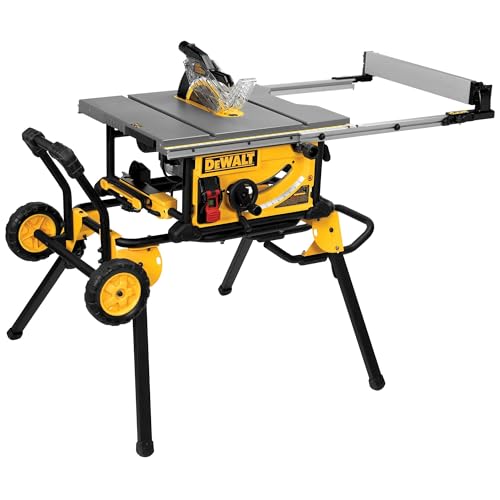 DEWALT DEWALT Table Saw 10 Inch with Foldable Rolling Table Saw Stand, 15 Amp, 4800 R |
32-1/2" rip capacity · 3-1/8" depth of cut · rack & pinion fence · 15A | $599.00 $649.00 |
#2 in Table Saws |
8% OFF In Stock |
 Skil SKIL 15 Amp 10-Inch Jobsite Table Saw with Folding Stand-TS6307-00 |
10" blade · 25-1/2" rip (tested) · integrated folding stand | $302.68 $329.99 |
#1 in Table Saws |
8% OFF In Stock |
 Bosch BOSCH GTS15-10 10 Inch Portable Jobsite Table Saw with Rise Wheeled Stand |
10" blade · 32-1/8" rip claim · Gravity-Rise wheeled stand | $649.00 |
#8 in Table Saws |
Only 1 left in stock (more on the way). |
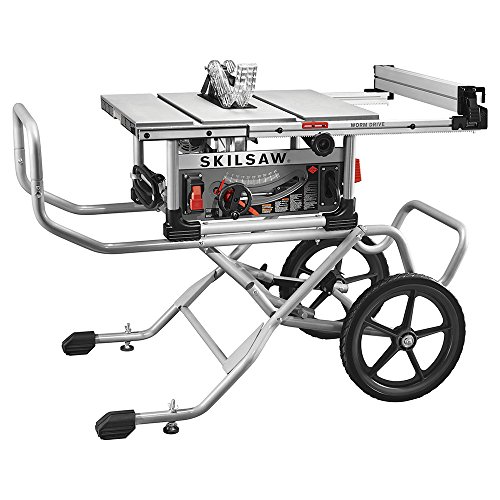 SKILSAW SKIL 10 Inch Heavy Duty Worm Drive Table Saw with Stand – SPT99-11 |
Worm drive · 3-5/8" depth of cut · 30-1/2" rip capacity | $648.00 |
#6 in Table Saws |
Only 12 left in stock (more on the way). |
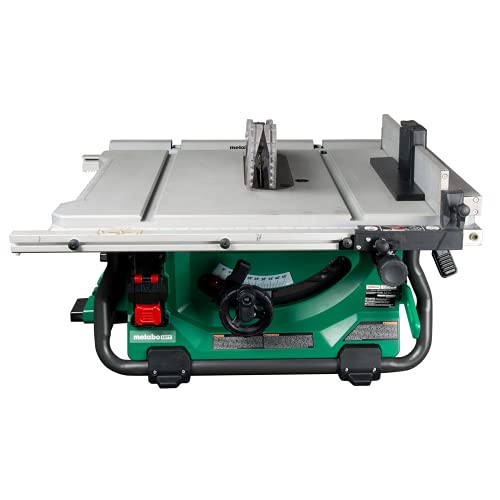 Metabo HPT Metabo HPT Table Saw, 36V MultiVolt 10 Inch Cordless, C3610DRJQ4 |
36V brushless cordless · 35" rip · 5,000 RPM | $599.00 $659.00 |
#183 in Table Saws |
9% OFF Only 3 left in stock – order soon. |
 SawStop SawStop CTS-120A60 Compact Table Saw – 15A,120V,60Hz |
Flesh-detection brake · rack & pinion fence · 15A, 120V | $974.00 |
#1133 in Saws |
In Stock |
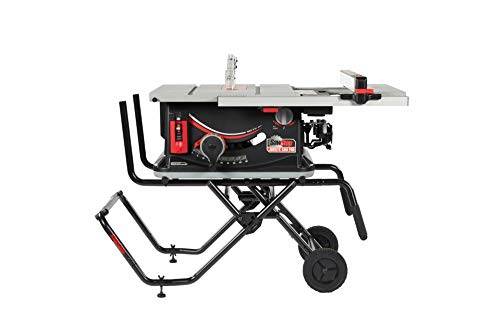 SawStop SawStop Jobsite Saw PRO with Mobile Cart Assembly – 1 1/2 HP 120V 60Hz JSS-120 |
1-1/2 HP jobsite saw · 24-5/8" table depth · brake in under 5 ms | $1,899.00 $2,025.00 |
#51 in Table Saws |
6% OFF In Stock |
Spec-Truth Table
| Model | Blade | Rip capacity | Motor / drive | Weight |
|---|---|---|---|---|
| DEWALT DWE7491RS | 10 in. | 32-1/2 in. | 15A corded, 4,800 RPM | 90 lb (PM) / 110 lb (FHM) |
| SKIL TS6307-00 | 10 in. | 25-1/2 in. (tested) | 15A corded | 51.15 lb (FHM) |
| BOSCH GTS15-10 | 10 in. | 32-1/8 in. (listing) | 15A corded, 3,800 RPM | Not stated |
| SKIL SPT99-11 | 10 in. | 30-1/2 in. | Worm drive, 15A | 94.3 lb (FHM) |
| Metabo HPT C3610DRJQ4 | 10 in. | 35 in. (claim) | 36V brushless, 5,000 RPM | Not stated |
| SawStop CTS-120A60 | Not stated | Not stated | 15A corded, 120V | Not stated |
| SawStop JSS-120A60 | Not stated | Not stated | 1-1/2 HP, 120V | Not stated |
1. DEWALT DWE7491RS 10-Inch Jobsite Table Saw — Best Overall
What We Like
Both independent labs we cross-checked put this saw first. Family Handyman named the DEWALT Job Site Table Saw its best overall, and the tester’s verdict was blunt: “I tested this product and like it a lot.” Popular Mechanics’ writer made it his best overall too, assembled it in under 20 minutes, and reported the rack-and-pinion fence was “dead-on accurate from the jump” with consistent tracking straight through the cut. Family Handyman’s tester, Ethan O’Donnell, worked through more than 50 cuts across 2×6 studs, plywood, MDF, OSB, melamine, birch, oak and a 4×4 cutoff, and credited the dial-driven fence and tool-free riving-knife swap with making it “a straightforward user experience.” The 32-1/2-inch right-side rip capacity and 3-1/8-inch depth of cut at 90 degrees are the best of any corded saw here, and the four-legged rolling stand folds with a single lever.
What Could Be Better
It is heavy: Popular Mechanics’ spec box lists 90 lb, while Family Handyman measured 110, and both note you feel it. Popular Mechanics also flagged the bevel and blade-height gearing as “sluggish” or stiff, and dust collection as “merely average.” There is no brake and no flesh-sensing, so this is a conventional saw in the most literal sense.
Flaws but not dealbreakers: the DWE7491RS is heavy at 90-110 lb, its blade-height and bevel gearing feels stiff, and its dust collection is only average — none of which shows up in the accuracy of a cut.
Who should skip it: anyone cutting full 4×8 sheets alone in a small shop. The weight and the 21-7/8 by 26-3/8-inch table fight you; the folding SKIL two slots down is easier to live with.
2. SKIL TS6307-00 15-Amp 10-Inch Jobsite Table Saw — Best Value (and Amazon’s #1 Best Seller)
What We Like
This is the current #1 Best Seller in Amazon’s own Table Saws category — and it is also where two independent test teams landed independently: Popular Mechanics made it its best value pick and Family Handyman made it its best portable. The legs ship already attached, so there is no assembly; they fold and lock, and there is onboard storage for the cord, rip fence, miter gauge, dust-port elbow, anti-kickback device and push stick. Family Handyman’s tester found the cuts “straight and spot on” and everything easy to adjust, and praised the storage specifically. It has rack-and-pinion fence rails, micro-adjustable parallel blade alignment, a 2-to-47 degree bevel with positive stops, and enough capacity to cut 4×4 stock at 90 degrees.
What Could Be Better
It is a small saw. Family Handyman lists a 25-1/2-inch rip capacity against the DEWALT’s 32-1/2, calls it “loud for its size,” and notes some components “feel less sturdy than those on pricier saws.” There is no brake and no flesh-sensing.
Flaws but not dealbreakers: the TS6307-00 is loud, its 25-1/2-inch rip rules out wide sheet rips, and its plastics feel lighter than the DEWALT’s — at $302.68 it still cuts square, and it is the cheapest saw here with a proper rack-and-pinion fence.
Who should skip it: anyone who regularly breaks down full sheets or does repeated production cuts — you want the 32-1/2-inch rip of the DEWALT for that.
3. BOSCH GTS15-10 10-Inch Portable Jobsite Table Saw — Best Portable
What We Like
Popular Mechanics names the Bosch GTS15-10 its best portable table saw, and the live listing explains the appeal: a 15-amp motor at 3,800 RPM, an advertised 32-1/8-inch rip capacity, Bosch’s Smart Guard System (riving knife plus anti-kickback pawls plus a barrier guard that still lets you see the cut), ClampZone areas that turn the off-cut side of the table into a light work surface, and the GTA50W Gravity-Rise wheeled stand that sets up in one action. The blade brake stops the blade in about three seconds, and everything from the rip fence to the hex wrench stores on the tool.
What Could Be Better
At $649 it costs $50 more than the DEWALT without adding rip capacity — it carries 32-1/8 inches against the DEWALT’s 32-1/2. Its soft-start and electronically regulated speed are conveniences, not accuracy upgrades, and stock is genuinely thin: the listing showed a single unit when we checked. And like every saw here, the “brake” is a motor run-down brake, not a flesh-sensing stop.
Flaws but not dealbreakers: you pay DEWALT money for a saw with slightly less rip capacity and much thinner stock — the Gravity-Rise stand, Smart Guard System and three-second blade stop are what the premium buys.
Who should skip it: if you want the most table for the money, the DEWALT rips a hair wider for $50 less, and the Metabo HPT below rips to 35 inches for the same money.
4. SKIL SPT99-11 10-Inch Worm Drive Table Saw — Best for Heavy Rips and Framing
What We Like
Family Handyman named this its best-for-worksite saw, and the worm drive is the reason. The listing claims a 3-5/8-inch depth of cut — the deepest in this guide — and 30-1/2 inches of rip capacity. Family Handyman’s tester reported that the miter gauge and fence “cut at a perfect 90 degrees out of the box,” described the accessories as “solid and sturdy,” and liked the wheeled folding cart with its 16-inch wheels, the on-board chute storage and the storage for the miter gauge, fence, guard and anti-kickback device. The riving knife arrives pre-installed, and outfeed and left-side supports let one person handle long stock.
What Could Be Better
Family Handyman found the assembly instructions “roundabout” with unlabeled parts, and this is the heaviest saw here at 94.3 lb with a large footprint that does not disappear when folded — the tester called it “huge” and “pricey.”
Flaws but not dealbreakers: the SPT99-11 is heavy, it takes real floor space even folded, and its instructions are poor — the worm-drive torque, 3-5/8-inch depth of cut and 30-1/2-inch rip are worth the lifting.
Who should skip it: hobbyists working in a garage. A worm-drive saw is built for framing lumber and repeated site cuts; you would be paying for torque you never use.
5. Metabo HPT C3610DRJQ4 36V MultiVolt 10-Inch Cordless — Best Cordless (and the Widest Rip)
What We Like
Popular Mechanics gives its best-ripping-capacity award to a Metabo HPT job-site saw, and the MultiVolt is the model on Amazon: a 36V brushless motor spinning 5,000 RPM with a claimed 35-inch rip capacity to the right — the widest of any saw in this guide, corded or not — plus 22 inches to the left and a 0-to-45 degree bevel. It is the largest working table of the group by the listing’s own numbers. Because it runs on the MultiVolt platform, it takes a 36V battery or runs on AC through the adapter, which is the point if you already own Metabo HPT packs.
What Could Be Better
This listing is a bare tool — the product title says “Battery Not Included” — so add a 36V battery and charger to the price if you do not already own them. Its Amazon best-seller rank (#183 in Table Saws) sits far behind the top five, and the listing showed three units in stock. Cordless power also depends on the pack you feed it, so runtime is a variable, not a fixed number.
Flaws but not dealbreakers: the C3610DRJQ4 ships without a battery, its Amazon sales rank is a distant #183, and cordless runtime depends on which pack you fit — but its 35-inch rip is the widest capacity here.
Who should skip it: anyone who does not already own Metabo HPT batteries. Bought bare with a new 36V pack and charger, it can cost more than the DEWALT costs complete, with a charger to keep track of.
6. SawStop CTS-120A60 Compact Table Saw — Best Safety Under $1,000
What We Like
This is the least expensive way to get SawStop’s active injury mitigation onto a table saw. The listing’s first feature says it plainly: “SawStop’s patented Safety System stops on contact with skin.” It keeps the practical details too — a rack-and-pinion fence that SawStop says is “always square,” a quick-tilt with micro-adjust, heavy-duty construction in a portable frame, and a fence with built-in high and low shelves for different cut types. If the most expensive accident in woodworking — a blade-contact injury to a hand — is the specific thing you want engineered out, this is the saw that does it below a thousand dollars.
What Could Be Better
Industry data says the brake is not free. The Power Tool Institute, a trade association whose members include most table-saw makers, reports that activation costs the owner a new blade at $60-$80 plus a brake cartridge at $95-$130, and describes false activations at a rate of “more than one per year.” The same source notes the technology cannot be retrofitted to an existing saw. And the federal rule that would have required this technology on every table saw was proposed in 2023 and then withdrawn in August 2025, so it is a feature you buy, not one you can count on being mandated.
Flaws but not dealbreakers: the CTS-120A60 costs roughly $671 more than the DEWALT, its cartridge fires more than once a year on average per industry figures, and every activation adds a blade plus a cartridge to the bill — which is the price of making a finger contact survivable.
Who should skip it: anyone on a tight budget who keeps the blade guard and riving knife fitted. Those guards are the first line of defence on every saw here; the brake is a second layer, not a substitute for using them.
7. SawStop JSS-120A60 Jobsite Saw PRO — Best Premium Pick
What We Like
The Jobsite Saw PRO is the full-size version of the same idea. The listing says its flesh-detection system “detects contact with skin and stops the blade in under 5 milliseconds,” and the saw around it is a genuine job-site machine rather than a bench saw with a brake: a 1-1/2 HP 120V motor, a 24-5/8-inch table depth that SawStop calls class-leading, a one-turn elevation system, and stowed dimensions of 26.5 by 29 by 45 inches on its mobile cart. If you want the largest table and the fastest brake in one tool, this is it.
What Could Be Better
At $1,899 it costs more than the DEWALT, the Bosch and the SKIL portable combined. Family Handyman, which likes SawStop’s safety features, still left it off its best-of list because it “doesn’t have as large a rip capacity as other table saws.” The brake economics from the section below apply here too. And the Power Tool Institute’s figures put a consumer SawStop at from $899 against $150-$400 for comparable benchtop saws without the technology — a useful reminder of what the brake alone costs.
Flaws but not dealbreakers: the JSS-120A60 is expensive, its rip capacity trails cheaper saws, and its blade-plus-cartridge consumables add up — all of which is the trade for flesh-sensing on a full job-site saw.
Who should skip it: hobbyists. The compact CTS covers occasional use, and a standard saw with the guard kept fitted covers most of the rest. Buy the PRO when a hand injury would end your livelihood.
The Safety Question: Flesh-Sensing versus the Blade Guard
This is the part of the table saw market where the marketing most outruns the data, so here is the primary-source version. In November 2023 the Consumer Product Safety Commission published a supplemental notice of proposed rulemaking (88 FR 74909, docket CPSC-2011-0074) proposing a performance standard that would require a table saw to “limit the depth of cut to no more than 3.5 millimeters when a test probe, acting as surrogate for a human finger or other body part, approaches the spinning blade at a rate of 1 meter per second.” The Commission’s staff estimated the rule would prevent or mitigate the severity of 54,800 medically treated blade-contact injuries annually, with aggregate net benefits of roughly $625 million to $2.3 billion a year.
That rule never took effect. The Power Tool Institute, the industry group whose members include five table-saw manufacturers, records that on August 20, 2025 the Commission withdrew the table-saw rulemaking among several it called costly and unsupported, and argues that voluntary standards are already working: it points to a CPSC 2017 special study finding that saws with a modular blade guard system were “seven times less likely” to be associated with injuries than older saws with a traditional guard, and to its own analysis showing a 3.5-to-1 improvement in blade-contact injury rates. It also reports that 71% of users preferred the modular guard and 83% said it reduced hazards. CPSC’s own NEISS data, cited in the same document, put average reported table saw injuries at 33,791 for 2016-2021, down from 37,243 for 2002-2006.
Read the source bias first. The Power Tool Institute is funded by tool manufacturers, several of which compete with SawStop, so its positions on SawStop’s patents and pricing are not neutral — we cite it for its cost figures and its own member data, and we cite the Federal Register for the regulatory record. Taken together, the practical takeaway for a buyer is narrow and useful: the guard and riving knife that ship with every saw in this guide are the intervention with the strongest evidence behind it, and a flesh-sensing brake is a genuinely valuable second layer that adds a recurring consumable cost. Neither is a licence to cut with your hands close to the blade.
Price Tiers: What Your Money Buys
Family Handyman frames the market neatly — entry-level saws around $200-$500, contractor saws $500-$1,000, professional cabinet saws $1,000 and up — and our live pricing sits inside those bands. Here is where this specific field separates.
Under $350 and under: the SKIL TS6307-00 at $302.68 is the floor for a saw we would actually recommend. It buys a folding stand, a rack-and-pinion fence and 25-1/2 inches of rip. That is a real table saw for cabinet-width rips and trim, and nothing cheaper on Amazon adds capability rather than removing it.
$400 to $650 — the sweet spot: the DEWALT DWE7491RS ($599), BOSCH GTS15-10 ($649), SKIL SPT99-11 worm drive ($648) and cordless Metabo HPT C3610DRJQ4 ($599) all sit here, and this is where rip capacity and drive type genuinely diverge — 30-1/2 to 35 inches of rip, worm drive versus direct-drive versus brushless 36V. Every one of the four is a saw a professional could justify.
About $650 is the stopping point. That is the number worth remembering. Between roughly $400 and $650 you are buying more capacity, more torque and better stands; past it, the extra money stops buying cut quality. Above $650 you are paying for exactly two things — the SawStop flesh-sensing brake ($974 compact, $1,899 job-site) or the freedom of a cordless platform you already own. A 32-1/2-inch DEWALT at $599 rips as wide as a 32-1/8-inch Bosch at $649 and nearly as wide as a $648 worm drive; what the premium adds is not accuracy.
Where We Disagree With the Big Test Labs
We read both lab tests carefully and we do not rank the field the same way. Two disagreements matter.
First, we put the cheaper saw first. Both Family Handyman and Popular Mechanics crown the DEWALT DWE7491RS their best overall, and we agree it is the best saw here — but we rank the SKIL TS6307-00 first for the majority of readers, and the reasoning is arithmetic rather than contrarian. The SKIL costs $302.68 against the DEWALT’s $599, and both labs independently named it their value or portable pick; it is also the current #1 Best Seller in Amazon’s Table Saws category, which is demand data rather than opinion. The only real sacrifice is rip capacity, 25-1/2 inches against 32-1/2, and that only bites if you break down full sheets. If you do, spend the extra $296. If you do not, the SKIL is the better buy, and we would rather say so than echo the labs’ most expensive pick.
Second, we rank a SawStop while Family Handyman leaves it off the podium. Family Handyman notes that it loves the SawStop’s safety features but excludes it from its best list because it “doesn’t have as large a rip capacity as other table saws.” That is true and still beside the point: rip capacity is a woodworking metric, and a flesh-sensing brake is not. We keep a SawStop in the top group precisely because it is the only saw here that addresses the industry’s 33,000-plus annual blade-contact injuries as a class, and because we think a buyer deserves at least one pick chosen on that basis.
Where we and the labs agree completely: the fence decides everything (Popular Mechanics: “if a fence doesn’t lock down square to the blade, little else matters”) and stability beats portability when the two conflict. Both labs reached the same conclusion on the SKIL from different test programmes — one portable, one value — which is the strongest independent signal in this entire guide.
What Actually Goes Wrong: The Recurring Complaints
Rather than invent failure statistics, here are the specific complaint patterns the two labs logged in their own testing, plus what shows up structurally in this product class.
1. Fence squareness and drift. The single most common accuracy complaint on cheaper saws is a fence that does not lock parallel to the blade. It is why both labs lead with the fence, why rack-and-pinion rails are worth paying for, and why the SKIL’s and DEWALT’s rack-and-pinion systems are the first things their testers praise.
2. Guard and riving-knife setup. This is a recurring assembly pain point, not a cutting defect. Family Handyman’s testers reported struggling with the blade guard, riving knife and anti-kickback pawls on the RYOBI, called the Bosch assembly “complex,” and flagged the Ridgid’s “difficult assembly.” On the DEWALT and the Milwaukee the same testers found the opposite, so it is a design variable, not table-saw fate.
3. Stand and base instability on light saws. Family Handyman’s tester describes watching a lightweight job-site saw wobble as long stock was fed into it and calls it dangerous as well as inaccurate. The stand is not an accessory on a saw this size — it is part of the tool.
4. Stiff bevel and height gearing, and average dust control. Popular Mechanics logged both on the otherwise-excellent DEWALT: gearing that is sluggish and dust collection that is “merely average.” Expect dust control to be the weakest link on almost any job-site saw unless you hook up a vacuum to the 2-1/2-inch port.
5. Noise. Family Handyman measured the SKIL portable as “loud for its size” and recorded 78 decibels for the Milwaukee cordless as the quietest in its group. Ear protection is not optional on any of these.
6. Bare-tool surprises on cordless saws. A cordless table saw sold without a battery is a real cost trap — the Metabo HPT pick here is a bare tool at $599, and a 36V pack plus charger is a separate purchase. Check the “what’s in the box” line before you compare price to a corded saw.
One honest caveat: these are failure patterns reported by testers and buyers, with no measured failure rate published anywhere we could verify. We are not quoting a defect percentage, because nobody credible publishes one.
How We Research These Picks
Our method for this guide: we pulled live U.S. pricing, specifications, best-seller ranks and stock directly from Amazon’s product API and re-verified each listing on September 26, 2026. We then cross-checked the field against hands-on testing published by Family Handyman (a nine-saw test with named testers and measurements) and Popular Mechanics (a long-form test using plywood, 2x lumber, pressure-treated 4x4s and bevel cuts), and against the Consumer Product Safety Commission’s Federal Register rulemaking record and the Power Tool Institute’s published position on table-saw safety. The spec-truth table, the price-tier analysis, the disagreement note and the failure-mode section are our own first-party synthesis of that material, not a restatement of another roundup’s ranking.
What is hands-on and what is not: we did not operate these specific saws, and we are not a test lab. Every cut-quality and measurement claim attributed to Family Handyman or Popular Mechanics is theirs, quoted or paraphrased from their published pages and linked below. Everything we state as a price, spec, stock level or best-seller rank came from the live Amazon listing on the date shown and will move over time. We flag manufacturer claims as claims — a “35-inch rip capacity” from a listing is the manufacturer’s figure, not something we measured, and where a listing publishes no figure we print “Not stated” rather than fill the gap. See our full methodology for exactly how we choose and rank products, including our “what we do not claim” section.
Internal reading: our guide to cordless power tool combo kits covers the drill-and-driver side of a workshop, our standing desk guide covers the assembly where you will use these tools, and our pressure washer roundup covers the outdoor cleanup they make easier.
- Federal Register (CPSC) — the 2023 proposed rule that would cap blade-contact cut depth at 3.5 mm, and the 54,800-injury annual estimate behind it
- Power Tool Institute — industry position plus the brake-cost figures and the 7x modular-guard injury finding (manufacturer-funded; disclosed in the text)
- Family Handyman — nine table saws tested by named testers; best overall, best portable and best-for-worksite picks
- Popular Mechanics — hands-on test of nine saws; best overall, best value, best portable and best-ripping-capacity picks
Frequently Asked Questions
What is the best table saw on Amazon?
For most people the SKIL TS6307-00 at $302.68 is the best balance of price and capability — it is Amazon’s current #1 Best Seller in Table Saws and the value or portable pick of both independent labs we cross-checked. If you routinely break down full sheets of plywood, step up to the DEWALT DWE7491RS at $599 for its 32-1/2-inch rip capacity and 3-1/8-inch depth of cut.
How much rip capacity do I need?
About 24 to 25 inches covers the common board widths and cabinet panels most people cut. If you break down full 4×8 sheets, you want 30 to 32 inches or more — the DEWALT gives 32-1/2, the Bosch 32-1/8, the SKIL worm drive 30-1/2, and the cordless Metabo HPT claims 35. Rip capacity is the spec that most often decides whether a project is comfortable or frustrating.
Is a SawStop table saw worth the money?
Only you can price a finger, but the economics are knowable. A SawStop CTS starts at $974 here, against $599 for a full-size DEWALT, and the industry’s own figures put a consumer SawStop at from $899 versus $150-$400 for comparable saws without the technology. Every activation also costs a blade ($60-$80) and a brake cartridge ($95-$130), with false activations reported at more than one a year on average. If a serious hand injury would end your income, that math can work; if you keep the guard and riving knife fitted on an ordinary saw, those are the first line of defence.
Do these table saws come with a stand?
Most do. The DEWALT DWE7491RS, SKIL TS6307-00, Bosch GTS15-10 and SKIL SPT99-11 all include a folding or wheeled stand, and the SawStop JSS-120A60 includes its mobile cart. The cordless Metabo HPT C3610DRJQ4 is sold as a bare tool with no battery, and the SawStop CTS does not include a folding stand unless you buy the bundle version.