The best mixing bowls are the ones you reach for every day — deep enough that a hand mixer does not fling batter across the counter, stable enough that it stays put, and honest enough about what its sizing and material claims actually mean. We checked seven mixing bowl sets sold on Amazon in 2026, read each live listing for sizes, material, care limits and handle design, set those specs against the published evidence on what happens when food meets plastic, and compared our ranking with the reviewers who have actually mixed in these bowls. The short version: the bowl that wins here costs $17.99, and the two most expensive picks in this guide are not the ones we would buy first.
Affiliate disclosure: As an Amazon Associate I earn from qualifying purchases. We earn commission from qualifying purchases made through links on this page. This never affects our rankings or what we recommend.
What’s in this guide
- How we picked these bowls
- The 7 best mixing bowls at a glance
- 1. Pyrex Essentials 3-Piece Glass Set (best overall)
- 2. Cuisinart 3-Piece Stainless Nesting Set (best stainless steel)
- 3. KitchenAid Classic Set of 5 (best everyday set)
- 4. OXO Good Grips 3-Piece (best non-slip plastic)
- 5. Anchor Hocking 10-Piece (best value large set)
- 6. Winco 8 qt Stainless Steel Bowl (best single large bowl)
- 7. DOWAN Ceramic Set of 3 (best ceramic for serving)
- Glass, stainless, plastic or ceramic: what actually changes
- The plastic question: what “BPA-free” does and does not tell you
- What size bowl you actually need (and why the quart figure lies)
- Where we disagree with the big reviewers
- Where paying more stops buying better
- The failure modes to watch for
- Who should skip these bowls
- Frequently asked questions
- Sources and methodology
How we picked these bowls
We started from the mixing, not the store shelf. Every pick below was checked against its live Amazon listing on September 17, 2026, so the quart sizes, stated materials, care limits, handle and lid details and best-seller ranks here match what the page actually said that day. We then set those specs against the published evidence on food-contact materials — the peer-reviewed review “Microplastics: A Real Global Threat for Environment and Food Safety: A State of the Art Review” (Ziani et al., Nutrients, 2023) — and against the hands-on bowl testing that exists: Wirecutter’s Best Mixing Bowls (13 sets, updated December 2025; note that Wirecutter is paywalled and we only used its published picks and the caveats it states openly), Bon Appétit’s case for metal nesting bowls, plus the two side-by-side bowl tests that block automated readers, Serious Eats’ “The 6 Best Mixing Bowls of 2026” (22 bowls whisked, whipped and folded through) and The Spruce Eats’ “The 7 Best Mixing Bowls of 2026,” which we name here by title but do not quote, because we could not load them to read them.
Sourcing transparency: what this guide is and isn’t. We did not run a durability, thermal-shock or odour lab test, and we do not claim to. What we did is read each live product listing (sizes, stated material, care instructions, handle and lid design, rating average and best-seller rank on September 17, 2026), check those claims against the published research named above, and compare our ranking with reviewers who have handled these bowls in person. Where our ranking differs from a bigger outlet, we say so by name and explain why. Our full process lives on the How We Test & Choose Products page.
The 7 best mixing bowls at a glance
Prices, stock and ranks below were pulled live from Amazon on September 17, 2026. Star averages come from the listings; we deliberately label the review counts as loose bands, because Amazon’s own rating counters disagreed between page variants when we checked them (“2,115 ratings” appeared on five unrelated bowl listings in the same session).
| Product | Standout spec | Price | Track record | Deal |
|---|---|---|---|---|
 Pyrex Pyrex Essentials (3-Piece) Glass Mixing Bowls Set for Prepping and Baking |
3-PIECE: Set includes 1-qt, 1.5-qt, and 2.5-qt round glass bowls. This is the perfect set for a | $17.99 |
#1 in Mixing Bowls |
In Stock |
 Cuisinart Cuisinart Mixing Bowl Set, Nesting Bowls, Stainless Steel, 3-Piece |
DURABLE STAINLESS STEEL CONSTRUCTION: Made from high‑quality stainless steel. Built for everyda | $38.99 |
#9 in Mixing Bowls |
In Stock |
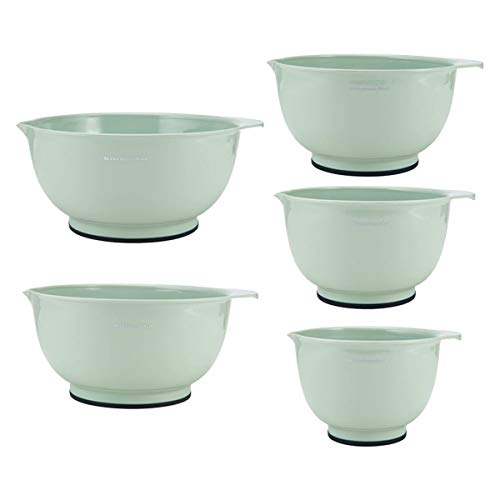 KitchenAid KitchenAid Classic Mixing Bowls, Set of 5, Pistachio |
Set of 5 bowls: This set of 5 mixing bowls include a 1. 5-Quart, 2. 5-Quart, 3. 5-Quart, 4. 5-Q | $31.99 $33.99 |
#6 in Mixing Bowls |
6% OFF In Stock |
 OXO OXO Good Grips 3-Piece Plastic Mixing Bowl Set- Blue, Gray, Jade |
Set includes: 1.5-quart, 3-quart, and 5-quart sizes | $29.95 |
#33 in Mixing Bowls |
In Stock |
 Anchor Hocking Anchor Hocking 10 Piece Mixing Bowl Set, Nesting Serving Bowls & Mixing Bowls |
INCLUDES: This Anchor Hocking set of mixing bowls contains (1) 1-ounce, (1) 2-ounce, (1) 4-ounc | $31.00 $49.99 |
#34 in Mixing Bowls |
38% OFF In Stock |
 Winco Winco 8 qt Stainless Steel Mixing Bowl |
Stainless steel durable construction for years of work | $13.30 |
#5 in Mixing Bowls |
In Stock |
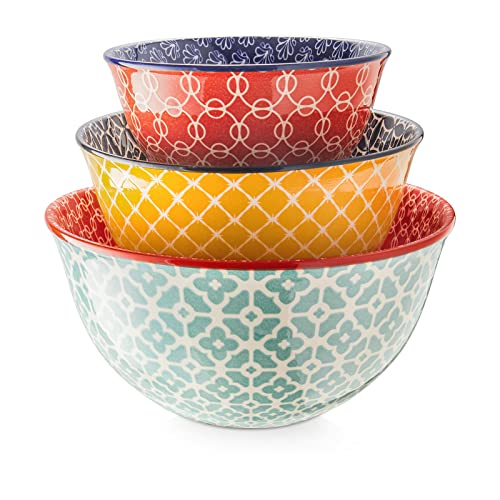 DOWAN DOWAN Mixing Bowls, Ceramic Mixing Bowls for Kitchen, Colorful Vibrant Nesting |
Beautifully Crafted Colored Mixing Bowls for Any Occasion: These ceramic mixing bowls feature v | $39.79 $43.99 |
#125 in Mixing Bowls |
10% OFF Prime Exclusive In Stock |
Spec truth: what each listing does and does not print
This is the part that decides whether a bowl works in your kitchen, and most listings skip it. Everything in the first four columns was read directly off the live product page on September 17, 2026.
| Pick | Stated sizes | Stated material | Care limits the listing states | What the listing never says |
|---|---|---|---|---|
| Pyrex Essentials 3-Piece | 1 qt, 1.5 qt, 2.5 qt | Tempered glass | Freezer, microwave and dishwasher safe | No oven rating, and no thermal-shock figure anywhere on the page |
| Cuisinart 3-Piece Nesting | 1.5 qt, 3 qt, 5 qt | Stainless steel | Dishwasher safe; refrigerator and freezer safe | No lid in this listing, no steel gauge, no oven or broiler claim |
| KitchenAid Classic (5 bowls) | 1.5 qt to 5.5 qt | Not stated in the feature list | Dishwasher safe; 1-year replacement plus limited lifetime | The material is never named — you are told the sizes, the non-slip base and the spout, not the plastic |
| OXO Good Grips 3-Piece | 1.5 qt, 3 qt, 5 qt | Plastic, BPA-free | Dishwasher safe; non-slip base | No microwave or oven claim published, despite buyers using them for both |
| Anchor Hocking 10-Piece | 1 oz to 3.5 qt (10 bowls) | Tempered glass | Microwave, oven and dishwasher safe per the listing | That six of the ten pieces are 1–16 oz prep cups, not mixing bowls |
| Winco 8 qt | 8 qt, single bowl | Stainless steel | Dishwasher safe | Gauge, weight, rim thickness — one line of specification, no lid |
| DOWAN Ceramic 3-Piece | 3.7 qt, 2 qt, 1 qt | Ceramic, described as lead-free and cadmium-free | Oven, microwave, dishwasher and freezer safe | Weight and thermal-shock limit, and the basis for the claim that ceramic is “sturdier than plastic or metal” |
1. Pyrex Essentials 3-Piece Glass Mixing Bowls Set — best overall
The number one best seller in Amazon’s mixing bowls category is also the cheapest pick in this guide, and that is not a coincidence. Pyrex sells three tempered-glass bowls — 1 quart, 1.5 quarts and 2.5 quarts — for $17.99, the glass resists staining and holding smells in a way plastic never quite does, and all three are microwave-, freezer- and dishwasher-safe. For everyday batter, eggs, marinades and leftovers, there is nothing in this guide that does the job better for less.
Glass is also the material that lets you see what you are mixing, which matters more than it sounds: you catch unmixed flour at the bottom of the bowl before it ends up in the oven. The trade-off is weight and the fact that the listing publishes no oven rating, so we would not treat a microwave-safe Pyrex bowl as an oven dish unless the specific product page says so. Wirecutter’s testers put a different Pyrex glass set (the lid-equipped Smart Essentials 8-piece) at the top of their glass category after 13 sets of testing; ours costs less, contains no plastic lids and comes in the sizes most people actually use.
What we like
- Cheapest pick here at $17.99, and the current best seller in Amazon’s mixing bowls category
- Tempered glass will not stain, warp or hold on to last night’s curry the way plastic can
- Microwave, freezer and dishwasher safe — the three things this set is genuinely built for
- You can see the mix through the wall of the bowl, so unmixed pockets of flour are obvious
- Three sensible sizes (1, 1.5 and 2.5 quarts) cover eggs, batter and a small salad
What could be better
- No lids and no oven rating on this listing — storage and oven use are not its job
- Heaviest option here once it is full, and glass plus a tile floor is the classic breakage scenario
- 2.5 quarts is not enough for a big batch of bread dough or a double cake recipe
Flaws but not dealbreakers: there is no lid in the box and the listing never gives an oven rating, so this is a mixing and microwave set rather than an all-purpose dish — at $17.99, that is a fair trade.
2. Cuisinart Mixing Bowl Set, Stainless Steel, 3-Piece — best stainless steel
If you own a hand mixer, steel is the material to beat: it is light, it does not shatter, and it chills quickly when you need cold cream to whip. The Cuisinart set gives you 1.5, 3 and 5 quarts in stainless steel for $38.99, with a nesting profile that stores in the space of the largest bowl. The listing advertises what matters here — dishwasher safe, refrigerator and freezer safe, and a smooth surface that does not retain flavours — and nothing else.
This is the same size trio and the same brand that Wirecutter ranks as its best metal pick after scooping 200 cookies and cracking more than 60 eggs in 13 sets of bowls, with one important difference: their pick is the Cuisinart set with lids. We rank the lid-less set here because it is the one Amazon actually sells as a stocked three-piece; if a lid matters to you, buy the version that includes it and treat the extra cost as the price of a lid. Wirecutter’s own stated caveat — that the Cuisinart bowls are small at 1.5, 3 and 5 quarts — is the reason this set is our stainless pick rather than our overall pick.
What we like
- Light enough to hold in one hand while you pour with the other — the real advantage steel has over glass
- Dishwasher safe, freezer and refrigerator safe, and it will not pick up the smell of garlic or fish
- Nests down to the footprint of the 5-quart bowl
- The 5-quart size is the bowl you want for a double batch of batter or a big salad
- Stainless steel will not shatter, which is why this is the safest pick in a house with hard floors
What could be better
- No lids on this three-piece listing, so nothing here goes straight into the fridge covered
- $38.99 buys three bowls — the same money buys five plastic bowls or ten glass pieces elsewhere in this guide
- Steel is not microwave-safe, so leftovers have to be transferred before reheating
Flaws but not dealbreakers: the three bowls are on the small side and there are no lids, but the size trio is the one most recipes are written for, and steel is the material that survives a drop.
3. KitchenAid Classic Mixing Bowls, Set of 5 — best everyday set
Five bowls for $31.99 is the best value-per-bowl in this guide, and the sizes — 1.5, 2.5, 3.5, 4.5 and 5.5 quarts — are spaced closely enough that you always have a bowl that fits the job rather than one that is obviously too big. Each bowl has a non-slip base, a pour spout and a nesting profile, and the set is dishwasher safe with a one-year replacement plus limited lifetime warranty.
The catch is one this listing demonstrates rather than admits: the feature bullets describe the sizes, the non-slip base, the spout and the warranty, and never name the material at all. That is worth knowing, because bowl material is exactly what decides microwave use, staining and how the base behaves after a few hundred dishwasher cycles. If you want a set that handles dry ingredients, folding, marinating and serving in five sizes and you are happy to treat them as everyday workhorses rather than heirloom pieces, this is the strongest dollar-for-dollar buy in the guide.
What we like
- Five bowls across 1.5 to 5.5 quarts for $31.99 — the best price per bowl here
- Non-slip base and a pour spout on every size, which is what stops one-handed mixing from going wrong
- Sizes are close enough together that you rarely have to improvise with the wrong bowl
- Dishwasher safe, with a one-year replacement warranty plus a limited lifetime warranty
- Nests flat enough to live in a shallow cabinet
What could be better
- The listing never names the bowl material, so microwave and staining behaviour has to be inferred rather than checked
- No lids, so nothing stores covered
- The 6% discount is small and the set is frequently restocked at around $32 — there is no urgency here
Flaws but not dealbreakers: the listing dodges the material question and there are no lids, but five well-spaced, non-slip bowls for $31.99 is the cheapest way to stop improvising with the wrong size.
4. OXO Good Grips 3-Piece Plastic Mixing Bowl Set — best non-slip plastic
OXO’s three-piece set is the one that solves the specific problem of a bowl that will not sit still: a wide grip and spout on one side, a non-slip base underneath, and a nesting stack in 1.5, 3 and 5 quarts for $29.95. The plastic is described as BPA-free and the set is dishwasher safe. This is the bowl to buy if you mix one-handed, if you have a slippery counter, or if the person using it is a teenager learning to bake.
The Spruce Eats named an OXO Good Grips set its overall pick after side-by-side testing, which is a genuine endorsement of the grip-and-spout design rather than of this exact plastic three-piece. Our reservation is the one thing the listing is silent on: there is no microwave or oven claim published anywhere on the page, yet plastic bowls of this type get used for melting butter and warming leftovers constantly. Check the care instructions on the bowl in your hand before you treat it as microwave cookware.
What we like
- Non-slip base plus a wide grip and spout — the most stable bowl to mix in one-handed here
- BPA-free plastic at a fair $29.95, in the three sizes most recipes assume
- Dishwasher safe and light enough for a child or a first-time baker to handle
- Nests compactly, so the set costs almost no cabinet space
What could be better
- No microwave or oven claim is published, which is a gap for a plastic bowl people will inevitably heat things in
- Plastic scratches over time, and scratched plastic is where smells and stains settle in
- Three bowls for $29.95 costs more per bowl than five KitchenAid bowls or ten Anchor Hocking pieces
Flaws but not dealbreakers: the listing never tells you whether the bowl is microwave-safe and the plastic will eventually scratch, but nothing else at this price grips a counter the way this one does.
5. Anchor Hocking 10-Piece Mixing Bowl Set — best value large set
Ten tempered-glass pieces for $31.00 — currently discounted 38% from a $49.99 list price — is the widest size range in this guide: 1, 2, 4, 6, 10 and 16 ounces, plus 1, 1.5, 2.5 and 3.5 quart bowls. The listing states microwave, oven and dishwasher safety, which is a broader set of claims than the Pyrex Essentials page makes, and Anchor Hocking has been making glass in the United States since 1905.
Be clear-eyed about what you are buying: six of those ten pieces are small prep cups, not mixing bowls, so the effective mixing set is really four bowls plus six useful little dishes for mise en place, dips and leftovers. That is still excellent value at $31, but if your cupboard only has room for one set, buy it for the four real bowls and treat the rest as a bonus rather than as ten mixing bowls.
What we like
- Ten pieces for $31.00 at a 38% discount — the cheapest way to cover every size in one purchase
- The 3.5-quart bowl is the largest glass bowl in this guide, and glass is the material you can bake and microwave in
- Listing states microwave, oven and dishwasher safety, a broader claim than the Pyrex page makes
- Glass does not warp, stain or hold smells, and the six small cups are genuinely useful for prepped ingredients
What could be better
- Only four of the ten pieces are real mixing bowls — the rest are prep cups
- Glass breaks, and this set puts ten breakable pieces in one cupboard
- Heaviest option here to lift when full, and the discount means stock moves quickly
Flaws but not dealbreakers: you are buying four mixing bowls and six small prep cups rather than ten bowls, but at $31.00 for the widest size range here, that arithmetic still works.
6. Winco 8 qt Stainless Steel Mixing Bowl — best single large bowl
Every set in this guide tops out between 3.5 and 5.5 quarts, which is exactly why the number five best seller in Amazon’s mixing bowls category is a plain 8-quart Winco bowl for $13.30. This is the commercial-kitchen shape: straight-ish walls, a wide mouth, no lid, no non-slip base, no colour, and enough volume for a full batch of pizza dough, a family-sized salad or a watermelon-sized pile of popcorn.
The listing gives you one line of specification — “stainless steel durable construction for years of work” — with no gauge, no weight and no rim measurement. What it does not give you is reassurance about how thin the steel is, and that is the trade-off you accept at $13.30: buy it as a second bowl for the jobs your set cannot handle, not as the nicest bowl you own. It is dishwasher safe, it will not break when it lands on a tile floor, and it is the least expensive way to stop halving recipes.
What we like
- 8 quarts for $13.30 — the cheapest way to get a genuinely large mixing bowl
- Steel will not shatter, and it weighs far less than a glass bowl of the same volume
- Big enough for a full batch of dough, a party salad or a large popcorn bowl in one bowl
- Dishwasher safe, with no seams or non-slip ring to trap food
What could be better
- One bowl, no lids, no handle and no colour choices — this is a utility bowl, not a display piece
- The listing publishes no steel gauge or weight, so thickness is unknown until it arrives
- Thin stainless dents if you drop it loaded, and it is not microwave-safe
Flaws but not dealbreakers: the listing tells you almost nothing about the steel and there is no lid or handle, but at $13.30 for 8 quarts this is the bowl that ends the “I need a bigger bowl” problem.
7. DOWAN Ceramic Mixing Bowls, Set of 3 — best ceramic for serving
Ceramic is the material nobody mentions in a mixing-bowl guide until they want to put the bowl on the table. DOWAN’s three-bowl set — 3.7, 2 and 1 quarts, currently $39.79 after a 10% discount — is glazed, colourful, oven-, microwave-, dishwasher- and freezer-safe, and light enough (they nest) to store in a cabinet rather than on display. If your bowls double as serving pieces, this is the set that does both jobs without a second purchase.
The listing’s weaker claims are worth flagging. It describes the bowls as “lead-free and cadmium-free” and as “sturdier than plastic or metal alternatives”; the first is a safety claim about the glaze we have no independent verification for, and the second is a claim about impact resistance that ceramic — a fired, brittle material — is the least likely of the four materials here to earn. Treat ceramic as the most beautiful and most breakable option, not the toughest one.
What we like
- Glazed, colourful ceramic that is presentable enough to serve from — two jobs, one purchase
- Oven, microwave, dishwasher and freezer safe according to the listing
- 3.7-quart and 2-quart sizes cover dough, batter and a serving salad
- Glaze resists sticking, so cleanup is a rinse rather than a soak
- The best gift set here, and the only one that looks deliberate on a table
What could be better
- Heaviest bowl per quart in this guide, and ceramic shatters rather than dents
- Its best-seller rank (#125 in Mixing Bowls) is the weakest track record here
- “Sturdier than plastic or metal” is not a claim we would repeat without a drop test behind it
- No lids, and the coloured glaze is the kind of finish that shows chips immediately
Flaws but not dealbreakers: ceramic is the most breakable material here and the listing overreaches on durability, but if you want a bowl that can go from mixing to the middle of the table, this is the pick.
Glass, stainless, plastic or ceramic: what actually changes
The material decides four things, and only one of them is durability.
- Glass is microwave- and oven-friendly, does not hold smells, and lets you see the mix. It is heavy and it breaks. The tempered glass in the Pyrex and Anchor Hocking picks is far more resistant to knocks than a cheap glass tumbler, but no glass listing in this guide publishes a thermal-shock rating, so the safe rule is the one the care instructions imply: microwave yes, sudden oven-to-cold-water no.
- Stainless steel is light, will not shatter, chills a cream or a dough quickly, and is the material hand-mixer owners should default to because it holds a big volume for its weight. It cannot go in the microwave, and thin steel dents — which is exactly the unknown on the Winco listing.
- Plastic is quiet, cheap, non-slip and safe for kids, and it is the only material here whose listing has to tell you whether it is BPA-free. It scratches, and scratched plastic is where a bowl starts to hold the smell of an onion it held three weeks ago.
- Ceramic is the only option that goes from mixing to the table without looking like equipment, and the only one where a chip is visible from across the room. It is also the heaviest per quart.
If you are buying one set and mixing is the only job, glass or steel is the honest default. If you want a set that stores covered and stacks in a dorm kitchen, the plastic picks win on price per bowl. The one thing we would not do is buy a fifth material to solve a problem the first four already solve.
The plastic question: what “BPA-free” does and does not tell you
“BPA-free” is printed on the OXO listing and it is a real claim about one additive, not a statement about particles. The peer-reviewed review Ziani et al., Nutrients 2023 is blunt about the mechanism: “Contact between food and plastic packaging is almost always the cause of mutual transfers between container and contents.” In the studies it tabulates, plastic food containers from China released 1–41 microplastic particles per container, and a sealed plastic food tray analysed in France released 4.0–18.7 particles per kilogram of food.
What that does not mean is that a BPA-free mixing bowl is dangerous; the review is a call for better measurement and standardisation, not a ban, and it is about dietary exposure built up across every plastic surface in a kitchen rather than about one bowl. What it does mean is that “BPA-free” answers a question about additives while leaving the particle question open, and that heat and abrasion are the two conditions most associated with more transfer. Practical translation: if you mix with plastic, do not also whisk hot liquids in it, replace bowls once the surface is visibly scratched, and use the glass or steel bowl for anything going in the microwave. That is a five-second decision that costs nothing.
What size bowl you actually need (and why the quart figure lies)
A bowl’s quart figure is the volume it holds filled flush to the rim. Working capacity is what it holds when you still have room to mix without a whisk sending flour over the edge, and in practice that is roughly two-thirds of the number on the page. That single fact explains most mixing-bowl disappointment:
- Under 2 quarts: eggs, a single cake layer, a vinaigrette, whisking two egg whites. A 2.5-quart bowl is already generous here.
- 3–4 quarts: the workhorse zone. A standard batch of cookie or pancake batter, a boxed cake mix, a salad for two or three.
- 5–6 quarts: a double batch of batter, a large salad, folding whipped cream into a mix, kneading a small dough.
- 8 quarts and up: full bread dough, a party salad, brining, popcorn. This is the Winco’s territory, and it is why that bowl sells so well as a second bowl rather than a set.
Match the bowl to the mixer, too. A hand mixer needs depth more than width, which is why copper-lined deep stainless bowls (the Cuisinart and the Winco shapes) keep batter in while a shallow wide ceramic serving bowl throws it out. If you bake bread or use a stand mixer, the hand mixer you own and the bowl it fits matter more than the highest quart count you can afford.
Where we disagree with the big reviewers
We are not the only people who have thought about bowls, and in one place we rank them differently on purpose.
- Wirecutter picks a Cuisinart stainless set as its best metal bowls, and a Pyrex glass set as its best glass; we rank a Cuisinart below a $17.99 Pyrex set overall. Their own published caveat — the Cuisinart bowls are “pretty small” at 1.5, 3 and 5 quarts, and their pick adds lids — is what settles it for us: a bare three-bowl steel set at $38.99 is a specialist purchase for hand-mixer users, while the Pyrex three-piece costs less than half of it and handles the daily jobs. Both are excellent; we rank for the median kitchen, not the median hand mixer.
- The Spruce Eats puts an OXO Good Grips set first; we rank it fourth. We think they are right about the design and wrong about its place in a value ranking: OXO’s grip and spout are the best on test, but three plastic bowls cost more than five KitchenAid bowls or ten Anchor Hocking glass pieces. Buy it for the grip if grip is the frustration; do not buy it as the cheapest way into the category.
- Nobody tests the small print. Across Wirecutter, Serious Eats, The Spruce Eats and Bon Appétit, we could not find any bowl review that flags how many of Anchor Hocking’s “10 pieces” are actual bowls, that the KitchenAid Classic listing never names its material, or that neither glass listing publishes an oven or thermal-shock rating. Those omissions are why the spec-truth table above exists.
Where paying more stops buying better
Bowl pricing runs in three bands, and the useful thing to know is that the middle band is where value stops improving.
- Under $20: the Pyrex Essentials three-piece at $17.99 and the Winco 8-quart at $13.30. Both are best sellers, both do one job extremely well, neither pretends to do more.
- $25–$40: the anchor of the category, and where the widest choice sits. KitchenAid’s five-bowl set ($31.99), Anchor Hocking’s ten-piece ($31.00), OXO’s three-piece ($29.95), Cuisinart’s steel trio ($38.99) and DOWAN’s ceramic three-piece ($39.79) all live here. This is where most people should buy.
- Above roughly $40: you are buying material, finish and serving looks rather than mixing performance. The DOWAN set at $39.79 is the top of what we would call justified; beyond that, a branded stainless set buys nicer rims and heavier steel, not a better-mixed batter.
Our stop point is roughly $40 for a set. Past it, the honest upgrade is not a more expensive mixing bowl — it is a second, larger stainless bowl so you never halve a recipe again, which is what the $13.30 Winco does.
The failure modes to watch for
These are the ways mixing bowls actually stop being useful. None of them is exotic, and all of them are cheaper to avoid than to replace.
- Glass that goes from hot to cold. Tempered glass survives knocks far better than thin glass, but the breakage pattern in glassware complaints is thermal, not impact: a hot bowl on a cold stone counter, or cold water into a bowl straight out of the microwave. Let glass bowls sit for a minute before the sink.
- Scratched plastic that holds smells. Once a plastic bowl has visible swirl marks, it keeps a film that staining and odour settle into. That is the moment to demote it to dry ingredients.
- A non-slip ring that peels. The rubberised base that makes the KitchenAid, OXO and Cuisinart bowls stable is the first thing to fail; the base then traps water and slides. Rinse and dry the base rather than soaking it.
- Lids that warp in the dishwasher. The bowl survives; the lid curls and stops sealing. If you buy a lidded set, wash the lids on the top rack.
- A nested set where the smallest bowl is useless. In most five- and ten-piece sets, the bottom two pieces are too small for any real recipe. Count the bowls you will actually mix in before you count the pieces.
- Dented thin steel. A loaded 8-quart bowl dropped on a corner dents and then wobbles instead of sitting flat. On a listing that publishes no gauge, treat thin steel as a knock risk rather than a lifetime buy.
Who should skip these bowls
- Skip the Pyrex Essentials set if you need a lid or want to bake in the bowl — the listing gives you neither.
- Skip the Cuisinart steel trio if you microwave leftovers in the mixing bowl; steel cannot go in the microwave.
- Skip the KitchenAid five-piece if you want to know exactly what your bowls are made of before you buy — this listing never says.
- Skip the OXO Good Grips set if your priority is the lowest cost per bowl rather than the best grip.
- Skip the Anchor Hocking ten-piece if you live somewhere with a hard floor and no dishwasher — ten glass pieces is ten chances to sweep.
- Skip the Winco 8-quart if you have small cabinets or you want a bowl that looks like anything other than a commercial kitchen.
- Skip the DOWAN ceramic set if you mix with a hand mixer at speed or your kitchen is a hard, busy space; ceramic is the wrong material for a bowl that gets knocked around.
Frequently asked questions
Are glass or stainless steel mixing bowls better? Stainless steel if you use a hand mixer, want light bowls that will not shatter, or chill dough; glass if you microwave, want to see the mix, or want a bowl that never picks up a smell. Neither is universally better, which is why the top two picks in this guide are one of each.
How many mixing bowls do I need? Three sizes — roughly 1.5, 3 and 5 quarts — cover almost every home recipe. A fourth, larger bowl (8 quarts) matters most if you bake bread or cook for a crowd.
Is BPA-free plastic safe for hot food? BPA-free describes the additive package, not particle shedding. The peer-reviewed evidence above shows measurable microplastic transfer from plastic food containers, with heat and abrasion among the aggravating conditions, so the practical rule is to mix hot or acidic things in glass or steel and keep scratched plastic for dry ingredients.
Can I put a tempered-glass mixing bowl in the oven? Only if the product page says so. The Pyrex Essentials listing here claims microwave, freezer and dishwasher safety and no oven rating at all, while the Anchor Hocking listing does claim oven safety. Read the specific page rather than the brand name.
Do mixing bowls need lids? Not for mixing, but lids turn a bowl into storage and let you carry batter without cling film. None of the seven sets here includes lids; if that matters, filter for the lidded version of the same product (Wirecutter’s Cuisinart pick, for example, is the lid-equipped variant of our number two).
What size mixing bowl fits a hand mixer? Four quarts or more, and deep rather than wide. Depth is what keeps the beaters inside the bowl.
Sources and methodology
Primary and institutional: Ziani K. et al., “Microplastics: A Real Global Threat for Environment and Food Safety: A State of the Art Review,” Nutrients 15(3):617, 2023 (peer-reviewed; source of the food-contact transfer statement and the per-container particle figures).
Independent testing and specialist reviewers: Wirecutter, “The Best Mixing Bowls” (13 sets; paywalled, cited for published picks and stated caveats only); Bon Appétit, “These Metal Nesting Bowls Are a Kitchen Prep Lifesaver”; and, by title only because their pages block automated readers: Serious Eats, “The 6 Best Mixing Bowls of 2026, Tested & Reviewed” (22 bowls tested) and The Spruce Eats, “The 7 Best Mixing Bowls of 2026, Tested and Reviewed.” General editorial: Taste of Home’s mixing bowl roundup.
What we did: read seven live Amazon listings on September 17, 2026 for sizes, stated material, care claims, handle and lid design, rating average and best-seller rank; verified price, stock and rank through Amazon’s product API the same day; compared each spec claim against the sources above; and built the spec-truth table by hand from those live pages. What we did not do: we did not shatter, drop, scratch, heat-shock or dishwasher-cycle a single bowl, and no number in this guide comes from a test we did not run. Prices and stock change; the listing figures are a September 17, 2026 snapshot. Related buying guides: measuring cups, cooking utensil sets, sheet pans and cutting mats. Our full process is on the How We Test & Choose Products page.