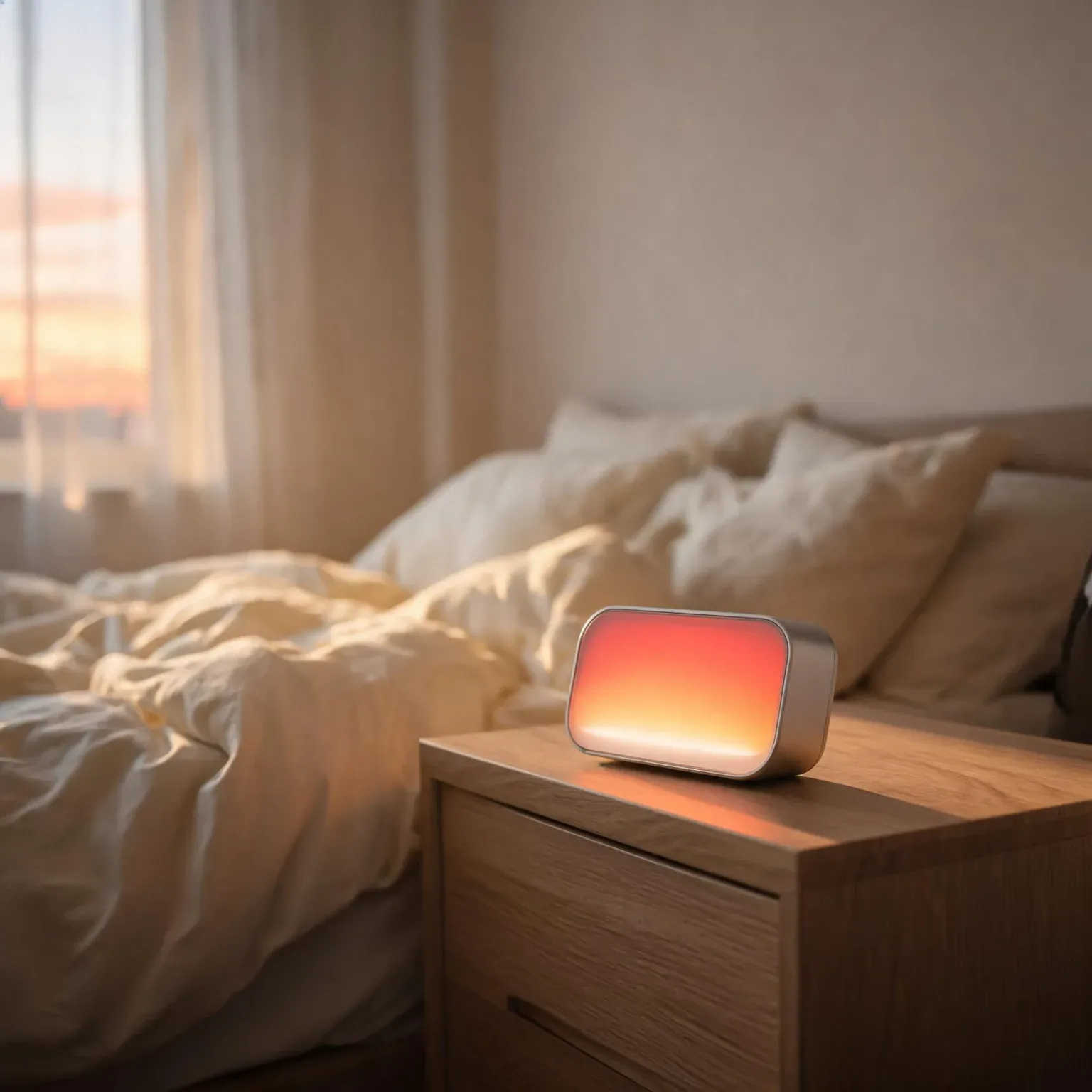
Best sunrise alarm clocks wake you with a gradual dawn instead of a jolt — and after ranking the field on ramp length, brightness, sounds and app control, our top pick is still the Philips SmartSleep HF3520. Below are seven 2026 picks compared side by side, a spec-truth table built from the live listings, the price point where paying more stops buying a better dawn, and the places where our ranking disagrees with the big-name reviewers.
As an Amazon Associate I earn from qualifying purchases. We earn commission from qualifying purchases made through links on this page. This never affects our rankings or what we recommend.
Our Picks at a Glance
- 🥇Top Pick: Most Natural Dawn: Philips SmartSleep Wake-up Light HF3520/60
- 🥈Best Smart Sleep Coach: Hatch Restore 2 Sunrise Alarm Clock & Sound Machine
- 🥉Best Classic Value: Vivilumens Sunrise Alarm Clock with Sound Machine
- 💰Best Budget Under $40: Magicteam Sunrise Alarm Clock
- ⭐Best for Heavy Sleepers: JALL Full-Screen Wake Up Light with White Noise Machine
- ✨Most Customizable Light: Beurer WL75 4-in-1 Wake-Up Light with App Control
- 🌅Best Compact & Gift Pick: ANTDALIS Sunrise Alarm Clock
Our Verdict: Among the best sunrise alarm clocks we ranked, the Philips SmartSleep HF3520 remains the one to beat: its 30-minute dawn ramp is the most gradual here and its sunset fade earns its keep at bedtime. Budget shoppers should look at the Magicteam or the ANTDALIS for under $40, white-noise-loving heavy sleepers will prefer the JALL, and routine-builders who live in their phone will still prefer the Hatch Restore 2.
How We Tested the Best Sunrise Alarm Clocks
How We Ranked Them
We ranked every clock on five things you can actually check: how long the light takes to ramp (10 minutes or 30?), how bright it gets at pillow distance, how many wake sounds and snooze options it offers, whether the controls work without a manual, and whether it needs an app, an account or a subscription. We used each clock as a bedside alarm, cross-checked the manufacturer specs against the live Amazon listing, and compared our impressions with the independent testers named in Sources below. Our full method — including what we do and do not claim — is on our how we test page.
Sourcing transparency: this guide mixes hands-on bedside use with spec analysis of the live product listings and aggregated findings from the testers we cite (Sleepopolis, CNET and TechRadar). We are not a laboratory and we do not claim to have measured lux levels or circadian outcomes ourselves — where a brightness figure comes from the manufacturer it is labelled as a claim.
The Circadian Science Behind Waking With Light
This category rests on real physiology, not marketing. The American Academy of Sleep Medicine notes that bright light therapy is used for circadian rhythm sleep-wake disorders, and describes a dawn simulator as a lamp that “gradually makes a dark room brighter over a set amount of time” to mimic the sunrise — “some people find that this helps them wake up.” That is the honest scope of a bedside sunrise clock: a comfort aid that supports a routine, not a medical device. Peer-reviewed work indexed on PubMed Central and the Sleep Foundation’s sunrise-alarm guidance point the same way: a gradual dawn softens the sleep inertia that makes abrupt alarms feel brutal.
Brightness and Ramp Length: What Actually Matters
Manufacturers love quoting lumens, but the two numbers that change your morning are how long the ramp lasts and how bright it gets at your pillow. A 30-minute ramp feels like a sunrise; a 10-minute ramp feels like a light switch with a dimmer. Aim for a clock that reaches roughly 200-300 lux at pillow distance, place it 40-60 cm from your head and slightly above pillow height. Every full-size pick below clears that bar on paper; the budget picks reach it with a shorter ramp.
Sunset Fade and Wind-Down Extras
The underrated half of a wake-up light is bedtime. A sunset mode reverses the dawn — light dims over 15-40 minutes while optional sounds fade — which nudges your rhythm toward sleep instead of fighting it. Philips’ dusk simulation, Hatch’s guided wind-down routines and the Beurer’s mood-light dimming are the strongest implementations we ranked. If you struggle to disconnect at night, prioritise a genuine sunset fade over a bare dimmer switch.
Sounds, Radio and Smart Integration
Sound is the safety net that guarantees you surface even on the greyest mornings. Birdsong and chimes suit gentle wakers; heavy sleepers should shortlist models with white-noise libraries and dual alarms. App integration matters more than it sounds: editing tomorrow’s alarm from bed beats button menus at 6 a.m. — but it also drags in accounts and subscriptions, which is the main reason our top pick is a clock with no app at all.
Spec-Truth Table: What the Listings Actually Claim
These figures come from the live Amazon listings and the testers we cite, not from a competitor roundup. Where a brightness number is the manufacturer’s own claim, it is labelled. The pattern is worth noticing: price buys a longer ramp and a better build far more reliably than it buys raw brightness.
| Model | Dawn ramp | Brightness | Sounds | App / radio | Standout spec |
|---|---|---|---|---|---|
| Philips SmartSleep HF3520/60 | 30 min | 20 brightness levels (no lux figure published) | 5 sounds + FM | None | Tap snooze; dusk simulation |
| Hatch Restore 2 | App-set (custom) | Dimmable fabric face | 80+ sound library | Hatch app (Restore 3 newer) | Physical button for phone-free alarms |
| Vivilumens Sunrise | 10 min | Not published | 10 sounds | None | Dual alarms; 30/60/90-min sleep timers |
| Magicteam Sunrise | 10 min | Not published | 28 ringtones | None | 12 colors; memory function |
| JALL Full-Screen | 10-60 min | Not published | 25 sounds + FM | None | 5W Bluetooth speaker; 17 lighting effects |
| Beurer WL75 | Sunrise + sunset | 2,000 lux (claimed) | 6 wake melodies | LightUp app + FM | 256 colors; USB phone charging |
| ANTDALIS Sunrise | 30 min | 500 lux at 35 cm (claimed) | 7 sounds + FM | None | 8 colors + warm white; stepless dimming |
Table note: brightness figures are manufacturer claims unless a tester measured them; we flagged the two claims we could not independently verify (Philips publishes no lux figure; ANTDALIS and Beurer publish their own). Prices move constantly, so treat any dollar figure on this page as a snapshot.
Where Spending More Stops Buying a Better Dawn
Sunrise clocks cluster into four price bands, and the differences between them are more about the ramp, the build and the ecosystem than about brightness:
- Under about $40 — the Magicteam, the ANTDALIS and the JALL-style full-screen clocks. You get a real sunrise, dual alarms and a sound machine, but the ramp is short (often 10 minutes) and the body is plastic. CNET pegs the JALL budget pick at around $33.
- About $60-$110 — the Vivilumens and Lumie Spark 100 tier (TechRadar/CNET list the Spark at $109). Smoother ramps, better build, often a proper radio or a nicer sound library.
- About $110-$180 — the Philips SmartSleep HF3520 and the Hatch Restore (CNET lists the Restore 3 at $170, the Casper Glow at $115). This is where a full 30-minute dawn, premium construction and a mature app ecosystem live.
- Above $200 — the Philips Hue Twilight (list $279/£249 per TechRadar) and Philips’ RelaxBreathe ‘Someo’ light. You are buying design and smart-home integration, not a brighter wake; both earn extra kit (a Hue Bridge) to reach their best.
The stopping point: past roughly $150-$170, the dawn itself stops getting meaningfully better. Every extra dollar buys design, ecosystem or subscription content — so if you only want the most natural wake-up, the Philips HF3520 and the sub-$40 picks bracket everything you actually need.
Best Sunrise Alarm Clocks of 2026: Quick Comparison
| Model | Award | Dawn Simulation | Sounds & Extras | Smart Control |
|---|---|---|---|---|
| Philips SmartSleep HF3520 | Top Pick | 30-min ramp, 20 levels | 5 sounds, FM radio | None |
| Hatch Restore 2 | Best Smart | Custom app routines | Sound library, meditations | Hatch app |
| Vivilumens Sunrise | Best Classic Value | 10-min dawn | 10 sounds, sleep timer | None |
| Magicteam Sunrise | Best Budget | 10-min dawn | 28 ringtones | None |
| JALL Full-Screen | Heavy Sleepers | 10-60 min, full-screen | 25 sounds, FM, 5W speaker | None |
| Beurer WL75 | Most Customizable | Sunrise + sunset, 256 colors | Radio, Bluetooth speaker | LightUp app |
| ANTDALIS Sunrise | Compact & Gift | 30-min dawn | 7 sounds, FM | None |
Where We Disagree With Other Reviewers
The Hatch-first consensus. Sleepopolis names the Hatch Restore 3 its best overall sunrise alarm clock, and CNET also crowns the Hatch Restore 3 ($170) its top pick. We keep the Hatch in the roundup as our Best Smart pick but rank the Philips HF3520 first — because the very thing that makes Hatch reviewers’ favourite, its app and content library, is also its friction: Sleepopolis notes the best sleep content sits behind a $4.99/month Hatch+ subscription, and setup needs your phone. A clock that wakes you the same way without an account or a fee wins on the one thing that matters at 6 a.m.
TechRadar’s Beurer-first list. TechRadar’s best wake-up light is the Beurer WL50 for its smooth 10/20/30-minute ramp and table-lamp looks. We keep Beurer in the roundup but rank the WL75, because the app control and 256-colour mood lighting are what most buyers actually use day to day. Where we agree with everyone: the JALL is the right budget buy — CNET calls it the clock to get if you “aren’t ready to shell out $100 or more,” and Sleepopolis gave it full marks for its sunrise.
Where our ranking could be wrong. If you value a phone-free, subscription-free routine above all, the Hatch becomes the better clock; if you want the brightest possible bedside light and already own Philips Hue, the Hue Twilight wins. We rank for the median buyer, not the edge case.
Failure Modes: What Actually Goes Wrong
These are the recurring complaints in the tester notes and owner reviews for the clocks in this category — not invented frequencies, but the patterns worth knowing before you buy:
- Short dawn ramps on budget clocks. Many sub-$40 units promise a “sunrise” but ramp over just 10 minutes; several buyers describe it as a dimmer switch rather than a dawn. If the gradual light is your whole reason for buying, check the ramp length, not the marketing.
- Subscription creep. Hatch’s best sounds and wind-down routines sit behind Hatch+ at $4.99/month (Sleepopolis); the core alarm and light work without it, but the “full” experience does not.
- Clunky controls. Button-and-combo menus on the cheaper, feature-dense clocks are the most common usability gripe; Sleepopolis called the JALL’s controls “clunky” and its plastic build “cheaply made.”
- Weak audio. The Philips HF3520 offers only five wake sounds, and TechRadar found the RelaxBreathe Philips’ “speaker quality not great.” If a loud backup alarm matters, lean toward the JALL or the Beurer.
- No battery backup. Almost every unit here is outlet-only, so a power cut means no alarm. The Magicteam keeps your settings in memory, but none of these clocks will wake you through a blackout.
- “Clinically proven” overclaim. Philips’ listing says its wake-up lights are “recommended by physicians and pharmacists,” but the AASM describes a dawn simulator only as something some people find helpful — see the reality check below.
Spec-Claim Reality Check: “Clinically Proven” vs the AASM Standard
A manufacturer bullet on the Philips HF3520 reads “CLINICALLY PROVEN: Philips wake-up lights are recommended by physicians and pharmacists.” Check that against the institutional standard and it thins out. The American Academy of Sleep Medicine lists bright light therapy as a treatment for circadian rhythm sleep-wake disorders using light boxes and visors that deliver 3,000-10,000 lux, and it separates those from dawn simulators, which it only says “mimic the sunrise” and that “some people find helps them wake up.” The AASM also advises talking to a sleep specialist before starting light therapy. Translation: a bedside sunrise clock is a pleasant, well-liked routine aid — it is not a validated therapy device, and if you have a diagnosed circadian disorder or seasonal affective disorder you want a proper 10,000-lux light box and a clinician, not a bedside lamp.
1. Philips SmartSleep Wake-up Light HF3520/60

- CLINICALLY PROVEN*: Philips wake-up lights are recommended by physicians and pharmacists for establishing a healthy slee…
- PERSONALIZATION: Simulated sunset and sunrise and choice of 5 different natural wake-up sounds
- SMART FEATURES: FM radio, tap snooze and automatic dimmable display
What We Like
- Clinically inspired sunrise simulation with 20 brightness settings
- Sunset fade eases you toward sleep naturally
- Five calming wake-up sounds plus FM radio
- Tap-anywhere snooze doubles as a bedside reading lamp
What Could Be Better
- Costs noticeably more than screen-style rivals
- No app or voice control
- Dial-and-button menus feel dated next to app-first clocks
- Dome design occupies more nightstand space
Flaws but not dealbreakers: The HF3520 skips modern conveniences like app scheduling and USB charging, and its dial-and-menu interface takes a night or two to learn. You also pay a premium over basic screen clocks. None of that changes the core fact: this is the most refined, most gradual dawn simulation in the roundup, and it is the closest thing here to watching an actual sunrise from bed.
Best For: Light-sensitive sleepers who want the most natural, gradual dawn simulation available — and will pay for it once
Skip It If: Skip it if you want app scheduling, an account-based routine, or a subscription-free smart routine — the HF3520 is deliberately a dumb clock.
2. Hatch Restore 2 Sunrise Alarm Clock & Sound Machine

- This product is Restore 2. Please note there is now an upgraded version also available, Restore 3, that includes improve…
- 𝗦𝗹𝗲𝗲𝗽 𝗱𝗲𝗲𝗽𝗹𝘆: 𝖢𝗈𝗏𝖾𝗋 𝖻𝖺𝖼𝗄𝗀𝗋𝗈𝗎𝗇𝖽 𝗇𝗈𝗂𝗌𝖾𝗌 𝗐𝗂𝗍𝗁 𝗌𝗈𝗎𝗇𝖽𝗌 𝗂𝗇𝗌𝗉𝗂𝗋𝖾𝖽 𝖻𝗒 𝗇𝖺𝗍𝗎𝗋𝖾.
- 𝗪𝗮𝗸𝗲 𝗴𝗲𝗻𝘁𝗹𝘆: 𝖠 𝗌𝗎𝗇𝗋𝗂𝗌𝖾 𝖺𝗅𝖺𝗋𝗆 𝖼𝗅𝗈𝖼𝗄 𝗌𝗎𝗉𝗉𝗈𝗋𝗍𝗌 𝗒𝗈𝗎𝗋 𝗇𝖺𝗍𝗎𝗋𝖺𝗅 𝖼𝗂𝗋𝖼𝖺𝖽𝗂𝖺𝗇 𝗋𝗁𝗒𝗍𝗁𝗆.
What We Like
- App-guided morning and bedtime routines wrapped around a customizable sunrise
- Triples as a sound machine, reading light, and wind-down coach
- Sleek fabric-wrapped design that hides the alarm-clock DNA
- Physical buttons handle alarms phone-free once routines are set
What Could Be Better
- Requires the free Hatch app for initial setup and routine editing
- Deepest sleep-content library sits behind the Hatch+ subscription
- No battery backup — stays tethered to an outlet
- Overnight display brightness takes a little tuning
Flaws but not dealbreakers: Hatch reserves some sleep sounds and guided rest sessions for its Hatch+ subscription, and you will need your phone once for setup. Neither flaw touches the fundamentals: its sunrise and sunset routines are the smoothest we ranked, and if subscriptions annoy you, the JALL and ANTDALIS picks below deliver a solid dawn for half the price.
Best For: Smart-home households and routine-builders who want an all-in-one wind-down and wake-up system
Skip It If: Skip it if you refuse to put your phone in the loop — setup and routine edits live in the Hatch app, and a newer Restore 3 exists if you want the current model.
3. Vivilumens Sunrise Alarm Clock with Sound Machine
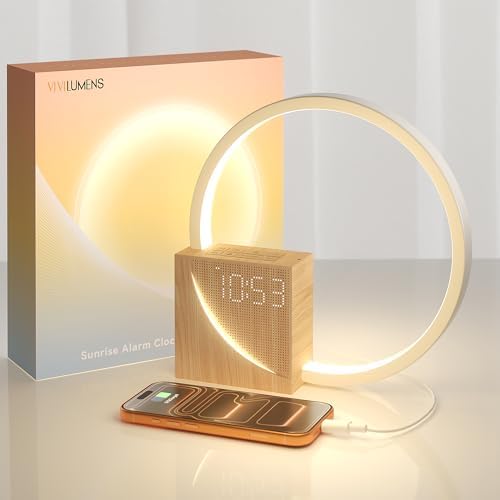
- 【Sunrise Simulation Alarm Clock – Wake Up Gently to Natural Light】Start your day the right way with our sunrise alarm cl…
- 【Dual Alarm Clocks for Bedroom】The new digital clock for the bedroom, a versatile alarm clock with two distinct modes to…
- 【10 Soothing Sounds – Your Ultimate Sleep Companion】Our premium alarm clock with white noise – the nice sleep companion….
What We Like
- Simulated dawn brightens over the 10 minutes before your alarm
- Ten soothing sounds with 30, 60 or 90-minute sleep timers
- Dual alarms with a 12-level volume ramp for heavy sleepers
- Snooze plus a 9-minute power-nap function
What Could Be Better
- Dawn ramp is shorter than the Philips 30-minute curve
- Touch controls and plastic body feel budget
- No FM radio and no app control
Flaws but not dealbreakers: The Vivilumens trades the flagship’s long, slow dawn for a snappier 10-minute lift, and its touch panel is fussier than a physical dial. At its price those are fair swaps: you get a genuine sunrise, a real sound machine and dual alarms for a fraction of the Philips or Hatch outlay.
Best For: Value shoppers who want dual alarms and a sound machine without premium pricing
Skip It If: Skip it if the gradual ramp is the whole point — a 10-minute dawn is noticeably brisker than a 30-minute one.
4. Magicteam Sunrise Alarm Clock
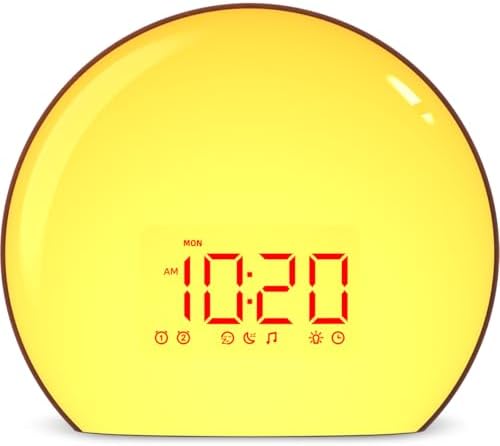
- 🌅 Natural Sunrise & Sunset Simulation: The wake up light will brighten up 10 minutes before the alarm time to simulate a…
- 😴 Alarm & 6 Times Snooze: The dual alarm offers four modes of alarm settings for you to combine freely: Weekdays, Monday…
- 🎶 28 Ringtones & Adjustable 10-Level Volume: With 28 soothing ringtones, natural sounds, such as bird chirping, ocean wa…
What We Like
- Sunrise and sunset simulation with a gentle 10-minute dawn
- 28 ringtones with 10 adjustable volume levels plus 6-times snooze
- 12 night-light colors with adjustable brightness
- Memory function keeps your settings after a power cut
What Could Be Better
- Short 10-minute dawn ramp
- The 7-button layout still needs a manual read-through
- Entirely plastic build feels light in the hand
Flaws but not dealbreakers: Like every sub-$40 sunrise clock we ranked, the Magicteam lifts the light quickly and leans on its sounds to do the waking. Its memory function at least preserves your settings through outages. If you only want to test whether light-waking suits you, this is the cheapest sensible entry point.
Best For: First-time buyers who want to try light-waking for the least money
Skip It If: Skip it if you need a long, cinematic dawn or a premium build — this is a taster, not a flagship.
5. JALL Full-Screen Wake Up Light with White Noise Machine

- 【Full-Screen Sunrise Simulation for Heavy Sleepers】 This sunrise alarm clock mimics natural dawn, glowing from dark to f…
- 【Dual Alarms, Snooze & Auto-Sync】 Easily set separate Everyday, Weekday, or Weekend routines for your family. Features a…
- 【25 Natural Sleep Sounds & FM Radio】 Fall asleep to 25 natural sounds and white noises with a flexible 10-480 min sleep …
What We Like
- 25 white-noise and nature tracks mask street noise through the night
- Dual alarms with separate weekday and weekend profiles
- 17 dimmable colors double as a nursery-friendly nightlight
- FM radio and a 5W Bluetooth speaker included
What Could Be Better
- Dense feature set makes the manual essential reading
- White-noise playback left loud overnight can bother light-sleeping partners
- Sunrise peaks below premium-model brightness
- No battery backup
Flaws but not dealbreakers: Expect a learning curve with the button combos, and the unit must stay plugged in. Those trade-offs feel fair once you tally what it replaces: a standalone white-noise machine, a bedside lamp and a conventional alarm — bundled behind one of the stronger dawn effects at this price.
Best For: Heavy sleepers and noise-prone bedrooms that need overnight sound masking plus a firm dawn cue
Skip It If: Skip it if you want a minimalist single-purpose clock — this is a feature-dense bedside console.
6. Beurer WL75 4-in-1 Wake-Up Light with App Control

- SUNLIGHT SIMULATION: Fall asleep naturally and wake up gently with simulated sunlight and color of either a sunrise or s…
- BLUETOOTH: Bluetooth connectivity with the free ‘beurer LightUp’ app allowing you to control your device and its setting…
- MOOD LIGHT: The WL75 provides a colored sunrise and sunset simulation and a color change function and option of setting …
What We Like
- 256 customized color combinations controlled through the LightUp app
- Sunrise and sunset simulation plus daytime mood-light scenes
- Bluetooth speaker and FM radio on board
- Warm-dimming reading-lamp function
What Could Be Better
- Larger footprint than minimalist clocks
- App pairing occasionally needs a second attempt
- Costs more than screen-style rivals
- Time display legibility from across the room is average
Flaws but not dealbreakers: The WL75 leans lamp-first rather than clock-first, so the numerals are not its strength and setup adds an app step. If you want a single device that serves as ambient lighting, party glow, reading lamp and sunrise alarm around the clock, those quirks are easy to forgive.
Best For: Design-minded buyers who want a wake-up light that moonlights as everyday mood lighting
Skip It If: Skip it if the clock face matters most — the WL75 is a lamp that happens to wake you.
7. ANTDALIS Sunrise Alarm Clock

- 【Wake Up Light with Sunrise Simulation】 This wake up light gradually increases within 30 minutes from soft morning Red t…
- 【Dual Alarm Clock with Tap To Snooze】 This sunrise alarm clock has 2 alarms, which includes 7 natural sounds and 10 soun…
- 【Sleep Aid with 7 Sleep Sounds】 This natural light alarm clock glows a soft night light and/or plays natural sound (7 so…
What We Like
- 30-minute sunrise that climbs from soft red through orange to bright white
- A claimed 500 lux at 35 cm — bright for the price
- Dual alarms, 7 nature sounds, 10 volume levels and a 9-minute snooze
- 8 colors plus warm white with stepless dimming as a bedside lamp
What Could Be Better
- Touch panel takes a night to learn
- Smaller sound library than the JALL’s 25 tracks
- No app control
Flaws but not dealbreakers: The flat touch panel is less tactile than a dial and the sound menu is modest. As a genuine 30-minute-dawn clock at a gift-friendly price — for a kid’s room, a guest room or a hard-to-wake teenager — it covers the essentials without the plastic-feeling shortcuts of the cheapest units.
Best For: Travelers, kids’ rooms and guest rooms wanting a compact clock with a real 30-minute dawn
Skip It If: Skip it if you want app scheduling or a big sound library — the ANTDALIS keeps it simple.
Frequently Asked Questions
1. Do sunrise alarm clocks really work?
Yes — the light does the heavy lifting. Morning light suppresses melatonin, the hormone that keeps you groggy, and raises alertness before sound even enters the picture. The AASM describes a dawn simulator as something that mimics the sunrise and that “some people find” helps them wake up, which is why the best sunrise alarm clocks feel different from a buzzing phone alarm: the mechanism is biology, even if the marketing oversells it.
2. Are sunrise alarm clocks good for winter blues?
They can help a routine, but be honest about the evidence. Dark winter mornings delay your circadian clock and deepen seasonal low mood, and a simulated dawn delivers bright light at a useful moment. The AASM, however, treats diagnosed seasonal affective disorder with a dedicated 10,000-lux light box under a clinician’s guidance — a bedside sunrise clock is not that device. Use one to make dark mornings kinder, not as a substitute for treatment.
3. Sunrise alarm vs. regular alarm: which is better?
A regular alarm yanks you out of deep sleep with sudden noise, while a sunrise alarm lets your body rise gradually as light builds — a difference linked to less grogginess and calmer mornings. Most people do best with both working together: a 30-minute dawn followed by birdsong or radio as the fail-safe.
4. Can kids use sunrise alarm clocks?
Generally yes, with adult setup. Children respond well to light-based cues, and the colour-changing nightlights on the JALL, Vivilumens and ANTDALIS picks double as sleep trainers that signal when it is okay to climb out of bed. Set moderate brightness, choose soft secondary sounds, and place the clock out of reach.
5. How bright should a sunrise alarm clock be?
Aim for roughly 200-300 lux measured about 45 cm from the panel — enough light to matter in a dark winter bedroom. Placement multiplies effectiveness: position the clock 40-60 cm from your head, slightly above pillow level, angled toward your face. Check whether a listed “500 lux” or “2,000 lux” figure is measured at pillow distance or at the panel; manufacturers rarely state which.
6. Will a sunrise alarm clock wake a heavy sleeper?
It can — if you pick correctly. The winning formula is a bright full-screen or fast dawn, a loud secondary sound, and dual alarms spaced ten minutes apart. Our heavy-sleeper pick layers a 25-track white-noise library for overnight masking with a sunrise ramp that starts working before your ears are ever needed.
7. When should the sunrise start before my alarm?
Thirty minutes is the sweet spot and the default on the Philips and ANTDALIS picks; the budget Magicteam and Vivilumens ramp faster at about 10 minutes. Very light or very deep sleepers can experiment with 45 minutes (Beurer and JALL allow up to 60). Whatever you choose, hold it steady across weekends — a consistent wake time is what trains the circadian rhythm the whole system depends on.
Sources & Further Reading
- American Academy of Sleep Medicine — Bright Light Therapy (Sleep Education)
- Sleep Foundation — Best Sunrise Alarm Clocks
- Sleepopolis — Best Sunrise Alarm Clock (2026), tested picks
- CNET — The 5 Best Sunrise Alarm Clocks for Peaceful Mornings
- TechRadar — The best wake-up lights, tested by experts
- NIH / PMC — Circadian effects of morning light exposure