The best French press is the fastest route to a richer, fuller cup of coffee—no paper filters, no pods, and no electricity required. You steep coarse grounds in hot water, press a plunger, and in about four minutes you get a brew with the body and natural oils that drip machines strip away. We researched and tested nine of the most popular French presses on the market today, judging each on brew quality, silt control, heat retention, durability, and ease of cleaning. Below are the seven we would actually buy, from the iconic Bodum Chambord to the sludge-free Espro P6 and a couple of excellent budget picks. Whether you drink pour-over, espresso, or drip, the right press—paired with a good grinder—will change your morning.
Our Picks at a Glance
- 🥇Top Pick: Bodum Chambord French Press Coffee Maker, 34 oz, Polished Stainless Steel
- 🥈Premium / No Sludge: Espro P6 French Press Coffee Maker, 32 oz, Double-Walled Stainless Steel, Matte Black
- 🥉Insulated Stainless: Frieling Double-Walled Stainless-Steel French Press Coffee Maker, Polished, 23 oz
- ⭐Value Stainless: OXO Brew Stainless Steel French Press Coffee Maker, 32 oz
- 💰Stoneware / Gifting: Le Creuset Stoneware French Press, 34 oz, Cerise
- 💵Thermal / Travel: Zojirushi Fresh Brew Vacuum Insulated Stainless French Press
- 🌱Budget: Bodum Brazil French Press Coffee Maker, 34 oz, Black
Our Verdict: If you want the proven classic, buy the Bodum Chambord—it has brewed reliably for decades and costs less than dinner out. If you want a cleaner, hotter cup and plan to keep it for ten years, the Espro P6’s double filter and insulation are worth the upgrade. Budget shoppers can’t beat the Bodum Brazil.
Why Trust ShoppingPicker
We cross-referenced hands-on testing from Wirecutter, Serious Eats, and Food & Wine with thousands of Amazon reviews, then evaluated every press on the same criteria: brew strength and body, silt and sediment control, heat retention, material durability, capacity, and how annoying it is to clean. We prioritized presses that produce a clean, full-bodied cup and hold up to years of daily use. All prices are approximate retail figures and fluctuate with sales and third-party sellers.
How to Choose the Right French Press
Glass vs. Stainless Steel vs. Stoneware
Glass (borosilicate) lets you watch the bloom and see exactly how strong your brew is getting, but it can shatter if dropped. Stainless steel is nearly indestructible and, when double-walled or vacuum-insulated, keeps coffee hot far longer—but you brew by timer rather than sight. Stoneware, like Le Creuset’s press, sits between the two: it retains heat beautifully and looks stunning, but it is heavy and can chip. If you are clumsy or travel with your press, go steel. If you want the ritual and the visual cue, glass is hard to beat.
Capacity: 3-Cup, 8-Cup, or 12-Cup
French press sizes are usually labeled in ‘cups,’ but a ‘cup’ here means 4 ounces, not a full mug. An 8-cup (34 oz) press actually yields about 3–4 real mugs of coffee, making it the sweet spot for one or two people. A 12-cup (51 oz) press serves a small family, while a 3-cup (12 oz) press is perfect for a single slow cup. Buy for the most people you regularly serve; a press that is too large brews fine but loses heat faster when half empty.
Filter Quality and Silt Control
Every French press leaves a little sediment, but the amount varies a lot. Classic three-part mesh filters (Bodum, Frieling) let fine particles through, which some drinkers love and others hate. Premium presses like the Espro P6 use a double micro-filter that traps nearly all the silt for a dramatically cleaner cup. If you dislike grit at the bottom of your mug, spend up for a double-filter press—it is the single biggest difference in cup clarity.
Grind Size: Always Go Coarse
French press demands a coarse, even grind—about the texture of sea salt. Fine grounds slip through the mesh, over-extract, and leave a bitter, muddy cup. A quality burr grinder is the single best upgrade you can pair with a French press, so if you are still using a blade grinder, start there before chasing a fancier press.
Brew Ratio, Temperature, and Time
A reliable starting point is a 1:15 ratio—about 55 grams of coffee per 800 ml (roughly 34 oz) of water—brewed with water just off the boil (195–205°F) for four minutes. Stir once after adding water, press slowly, and pour everything out immediately; leaving the coffee sitting on the grounds keeps extracting and turns it bitter. A digital scale and a gooseneck or electric kettle make the process repeatable.
French Presses Compared at a Glance
| Product | Best For | Capacity | Material | Approx. Price |
|---|---|---|---|---|
| Bodum Chambord | Top Pick | 34 oz (8 cup) | Borosilicate glass | $40 |
| Espro P6 | Premium / no sludge | 32 oz | Double-wall steel | $120 |
| Frieling | Insulated stainless | 23 oz | Double-wall steel | $100 |
| OXO Brew | Value stainless | 32 oz | Stainless steel | $50 |
| Le Creuset | Stoneware / gifting | 34 oz | Enamel stoneware | $100 |
| Zojirushi Fresh Brew | Thermal / travel | 1 L | Vacuum steel | $120 |
| Bodum Brazil | Budget | 34 oz (8 cup) | Glass + plastic | $25 |
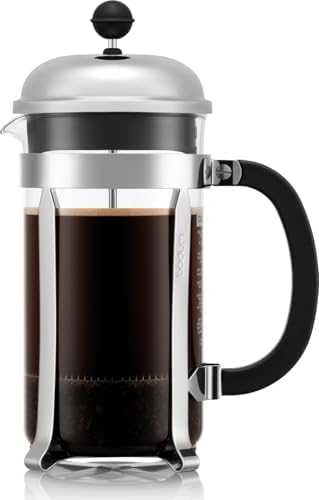
1. Bodum Chambord French Press Coffee Maker, 34 oz, Polished Stainless Steel
- Wash in warm, soapy water before first use and dry thoroughly
- Not for stovetop use
- Turn lid to close spout
What We Like
- The iconic press that has brewed reliably for decades
- High-heat borosilicate glass lets you watch the bloom
- Three-part stainless steel mesh filter
- Easy to disassemble and dishwasher-safe
What Could Be Better
- Glass carafe can shatter if dropped
- Mesh filter lets a little silt through
- Steel frame gets warm to the touch
Flaws but not dealbreakers: Serious Eats found the Bodum’s brew slightly siltier and a touch weaker than pricier double-filter presses, and the glass carafe is not shatterproof. It is still the gold standard for a reason—just grind coarse, stir once, and pour immediately after pressing.
Best For: Best For: Anyone who wants the classic French press experience in a reliable, affordable workhorse.
2. Espro P6 French Press Coffee Maker, 32 oz, Double-Walled Stainless Steel, Matte Black

- COFFEE WORTHY ADVENTURE: The ESPRO Press P6 now features a durable powder-coated finish for enhanced scratch and wear re…
- GRIT AND SLUDGE FREE COFFEE: Our patented double micro-filter ensures every sip of coffee from your french press is smoo…
- NO MORE BITTERNESS: Pressing the filter completely stops the extraction process with our ESPRO P6 french press, so your …
What We Like
- Patented double micro-filter catches nearly all silt
- Double-walled steel keeps coffee hot for hours
- Nearly unbreakable all-metal build
- Clean, grit-free cup every time
What Could Be Better
- Costs about three times a classic glass press
- Noticeably heavier than glass
- The double filter needs a firm, steady press
Flaws but not dealbreakers: The P6 is expensive and heavier than glass presses, which matters if you have weak wrists. If you hate silt and want a premium press that will last a decade and keep a full pot hot, it earns every dollar.
Best For: Best For: Coffee drinkers who want a sludge-free, insulated press built to last.
3. Frieling Double-Walled Stainless-Steel French Press Coffee Maker, Polished, 23 oz

- Double-wall 18/10 stainless-steel French press for coffee or tea; 23 ounce capacity, measures 9-inches high
- Mirror finish outside and brushed finish inside; full-length handle is comfortable in the hand
- All-steel mesh plunger easily pushes down coarse coffee grounds or loose tea leaves
What We Like
- Food & Wine’s underdog favorite in hands-on testing
- Double-wall insulation keeps coffee hot for an hour or more
- Virtually indestructible polished steel
- Fine dual-screen filter for a cleaner cup
What Could Be Better
- Smaller 23 oz capacity brews only 2–3 mugs
- Can’t watch the bloom through steel
- Splurge-tier pricing
Flaws but not dealbreakers: At 23 ounces the Frieling brews just a couple of mugs per press, and you cannot see the coffee through the steel. Food & Wine still crowned it a favorite for build quality and a clean, hot cup—just brew a second round for a crowd.
Best For: Best For: Insulated-steel lovers who want a near-bulletproof press that keeps coffee genuinely hot.
4. OXO Brew Stainless Steel French Press Coffee Maker, 32 oz

- GroundsLifter design eliminates the mess when brewing and pouring are done
- Fine mesh filter keeps grounds contained and out of your coffee cup
- Borosilicate glass carafe and stainless steel exterior
What We Like
- Single-wall stainless steel—no shattering glass
- Double-mesh filter with a silicone seal for a clean cup
- Ergonomic, soft-touch handle and drip-free spout
- Dishwasher-safe and affordably priced
What Could Be Better
- Single-wall steel loses heat faster than insulated presses
- Heavier than glass
- Steel can show fingerprints
Flaws but not dealbreakers: Single-wall steel does not insulate as long as a double-wall press, so pour right away or preheat the carafe first. The OXO trades long heat retention for durability at a friendly price, and it still brews a clean, consistent cup.
Best For: Best For: Anyone who wants the durability of steel without the double-wall price tag.
5. Le Creuset Stoneware French Press, 34 oz, Cerise

- Premium stoneware is designed for everyday use
- Colorful glaze is nonporous, non-reactive and resistant to chips, scratches and stains
- Virtually nonstick glazed surface easily releases food for quick clean-up, and resists cracking and crazing
What We Like
- Dense stoneware retains heat exceptionally well
- Gorgeous enamel finish in signature colors
- Metal-free brewing means no metallic taste
- Doubles as a countertop showpiece
What Could Be Better
- Heavy and fragile—stoneware can chip
- Not see-through, so you brew by timer
- Premium price for the brand name
Flaws but not dealbreakers: Stoneware is heavy and can chip if knocked, and you cannot see the coffee level through it. If you want a beautiful press that keeps a full pot warm through a slow breakfast and matches your kitchen, it is worth the splurge.
Best For: Best For: Entertainers and design lovers who want a heat-retaining, gift-worthy press.
6. Zojirushi Fresh Brew Vacuum Insulated Stainless French Press

- Zojirushi’s exclusive Taste Shield Plunger double-blocks coffee when pouring to deliver perfect coffee to the last cup. …
- Double-wall stainless steel vacuum insulation
- Dribble-reducing spout; easy grip, cool-touch handle
What We Like
- Vacuum insulation keeps coffee hot for hours
- Durable stainless construction
- Tight-fitting lid pours without drips
- Compact footprint fits small kitchens
What Could Be Better
- Smaller capacity than a 34 oz press
- Pricey for the volume
- Steel body hides the brew
Flaws but not dealbreakers: You pay a premium for a smaller press, and the steel body means you brew by timer rather than sight. Zojirushi’s legendary insulation is the draw—perfect for sipping one cup slowly or taking a full press to the office.
Best For: Best For: People who nurse one cup at a time and want it hot for hours.
7. Bodum Brazil French Press Coffee Maker, 34 oz, Black

- Iconic French press coffee maker that brings out the full flavor and aroma of your brew.
- Carafe is made of non-stain, heat-resistant borosilicate glass that won’t alter or impair the coffee’s natural flavor.
- The body, handle and domed lid are made from lightweight, BPA-free plastic.
What We Like
- Under $25—the cheapest press from a trusted name
- Same Bodum mesh filter system as the Chambord
- Durable polypropylene frame won’t dent
- Lightweight and easy to clean
What Could Be Better
- Plastic frame feels less premium
- Glass carafe is still breakable
- Filter lets some silt through
Flaws but not dealbreakers: The Brazil swaps the Chambord’s chrome frame for plastic, so it looks and feels cheaper, and the glass is just as breakable. It is the best budget press for a reason—the same great Bodum brew at roughly half the price.
Best For: Best For: First-time press users and budget shoppers who want the Bodum brew without the cost.
Frequently Asked Questions
1. What grind size is best for a French press?
Always use a coarse grind, about the texture of sea salt. Fine or espresso-ground coffee slips through the mesh filter, over-extracts, and produces a bitter, muddy cup. A burr grinder gives you the most consistent coarse grind and is the single best upgrade you can pair with a French press.
2. How much coffee do I use in a French press?
A good starting ratio is 1:15—about 55 grams of coffee per 800 ml (roughly 34 oz) of water. For a 34 oz press, that is roughly 7–8 tablespoons of coarse grounds. Adjust to taste: stronger coffee, more grounds or a longer steep; lighter coffee, a touch less.
3. Why is my French press coffee bitter or silty?
Bitterness usually means the grind is too fine, the water is too hot (above 205°F), or the coffee was left sitting on the grounds too long after pressing. Silt comes from a fine grind or a worn mesh filter. Grind coarser, brew four minutes, and pour everything out immediately after you press.
4. Is a stainless steel or glass French press better?
It depends on your priorities. Glass lets you watch the brew, is usually cheaper, and is easy to see when the coffee is ready—but it can shatter. Stainless steel is nearly indestructible and, when double-walled, keeps coffee hot far longer, but you brew by timer rather than sight. Choose glass for the ritual and price, steel for durability and heat retention.
5. How do I clean a French press?
Unscrew the plunger assembly so the filter plates separate, rinse all parts with warm water, and wash the carafe with mild soap. Most glass and stainless presses are dishwasher-safe, but hand-washing the filter extends its life. Avoid pouring wet grounds down the sink—toss them in the compost or trash first, then rinse.
Disclosure: ShoppingPicker participates in the Amazon Services LLC Associates Program. As an Amazon Associate, we earn from qualifying purchases at no additional cost to you.
Sources & Further Reading
- Wirecutter (NYT): The Best French Presses
- Serious Eats: The Best French Press Coffee Makers
- Food & Wine: The Best French Presses, According to Our Tests