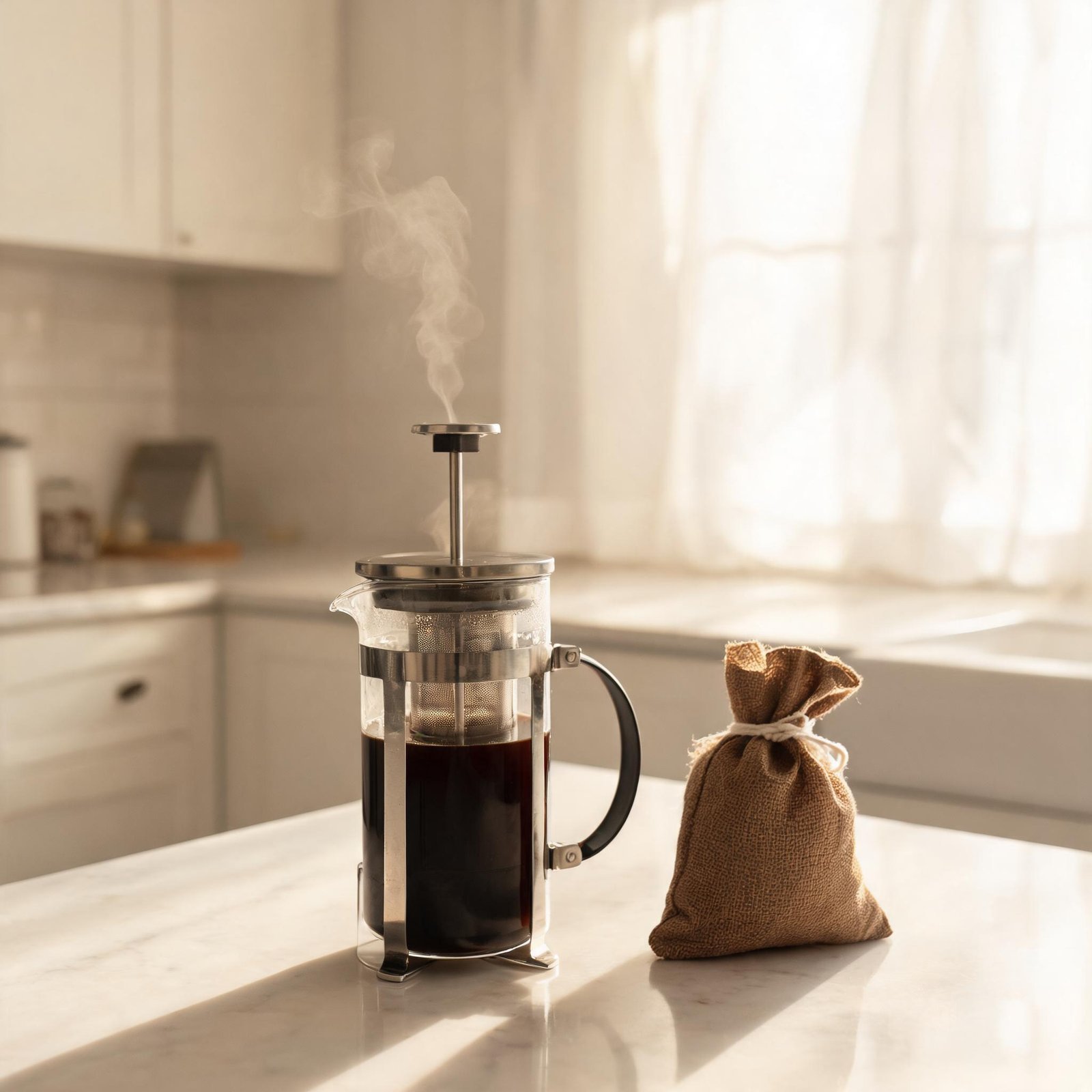
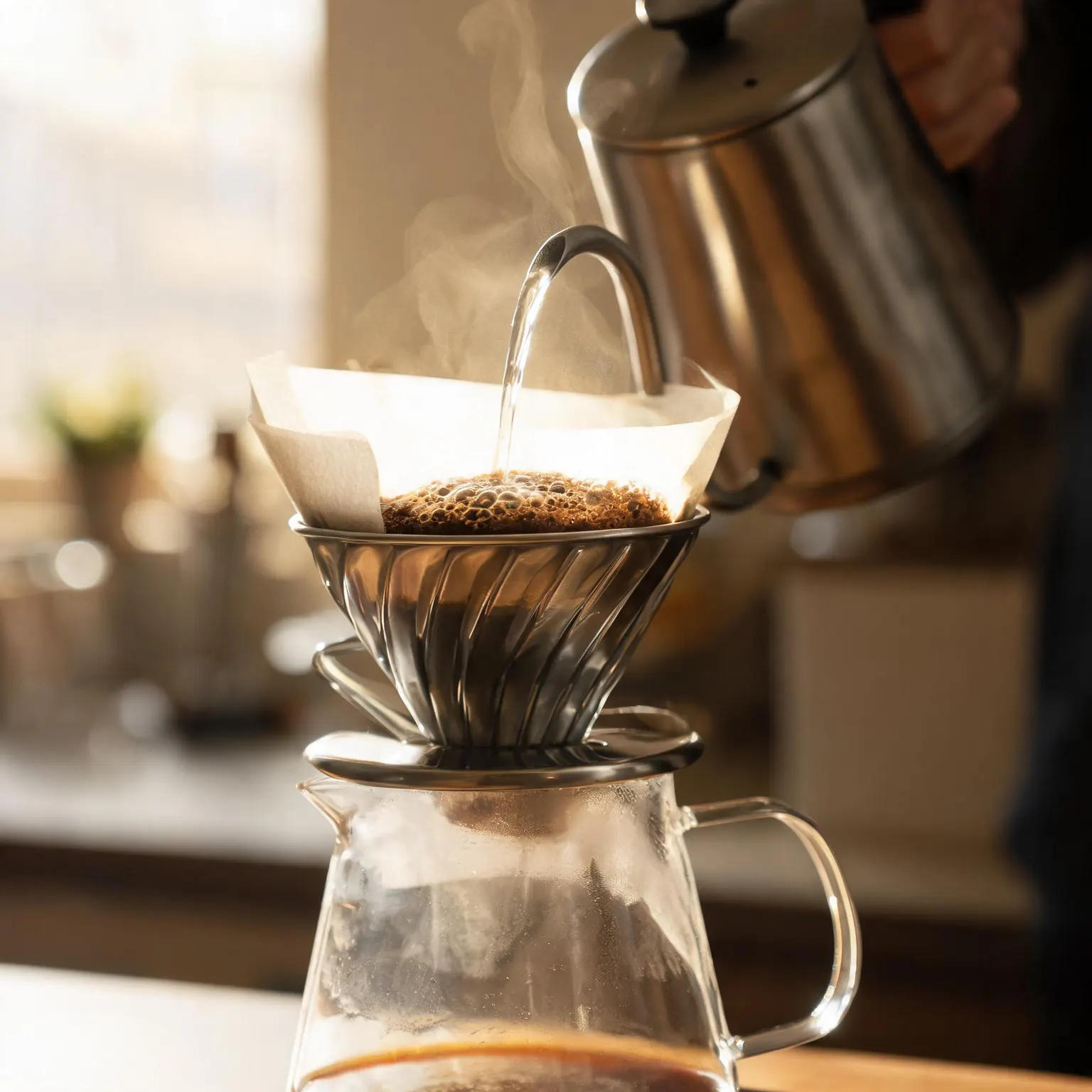
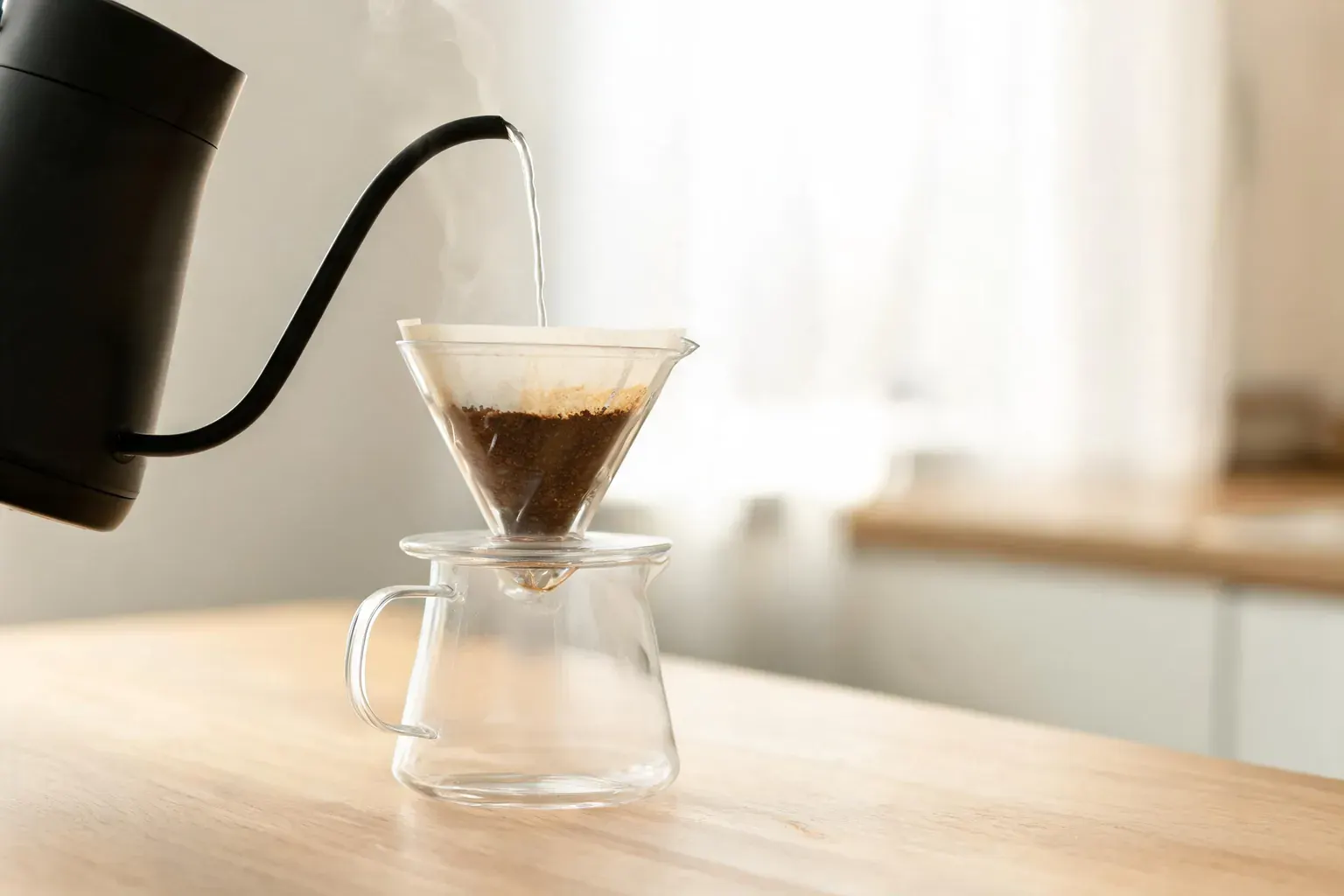
Finding the best gooseneck electric kettle comes down to two variables you can actually control: how precisely you can set the water temperature, and how steadily you can pour. Everything else on a spec sheet is decoration. We re-verified every gooseneck electric kettle in this guide against its live Amazon listing on September 26, 2026 — brand as the first word of the title, buy box active, price and stock as a buyer sees them today — and ranked the seven by pour control, temperature accuracy and the price at which the extra accuracy stops mattering. The Cosori 0.8 L leads for most people; the Fellow Stagg EKG Pro is the one to buy if precision is the whole point.
Affiliate disclosure: As an Amazon Associate I earn from qualifying purchases. We earn commission from qualifying purchases made through links on this page. This never affects our rankings or what we recommend.
Jump to:
- The 7 best gooseneck electric kettles at a glance
- 1. Cosori — best gooseneck electric kettle for most people
- 2. Fellow — best premium gooseneck kettle
- 3. OXO — best build quality and design
- 4. Govee — best smart (app and WiFi) gooseneck kettle
- 5. Epeios — best fast-heating value
- 6. Elite Gourmet — best budget digital kettle
- 7. KOIOS — best gooseneck kettle under $40
- Where paying more stops buying better coffee
- Where our ranking differs from other reviewers
- The failure patterns that show up in owner reviews
- Spec-claim reality check: ±1°F precision and 304 vs 316L
- How to choose a gooseneck electric kettle
- How we evaluated these gooseneck kettles
- Related guides from ShoppingPicker
- Frequently asked questions
- Our verdict: which gooseneck kettle should you buy?
The 7 best gooseneck electric kettles at a glance
Every model below was re-verified against its live Amazon listing on September 26, 2026. Read the price column first and the keep-warm column second: those two rows explain most of the price spread here, which runs from $39.99 to $179.95. Capacity, power and temperature range are taken from each listing as published, and where a listing does not state a figure we write “Not stated” rather than borrow one from a competitor.
| # | Model | Capacity | Power | Temperature control | Keep-warm | Price |
|---|---|---|---|---|---|---|
| 1 | Cosori Cosori Gooseneck Electric Kettle with Temperat | 0.8 L | Not stated | 5 presets; ±5°F hold tolerance | 1 hour | $69.99 |
| 2 | Fellow Fellow Stagg EKG Pro Gooseneck Electric Kettle | 0.9 L | Not stated | To-the-degree; 135–212°F (Home Grounds test) | 1 hour | $179.95 |
| 3 | OXO OXO Brew Pour Over Gooseneck Electric Kettle – | Not stated | Not stated | 1°F steps, 104–212°F | 30 minutes | $119.97 |
| 4 | Govee Govee Smart Electric Kettle | 0.8 L | 1200 W | 104–212°F; 4 presets | 2 hours | $79.99 |
| 5 | Epeios Epeios Gooseneck Electric Kettle ±1°F Temperat | 0.9 L | 1200 W | ±1°F, 100–212°F | 60 minutes | $69.99 |
| 6 | Elite Gourmet Elite Gourmet EKT3001 1L Digital Kettle | 1 L | Not stated | 13 presets + 3 custom (195–205°F) | Keep warm | $49.99 |
| 7 | KOIOS KOIOS Gooseneck Electric Kettle | 0.8 L | 1200 W | ±1°F, 100–212°F | 4 hours | $39.99 |
1. Cosori — best gooseneck electric kettle for most people

The kettle we would actually buy: a food-grade 304 stainless interior with no plastic in the water path, five temperature presets, a one-hour hold and a $69.99 price that undercuts every kettle with a bigger brand name.
What We Like
- Five one-touch temperature presets; the listing states the hold function keeps water “within 5°F of the desired temperature”, which is loose enough for coffee but still finer than a stovetop kettle
- The interior, lid and spout are food-grade 304 stainless steel, so nothing plastic sits in the water path and there is no plastic aftertaste to compete with a delicate light roast
- One-hour keep-warm and a counterbalanced handle that Home Grounds’ tester described as giving control “on par with the more expensive brand-name options”
- Value benchmark: at $69.99 it carries the same core feature set as kettles costing $40–$110 more, which is why it leads this list rather than the $180 Fellow
Flaws but not dealbreakers
- A ±5°F hold tolerance is looser than the ±1°F models further down this list — fine for pour-over, tight for a delicate 175°F white tea
- No brew timer, so you still run your own stopwatch for the pour
- The listing does not publish a wattage figure, and the handle joint gets warm on a long keep-warm cycle (a complaint that also appears on the Fellow)
Who should skip it: Skip it if you want a built-in brew timer or app control — step up to the OXO or the Govee for those.
2. Fellow — best premium gooseneck kettle
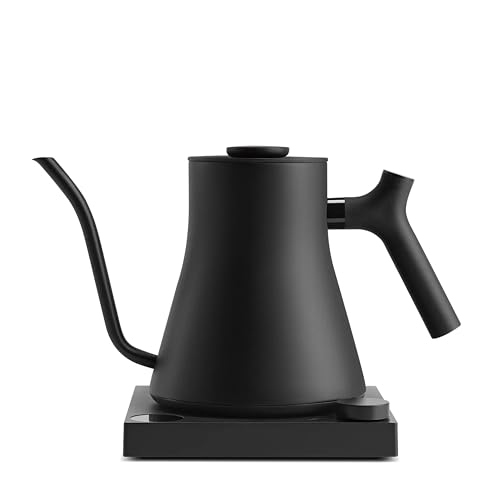
The pour-over benchmark: to-the-degree control, a real brew timer and the gooseneck every other kettle in this category is measured against — if your budget stretches to $180.
What We Like
- To-the-degree temperature control with a high-resolution LCD and a built-in brew timer — Fellow built this one specifically for pour-over, and the review community treats it as the reference point
- Home Grounds’ tester measured the Stagg line holding “precise and accurate temperatures throughout its range, from 135 °F and 212 °F” and keeping water at the set point for up to an hour
- The precision spout is the benchmark the rest of the category is judged against; The Coffee Chronicler lists the Stagg EKG among its top picks for home baristas
- 0.9 L capacity with a solid, durable build — The Coffee Chronicler called it “solid and durable”
Flaws but not dealbreakers
- $179.95 is more than twice the Cosori, and for most daily drinkers that money buys a clearer improvement as a better grinder than as a better kettle
- Home Grounds logged a “joint between handle and body gets hot” con on the Stagg design
- No WiFi or app control — the smart features live on the base, not on your phone
Who should skip it: Skip it if you mostly want quick hot water for tea and instant coffee; the precision is wasted there.
3. OXO — best build quality and design
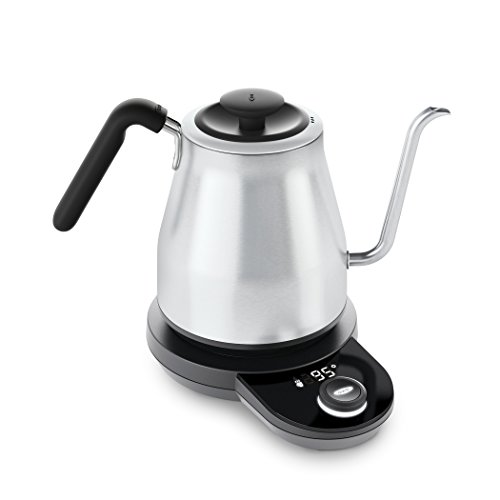
One-degree temperature control, a 30-minute hold and an integrated count-up brew timer in a stainless, cordless, cool-touch package — the best-engineered kettle here that is not the Fellow.
What We Like
- Heats in one-degree increments from 104°F to 212°F and holds your setting for up to 30 minutes, per the listing
- An integrated brew timer counts up automatically, so you can time the pour without pulling out your phone
- Cordless design — it lifts off the base — with a curved gooseneck spout tuned for steady, accurate flow and a cool-touch handle
- Automatic shut-off after the keep-warm window, and a mid-premium build at $119.97 rather than the Fellow’s $180
Flaws but not dealbreakers
- The 30-minute hold is the shortest here — the KOIOS holds four hours and the Govee two
- $119.97 makes it the second most expensive kettle in this guide, and it has no WiFi or app features
- The listing does not publish a stainless grade for the interior, so we cannot confirm 304 versus 316L
Who should skip it: Skip it if a long keep-warm matters more than build quality; the KOIOS holds four hours for a third of the price.
4. Govee — best smart (app and WiFi) gooseneck kettle

The only kettle here you can start from your phone: WiFi and Bluetooth app control, a two-hour hold and 1200W of power in a precise gooseneck spout.
What We Like
- True WiFi and Bluetooth app control — schedule a boil from the phone and the control range is not limited by Bluetooth distance, per the listing
- Variable temperature from 104°F to 212°F with four presets and a two-hour keep-warm, longer than most kettles in this guide
- 1200W heats a full 0.8 L in roughly three to five minutes, and the ready beep can be muted from the app
- Precise gooseneck spout at $79.99 — smart features without the premium-brand surcharge
Flaws but not dealbreakers
- The app is the point; buyers who will only ever use the base controls are paying for software they will not use
- App-dependent features depend on Govee continuing to support the service
- The on-base touch interface is small and secondary to the phone
Who should skip it: Skip it if you want a kettle that works identically forever with no app or account behind it.
5. Epeios — best fast-heating value

1200W, ±1°F adjustment and a 7 mm spout for $69.99 — the speed of the premium kettles at the price of the Cosori.
What We Like
- 1200W with a claimed three-to-five-minute boil; The Coffee Chronicler’s own testing of a 1200W kettle reached 600 ml of room-temperature water to 98°C in 2:24
- ±1°F adjustment from 100°F to 212°F with an LED display and one-touch °F/°C switching
- A fine 7 mm gooseneck spout designed for a stable vertical stream and better bloom control
- 60-minute keep-warm and an ergonomic heat-resistant handle for $69.99
Flaws but not dealbreakers
- 0.9 L is smaller than the 1 L Elite Gourmet at $20 less
- The display is a simple LED panel, not the higher-resolution LCD of the premium picks
- No brew timer
Who should skip it: Skip it if you brew for a crowd; 0.9 L fills two large mugs, not four.
6. Elite Gourmet — best budget digital kettle

The most preset-rich control panel under $50: 13 pre-programmed temperatures plus three custom settings, a 1 L capacity and a 304 stainless interior.
What We Like
- Thirteen pre-programmed temperatures plus three custom settings, with the listing naming 195° for oolong, 200° for coffee and 205° for black tea
- 1 L capacity with a food-grade 304 stainless-steel interior and a matte-black finish with copper accents
- An audible “ready” beep that can be silenced, plus a keep-warm function
- $49.99 for the widest preset set in the sub-$50 tier
Flaws but not dealbreakers
- The listing’s own colour field reads “Copper” while the title says “Matte Black” — a listing inconsistency to check at checkout
- The keep-warm window is shorter than the KOIOS and Govee holds
- The copper-accent finish shows fingerprints, and there is no brew timer
Who should skip it: Skip it if you need a long hold or a brew timer; it is a control-panel bargain, not a barista tool.
7. KOIOS — best gooseneck kettle under $40

A genuinely temperature-controlled precision kettle for $39.99, with ±1°F adjustment, a four-hour keep-warm and a mute mode for quiet mornings.
What We Like
- ±1°F adjustment from 100°F to 212°F, with a press-and-hold to switch between ±1°F and 5°F steps
- 1200W boils a full 0.8 L in about three to five minutes, and the keep-warm holds for four hours — the longest hold in this guide
- A true mute mode for quiet early-morning brews, and a 304 food-grade, non-BPA interior
- $39.99 for real temperature control rather than an on/off switch
Flaws but not dealbreakers
- The smallest kettle here, so a single fill makes a smaller pour-over batch
- KOIOS is a lesser-known brand, so long-term support is unproven next to Cosori or OXO
- No brew timer, and no published wattage for the plastic-free claim beyond the 304 interior
Who should skip it: Skip it if you brew large batches or want a marquee brand on your counter.
Where paying more stops buying better coffee
The gooseneck kettle market splits into four price bands, and only the first two change what ends up in your cup.
- Under $50 — real control, lesser brands. The KOIOS ($39.99) and Elite Gourmet ($49.99) both give you genuine variable temperature control and a 304 stainless interior. What you give up is brand history, a brew timer, and in the KOIOS’s case physical size.
- $50–$90 — the sweet spot. The Cosori ($69.99), Epeios ($69.99) and Govee ($79.99) add proven names, 1200 W heating in most cases, longer keep-warm windows, and on the Govee, app control. This is the band where nearly every home brewer should stop.
- $90–$130 — you are buying engineering. The OXO Brew ($119.97) buys a one-degree control range, a 30-minute hold, a cordless balanced body and an integrated brew timer. Excellent, but the water it produces is not better than the Cosori’s.
- $130+ — the benchmark. The Fellow Stagg EKG Pro ($179.95) buys to-the-degree control, a high-resolution display and the reference gooseneck spout. Buy it because you want the best kettle, not because the coffee will be twice as good.
Where the curve flattens: for the coffee itself, temperature accuracy stops paying off somewhere around $70–$90. Above that you are funding design, a timer, brand support and longevity — worthwhile things, but not extraction. If you have $180 to spend on better coffee and you are choosing between a kettle and a grinder, buy the grinder and the $70 kettle: consistent grind size moves the cup more than the last half-degree of water temperature ever will.
Where our ranking differs from other reviewers
Two respected coffee specialists rank the Fellow Stagg EKG at the top. Home Grounds names the Stagg EKG its overall pick, and The Coffee Chronicler lists the Stagg EKG among its top choices for home baristas. Both are correct that the Stagg is the most precise kettle you can buy, and Home Grounds’ tester backed that up with measurements — it held “precise and accurate temperatures throughout its range, from 135 °F and 212 °F”.
We still rank the $69.99 Cosori first and the $179.95 Fellow second, and the reason is the one thing a specialist review is not set up to weigh: the marginal gain in the cup. Both kettles deliver water hot enough and steady enough to brew well; the Fellow’s advantage is precision and feel, not a different drink. Spending the $110 difference on a better grinder will change your coffee more.
We also disagree with the format of most roundups. A single “best overall” pick tends to bury the spec that actually separates these kettles for a real buyer — the keep-warm window. The KOIOS holds temperature for four hours and the Govee for two, while the $119.97 OXO holds for thirty minutes. For a desk worker refilling a mug all afternoon, that matters more than half a degree of accuracy, and it is why our $39.99 pick sits above kettles costing three times as much on the value question.
The failure patterns that show up in owner reviews
None of these kettles is unreliable, but the same handful of complaints recurs across hands-on tests and owner reviews. We are not quoting a measured failure rate — these are qualitative patterns, not a statistical sample.
- Temperature overshoot into a rolling boil. The Coffee Chronicler reported that their kettle’s “temperature sensor shoots too high and goes into a rolling boil”, and traced it to water or dirt sitting near the base sensor. Keep the contact point dry and clean.
- Touch panels that feel unresponsive. The Coffee Chronicler called one smart kettle’s touchpad “awkward” and “sometimes… unresponsive”, and Home Grounds logged the same con on the Timemore Fish.
- Kettles that miss their set temperature. Home Grounds wrote that “a surprising number don’t hit the temperatures they claim”, and its own test of the Timemore Fish found it “off by a degree or two, especially at the lower temperatures”. This is the single most common reason to distrust a bold accuracy claim.
- Hot handle joints. Home Grounds logged a “joint between handle and body gets hot” con on the Stagg design — true of many steel-and-plastic handles after a long hold.
- Scale and drift. Limescale builds between the spout and the sensor and is the usual cause of gradually worsening temperature accuracy. Descaling at the interval your manual specifies is the fix, and it is the one maintenance task that measurably extends these kettles’ useful life.
Spec-claim reality check: ±1°F precision and 304 vs 316L
Does a ±1°F claim mean ±1°F in practice?
Several listings here advertise ±1°F control, and even the Cosori’s hold function is quoted at “within 5°F”. Two things temper that. First, independent testers consistently find real-world accuracy looser than the spec: Home Grounds measured kettles “off by a degree or two”, and The Coffee Chronicler watched a sensor overshoot into a boil. Second, and more importantly, the standard that governs good brewing — the Specialty Coffee Association’s SCA-310 Home Coffee Brewers: Specifications and Test Methods — specifies a brewing temperature range, not a single degree, because extraction responds to a window rather than a point. A ±1°F hold is a nice-to-have; a kettle that lands reliably inside the SCA brewing window is what you actually taste.
A ±1°F number is not a calibrated measurement
Real accuracy is a calibration claim, and calibration is NIST’s job. The NIST Temperature and Humidity Group maintains the United States’ national standards of temperature and calibrates thermometers by comparison against ITS-90 fixed points. A $40 consumer kettle’s on-board thermistor is not a NIST-traceable instrument, so read a stated ±1°F as “repeatable and consistent”, not “certified accurate”.
304 versus 316L stainless steel
Every kettle in this guide that names a grade uses 304 stainless in the water path, which is the food-grade standard for the category. Two listings market 316L, which adds molybdenum for better corrosion and scale resistance. At brewing temperatures the difference is durability against scale over years, not taste on day one — the material check that matters is simply that no plastic sits in the water path, which all seven of these satisfy.
How to choose a gooseneck electric kettle
- Temperature control, not just presets. Variable control in 1°F steps beats a fixed preset list, because you will want roughly 175°F for white tea and 195–205°F for coffee. The KOIOS, Epeios, Govee, OXO and Fellow all offer stepwise control; the Cosori and Elite Gourmet work from preset sets.
- The spout. A narrow 7–8 mm gooseneck is the whole point — it is what slows the pour into a controlled stream. A wide spout on a “gooseneck-styled” kettle defeats the design.
- Materials. 304 stainless interior at minimum, with no plastic in the water path. That alone rules out most sub-$25 kettles.
- Capacity. 0.8–1 L covers one to three cups comfortably. Buy larger only if you brew for several people at once; a bigger kettle takes longer to heat and is harder to pour precisely.
- Keep-warm window. Match it to how you drink: 30 minutes (OXO) suits a single brewing session, while 2–4 hours (Govee, KOIOS) suits all-day top-ups at a desk.
- Conveniences, not accuracy. A brew timer and app control are genuinely useful, but they do not make the water more accurate. Buy them for convenience, never as an accuracy upgrade.
How we evaluated these gooseneck kettles
We are not a test lab and we did not run our own controlled temperature or taste tests for this guide. What we did: re-verified all seven Amazon listings on September 26, 2026 (brand as the first word of the title, live buy-box price, stock status and capacity/power/temperature figures as published), built the comparison table above from that live data rather than copying another roundup, read the published hands-on testing of Home Grounds and The Coffee Chronicler, and checked the two claims you cannot confirm from a listing — “±1°F accuracy” and material grade — against the Specialty Coffee Association’s SCA-310 Home Coffee Brewers standard and the NIST temperature-metrology program. Where a reviewer measured something, we name them and say so; where a claim is a manufacturer’s, we say that too.
Our full process, including the section on what we do not claim, is set out in how we test and choose products. In short: prices move, we are not a laboratory, and we never invent a measurement, a rating or an expert. Corrections are welcome via our contact page.
Sources: Specialty Coffee Association, Coffee Standards (SCA-310 Home Coffee Brewers: Specifications and Test Methods). NIST, Thermometry and Industrial Thermometer Calibrations. Home Grounds, Best Gooseneck Kettles. The Coffee Chronicler, My Favorite Gooseneck Kettles for Home-Baristas.
Related guides from ShoppingPicker
- Best pour-over coffee makers of 2026
- Best measuring cups for the kitchen
- Best coffee canisters to keep beans fresh
Frequently asked questions
What temperature should I use for pour-over coffee?
Most pour-over coffee brews best between about 195°F and 205°F, which is the window the Specialty Coffee Association’s brewing standard is built around. Lighter roasts generally reward the hotter end, darker roasts the cooler end. A kettle with 1°F steps lets you dial into a specific bean; a preset-only kettle gets you close.
Is a gooseneck kettle worth it if I don’t make pour-over coffee?
Less so. The gooseneck spout exists to control the pour, which only matters when you are saturating a coffee bed by hand. If you drink French press, AeroPress or tea, a standard variable-temperature kettle gives you the same water for less money. The exception is precision tea brewing, where variable temperature still helps.
What is the difference between 304 and 316L stainless steel in a kettle?
Both are food-grade. 304 is the category standard; 316L adds molybdenum for better resistance to corrosion and scale. At brewing temperatures the practical difference is durability over years rather than taste, so 304 is entirely adequate — the material rule that matters is keeping plastic out of the water path.
How do I clean and descale a gooseneck electric kettle?
Empty and rinse after use, and descale on the interval your manual specifies with a citric-acid or vinegar-and-water solution, then boil fresh water twice and discard. Scale that collects around the spout and the base sensor is the usual cause of drifting temperature accuracy, so keeping the sensor contact point dry is worth the ten seconds it takes.
Can I use a gooseneck kettle for anything besides coffee and tea?
Yes. Pour-over brewing, tea, instant coffee, oatmeal, baby formula and cooking all benefit from precise hot water. A variable-temperature kettle is simply a controlled hot-water source; the gooseneck spout just adds pouring precision.
How long do gooseneck electric kettles typically last?
With regular descaling, several years is normal for a steel kettle with a digital base; the base electronics and the sensor are the wear items, not the body. Handle life varies: across the kettles we read about, the recurring complaints were temperature sensors and touch panels rather than the steel itself.
Should I buy a kettle with a built-in thermometer or a digital display?
A digital display with settable temperature is the more useful option, because it lets you target a temperature instead of watching a needle climb. An analogue thermometer tells you where you are; a digital control tells the kettle where to stop.
Our verdict: which gooseneck kettle should you buy?
For most people, the Cosori 0.8 L gooseneck kettle is the pick: a 304 stainless interior, five presets, a one-hour hold and a $69.99 price that leaves budget for the upgrade that actually changes your coffee — a better grinder. If budget is not the constraint and you want the reference kettle, the Fellow Stagg EKG Pro is the most precise and best-built option here. If you want app control, buy the Govee Smart Kettle; if you want the longest keep-warm for the least money, buy the KOIOS.