A genuinely great coffee maker is less about the machine and more about matching it to how you actually brew — and the best coffee makers of 2026 are not the ones with the loudest spec sheets. We re-verified seven machines, $49.72 to $249.95, against live Amazon data on October 4, 2026 — prices, stock, specs and each listing’s own review summary — and ranked them across the three lanes that matter: drip, single-serve, and espresso.
Affiliate disclosure: As an Amazon Associate I earn from qualifying purchases. We earn commission from qualifying purchases made through links on this page. This never affects our rankings or what we recommend.
What this guide covers
- The seven picks compared at a glance
- 1. Cuisinart PerfecTemp 12-Cup — best drip for most kitchens
- 2. BLACK+DECKER 12-Cup Grind & Brew — best budget bean-to-pot
- 3. Keurig K-Elite — best pod machine
- 4. Ninja Pods & Grounds — best pods-and-grounds single serve
- 5. Hamilton Beach The Scoop — best pod-free single serve
- 6. De’Longhi Stilosa — best budget espresso
- 7. Breville Bambino — best espresso upgrade
- Spec-truth table: what the listings actually publish
- What you get at each price tier — and where paying more stops buying performance
- Where our ranking diverges from the testers — and where it doesn’t
- Brewing basics: temperature, ‘cup’ math and caffeine, checked against the standards
- Fine print and failure modes: what actually goes wrong
- How to choose without overpaying
- Frequently asked questions
- The bottom line
- How we research and verify this guide
- Related guides
The seven picks compared at a glance
| Product | Standout spec | Price | Track record | Deal |
|---|---|---|---|---|
 Cuisinart Cuisinart 12-Cup Coffee Maker, Programmable PerfecTemp Thermal Carafe Coffee M |
PROGRAMMABLE COFFEE MACHINE: Fully automatic Cuisinart 12-Cup* Coffee Maker with 24-hour progra | $128.49 $149.95 |
#29 in Coffee Machines |
14% OFF In Stock |
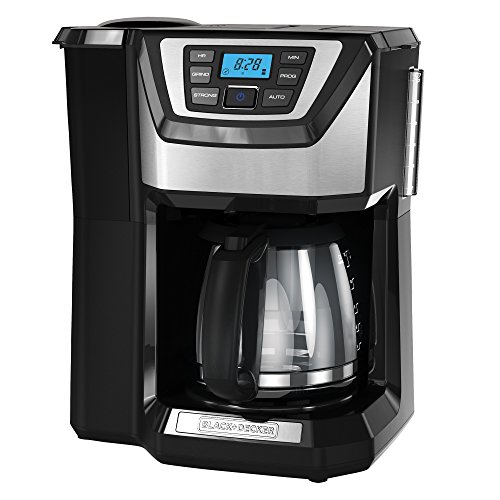 BLACK+DECKER BLACK+DECKER 12-Cup Grind and Brew Coffee Maker |
Note: 1)Too coarse a grind, too little coffee, or insufficiently tamping the grounds before bre | $49.72 |
#60 in Coffee Machines |
In Stock |
 Keurig Keurig K-Elite Single Serve K-Cup Pod Coffee Maker, with Strength and Temperat |
WHAT'S IN THE BOX: One water filter handle, and one filter to help ensure your beverages taste | $164.00 $209.99 |
#2 in Single-Serve Brewers |
22% OFF In Stock |
 Ninja Ninja Pods & Grounds Iced Coffee Maker, K-Cup Pod Compatible, Stone PB041ST |
BREW WITH PODS OR GROUNDS: Brew a single-serve cup of coffee with grounds for ultimate flavor o | $79.99 $99.99 |
#12 in Single-Serve Brewers |
20% OFF Prime Exclusive In Stock |
 Hamilton Beach Hamilton Beach The Scoop Single Serve Coffee Maker & Fast Grounds Brewer for 8 |
EASY — SCOOP YOUR FAVORITE GROUND COFFEE, PLACE AND BREW. Simplify your morning routine and sav | $80.95 |
#224 in Coffee Machines |
Only 3 left in stock (more on the way). |
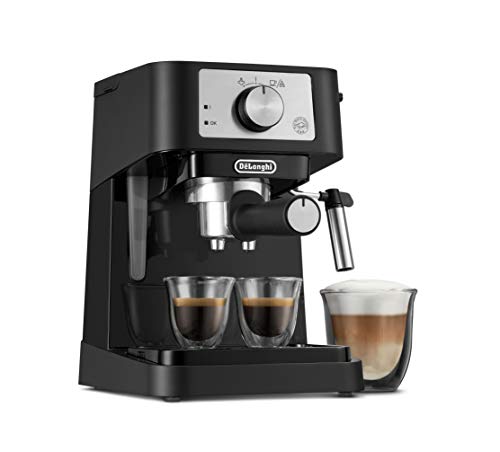 De'Longhi De'Longhi Stilosa Compact Manual Espresso Machine, Manual Milk Frother |
Please refer to user guide or user manual or user guide (provided below in PDF) before first us | $99.95 $149.95 |
#1 in Manual Espresso Machines |
33% OFF In Stock |
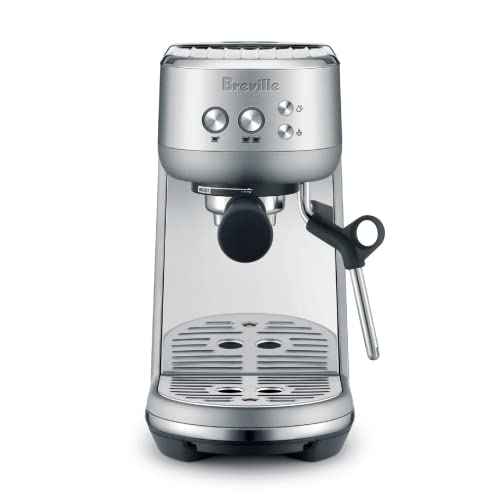 Breville Breville BES450BSS Bambino Espresso Machine, Brushed Stainless Steel |
MICROFOAM MILK TEXTURING: Cappuccino maker and latte machine has an automatic steam wand allowi | $249.95 $299.95 |
#2 in Semi-Automatic Espresso Machines |
17% OFF In Stock |
1. Cuisinart PerfecTemp 12-Cup — best drip coffee maker for most kitchens
The PerfecTemp (model DCC-3400NAS) is the machine we’d put in a normal kitchen: a 12-cup batch brewer with a double-wall stainless thermal carafe, 24-hour programmability, brew-strength control, a 1–4 cup setting and a self-clean cycle — at $128.49, which is 14% off its $149.95 list. It carries the strongest rating pool of any classic drip machine in this guide (4.7 stars across 11,000+ ratings) and the longest listed warranty here, three years limited. Its own review summary is the reason it leads: owners say it makes “good, hot coffee with great taste that never turns bitter.” The labs crown fancier machines (see the tester section below) — our case is that this is where batch-brew quality, capacity and service network cross at the fairest price.
What We Like
- Thermal stainless carafe keeps a full pot hot for hours without a scorching hot plate
- Owners report “good, hot coffee with great taste that never turns bitter”
- 24-hour programming, brew-strength control and a 1–4 cup setting for small batches
- Backed by a three-year limited warranty — the longest term in this roundup
Flaws but not dealbreakers
- Its review summary splits on heat retention — some say the carafe keeps coffee hot, others say it fades
- Customers report the spout can dribble if you pour quickly
Who should NOT buy this: Skip it if you want a glass carafe you can watch fill, or if you mostly brew single cups.
2. BLACK+DECKER 12-Cup Grind & Brew — best budget bean-to-pot
At $49.72, the CM5000B is the cheapest way to get whole beans ground straight into a full pot. It’s a 12-cup programmable brewer with a built-in grinder and the Sneak-A-Cup pause-and-pour feature. Its review summary is unusually specific about the upside: owners say it grinds beans fresh and makes great-tasting coffee — and that it runs quieter than standalone countertop grinders. This is the pick for someone who wants “grind fresh” to become automatic without spending $120+ on a grind-and-brew. Just read the flaws below: durability is the trade.
What We Like
- Built-in grinder turns whole beans into a full pot of fresh coffee for under $50
- Reviewers say it’s quieter than a standalone countertop grinder
- 24-hour programmable timer plus Sneak-A-Cup pause-and-pour
- Simple to clean per its own review summary
Flaws but not dealbreakers
- Durability is the recurring complaint — its summary notes failures within months, plus occasional leakage
- Long-term value feedback is mixed: some call it a bargain, others “not worth the money” after a failure
Who should NOT buy this: Skip it if you expect burr-grinder consistency — this is convenience grinding, and the durability reports are real.
3. Keurig K-Elite — best pod machine for most people
The K-Elite is the pod machine to beat: at $164.00 (22% off a $209.99 list) it is the current #2 best seller in Amazon’s Single-Serve Brewers category with a 73,000-strong rating pool behind it — by far the deepest track record in this guide. It brews 4–12 oz pours, adds a strong-brew setting and an iced-coffee mode, carries a 75-oz removable reservoir with a water filter included, and has the quality-of-life extras pod owners actually use: hot water on demand, a descale reminder, and quiet-brew tech for early mornings.
What We Like
- The biggest track record in this guide: 4.2 stars across 73,000+ ratings
- Brews 4–12 oz plus strong-brew and brew-over-ice settings
- 75-oz removable reservoir with a water filter included in the box
- Hot water on demand and a built-in descale reminder
Flaws but not dealbreakers
- Durability is its review summary’s weak spot — several owners report breakdowns around the three-month mark
- Pod lock-in: every cup carries a per-cup premium over ground coffee
Who should NOT buy this: Skip it if you care what each cup costs or want brew-temperature control — the pods decide both for you.
4. Ninja Pods & Grounds — best pods-and-grounds single serve
The PB041ST is the versatility play: one compact machine that brews K-Cup-compatible pods and your own grounds (6–24 oz pours), with Classic, Rich and Over Ice modes. At $79.99 (20% off a $99.99 list) it’s also the highest-rated machine in this roundup — 4.5 stars across 4,600+ ratings — and its review summary includes owners saying it brews “richer than usual” and performs better than a Keurig. The included kit (scoop, brew basket, pod adapter, permanent filter) means you can start with either lane and switch whenever.
What We Like
- Pods and grounds in one machine — 6–12 oz pod pours, 6–24 oz grounds pours
- Review summary: owners say it brews richer than usual and prefer it to a Keurig
- Over Ice mode plus three brew styles in both lanes
- Compact body with a storage drawer; scoop, filter and pod adapter included
Flaws but not dealbreakers
- Durability is mixed in its summary, with some reports of failures around two months
- 56-oz reservoir is smaller than the K-Elite’s 75 oz
Who should NOT buy this: Skip it if you already own separate pod and drip machines — this is a replacement, not an addition.
5. Hamilton Beach The Scoop — best pod-free single serve
The Scoop is for people who want single-serve speed without pods or paper filters: you scoop ground coffee into the mesh basket, and it brews 8–14 oz in minutes from a 40-oz removable reservoir. Its review summary calls out quick, consistent brewing and easy clean-up — the mesh basket means nothing to throw away but the grounds. At $80.95 it is no longer the budget pick it once was, and its availability message showed “Only 3 left in stock” at our check-time — buy it because you want the pod-free routine, not because it’s cheap.
What We Like
- Zero pods and zero paper filters — scoop, brew, rinse the mesh basket
- 40-oz removable reservoir; flip stand fits mugs or a 7-inch travel cup
- Reviewers call it quick and consistent, and “easy to use and clean”
- Brews up to 14 oz in minutes — the simplest single-cup routine here
Flaws but not dealbreakers
- At $80.95, the value case is thinner than its launch-era pricing — you’re paying for pod-free convenience
- Its summary notes mixed reliability (“some report it stops working”) and brew-size quirks versus smaller mugs
Who should NOT buy this: Skip it if you need more than one cup at once or want temperature control — it is one button, one cup.
6. De’Longhi Stilosa — best budget espresso machine
The Stilosa (EC260BK) is the entry point we trust: $99.95, 33% off its $149.95 list, and the #1 best seller in Amazon’s Manual Espresso Machines category with a 13,800-strong rating pool. You get a stainless-steel boiler, a manual steam wand, a portafilter, a tamper-scoop and single and double filter baskets — a complete starter kit for real pump espresso. Owners say it makes great shots and is easy to learn on; the honest caveats are in the flaws and the failure modes below. The bar-number marketing on machines like this is explained in the brewing section — read that before paying more for “more bars.”
What We Like
- #1 best seller in Amazon’s Manual Espresso Machines category (13,800+ ratings)
- Full starter kit: portafilter, tamper-scoop, single and double baskets
- Stainless-steel boiler and a manual steam wand for microfoam
- The cheapest true pump espresso machine we’d recommend
Flaws but not dealbreakers
- Its summary reports the steam wand drips during operation
- Durability concern: some units reported failing within a year
Who should NOT buy this: Skip it if you won’t grind fresh — and note that temperature stability only starts at the Bambino.
7. Breville Bambino — best espresso upgrade
The Bambino (BES450BSS) is what $249.95 (17% off a $299.95 list) buys over the budget class: a ThermoJet heater that reaches brew temperature in three seconds, PID digital temperature control, low-pressure pre-infusion, and an automatic steam wand that TechGearLab scored 9/10 for microfoam texture — above its own Bambino Plus score in the same test. Add a 54 mm portafilter with a 19 g basket and a 6.3-inch-wide stainless body, and you have the machine for someone who has decided espresso is a hobby, not a whim. It is the one pick here where paying more demonstrably changes the cup.
What We Like
- 3-second heat-up via ThermoJet — the fastest here by a wide margin
- PID temperature control and low-pressure pre-infusion for repeatable shots
- Automatic steam wand — scored 9/10 for microfoam texture in TechGearLab’s blind pouring test
- 54 mm portafilter, 19 g basket, compact 6.3-inch footprint
Flaws but not dealbreakers
- No grinder built in — budget for a burr grinder or the machine will flatter nothing
- Durability notes are mixed in its review summary; more machine means more to maintain
Who should NOT buy this: Skip it if $250 is your entire budget — a Stilosa plus a decent grinder may serve you better.
Spec-truth table: what the listings actually publish
Every number below was pulled from the live Amazon listings on October 4, 2026 — not from marketing copy. Where a listing publishes no figure, we say so rather than guess. Two caveats we found in the listings themselves: the Keurig and Ninja specification tables mislabel a weight as “capacity,” so we use their own feature copy for tank sizes; and one wattage field on the BLACK+DECKER (60 W) is clearly a data-entry slip for a machine this class — treated as not reliably published. “Cup” figures follow the 5-oz industry convention (per Cuisinart’s own footnote), so a “12-cup” carafe is about 60 fl oz.
| Model | Class | Verified price | Capacity / tank | Power | Dimensions (D × W × H) | Weight | Warranty (as listed) |
|---|---|---|---|---|---|---|---|
| Cuisinart PerfecTemp 12-Cup (DCC-3400NAS) | Drip / thermal carafe | $128.49 | 12 cups (60 oz) | 1100 W | 7.75 × 9 × 14.25 in | 10.2 lb | 3-year limited |
| BLACK+DECKER Grind & Brew (CM5000B) | Drip / built-in grinder | $49.72 | 12 cups (~60 oz) | not reliably published | 10 × 13.5 × 15.5 in | 9.5 lb | 2-year limited |
| Keurig K-Elite | Single-serve pods | $164.00 | 75-oz reservoir | 1500 W | 12.7 × 9.9 × 16.5 in | 6.6 lb | not stated |
| Ninja Pods & Grounds (PB041ST) | Pod + grounds single serve | $79.99 | 56-oz reservoir | 1500 W | 13.07 × 5.31 × 13.31 in | not stated | 1-year limited |
| Hamilton Beach The Scoop (49987) | Grounds single serve | $80.95 | 40-oz reservoir | 1200 W | 11.2 × 5.6 × 12.9 in | 5.7 lb | 1-year |
| De’Longhi Stilosa (EC260BK) | Manual espresso | $99.95 | 1000 ml (34 oz) | 1100 W | 12.13 × 9.45 × 14.17 in | 8.6 lb | 1-year |
| Breville Bambino (BES450BSS) | Semi-auto espresso | $249.95 | 47 fl oz (1.4 L) | 1560 W | 13.7 × 6.3 × 12 in | 10.9 lb | 1-year limited |
What you get at each price tier — and where paying more stops buying performance
Under $50 — batch brewing, not precision. The BLACK+DECKER Grind & Brew at $49.72 is the only pick down here, and it spends its budget on the thing that matters most at this price: grinding whole beans right before brewing. What you don’t get below $50 is temperature control, a thermal carafe, or a brand that stands behind it for longer than two years.
$80–$100 — where you pick a lane. The Ninja Pods & Grounds ($79.99), The Scoop ($80.95) and the Stilosa ($99.95) all live in this band, and they buy three different things: pod/grounds flexibility, a pod-free routine, or real espresso. None of them is “better” than the others in the abstract — this is the band where the wrong pick is the one that doesn’t match your morning.
$128–$165 — the batch and pod flagships. The Cuisinart PerfecTemp ($128.49) and Keurig K-Elite ($164.00) are the two most “finished” machines here: thermal carafe and three-year coverage on one side, the deepest track record and the fastest routine on the other. If you brew for two or more people, the money is well spent. If you brew solo, it is mostly spent on features you won’t touch.
$250 — where money starts buying control. For drip and pods, spending past roughly $165 stops buying better coffee for most people and starts buying design and certification — the labs’ own winners run $339+ and their tasting notes are about consistency, not magic. Espresso is the exception: the Bambino’s $249.95 buys measurable differences — three-second heat-up, PID stability, and a steam wand that pours better microfoam than machines at twice its price’s weight class. That is the only “pay more, get more” jump we endorse here.
Where our ranking diverges from the testers — and where it doesn’t
Four independent teams have published deep coffee-maker tests recently — and none of them ranks our picks first. That’s worth understanding rather than hiding, so here is exactly where their conclusions diverge from ours, and where everyone actually agrees.
America’s Test Kitchen. ATK bought more than a dozen drip machines, brewed and tasted them, and crowns the $339 Technivorm Moccamaster KBT, with the OXO Brew 8-Cup as “also great” and the Zojirushi ZUTTO as Best Buy. We don’t dispute the finding — we dispute that a $339 machine is the right recommendation for most buyers when our top drip pick costs 62% less and carries a deeper owner record. But their most useful discovery is a caution that applies to every machine in this guide: after tracking brew water temperature on every model, they found “few machines were able to stay in that zone the whole time” — which is why we weight carafe quality and settled, reviewed performance over spec-sheet promises. (Full test.)
TechGearLab. TechGearLab also crowns the Moccamaster as the best drip machine they have ever tested, with the $90 Ninja CE251 as their best value and the Breville Precision Brewer as the best programmable model. Their espresso results matter most here: in their milk-steaming comparison the Breville Bambino scored 9/10 for microfoam texture — above the Bambino Plus — which is the basis for our upgrade pick. Their best-value espresso crown goes to the Casabrews CM5418; we rank the De’Longhi Stilosa instead, because its category record is deeper (#1 in Manual Espresso Machines, 13,800+ ratings) and TechGearLab’s own con list notes the CM5418 “vibrates when pulling shots.” (Full test.)
HomeGrounds. HomeGrounds — a coffee-focused site whose lead tester has spent a decade reviewing makers and espresso machines — lands on the Moccamaster for best overall too, and on grind-and-brew machines they name the Breville Grind Control as the best and the Cuisinart Grind And Brew as the affordable alternative. Our budget bean-to-pot is the BLACK+DECKER at $49.72 — cheaper still, with the durability caveats stated plainly below; if you prefer the Cuisinart, it is a legitimate step up in price and finish. (Full guide.)
Where everyone agrees — including us. Thermal carafes beat scorching hot plates; fresh-ground beans beat stale pre-ground; and the last 10% of brew quality costs two to three times as much as the first 90%. Our ranking doesn’t copy theirs and theirs doesn’t copy ours — the takeaway for a buyer is the same from all four: pay for fresh grounds and honest temperature behavior, not for a badge or a spec number.
Brewing basics: temperature, ‘cup’ math and caffeine, checked against the standards
Temperature is the spec that matters. The Specialty Coffee Association’s brewing standards specify water between 194 and 205°F held across the brewing cycle — the figure every serious drip tester tracks, and the reason a thermal carafe beats a hot plate. On the espresso side, ignore the bar-number arms race: the number printed is the pump’s maximum pressure, extraction happens around 9 bar at the puck, and machines use an over-pressure valve to get there. What actually changes your cup is temperature stability (a PID, like the Bambino’s) and pre-infusion — which is why the Bambino costs 2.5× the Stilosa, and why we’d rather you spend the difference there than on “more bars.”
What “SCA certified” actually means — and how to check it. The SCA runs a third-party certification program: certified home brewers are “coffee makers that meet SCA’s rigorous standards for brewing quality, consistency, and performance,” tested independently, with a published list. Newly certified examples include the GE Cafe Specialty Drip and the Kismile Precision Drip — and certification is model-specific, never brand-wide, so check the live list before paying a premium for the phrase. None of the seven machines here highlights certification in its own listing. (Certified list · Coffee standards.)
“Cup” math and caffeine, while we’re at it. The industry “cup” on the box is about 5 oz — Cuisinart’s own listing footnotes it — so a “12-cup” carafe is roughly 60 fl oz, which is about five 12-oz mugs. The FDA frames 400 mg of caffeine a day as “about two to three 12-fluid-ounce cups” for most adults, so the sole drinker of a full pot is well past that reference line; single-serve pours in the 8–12 oz range keep portions honest, and decaf runs 2–15 mg per 8-oz cup if you are mixing. (FDA guidance.)
Fine print and failure modes: what actually goes wrong
Every pick has a pattern in its negative reviews; these are read from the live listings’ own review summaries at check time, so you buy with your eyes open. These are owner reports, not a measured failure rate:
- Cuisinart PerfecTemp: pour spout can drip if you pour quickly; split owner opinions on how long the carafe holds heat.
- BLACK+DECKER Grind & Brew: breakdowns reported within months of purchase; occasional water leakage; mixed long-term value feedback.
- Keurig K-Elite: several reports of failures around the three-month mark — the one recurring knock on an otherwise loved machine.
- Ninja Pods & Grounds: mixed durability, with some units reported failing around two months.
- Hamilton Beach The Scoop: some units stop working entirely; brew-size output can feel off against smaller mugs.
- De’Longhi Stilosa: the steam wand drips during operation; some owners report failures within a year.
- Breville Bambino: mixed durability notes; more machine, more maintenance points (descale, steam wand, drip tray).
The pattern across the band: these machines mostly brew well — what varies is how long they last. Treat the warranty as the floor and keep your receipt.
How to choose without overpaying
Pick your lane first. Count your cups and your minutes. Batch brewing for two or more people: the Cuisinart PerfecTemp (or the $49.72 BLACK+DECKER if budget rules). One cup in a hurry: the Keurig K-Elite for pods, or the Ninja for both pods and grounds. Pod-free routine: The Scoop. Espresso as a hobby: the Stilosa to start, the Bambino when you’re ready to spend on control.
Then pick your compromises. Thermal versus glass carafe (thermal keeps coffee without scorching it); reservoir size (75 oz means a week of solo mornings, one busy brunch for company); pod lock-in versus grounds freedom. None of these are upgrades — they are the shape of your morning, so shop them first and features second.
Then ignore three things. The bar number on espresso machines (see above). The word “12-cup” as a size claim (it’s 5-oz cups — about 60 oz). And the struck-through list price: five of our seven picks carried a 14–33% discount at check time, so the list price is an anchor set by the seller, not a benchmark. Buy the lane, then the machine — and if espresso, budget for the grinder before any upgrade.
Frequently asked questions
How often should I clean and descale my coffee maker?
Descale every one to three months depending on your water hardness — mineral scale clogs lines and wrecks brew temperature. Clean the carafe, basket and reservoir weekly with warm soapy water (coffee oils go rancid). The K-Elite has a descale reminder built in; on everything else, let taste and slower brewing be your signal, and follow the manual for descaling specifics — vinegar works, but some manufacturers specify a solution.
Does a more expensive machine make better coffee?
Up to a point — and the point differs by lane. For drip and pods, spending past roughly $165 stops buying better coffee for most people and starts buying design and certification; the labs’ winners cost $339+ and their notes are about consistency, not transformation. For espresso, the money is real: the Bambino’s three-second heat-up, PID and steam quality are measurable. But in every lane, a good grinder and fresh beans beat a more expensive machine fed stale pre-ground.
Pods or grounds — what does convenience actually cost?
Count it in multiples, not cents. A pod cup typically costs several times a cup brewed from bulk grounds, and at two cups a day the annual gap runs into the hundreds of dollars. That’s the real price of pod convenience — the machines are often cheap; the habit isn’t. The Ninja Pods & Grounds exists precisely because we think you should be able to switch lanes without buying twice.
Do I need 15 or 20 bar?
No — and the number is the most abused spec in espresso. It describes the pump’s maximum pressure, not what reaches your puck; extraction happens around 9 bar, and every legitimate machine regulates down to that. What actually shows up in the cup: stable temperature (PID), low-pressure pre-infusion, and a steam wand that makes microfoam. Spend on those, not on bars.
How long should a coffee maker last?
We don’t publish a lifespan claim — nobody measures these machines over years for us. What we can tell you from the listings: the warranties here run from one to three years, owner-reported failures cluster early (months 2–12), and cleaning discipline is the lever you control. Treat the warranty as the floor, keep your receipt, and register the machine the day it arrives.
The bottom line
Buy the lane, then the machine — and if espresso, budget for the grinder before any upgrade:
- Best drip for most kitchens: Cuisinart PerfecTemp 12-Cup ($128.49) — thermal carafe, 3-year coverage, the strongest owner record in this guide.
- Best under $50: BLACK+DECKER Grind & Brew ($49.72) — fresh-ground convenience with the durability caveats stated openly.
- Best pod machine: Keurig K-Elite ($164.00) — the #2 best seller in its category with the deepest rating pool here.
- Best pods-and-grounds: Ninja Pods & Grounds ($79.99) — two formats, iced mode, and the highest rating (4.5) in this roundup.
- Best pod-free single serve: Hamilton Beach The Scoop ($80.95) — mesh-basket brewing, nothing to throw away.
- Best budget espresso: De’Longhi Stilosa ($99.95) — category #1 and a complete starter kit for real pump espresso.
- Best espresso upgrade: Breville Bambino ($249.95) — 3-second heat-up, PID control, and 9/10 microfoam scores.
How we research and verify this guide
We are not a laboratory, and we don’t out-test the testers. This guide is built from three inputs: live Amazon data pulled on October 4, 2026 — prices, discounts, availability, category ranks and specification tables, with every title checked so the brand is the first token; each listing’s own review summary, which is where the recurring-theme notes come from; and the independent published testing of America’s Test Kitchen, TechGearLab, the Specialty Coffee Association’s certification program and HomeGrounds, cited inline. We did not run our own brew, temperature or durability tests, and we never invent a measurement, quote or rating. Where listings contradict themselves, we say so instead of picking the nicer number.
Prices and stock move — every figure was true at check time and may differ by the time you read this. Our full process, including what we do not claim, is in how we test and choose products. Corrections are welcome via our contact page, and the affiliate relationship is described on our affiliate disclosure page.
Specialty Coffee Association — Certified Home Brewers: the third-party certification program and its model list.
America’s Test Kitchen — The Best Coffee Makers: a dozen-plus drip machines tested; the 194–205°F temperature-tracking finding.
TechGearLab — 10 Best Coffee Makers, Lab Tested & Ranked: 12 machines brewed and tasted; espresso and microfoam comparisons.
HomeGrounds — Best Coffee Makers of 2026: a decade of hands-on maker testing; the grind-and-brew cross-check.
Related guides
- Best coffee grinders for home brewing — if you’re going espresso, start here.
- Best espresso machines with a grinder — the all-in-one path, compared.
- Best gooseneck electric kettles — for pour-over days.
- Best pour-over coffee makers — manual brewing that beats most machines.