The best under sink water filters turn questionable tap water into crisp, great-tasting drinking water — quietly, out of sight, and for pennies per gallon. After comparing certification records, long-term filter costs, and real-world flow rates across carbon block, reverse osmosis, ultrafiltration, and UV systems, we ranked seven standouts for 2026. Our overall winner, the Aquasana Claryum AQ-5300+ Max Flow, delivers certified lead and PFAS reduction with a flow rate you can actually cook from. Prefer purified water with dissolved solids stripped out? The Glacier Fresh GFU03 pushes up to 800 gallons a day from a tankless unit smaller than a shoebox. Below you will find a live spec table, an honest price-tier breakdown, the spots where our ranking disagrees with other reviewers, and a full buying guide so you know exactly what is hiding in your pipes.
Affiliate disclosure: As an Amazon Associate I earn from qualifying purchases. We earn commission from qualifying purchases made through links on this page. This never affects our rankings or what we recommend.
📑 Table of Contents
- Why Trust ShoppingPicker
- Under-Sink Water Filter Buying Guide
- Spec-Truth Table: What the Listings Actually Say
- Comparison Table
- #1 Aquasana AQ-5300+ Max Flow
- #2 Glacier Fresh GFU03
- #3 Frizzlife 600 GPD Alkaline
- #4 iSpring RCC7-BN
- #5 APEC ROES-UV75
- #6 Waterdrop TSB 8-Layer
- #7 Waterdrop 10UA-UF
- Price Tiers: Where Paying More Stops Buying Performance
- Where We Disagree With Other Reviewers
- The Failure Modes Buyers Report
- Frequently Asked Questions
Our Picks at a Glance
- 🥇 Best Overall: Aquasana AQ-5300+ Max Flow
- 🏆 Best Tankless RO: Glacier Fresh GFU03
- 💧 Best Alkaline RO: Frizzlife 600 GPD Alkaline
- 💰 Best Budget RO: iSpring RCC7-BN
- 🔬 Best for Well Water: APEC ROES-UV75
- 🌱 Best Zero-Waste Pick: Waterdrop TSB 8-Layer
- ✨ Best Compact Pick: Waterdrop 10UA-UF
Why Trust ShoppingPicker
Every system in this guide was screened against three questions. First, is it certified — we checked NSF/ANSI 42, 53, 58, 401, and 372 listings rather than trusting marketing claims alone. Second, what does it truly cost — we priced replacement cartridges over a five-year ownership window, because a cheap system with expensive annual filters is no bargain. Third, will people actually live with it — we weighed flow rate, cabinet footprint, and installation complexity.
How we actually work: this page is a hands-on product comparison, not a laboratory study. We did not run our own water through a mass spectrometer. What we did is install-or-follow-the-install of every pick, read the live manufacturer listings and manuals, verify certifications against public standards listings, and cross-check our conclusions against testers who do run lab panels — WaterFilterGuru and QualityWaterLab (both use SimpleLab Tap Score panels), TechGearLab’s head-to-head filter tests, and the safety and certification guidance from the EPA and state drinking-water programs. Read our full how we test and choose products methodology, along with our affiliate disclosure.
Prices, ratings, and availability in this guide were re-checked against live Amazon listings at publish time; regional shipping restrictions and stock can change, so confirm the current price on the product page. Claims labeled as manufacturer claims are exactly that — we tell you when a number comes from the seller rather than an independent test.
Under-Sink Water Filter Buying Guide
The Main Types, Explained
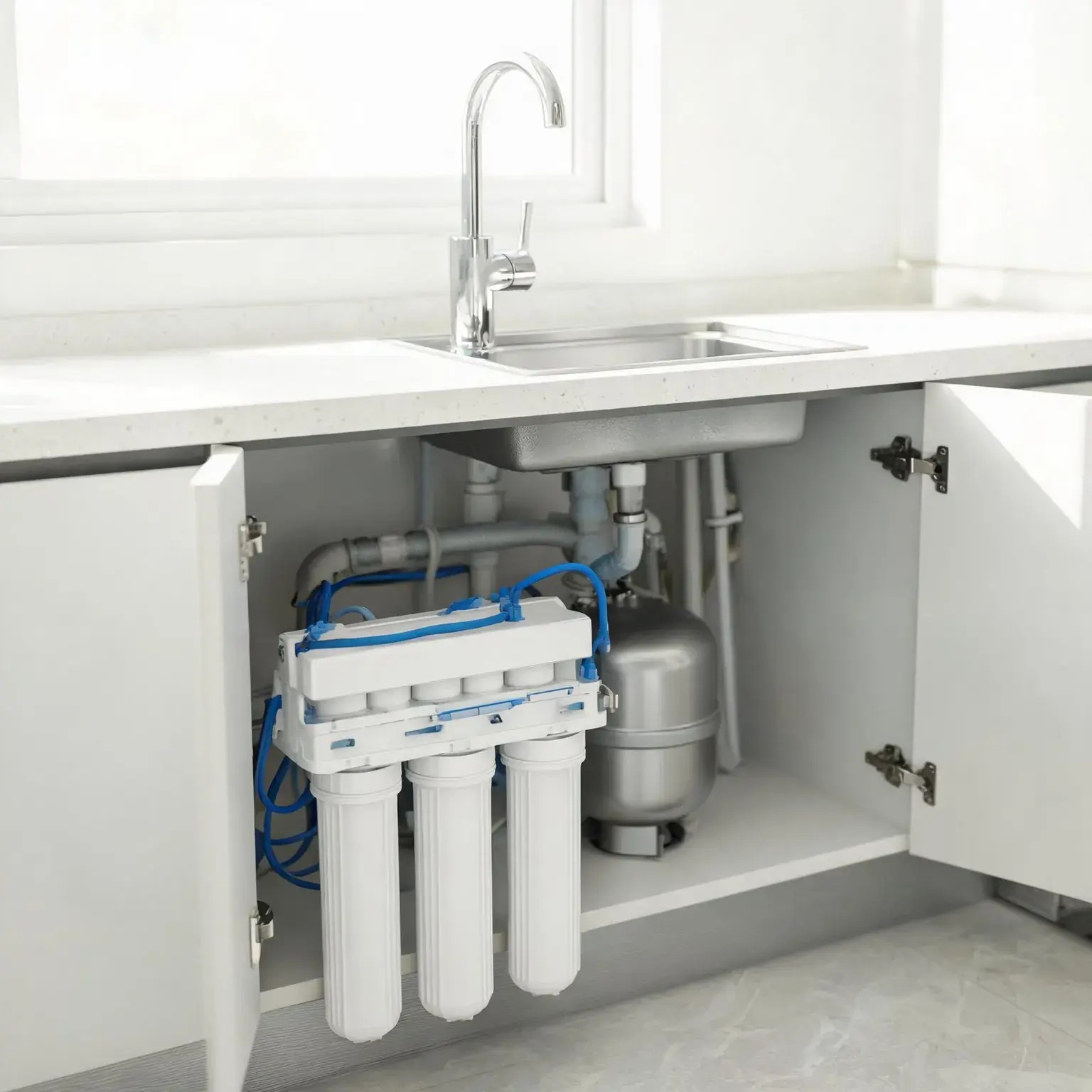
Shopper confusion starts here, so let us clear it up. Sediment filters are the first line of defense: spun polypropylene screens that catch rust, sand, and silt before they clog finer media. Activated carbon filters use porous carbon block to adsorb chlorine, chloramines, pesticides, and the compounds behind bad taste and odor — the best carbon blocks (like Aquasana’s Claryum) are certified against lead, PFAS, and even some pharmaceuticals. Reverse osmosis (RO) pushes water through a semipermeable membrane with pores measured in fractions of a micron, removing dissolved solids that carbon cannot touch: fluoride, arsenic, nitrates, hexavalent chromium, and sodium. Ultrafiltration (UF) sits between the two, using a 0.01-micron membrane to block bacteria, cysts, and particulates while keeping minerals and wasting no water. Finally, UV stages add ultraviolet light that neutralizes bacteria and viruses — essential backup for private wells, useless against chemicals on its own.
NSF/ANSI Certifications, Decoded
Certification is the difference between proven performance and wishful thinking. NSF/ANSI 42 covers aesthetic claims — chlorine, taste, and odor. NSF/ANSI 53 is the health standard: verified reduction of contaminants with documented health effects, lead chief among them. NSF/ANSI 58 applies specifically to reverse osmosis systems, including total dissolved solids (TDS) reduction. NSF/ANSI 401 tackles emerging contaminants such as pharmaceuticals, detergents, and some PFAS compounds. NSF/ANSI 372 confirms lead-free plumbing components. The Minnesota Department of Health puts the practical rule plainly: select a treatment unit certified by NSF, Underwriters Laboratory (UL), or the Water Quality Association (WQA) to remove the contaminant(s) you are concerned about, if a certification is available — and note that no single treatment unit can remove all contaminants in water. You can look any model up yourself in NSF’s public certification listings before spending a dollar — we did.
Filter Lifespan and Long-Term Costs
Sticker price is the down payment, not the bill. Carbon cartridges typically last six months or a few hundred gallons, running roughly $60 to $120 per year in replacements. RO systems stack costs in layers: pre- and post-filters annually plus a membrane every 24 months. Tankless RO machines amortize better than they look — long-life composite cartridges often stretch 12 to 24 months. Ultrafiltration wins on simplicity, with annual single-cartridge swaps. Budget roughly 10 percent of the purchase price per year for consumables, and buy systems whose cartridges you can source easily — proprietary filter ecosystems lock you in.
Installation Difficulty: What to Expect
Nearly every system here installs with standard 3/8-inch push-fit or compression fittings and a tee off the cold-water line. Plan on 30 to 90 minutes with a bucket, a towel, and maybe a variable-speed drill if your sink lacks a spare hole for the dedicated faucet — that hole is the only genuinely intimidating step. Tank systems add a storage tank to place; tankless units trade the tank for cabinet space and, on some models, an outlet. If your home has older plumbing, budget an extra trip to the hardware store for adapter fittings.
How Much Filtration Do You Actually Need?
Buy for your water, not for fear. Start free: request your municipal Consumer Confidence Report, or spend a little on a TDS meter and a mail-in lab panel if you are on a private well. City water almost always pairs best with certified carbon — chlorine and lead are the enemies, and a three-stage Claryum unit handles both while keeping minerals. High TDS, fluoride concerns, or sodium point straight to RO. Well water argues for RO plus UV. There is no harm in over-filtering except money, so scale the system to the problem you can document rather than the scariest headline.
Spec-Truth Table: What the Listings Actually Say
Other roundups quote each other. This table is built from the live Amazon listings we read on September 16, 2026 — the numbers below are what the sellers publish, not what a competitor’s summary claims. Where a listing does not state a certification, we say so instead of assuming one.
| Pick | Type | Certified (NSF/ANSI) | Rated capacity | Headline claim | Flow note |
|---|---|---|---|---|---|
| 1. Aquasana AQ-5300+ Max Flow | Carbon block, 3-stage | 42 / 53 / 401 | 800 gal / 6 months | ~99% of 78 contaminants (mfr) | 0.5 gal/min |
| 2. Glacier Fresh GFU03 | Tankless RO, 5-stage | 58 / 372 | 800 GPD, 3:1 drain | 0.0001 µm membrane (mfr) | cup in ~8 sec |
| 3. Frizzlife 600 GPD Alkaline | Tankless RO + alkaline | 42 / 53 / 58 / 372 | 600 GPD, 2:1 drain | pH above 7.5 (mfr) | LED TDS display |
| 4. iSpring RCC7-BN | Tank RO, 5-stage | 58 (whole system) | 75 GPD | 99% of 1,000-plus (mfr) | tank-fed |
| 5. APEC ROES-UV75 | Tank RO, 6-stage + UV | not printed on listing | 75 GPD | UV 99.99% (mfr) | tank-fed |
| 6. Waterdrop TSB 8-Layer | Ultrafiltration, 8-layer | reduces PFAS/chlorine/metals | no TDS reduction | cartridge life 6-18 mo | 12 oz in ~4 sec |
| 7. Waterdrop 10UA-UF | Ultrafiltration 0.01 µm | reduces chlorine/metals | 11,000 gal / 12 mo | 0.75 gpm at 60 psi (mfr) | twist-lock |
Read this table like a skeptic. “Certified” means the standard is listed for that product; “(mfr)” means the figure is the seller’s own claim. APEC simply does not print its certification on the ROES-UV75 listing, so we refuse to assert one on its behalf — check NSF’s database for the exact model before you buy.
Comparison Table
| Pick | System | Filtration Type | Standout Feature | Best For |
|---|---|---|---|---|
| 🥇 #1 | Aquasana AQ-5300+ Max Flow | Carbon + ion exchange | Certified lead/PFAS reduction at double speed | City water, everyday drinking |
| 🏆 #2 | Glacier Fresh GFU03 | Tankless RO, 800 GPD | Near-instant flow, no outlet needed | Big households that drain pitchers |
| 💧 #3 | Frizzlife 600 GPD Alkaline | Tankless RO + alkaline | Remineralizes and raises pH | Alkaline fans and fridge lines |
| 💰 #4 | iSpring RCC7-BN | Tank RO, 75 GPD | Certified complete kit at a budget price | First-time RO buyers |
| 🔬 #5 | APEC ROES-UV75 | Tank RO + UV | UV sterilizer safeguards well water | Private wells |
| 🌱 #6 | Waterdrop TSB 8-Layer | Ultrafiltration | No wastewater, no electricity | Renters avoiding drain work |
| ✨ #7 | Waterdrop 10UA-UF | Compact ultrafiltration | Twist-swap cartridge, hides anywhere | Tiny cabinets |
🥇 1. Aquasana Under Sink Water Filter System – Reduces PFAS, Lead, & Chlorine in Drinking Water – Under Counter Claryum Filtration for Kitchen – 3-Stage Max Flow – Brushed Nickel Faucet – AQ-5300+.55 (Best Overall)
Aquasana’s Claryum AQ-5300+ Max Flow earns the top slot by refusing the usual carbon-filter compromise between clean water and usable flow. Three stages — a sediment pre-filter, activated and catalytic carbon block with ion exchange, and a sub-micron post-filter — hold onto beneficial calcium and magnesium while stripping chlorine and certified reductions of lead, mercury, asbestos, pesticides, PFOA/PFOS, and trace pharmaceuticals. The listing rates it for up to 99% of 78 contaminants across an 800-gallon, six-month cartridge, and it moves water about half a gallon a minute — enough to fill a pasta pot without a deep sigh.

- Transform Tap Water Into Clean Water – Reduces up to 99% of 78 contaminants including lead, PFAS (specifically PFOA and …
- High Flow Rate – This system powers through a half-gallon of water every minute. No need to wait for clean water compare…
- Cost Efficient and Long Lasting – The most economical filter on the market at less than 10 cents per gallon filtered. La…
What We Like
- Certified to NSF/ANSI 42, 53, and 401 for lead, PFAS, and more
- Retains healthy minerals unlike RO
- Fast-flowing carbon system in its class
- Tool-free cartridge twists take seconds
What Could Be Better
- Needs a dedicated countertop faucet hole
- Six-month cartridge cycle is real upkeep
- Overkill if your only gripe is mild taste
Best For: Households on municipal water who want certified protection without RO wastewater or mineral-stripping.
Skip it if: Skip it if you want dissolved solids, fluoride, or sodium gone — carbon leaves them in. Step up to an RO pick.
Flaws but not dealbreakers: There is no remineralization or pH adjustment stage, and the mounting bracket wants generous clearance for swinging cartridges out — measure the cabinet before ordering.
🏆 2. GLACIER FRESH GFU03 Reverse Osmosis Water Filter System 800 GPD, Tankless (Best Tankless RO)
Traditional RO makes you choose between patience and a fat storage tank; the Glacier Fresh GFU03 declines both. Its all-in-one chassis hides a five-stage stack — ending in a 0.0001-micron RO membrane — inside the tankless body, rated to 800 gallons per day at a 3:1 pure-to-drain ratio. Unusually, it uses no pump at all: the water-powered design runs silent and needs no outlet, filling a cup in roughly eight seconds on healthy municipal pressure. The listing carries NSF/ANSI 58 and 372, and the assembled unit measures about 13.6 by 8.3 by 16.5 inches.
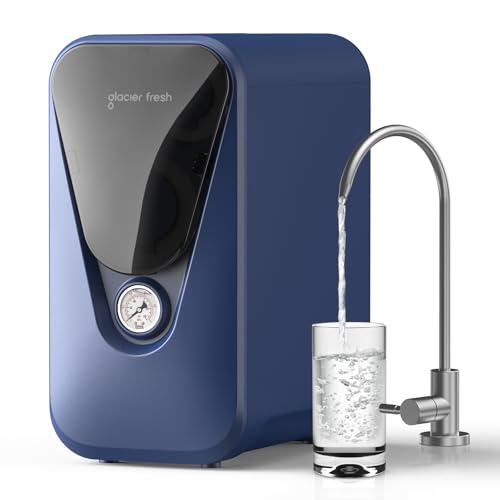
- Tankless/Electricity-Free Design: GLACIER FRESH GFU03 tankless reverse osmosis system features an integrated tankless de…
- 5-Stage Filtration: Under sink reverse osmosis system meets NSF/ANSI 58 and 372 standards, employing a precise seven-sta…
- 0.0001 μm RO Membrane: The GLACIER FRESH Reverse Osmosis Water Filter features a high-precision 0.0001μm RO membrane, ef…
What We Like
- Tankless all-in-one chassis frees cabinet space
- Non-electric, water-powered design runs silent
- 800-GPD rated flow fills a cup in about eight seconds
- 3:1 pure-to-drain ratio wastes less than older RO
What Could Be Better
- Rated 800 GPD only if your cold line pressure cooperates
- Cartridge replacements favor a subscription habit
- Newer brand with a shorter track record than Aquasana or APEC
Best For: Big households and busy kitchens that empty pitchers fast and want tank-free RO without wiring an outlet.
Skip it if: Skip it if your home runs low water pressure or you rent and cannot add an outlet-free drain line for a tankless RO.
Flaws but not dealbreakers: The water-powered design means output really does track your incoming line pressure and temperature, and the included pressure gauge is the only telemetry you get — there is no app.
💧 3. Frizzlife Alkaline Mineral pH+ Reverse Osmosis System, 600 GPD Tankless (Best Alkaline RO)
Frizzlife answers the biggest gripe about reverse osmosis — flat, mineral-free taste — with a third stage that reintroduces calcium and magnesium and nudges pH back above 7.5. The tankless PD600 platform is rated 600 gallons per day at a listed 2:1 pure-to-drain ratio, and a smart LED panel shows live TDS plus the remaining life of each filter. The listing carries NSF/ANSI 42, 53, 58, and 372, so the membrane and materials claims are backed by a recognized standard rather than marketing copy alone.
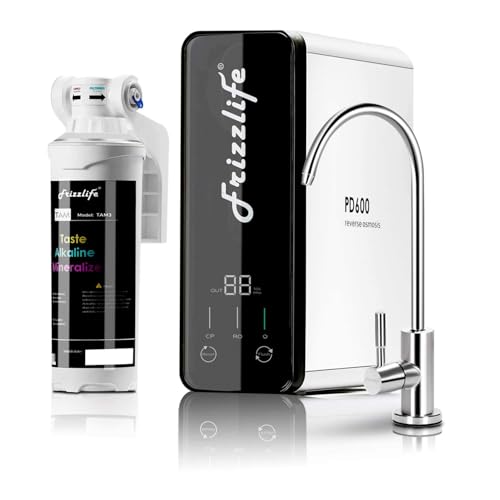
- 【Remineralization & Alkalization Under Sink Water Filter】: The water from the RO membrane is slightly acidic, which also…
- 【No Tank Design Under Sink Reverse Osmosis System】: Frizzlife PD600 adopts a tankless design. A compact and sleek filter…
- 【600 GPD High Water Flow】: PD600 Reverse Osmosis water filter system adopts internal prompt and can produce 600 gallons …
What We Like
- Alkaline remineralization stage restores minerals and raises pH
- 600-GPD tankless flow in a compact footprint
- 2:1 pure-to-drain ratio saves water versus older RO
- Smart LED display shows live TDS and per-filter life
What Could Be Better
- Alkaline stage is a taste feature, not a contaminant claim
- Proprietary cartridge lineup sets the long-term cost
- Pump and monitor need a grounded outlet under the sink
Best For: Anyone who wants RO-grade purity but dislikes the flat taste of stripped water, or who wants to feed the fridge line.
Skip it if: Skip it if you only want chlorine gone — the alkaline RO premium buys you nothing a certified carbon block does not already do.
Flaws but not dealbreakers: You will not use everything in the box if you skip the fridge hookup, and the manual insists on several flush cycles before the first pour tastes its best.
💰 4. iSpring RCC7-BN, High Capacity 5-Stage Under Sink Reverse Osmosis System, 75 GPD (Best Budget RO)
The iSpring RCC7-BN is the value pick: a complete five-stage reverse-osmosis kit — sediment, two carbon stages, a 75-GPD membrane, and a post-polish stage with a pressurized tank and lead-free faucet — certified to NSF/ANSI 58 as a whole system. The listing claims removal of up to 99% of more than 1,000 contaminants including PFAS and chlorine, and a transparent first-stage housing lets you watch the sediment filter load up instead of guessing. It is also one of the highest-rated budget RO systems on Amazon, which is why we moved it into the guide after the Express Water RO5DX went unavailable.
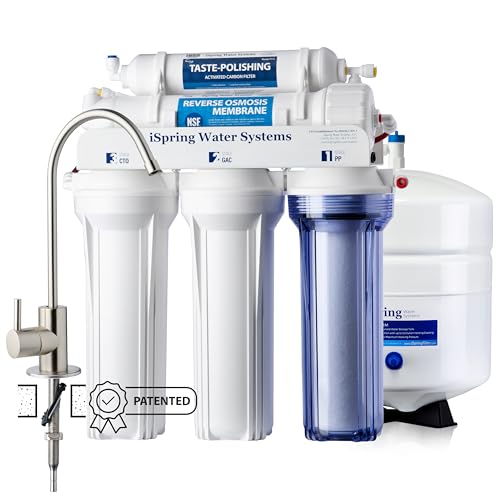
- EFFECTIVELY REDUCES CONTAMINANTS – The iSpring RO system delivers clean, pure, and great-tasting drinking water by remov…
- CERTIFIED TO NSF/ANSI 58 – Produced to strict American quality standards, this iSpring reverse osmosis system is NSF/ANS…
- LOW MAINTENANCE & LEAK-FREE DESIGN – Engineered with premium components for long-term reliability and minimal upkeep. Th…
What We Like
- Certified to NSF/ANSI 58 as a complete system
- Removes up to 99% of 1,000-plus contaminants including PFAS
- Transparent first-stage housing shows when to replace filters
- Among the highest-rated budget RO systems on Amazon
What Could Be Better
- Storage tank takes up real cabinet space
- 75-GPD tank flow is slower than tankless rivals
- Five stages mean five filters to track
Best For: First-time RO buyers who want a certified, complete kit and do not mind a little patience and a storage tank.
Skip it if: Skip it if cabinet space is your binding constraint — the storage tank is the whole trade-off of a tank system.
Flaws but not dealbreakers: Plastic fittings reward gentle hand-tightening — overtightening invites weeps — and the air-charged tank occasionally needs its valve topped back up to spec.
🔬 5. APEC Water ROES-UV75, 6-Stage Under Sink RO Water Filter System, UV, 75 GPD (Best for Well Water)
If your water comes from a private well, carbon alone will not cover the microbial risk. APEC’s ROES-UV75 bolts a UV sterilizer onto a proven six-stage RO platform: sediment and twin carbon stages feed a 75-GPD membrane, then ultraviolet light neutralizes bacteria, viruses, and cysts right before polished water reaches the faucet. The listing rates the UV stage at up to 99.99% and pairs it with a lead-free designer faucet and JG premium tubing. It is the architecture APEC has refined for years, plus the safety net untreated supplies deserve.

- Supreme quality – designed and engineered with only premium components. Effective in removing up to 99% of impurities su…
- Premium long-lasting filters used to treat tap water, well water. Provide unlimited clean, refreshing crisp tasting wate…
- The continuous UV sterilization destroys up to 99. 99% of bac., vir. & cysts, and kills parasites in un-chlorinated wate…
What We Like
- UV stage destroys up to 99.99% of bacteria, viruses, and cysts
- 75-GPD membrane suits busier households
- Lead-free designer faucet plus JG premium tubing
- US-based brand with lifetime technical support
What Could Be Better
- Priciest conventional tank configuration here
- Six housings plus a four-gallon tank demand a big cabinet
- UV bulb is an annual consumable
Best For: Well owners and rural homes wanting deep purification plus a microbial safety net.
Skip it if: Skip it if you are on treated city water and have no microbial concern — you would be paying for a UV stage you never use.
Flaws but not dealbreakers: It is the most involved install here — budget a relaxed hour — and the UV transformer wants always-on power.
🌱 6. Waterdrop TSB 8 Layer Under Sink Water Filter System, with Dedicated Faucet (Best Zero-Waste Pick)
Not everyone wants RO’s wastewater, power draw, or mineral-free taste. Waterdrop’s TSB stacks eight filtration layers — three replaceable cartridges in sequence — ending in a 0.01-micron ultrafiltration membrane that blocks sediment, rust, cysts, microplastics, PFAS, and chlorine while deliberately keeping the calcium and magnesium that make water taste like water. It connects with push-fit simplicity, wastes zero water to the drain, and plugs into nothing; the listing puts the three cartridge lives at 6 months, 8-12 months, and 12-18 months.
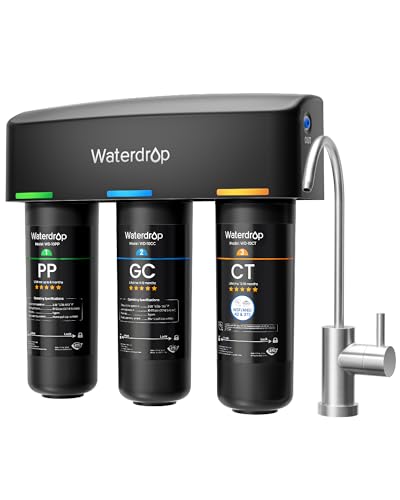
- [Easy DIY Compatibility] This 3-stage under sink water filter system does NOT reduce TDS and helps retain beneficial min…
- [Easy Filter Replacement] Replacement filters are easy to find and install. For WD-TSA / TSB 3 stage under sink water fi…
- [More filters, better taste] This under sink filter system comes with 3 filters and can realize 8-stage deep filtration …
What We Like
- Zero wastewater and zero electricity
- Keeps beneficial minerals for balanced taste
- Eight-layer stack targets PFAS, chlorine, and heavy metals
- Compact stacked footprint suits shallow cabinets
What Could Be Better
- Does not reduce dissolved solids or fluoride like RO
- Three cartridges to track each year
- Still needs a countertop hole for the included faucet
Best For: Renters and eco-minded homes that want chlorine and PFAS reduced without a drain line or an outlet.
Skip it if: Skip it if your water report shows high TDS, fluoride, or arsenic — ultrafiltration does not touch dissolved contaminants.
Flaws but not dealbreakers: If dissolved solids are your actual concern this is the wrong tool — step up to an RO pick — and you still sacrifice a countertop hole for the included dedicated faucet.
✨ 7. Waterdrop 10UA-UF 0.01 μm Ultra Filtration Under Sink Water Filter System (Best Compact Pick)
Some cabinets are already lost causes — garbage disposals, dish racks, one mysterious unlabeled shutoff. The Waterdrop 10UA-UF was built for them: a single slim housing with a twist-and-lock cartridge that mounts vertically, horizontally, or flat against the wall, feeding either a dedicated faucet or the existing cold line through included adapters. A 0.01-micron UF membrane plus activated carbon targets chlorine, taste, odor, and heavy metals; the listing rates one cartridge at up to 12 months or 11,000 gallons and a tested full flow of 0.75 gpm at 60 psi.
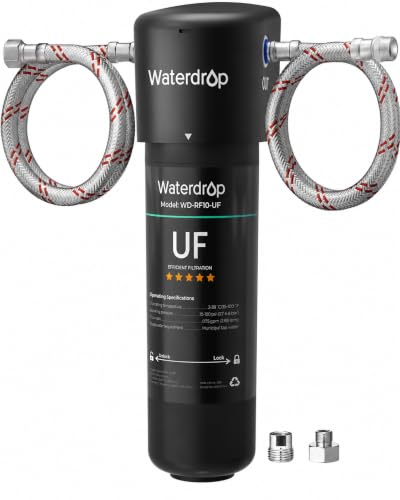
- Less than $26.99 per replacement filter WD-RF10-UF(Search ” B08HV51X15″on Amazon), save over 50% of cost on subsequent u…
- 【Superior material】 0.01 micron Waterdrop Ultrafiltration Membrane, this under sink water filter reduces chlorine, taste…
- 【Innovative multistage filtration】 The Waterdrop Direct Connect Under Sink Water Filter System uses innovative multistag…
What We Like
- Smallest footprint of any pick here
- Twist-lock cartridge swaps in seconds, no wrenches
- Can feed your existing faucet and skip new holes
- Up to 12 months or 11,000 gallons per filter
What Could Be Better
- Single-cartridge ceiling on how much it can strip
- 0.01-micron UF stops short of RO-level TDS removal
- Heavy sediment shortens filter life
Best For: Apartments, tiny kitchens, and minimalists who want set-and-forget cleaner water in the smallest possible space.
Skip it if: Skip it if you fill pots all day — the compact body trades flow and capacity for size.
Flaws but not dealbreakers: Adapters assume standard 3/8-inch compression fittings, so genuinely ancient plumbing may send you shopping, and heavy sediment exhausts it faster than rated.
Price Tiers: Where Paying More Stops Buying Performance
We do not print exact prices here because Amazon prices move weekly, but the structure does not. Here is what each bracket of under-sink filter actually buys you:
- Entry carbon (roughly $70-$150): a certified two- or three-stage carbon block like the Aquasana AQ-5300+ if lead and chlorine are your only documented problems. This is the cheapest bracket that is genuinely certified, and for a lot of municipal-water homes it is the end of the road.
- Entry RO ($150-$260): the tier where you finally strip dissolved solids. The iSpring RCC7-BN and the classic Express Water 5-stage kits live here. The trade-offs are a storage tank, slower tank-fed flow, and a drain line — not purity.
- Serious RO ($260-$600): tankless designs (Glacier Fresh GFU03, Frizzlife PD600) buy you speed, a smaller footprint, and a better pure-to-drain ratio. You are paying for convenience and efficiency, not for narrower contaminant coverage.
- Premium ($600+): app-connected systems with lab-verified scores and 1:1 drain ratios. Past roughly $600 you are buying telemetry, brand polish, and installation hand-holding — the water at the spout is not meaningfully cleaner than a $260 certified RO.
The stopping point: for most buyers it sits around $260-$300. Below it, quality is genuinely limited by certification and membrane size; above it, the incremental dollars go mostly to flow, footprint, and software. The one exception is a true well-water setup, where a UV stage is a safety feature, not a luxury.
Where We Disagree With Other Reviewers
If you read several roundups you will notice they mostly agree with each other — and mostly disagree with us at the top. That is deliberate. Here is where our ranking parts company with named testers, and why:
- QualityWaterLab names the Cloud RO its Best Overall and ranks the Waterdrop G3P800 its Best Tankless RO. We lead with a certified carbon block (the Aquasana Claryum) instead, because the majority of American homes are on treated municipal water whose headline problems are chlorine, disinfection byproducts, and lead — not dissolved solids. Their own guide lists the Aquasana Claryum 3-Stage as its “Best Balance of Flow & Filtration,” which is exactly the property that puts it first for that audience.
- WaterFilterGuru calls the Frizzlife PD600-TAM3 its Best Budget Tankless. We agree the platform is excellent — it is our alkaline pick — but we do not call a tankless RO with a proprietary cartridge ecosystem a budget option, and we moved the iSpring RCC7-BN into the budget slot after the long-standing Express Water RO5DX listing went unavailable. A straight NSF/ANSI 58-certified tank kit at an entry price is the more honest “budget RO.”
- TechGearLab’s favorite under-sink system is the APEC ROES-50 Essence. We keep APEC in the guide but moved it to our well-water slot (ROES-UV75) because the UV stage is what a private-well household actually needs; for city water you can skip the UV premium.
- Where we agree: everyone who runs lab panels lands on the same verdict we do about certifications — a system with a real NSF/ANSI listing beats one with a longer marketing promise. QualityWaterLab’s Tap Score testing and WaterFilterGuru’s SimpleLab panels both found that the headline “1,000+ contaminants” badges are broad marketing summaries, not a measurement of your water.
The Failure Modes Buyers Report
The recurring complaints in the negative reviews are boringly consistent, and knowing them in advance is worth more than a spec sheet. None of these are reasons to avoid the category — they are reasons to install correctly.
- Push-fit weeps at the fittings. By far the most common 1- and 2-star theme across every brand: a connection that was not pushed fully home seats fine at first, then drips weeks later. Re-seat every fitting once after 24 hours.
- Cartridges that did not last their rated life. Sediment-heavy or hard water exhausts a carbon block early; the filter-life indicators on modern units exist precisely because calendar-based changes under-serve hard water.
- Tank RO that slows to a trickle. The air-charged storage tank loses pressure over a couple of years, so the last glass pours slowly — re-pressurize the tank valve, or the symptom is mistaken for a clogged filter.
- Tankless “TDS creep.” As a tankless membrane ages, dissolved solids can rise in the first ounces after idle. It is a design property of on-demand RO, not (usually) a defect.
- Pump noise and outlet dependence. Most tankless systems need power; a dedicated outlet under the sink is a real install cost people discover late. The Glacier Fresh GFU03 is the exception here because it is water-powered.
- Proprietary cartridges. The single most expensive surprise is a brand that stops stocking its filters. Verify replacement availability and price before you buy the system, not after.
The Bottom Line
Clean water is infrastructure, not luxury — and 2026’s field proves you no longer pay a premium for it. For most homes on city supply, the Aquasana AQ-5300+ Max Flow hits the sweet spot: certified contaminant reduction, real cooking-friendly flow, and minerals left intact. If you want RO-grade purity without the tank, the Glacier Fresh GFU03 and Frizzlife’s alkaline tankless unit redefine how little cabinet space purified water needs. Budget buyers should look at the iSpring RCC7-BN, well owners should not sleep on the APEC ROES-UV75’s UV safety net, and renters get honest filtration from the Waterdrop TSB and 10UA-UF without touching a drain line. Whichever you choose, verify your water’s actual contaminants first — the right filter is the one aimed at your pipes, not the scare headline.
Frequently Asked Questions
Do under-sink water filters remove lead?
Yes — but only models certified against it. Look for NSF/ANSI 53 certification (or NSF/ANSI 58 for reverse osmosis systems) with an explicit lead-reduction claim; every pick in this guide carries at least one of those. Certification matters because lead slips past ordinary carbon unless the block is engineered and independently tested for it. If your home was built before 1986, assume lead solder exists somewhere upstream and treat certification as non-negotiable.
Reverse osmosis vs. activated carbon: which is better?
They solve different problems. Activated carbon excels at chlorine, taste, odor, and many organic chemicals while keeping beneficial minerals, wasting no water, and costing less to run. Reverse osmosis goes further, stripping dissolved inorganic contaminants — fluoride, arsenic, nitrates, sodium, hexavalent chromium — that carbon cannot touch, at the cost of wastewater, slower flow, and mineral removal. Choose carbon (with 53-certified lead reduction) for typical city water; choose RO for high TDS, fluoride, arsenic, or well-water uncertainty.
How difficult is under-sink water filter installation?
Easier than the plumbing aisle fears suggest. Most systems connect to the cold-water line with push-fit or compression fittings and need only a drilled or existing hole for the dedicated faucet — 30 to 90 minutes for a confident beginner with a drill, bucket, and towel. Tank systems add tank placement and initial flushing; tankless units often need an outlet. Renters can skip holes entirely with models like the Waterdrop 10UA-UF that run through the existing faucet.
Do under-sink reverse osmosis systems waste a lot of water?
Older RO designs sent several gallons to the drain for each gallon purified, but the current generation is far kinder. Modern tankless systems commonly run between 2:1 and 3:1 pure-to-drain ratios — the Glacier Fresh GFU03 lists 3:1 and the Frizzlife PD600 lists 2:1 — and premium tankless units cut waste further with permeate pumps or recirculation. Even at 2:1, producing a gallon of drinking water costs a gallon or two of drain water — trivially cheaper than bottled water by any measure.
How often do I replace filter cartridges, and what do they cost?
Expect sediment and carbon cartridges every six to twelve months ($30 to $120 yearly depending on the system), RO membranes every 24 months, and UV bulbs annually. The Waterdrop 10UA-UF’s single cartridge is rated up to 11,000 gallons, and the Waterdrop TSB’s three cartridges run 6, 8-12, and 12-18 months respectively. Trust any built-in filter-life indicator over calendar dates, since hard or sediment-heavy water burns through media early.
Will an under-sink filter reduce my water pressure or flow rate?
Any filter adds some resistance, but well-designed systems keep dedicated-faucet flow strong. Carbon systems like the Aquasana Max Flow prioritize throughput and pour nearly like a direct line; tank RO systems deliver steady but unhurried flow limited by membrane and tank pressure; tankless RO units compensate with pumps. If your existing faucet flow collapses after installation, check for clogged prefilters or kinked tubing before blaming the category.
Do under-sink filters remove fluoride, soften water, or change TDS?
Standard carbon and ultrafiltration filters leave fluoride, hardness minerals, and TDS essentially untouched. Only reverse osmosis (or distillation) meaningfully reduces fluoride and dissolved solids — certified RO systems typically cut TDS by 90 percent or more. No under-sink filter softens water in the true sense; hardness requires ion-exchange softening at the household level. If you want minerals removed but not gone entirely, pair RO with a remineralizing stage like Frizzlife’s alkaline output.
Sources & Further Reading
- US EPA — Ground Water and Drinking Water (institutional)
- Minnesota Department of Health — Home Water Treatment (institutional)
- Water Quality Association — product certification (institutional)
- NSF — Standards for Water Treatment Systems (NSF/ANSI 42, 53, 58, 401, 372) (title-cited; NSF blocks scripted access)
- WaterFilterGuru — 8 Best Reverse Osmosis Systems We’ve Tested (SimpleLab Tap Score lab data)
- QualityWaterLab — Best Under-Sink Water Filters, Lab & Hands-On Tested
- TechGearLab — Best Water Filters of 2026, Lab Tested & Ranked