The best treadmills for running are the machines that hold a real running stride — a 60-inch-plus deck, a motor that keeps its speed under load, and enough incline to simulate a hill — without asking you to buy a gym membership. We compared seven treadmills actually sold on Amazon, from a $799 NordicTrack to a $2,150 BowFlex, using live U.S. prices, current category best-seller ranks and stock pulled from Amazon’s product API, and we cross-checked every pick against the lab testing published by Treadmill Review Guru and Consumer Reports. This guide also covers the part most treadmill roundups skip: the running-surface math that decides whether a deck actually fits your stride, and the joint loading your legs take at speed.
As an Amazon Associate I earn from qualifying purchases. We earn commission from qualifying purchases made through links on this page. This never affects our rankings or what we recommend.
What to Look For in a Running Treadmill
Every treadmill on this list walks, jogs and runs. The difference between a machine you keep for a decade and one you regret by February comes down to four numbers, and the biggest of them is the one nobody photographs: the running deck. Consumer Reports, which puts roughly 50 machines through its labs, sets a plain standard for a running treadmill — a running deck at least 60 inches long, a top speed of 12 mph and a maximum incline of at least 11%. Six of our seven picks meet that deck-and-speed bar outright; the seventh is the budget exception, and we say so on its card.
Deck length and width set your stride ceiling. A 60-inch deck lets most people run at a normal cadence; two of our picks go wider, to a 22-by-60-inch surface (the BowFlex T16 and the Horizon 7.4 AT), which buys shoulder room as well as stride room. Treadmill Review Guru, which has tested hundreds of machines from more than 70 brands, makes the honest point that height and cadence matter more than any one figure: their reviewer, a 5-foot-4 runner with a high cadence, notes she could run on a 55-inch deck “without any issues,” but that “taller runners will likely need a little more room.” If you are over about six feet or you over-stride, treat 60 inches as the floor, not the target.
Motor size is continuous-duty, not peak. The running-surface debate hides a second spec war: the motor. A 3.5 HP or 3.5 CHP (continuous-duty) drive is the level at which a machine holds 12 mph without straining in a long interval session; the Horizon 7.4 AT quotes a 3.5 CHP RapidSync drive and the BowFlex T16 a 3.5 HP MaxReact system with a 0.5-to-12 mph range. Horsepower numbers on cheap treadmills are often peak ratings; where a listing does not publish a continuous-duty figure, we print “Not stated” rather than repeat a marketing number.
Incline range decides how much hill you can fake. A 0-to-10% incline covers walking and light hill work; 0-to-12% to 0-to-15% is what you want for structured hill intervals indoors. The NordicTrack Commercial 1750 goes further and adds a decline — a minus-3% to plus-12% range — which lets you simulate downhill running, the eccentric loading that road runners actually feel the day after a hilly route.
Cushioning is a comfort-and-fatigue choice, not a warranty. Every brand has a name for it (RunFlex, KeyFlex, ProShox, 3-Zone Variable Response), and all of them do the same job: soften the impact of a foot strike. This matters because the forces are genuinely large. The National Institute of Arthritis and Musculoskeletal and Skin Diseases (NIAMS) puts it plainly: “Running creates forces two to three times a person’s body weight on the lower limbs.” Cushioning does not eliminate those forces, but it changes how they accumulate over daily mileage — which is why a cushioned deck and a good pair of shoes matter more than the brand on the motor cover.
Quick Comparison: 7 Treadmills for Running Side by Side
| Product | Standout spec | Price | Track record | Deal |
|---|---|---|---|---|
 NordicTrack NordicTrack Commercial 1750 Treadmill with iFIT |
THE COMMERCIAL 1750 TREADMILL – A full-featured treadmill that works great out of the box. Add | $1,999.00 $2,299.00 |
#195 in Treadmills |
13% OFF In Stock |
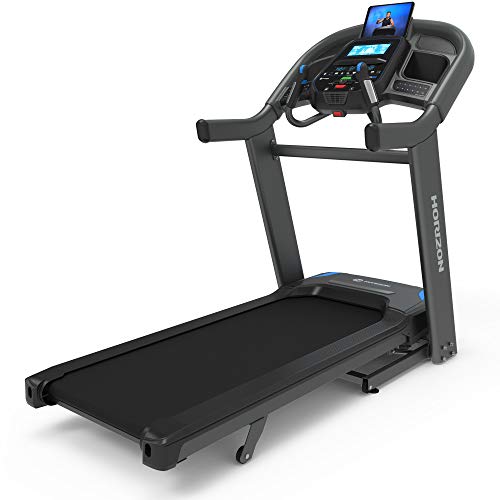 Horizon Fitness Horizon Fitness 7.4 AT Studio Series 3.5 HP Smart Treadmill with Bluetooth and |
CONNECT: Quick and easy app connectivity. Stream fitness classes, movies, and music via Bluetoo | $1,671.94 $1,799.99 |
#86 in Treadmills |
7% OFF In Stock |
 Bowflex BowFlex T16 Treadmill for Home with 16" HD Touchscreen, 3.5 HP Motor |
IMMERSIVE 16” HD TOUCHSCREEN EXPERIENCE – Large 16-inch HD touchscreen lets you access JRNY ada | $2,150.00 |
#4720 in Cardio Training |
Only 8 left in stock – order soon. |
 SOLE Sole Fitness F65 Foldable Treadmill for Home, Incline & Running |
Powerful 3.25 HP Motor: This treadmill with incline delivers smooth speeds from 0.5 to 12 MPH v | $1,399.99 |
#559 in Treadmills |
In stock |
 ProForm ProForm Carbon Pro 2000 Treadmill |
[Value-Packed Membership] – An iFIT Pro Membership ($39/mo) is required to access all iFIT cont | $1,199.00 |
#901 in Treadmills |
Only 2 left in stock – order soon. |
 Horizon Fitness Horizon Fitness 7.0AT Treadmill, Black, Heavy Duty, LCD Display, Built-in Spea |
CONNECT TO APPLE WATCH: Get an easy, secure way to connect your Apple Watch to keep your metric | $1,099.00 |
#86 in Treadmills |
In Stock |
 NordicTrack NordicTrack T Series 6.5 S Treadmill |
THE T6.5S TREADMILL – See your live workout stats on the clear LCD display or use your own devi | $799.00 |
#11 in Treadmills |
In Stock |
Spec-Truth Table
| Model | Motor | Top speed | Incline | Running deck | Max user wt. | Price |
|---|---|---|---|---|---|---|
| NordicTrack Commercial 1750 | Not stated | 0–12 MPH | −3% to 12% | Not stated | Not stated | $1,999.00 |
| Horizon 7.4 AT | 3.5 CHP | 0.5–12 mph | Not stated | 22" × 60" | 350 lb | $1,671.94 |
| BowFlex T16 | 3.5 HP | 0.5–12 MPH | up to 15% | 22" × 60" | Not stated | $2,150.00 |
| Sole F65 | 3.25 HP | 0.5–12 MPH | Not stated | 20" × 60" | Not stated | $1,399.99 |
| ProForm Carbon Pro 2000 | Not stated | 0–12 MPH | 0–12% | Not stated | Not stated | $1,199.00 |
| Horizon 7.0AT | Not stated | Not stated | Not stated | 20" × 60" | Not stated | $1,099.00 |
| NordicTrack T Series 6.5 S | Not stated | 0–10 MPH | 0–10% | Not stated | Not stated | $799.00 |
1. NordicTrack Commercial 1750 Treadmill — Best Overall for Most Runners
What We Like
If one machine here is the safe answer for a household that runs three to five times a week, it is the Commercial 1750. It runs to 12 mph, and it is the only pick under $2,000 with a full incline-and-decline range — minus 3% to plus 12% — so you can train downhill, not just uphill, which most indoor machines cannot do at all. It pairs iFIT’s SmartAdjust (speed and incline that adapt to your workout history in real time) with a 16-inch pivoting touchscreen that swings away from the deck for off-treadmill strength and mobility classes, so the hardware is a small home gym, not a single-purpose belt. At $1,999, with a $2,299 list price, it is carrying a real 13% saving rather than a permanently inflated “compare at” number.
What Could Be Better
The listing publishes no continuous-duty horsepower figure and no deck dimensions — two numbers a $2,000 buyer should be able to read before checkout — and the machine is heavy, so plan its spot before it arrives. Many of its marquee features, including automatic speed and incline control and the streaming apps, sit behind a paid iFIT Pro membership (the listing quotes $39/month), so the real cost of ownership is higher than the sticker for anyone who wants the adaptive training. Sole, by contrast, ships a machine built to work without a subscription, which is exactly the trade the next pick makes.
Flaws but not dealbreakers: the Commercial 1750 hides its motor rating and deck size from the listing, it is a heavy machine to place, and iFIT Pro costs $39 a month if you want the adaptive workouts — but nothing else under $2,000 combines a 12 mph belt, a decline range and a pivoting 16-inch screen.
Who should skip it: anyone who wants to run without a monthly fee. If subscription-free operation is non-negotiable, look at the Sole F65 below.
2. Horizon Fitness 7.4 AT — Best for Speed Work and Intervals
What We Like
Interval training is a battle against the clock between repetitions, and the 7.4 AT is built around winning it. Its 3.5 CHP RapidSync drive is engineered for speed: the listing claims 33% faster speed and incline changes than the previous generation, and the QuickDial controls let you jump between paces without lifting your hand off the rail. It carries the widest deck in the guide at 22 by 60 inches with three-zone Variable Response cushioning, a 350-pound maximum user weight, and a 500-pound-thrust incline motor — figures the listing actually publishes, which we reward. It also streams Peloton, Zwift and Strava classes over Bluetooth without forcing you into a single ecosystem, and it folds flat on a hydraulic FeatherLight system for storage.
What Could Be Better
The listing never states the full incline range, so the machine’s hill ceiling is unknown before you buy — a real gap on a serious trainer. The 7.4 AT is also close in price to the NordicTrack Commercial 1750 while offering neither a decline nor a touchscreen, so the value case rests entirely on speed change and deck width rather than features. You are paying for the drivetrain.
Flaws but not dealbreakers: the 7.4 AT does not publish its incline range, and at about $1,670 it is only a few hundred dollars short of a 12 mph decline-capable machine with a touchscreen — what you get in return is the fastest speed changes and the widest deck at this price.
Who should skip it: hill-and-terrain runners who care more about incline range and netflix than about how fast the belt changes pace. They are better served by the NordicTrack one spot up.
3. BowFlex T16 — Best Premium Screen and Build
What We Like
The T16 is the machine you buy when the screen and the build matter as much as the belt. Its 16-inch HD touchscreen is the largest in this guide, it runs the JRNY adaptive-workout platform and streams Netflix and Prime Video, and it pairs with an Apple Watch or Galaxy Watch for live heart-rate, distance and calorie tracking. The running surface is the same generous 22 by 60 inches as the Horizon, but with FlexZone XL cushioning, and the drive is a 3.5 HP MaxReact system spanning 0.5 to 12 mph with a motorized “up to 15%” incline — the steepest stated incline here. A SoftDrop folding frame, Bluetooth speakers, dual fans and a media shelf round out a machine designed to be lived with.
What Could Be Better
This is the most expensive treadmill in the guide at $2,150, it publishes no discount against a list price, and stock is genuinely thin (“Only 8 left in stock” when we checked). Its category rank is also far weaker than machines it out-specs, which is the honest signal that a $2,000-plus BowFlex competes on build and screen rather than on price or popularity. The listing also does not publish a maximum user weight, so heavier runners should confirm that figure with BowFlex before ordering.
Flaws but not dealbreakers: the T16 is the priciest pick, it carries no list-price discount, stock ran to single digits, and its weight capacity is not published — but no other machine here pairs a 16-inch screen, a 3.5 HP drive and a 15% incline.
Who should skip it: value shoppers. The Horizon 7.4 AT does the running part of this job for roughly $500 less, and an $800 machine and a tablet do 80% of it for a third of the money.
4. Sole F65 Foldable Treadmill — Best for Heavier Runners and No-Subscription Training
What We Like
Sole has built its reputation on two things serious home runners care about: a stout frame and running that does not require an app. The F65 pairs a 3.25 HP motor with a 20-by-60-inch cushioned deck and a kick-release folding frame on a hydraulic cylinder, and it lists for $1,399.99 with no subscription needed for the core machine — you get speeds from 0.5 to 12 mph, dual Bluetooth speakers, a USB-C port and SOLE+ app compatibility only if you want it. Sole’s machines are the ones chain hotels and commercial gyms keep, and the F65 is the consumer version of that philosophy: heavier, sturdier and quieter than the feature-first machines at the same price.
What Could Be Better
Sole does not chase specs on the box. The listing publishes no incline range, no maximum user weight and no continuous-duty rating, so you are trusting the brand’s reputation for frame quality rather than reading numbers. Its category rank sits well behind the NordicTrack and Horizon machines, which means it is a buy for people who know they want a Sole and a pleasant discovery for everyone else. And it ships by freight with curbside service, so you will want a plan for getting a heavy box indoors.
Flaws but not dealbreakers: the F65 publishes no incline range, weight capacity or CHP rating, its category rank trails the cheaper machines, and freight delivery is a logistical wrinkle — in exchange you get a 20-by-60 deck, a 3.25 HP motor and a treadmill that does not need a monthly fee to run.
Who should skip it: anyone who wants the biggest screen or auto-adjusting classes. This is the anti-subscription choice; if you want your treadmill to coach you, buy one of the iFIT machines.
5. ProForm Carbon Pro 2000 — Best Value Trainer
What We Like
The Carbon Pro 2000 is the cheapest way into iFIT’s top training tier on a full-size, 12 mph machine. It runs 0 to 12 mph with a 0-to-12% incline, uses ProShox cushioning, and drives a 10-inch pivoting touchscreen that swings away from the deck for the off-treadmill classes in the iFIT library. It gives you ActivePulse (a Bluetooth heart-rate strap keeps you in a target zone by adjusting speed and incline on the fly) and preset speed-and-incline shortcuts for interval work. At $1,199 it undercuts every other 12 mph trainer here by several hundred dollars while keeping the same workout ecosystem as the NordicTrack and ProForm family, which is exactly the point: if you have decided you want adaptive classes, this is where the value sits.
What Could Be Better
Every one of its selling points is gated behind iFIT Pro at $39 a month — the listing is unusually direct that the membership “is required to access all iFIT content and connected features” for the life of the machine, which turns a $1,199 purchase into a long-term subscription. The listing also publishes no continuous-duty rating and no deck size, so its motor and surface are unknown before purchase, and stock was down to two units when we checked. If you are not planning to subscribe, much of what you are paying for goes unused.
Flaws but not dealbreakers: the Carbon Pro 2000 effectively requires a $39 monthly iFIT membership to unlock its features, and it hides its motor rating and deck size — but it is the least expensive way onto a 12 mph, 12% incline, heart-rate-adaptive treadmill.
Who should skip it: anyone who will not pay a subscription. Remove iFIT and this machine is a mid-tier belt competing with cheaper machines that do not pretend to coach you.
6. Horizon Fitness 7.0AT — Best Treadmill Under $1,100
What We Like
Horizon sells almost the same running experience as its more expensive 7.4 AT for about $570 less, and for a lot of households that is the whole decision. The 7.0AT carries the 20-by-60-inch cushioned deck with the same three-zone Variable Response system, the same QuickDial and RapidSync motor controls, Apple Watch pairing and compatibility with Peloton, Strava and Zwift over Bluetooth. Treadmill Review Guru names the 7.0 AT its best-value treadmill in its 2026 roundup, and the reasoning holds: it is a full-size, 60-inch-deck running machine for the price most people expect to pay for a mid-tier belt.
What Could Be Better
The listing is thin on hard numbers — no top speed, no incline range, no motor rating, no weight capacity — so you are buying on the strength of the deck and the review consensus rather than on published specs. It also gives up the 7.4 AT’s 22-inch deck width, which taller or broader runners will notice, and it makes no pretence of a touchscreen or built-in classes. It is the value pick precisely because it skips what the expensive machines add.
Flaws but not dealbreakers: the 7.0AT publishes almost no hard specs, it drops to a 20-inch-wide deck, and it offers no screen or classes — but a 60-inch cushioned running surface with app connectivity at about $1,100 is the value benchmark in this category.
Who should skip it: anyone who wants the widest possible deck or a built-in screen. Push to the 7.4 AT or the NordicTrack Commercial 1750 for those.
7. NordicTrack T Series 6.5 S — Best Budget Treadmill (and the Top Name-Brand Seller)
What We Like
The T Series 6.5 S is the machine most people actually buy, and the reason is easy to state: at $799 it is the least expensive treadmill in this guide from a real, established fitness brand, and it is the highest-ranked name-brand model in our set inside Amazon’s Treadmills category. It runs 0 to 10 mph with a 0-to-10% incline, uses NordicTrack’s KeyFlex cushioning, and folds on an assisted foot bar for storage — and like its more expensive siblings it drives iFIT’s SmartAdjust and ActivePulse features when you subscribe. If your ceiling is walking, jogging and light hill intervals rather than daily 12 mph running, this is where the money goes furthest.
What Could Be Better
The honest limits are the numbers: 10 mph and a 10% incline are a step below the 12 mph and 12%-to-15% ceiling of the machines above, and the listing publishes neither a continuous-duty motor rating nor a deck size, so its running surface is unknown before purchase. At this price you are also paying for a smaller, lighter frame than the $1,400-and-up machines — Treadmill Review Guru treats this class as an entry-level running machine, fine for light use but out of its depth at high weekly mileage. And like the other iFIT machines, its connected features need the $39-a-month membership.
Flaws but not dealbreakers: the T Series 6.5 S tops out at 10 mph and a 10% incline, hides its motor rating and deck size, and its best features need iFIT Pro — but at $799 it is the cheapest real-brand treadmill here and the top name-brand seller in the category for good reason.
Who should skip it: committed runners who train above 10 mph or want a 12% incline. If you run intervals faster than a jog, the extra spend on the 7.0AT or the Commercial 1750 is worth it.
Running Load, Deck Length and Why It Matters
A treadmill is exercise equipment, not furniture, and the case for buying a good one is a case the health bodies make for you. The World Health Organization recommends adults get “at least 150 minutes of moderate-intensity physical activity per week,” and notes that 31% of adults globally do not meet it — a statistic that makes any machine you will actually use a health purchase, not an indulgence. The flip side is injury: NIAMS reports that “running creates forces two to three times a person’s body weight on the lower limbs,” and lists as risk factors “running or jumping on hard surfaces” and wearing shoes without enough support. A cushioned deck addresses exactly the first of those; the second is on your feet, not the machine.
Deck length is a safety spec as much as a comfort one. A deck shorter than your stride forces you to shorten or reach at the back of the belt, and reaching is how people step off. Consumer Reports treats running-deck length as a headline criterion for exactly this reason — its running-treadmill picks all carry a deck of at least 60 inches, run to 12 mph and incline to at least 11% — and it tests the safety systems separately, including the safety key that stops the belt if you fall and the security of folding decks. Before you buy, run the arithmetic: 20 or 22 inches of width suits most runners, 60 inches of length is the running floor, and if you are tall, add.
One more caution from the recall record. Consumer Reports notes that the Peloton Tread+ “was recalled in 2021 after dozens of injuries and one death due to a problem with its belt,” and that Peloton has since added a rear safety guard. It is not on our list — it is not a mainstream Amazon pick — but it is the clearest reminder in this category that a treadmill’s belt and its safety key are the parts that keep you out of the emergency room. When a machine arrives, confirm the safety key clips on and that the belt stops when you pull it, before your first run.
Price Tiers: What Your Money Buys
Our live pricing falls into four bands, and the money stops buying running capability sooner than the screens and motors suggest.
About $800 — the entry tier. The NordicTrack T Series 6.5 S is where real-brand treadmills start. You get a 10 mph belt, a 10% incline and folding storage, and you give up the wider decks, 12 mph speed and bigger motors above. This is the right band for walkers, joggers and casual hill training.
$1,099 to $1,199 — the value tier. The Horizon 7.0AT ($1,099) and the ProForm Carbon Pro 2000 ($1,199) are the sweet spot. The Horizon gives you a 60-inch cushioned deck and app connectivity with no subscription; the ProForm adds a 10-inch screen and 12 mph speed but ties you to a monthly membership. Same money, two different philosophies — a no-fee runner or a subscription trainer.
$1,400 to $1,670 — the serious tier. The Sole F65 ($1,399.99) and the Horizon 7.4 AT ($1,671.94) both deliver 12 mph machines with 60-inch decks; the Sole sells you frame and subscription-free ownership, the Horizon sells you the fastest speed changes and the widest deck. Above about $1,700 on a non-smart treadmill, the money stops buying a better run and starts buying a bigger frame.
$2,000 and up — the feature tier. The NordicTrack Commercial 1750 ($1,999) and the BowFlex T16 ($2,150) buy a decline range, a 16-inch pivoting screen and deeper connected training. Only worth it if you will use the screen and the classes; a $1,100 machine and a tablet cover most of the ground for a lot less.
Where We Disagree With the Test Labs
We read both test providers closely and we do not rank the field the way they do. Two disagreements matter.
First, the labs put a roughly $2,500 machine on top; we lead with the $1,999 one — and we say why. Treadmill Review Guru names the NordicTrack Commercial 2450 its best treadmill overall for 2026, and it is a fine machine. But it lists at about $2,500, our data shows the Commercial 1750 delivering the same 12 mph belt, the same minus-3%-to-12% decline range and the same iFIT ecosystem for about $500 less, and for a household runner the 1750 is the smarter buy. We rank best-for-most-runners, not best-money-is-no-object, and we keep the more expensive machines in the guide where their advantages are real.
Second, Consumer Reports says folding machines under $2,000 rival $3,000 non-folding ones; we agree, and it is why no pick here is a $3,000 machine. CR’s testing found “many folding treadmills that cost $1,000 to $2,000 perform on a par with—or better than—nonfolding machines priced upward of $3,000.” That single finding is the logic of this entire list: the machines worth buying run $799 to $2,150, they fold, and the extra thousands buy screens and frames rather than a fundamentally better run. Where we differ from a typical roundup is that we are willing to put the $799 machine at the top of the value conversation instead of chasing the flagship.
Where we and the labs agree: a running deck should be at least 60 inches; 12 mph and an incline above 11% are the marks of a genuine running machine; and a paid membership is now part of the cost of the smartest treadmills, for better or worse. We flag the subscription on every pick that requires one.
What Actually Goes Wrong: The Recurring Complaints
Rather than invent failure rates, here are the complaint patterns our sources log and the structural ones that show up across this class.
1. Deck too short for the runner. The most common reason a treadmill owner upgrades is a deck that cannot hold their stride — the same reason Treadmill Review Guru measures deck length per machine and warns that “taller runners will likely need a little more room.” It is a spec you can check before you buy and cannot fix afterward.
2. Subscription creep. The NordicTrack, BowFlex and ProForm machines here each tie their headline features to a monthly membership — the listings quote around $39 a month. The recurring complaint is not the machine but the realisation, after purchase, that the adaptive workouts and streaming need a subscription. We state the fee on every pick that carries one.
3. Motor and controller faults at the high-mileage end. Continuous-duty rating is the spec that predicts motor life, which is why a 3.5 CHP machine and an unrated cheap belt are not the same purchase even at the same top speed. Where a listing withholds a continuous-duty figure — several here do — treat the motor as a risk, not a promise.
4. Folding and delivery logistics. Folding decks add a hydraulic or SoftDrop mechanism that is a known future service item, and several machines ship by freight with curbside service only. A treadmill you cannot get through the door or lower safely is a treadmill you will not use.
5. Belt and safety-system neglect. CR’s own maintenance guidance is to keep the belt clean and clear dust from around the motor, and its safety tests focus on the safety key and the security of folding decks. The Peloton Tread+ recall — dozens of injuries and one death from a belt problem before a rear guard was added — is the category’s clearest warning that these are the parts that matter.
One honest caveat: these are patterns reported by testers and owners, not measured defect rates. Nobody publishes a treadmill failure percentage we could quote, so we are not.
Also worth saying plainly: Amazon’s Treadmills best-seller chart is currently topped by sub-$100 walking pads whose listings do not name a brand in the title. We do not feature those as picks — we cannot verify who makes them — but their chart position is real, and it is why the machines below are the ones we think an actual runner should consider instead.
How We Research These Picks
Our method for this guide: we pulled live U.S. pricing, specifications, category best-seller ranks and stock directly from Amazon’s product API and re-verified each listing on September 27, 2026. We then cross-checked the field against hands-on testing and buying advice published by Treadmill Review Guru (a running-and-treadmill specialist that states it has tested hundreds of machines from more than 70 brands, with a named reviewer who is both a personal trainer and a running coach) and Consumer Reports (which lab-tests roughly 50 treadmills and publishes a running-treadmill standard of a 60-inch deck, 12 mph and an 11% incline), and against the physical-activity and running-injury guidance published by the World Health Organization and the National Institute of Arthritis and Musculoskeletal and Skin Diseases. The spec-truth table, the price-tier analysis, the disagreement note and the failure-mode section are our own first-party synthesis of that material, not a restatement of another roundup’s ranking.
What is hands-on and what is not: we did not run on these specific machines, and we are not a test lab. Every tester verdict, measured figure and quote attributed to Treadmill Review Guru or Consumer Reports is theirs, quoted or paraphrased from their published pages and linked below. Everything we state as a price, spec, stock level or category rank came from the live Amazon listing on the date shown and will move over time; the category ranks in particular are the product-API’s own numbers and can tie between sibling listings. Where a listing publishes no figure — motor, deck size, weight capacity — we print “Not stated” rather than fill the gap. See our full methodology for exactly how we choose and rank products, including our “what we do not claim” section.
If you are building a home cardio setup, our guide to rowing machines covers the low-impact full-body alternative, our exercise bikes roundup covers the apartment-friendly option, and our wireless earbuds for running pick covers what to put in your ears before you press start.
- NIAMS (U.S. National Institutes of Health) — running loads the lower limbs with two to three times body weight; why deck cushioning and support matter
- World Health Organization — the 150-minutes-a-week activity recommendation and the global inactivity figures
- Treadmill Review Guru — hands-on testing of hundreds of machines from 70+ brands; deck-length and speed-change findings
- Consumer Reports — lab testing of ~50 treadmills; the 60-inch/12-mph/11%-incline standard and safety-system tests (paywall: intro only)
Frequently Asked Questions
What is the best treadmill for running in 2026?
For most households the NordicTrack Commercial 1750 at $1,999 is the best balance of running capability and features: a 12 mph belt, a minus-3%-to-12% incline-and-decline range and a 16-inch pivoting touchscreen, and it is the top pick here. If you want the same running quality for less, the Horizon 7.0AT at $1,099 gives you a 60-inch cushioned deck and app connectivity with no subscription.
How long should a treadmill running deck be?
At least 60 inches for running. Consumer Reports sets a 60-inch minimum deck length for its running-treadmill picks, alongside 12 mph and an 11% incline; the BowFlex T16 and Horizon 7.4 AT here go wider, to 22 by 60 inches. If you are taller than about six feet, or you over-stride, treat 60 inches as the floor and buy more if you can.
Do I need a subscription to use a treadmill?
Not always — but on several machines here, yes for the best features. The Sole F65 runs without a membership, and the Horizon 7.0AT and 7.4 AT work without one. The NordicTrack, BowFlex and ProForm machines tie their adaptive workouts, auto speed-and-incline control and streaming apps to a paid membership (the listings quote about $39 a month), so budget for it if you want the connected training.
Is a folding treadmill as good as a non-folding one?
Often, yes. Consumer Reports testing found that “many folding treadmills that cost $1,000 to $2,000 perform on a par with—or better than—nonfolding machines priced upward of $3,000.” Every pick on this list folds, and it is why we do not include a single $3,000 machine.
What incline range do I need for running?
Twelve percent is the practical ceiling for useful indoor hill work, which the BowFlex T16 (up to 15%) and the NordicTrack Commercial 1750 (12%, plus the unusual ability to decline to minus 3%) both clear. A 10% machine like the NordicTrack T Series 6.5 S covers walking and light hill intervals. Declines below zero are worth paying for only if you specifically want to train downhill running.