The best snowshoes are the pair that matches your weight, your boots, and the terrain you actually walk – not the pair with the loudest brand. We pulled live Amazon pricing and stock data on nine current models on November 8, 2026, ranked them from a $50 value anchor to a $400 backcountry benchmark, and cross-checked the rankings against two independent test labs. Whether you are buying your first pair for groomed trails or replacing a ten-year-old beater for mountain routes, there is a verified pick below with its flaws stated plainly.
Affiliate disclosure: As an Amazon Associate I earn from qualifying purchases. We earn commission from qualifying purchases made through links on this page. This never affects our rankings or what we recommend.
The picks at a glance
Nine live-verified picks across three price tiers, one per model family so you can compare like with like:
- Best value overall: Retrospec Drifter 25 – heel lifters and ratchet bindings for $50
- Toughest mid-price: MSR Evo Trail – an effectively indestructible UniBody deck at $170
- Best family/bulk buy: G2 GO2GETHER 25 – crampons, ratchets, and a carry bag under $115
- Lightest trail shoe: Atlas Helium Trail – snow-shedding deck, slip-on binding
- Best for big loads: Crescent Moon Denali 37 – 300-pound flotation for powder days
- Backcountry value: MSR Revo Ascent – Lightning-class traction, $80 less, modular float
- Best binding: Tubbs Flex VRT – a real Boa dial with carbon-steel bite
- Best closeout deal: Atlas Montane 30 – a 2025-model all-rounder at $250
- Premium benchmark: MSR Lightning Ascent – the 360-degree traction standard at $400
Comparison table: nine live-verified snowshoes
| Product | Standout spec | Price | Track record | Deal |
|---|---|---|---|---|
 Retrospec Retrospec Drifter Snowshoes for Women & Men – Lightweight Aluminum Frame Snow |
LIGHTWEIGHT POWER: These lightweight aluminum frame men's and women's snowshoes keep your steps | $49.99 |
#4 in Snowshoes |
In Stock |
 MSR MSR Evo Trail Snowshoes, 22 Inch Pair, Midnight | Why We Like The MSR Revo Tra |
Steel crampons and traction rails provide a reliable traction and lasting grip | $169.95 |
#43 in Snowshoes |
Only 4 left in stock – order soon. |
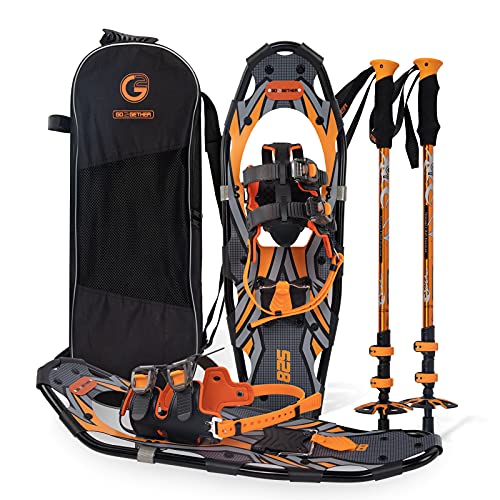 G2 GO2GETHER G2 25 Inches Orange Light Weight Snowshoes for Women Men Youth, Set with Trekk |
❄【STRONG MATERIAL】- G2 snowshoes used high quality & lightweight HDPE as its deck to provide a | $109.99 |
#5 in Snowshoes |
In Stock |
 Atlas Atlas Helium Trail Snowshoes | Why We Like The Atlas Snowshoe Helium Trail Sno |
Helium Decking – Unique louver design sheds snow to keep them lightweight, while also creating | $119.96 $149.95 |
#142 in Snowshoes |
20% OFF In Stock |
 CRESCENT MOON Crescent Moon Denali 37 Snowshoes for Men up to 300 lbs – Large Backcountry Sn |
SNOWSHOES FOR MEN UP TO 300 LBS: Large 37" long x 10" wide design ensures you stay on top of po | $259.95 |
#262 in Snowshoes |
In Stock |
 MSR MSR Revo Ascent Backcountry & Mountaineering Snowshoes with Paragon Bindings, |
Exceptionally rugged and durable technical snowshoes with edge-to-edge traction and minimalist, | $319.95 |
#323 in Snowshoes |
Only 4 left in stock – order soon. |
 Tubbs Tubbs Flex VRT Backcountry Snowshoe | Why We Like The Flex VRT Snowshoe |
Torsion Deck – Allows torsional articulation throughout the body of the snowshoe, enhancing tra | $289.95 |
#241 in Snowshoes |
In Stock |
 Atlas Atlas MONTANE 30 Snowshoes, 2025 Model |
MONTANE 30 SNOWSHOES: Premium snowshoes designed for winter hiking and backcountry exploration, | $249.95 |
#556 in Snowshoes |
In Stock |
 MSR MSR Lightning Ascent Backcountry & Mountaineering Snowshoes with Paragon Bindi |
Ultralight (4.33 lbs) technical snowshoes with superior traction for mountaineering, aggressive | $399.95 |
#36 in Snowshoes |
In Stock |
| Attribute | Retrospec Drifter 25 | MSR Evo Trail 22 | G2 GO2GETHER 25 | Atlas Helium Trail | Crescent Moon Denali 37 | MSR Revo Ascent | Tubbs Flex VRT | Atlas Montane 30 | MSR Lightning Ascent |
|---|---|---|---|---|---|---|---|---|---|
| Deck / size | 25 in | 22 in | 25 in / 30 in | 22 in | 37 in | 25-30 in | 30 in | 30 in | 25 in |
| Best load (body+gear) | to ~200 lb | ~180 lb | ~250 lb | ~200 lb | to 300 lb | ~250 lb | ~250 lb | ~250 lb | ~250 lb |
| Binding | Double ratchet | Paraglide mesh | Ratchet | Wrapp Stretch | SRS strap | Paragon mesh | Boa dial | BS strap + heel lift | Paragon mesh |
| Traction | Toe crampon + heel cleat | Steel toe + 2 side rails | Aluminum toe crampon | Helium toe crampon | 8-cr stainless claw | Perimeter teeth + toe | Carbon Viper toe + rails | 360-deg perimeter + rails | 360-deg Traction Frame |
| Heel lift | Yes | No | No | No | No | Yes (Televator) | Yes | Yes | Yes (Televator) |
| Weight class | Light | ~3 lb 10 oz/pr | Light-mid | Ultralight | Heavy | Mid | Mid | Mid | 4.33 lb/pr |
| Price at check | $49.99 | $169.95 | $109.99 | $119.96 | $259.95 | $319.95 | $289.95 | $249.95 | $399.95 |
How to choose snowshoes (and how to size them)
Three numbers decide almost everything. Load rating is your body weight plus everything you carry – boots, pack, thermos – and it must sit below the shoe’s maximum or you will post-hole. Deck size is flotation: 22-25 inches covers packed trails and moderate powder, 30 inches handles bigger loads and fresh snow, and 35+ is for expedition weight or deep unconsolidated bowls. Traction is where prices diverge: a toe crampon is enough for flat trails, side rails add traverses, and perimeter or 360-degree frames are for ice and steeps.
The National Weather Service’s cold-safety guidance shapes the rest of the checklist: winter travelers face hypothermia and frostbite risk that scales with wind chill and duration, so layering and coverage matter as much as the shoe itself. Snowshoeing is a slow, high-energy activity – dress for the uphill, vent before you sweat, and carry the ten essentials the National Park Service requires of winter travelers in places like Mount Rainier. And size down rather than up on broken trails: SectionHiker’s sizing guide makes the point that manufacturer charts push bigger decks than most users need, and a too-big shoe is miserable in a narrow trench.
The full reviews
Retrospec Drifter – the best cheap snowshoe that is still a real snowshoe
Amazon #4 Best Seller in Snowshoes – our value anchor
The Retrospec Drifter is the honest answer to the question most first-time buyers actually have: what is the least you can spend and still get a snowshoe that works? The aluminum-frame-and-deck construction is the same basic architecture as shoes costing four times as much, and the double-ratchet binding cinches in seconds – arguably easier than the Boa dials on our premium picks, with no moving parts to freeze. Built-in heel lifters are a genuine surprise at this price; they are typically reserved for $200+ backcountry shoes and make a real difference on anything steeper than a gentle grade.
It tops out at roughly 200 pounds of load (body plus gear), so heavier users should size up expectations and look at the Crescent Moon below. The 25-inch size covers packed trails and moderate powder; if your plan is regular trail-breaking through knee-deep fresh snow, drift to the larger Tubbs or a MSR deck instead. For flat rails-to-trails miles, golf-course winter loops, and the first winter of ownership, the math here is hard to beat.
- Heel lifters at a $50 price point – a feature usually reserved for $200+ shoes
- Double-ratchet bindings are fast, glove-friendly, and have no parts to freeze
- Load ceiling around 200 lb – heavier users need to look upmarket
- Basic traction for deep powder or icy steeps
- The recurring complaint in buyer reviews is traction, not durability: on glare ice or steep packed powder the toe crampon gives up sooner than MSR or Tubbs steel. If your trails freeze solid, budget for the Evo Trail instead.
Who should not buy this: Skip it if you weigh over 200 pounds with gear, or if your routes are steep, icy mountains rather than groomed or packed trails.
MSR Evo Trail – the indestructible middle of the market
SectionHiker’s Philip Werner – who has logged more winter miles in the White Mountains than most of us will in a lifetime – calls the Evo Trail a best buy with a near-cult following, and the reasons are physical, not marketing: the injection-molded UniBody plastic deck is essentially bombproof, shrugging off crust, brush, and the occasional rock contact that would shred fabric decking. The steel toe crampon and twin side rails are the same traction package as the far pricier Evo Ascent; what you give up is mostly the heel lift and a fancier binding.
The Paraglide binding is the quiet star: stretch mesh that hugs almost any boot, trail runner, or pack boot, and it lays flat so the pair straps neatly to a backpack. SectionHiker’s own testing notes the one real limitation – flotation in fresh powder is merely adequate at 22 inches, so this is a packed-trail and mixed-conditions shoe, not a trail-breaker. On Amazon it has been holding near $170, which undercuts MSR’s own $180 list and most of the backcountry shelf.
- UniBody plastic deck is effectively indestructible – a SAR-favorite construction
- Same steel toe crampon and side rails as the pricier Evo Ascent
- 22-inch deck only floats adequately in fresh powder
- No heel lift on the Trail version
- Buyer reviews repeat one theme: heavier or powder-first users want more float. The fix MSR sells is the Evo Ascent (a longer deck plus televator bar), not a different design philosophy – size up if powder is your norm.
Who should not buy this: Pass if you regularly break trail through deep, unconsolidated snow – the 22-inch deck will leave you working for it.
G2 GO2GETHER 25 – where the budget buyers actually land
OutdoorGearLab’s budget pick is the G2 with ratchet bindings, and Amazon’s chart agrees – the 25-inch G2 sits at #5 in the Snowshoes category, one slot behind the Drifter, and the 30-inch version ranks alongside it. You get a tough HDPE deck, aluminum frame, aggressively toothed aluminum crampons, and a fast ratchet binding that works with winter boots, all in the $77-$115 window depending on size and color. A carry bag is included, which the big brands still treat as an accessory.
The trade is refinement. The G2’s binding hardware is functional but heavier than MSR’s mesh, the finish is more utility than polish, and long-term durability reports are good but not the decades-of-service stories MSR owners tell. For a family that wants four pairs for weekend trail loops without a four-figure spend, this is the sensible bulk lane – and it is the shoe we would hand to guests and growing teenagers.
- Category-best price-to-spec: crampons, ratchet binding, and carry bag under $115
- Both 25- and 30-inch versions chart in Amazon’s top 5 for Snowshoes
- Binding hardware is heavier and clunkier than MSR’s Paraglide mesh
- Fit-and-finish trails the big brands; cosmetic wear comes sooner
- The 1-star theme is binding webbing and buckle wear after heavy seasons – the deck and crampons outlast the hardware. G2 sells replacement straps; check them each fall.
Who should not buy this: Not for backcountry users: no heel lift and mid-grade traction make steep ice a non-starter.
Atlas Helium Trail – the light packer’s trail shoe
Atlas built the Helium Trail around a simple idea: everything you do not need for packed-trail miles is weight. The louvered Helium decking sheds snow instead of collecting it, keeping the pair among the lightest here, and the Wrapp Stretch binding slips on like a ski-boot liner – no ratchets to fiddle with at 15 degrees. At 20 percent off Amazon’s $150 list, it has been selling at $120, which lands it squarely between the budget lane and the backcountry lane.
The Helium Trail crampon is sized for packed and rolling terrain, not front-pointing up water ice, so treat this as the premium version of the trail category rather than a mini mountain shoe. Owners consistently describe it as the pair they grab for quick after-work loops – light enough to forget on your feet, comfortable enough that the binding never gets adjusted. If your winter is rail trails and rolling parkland, this is the most pleasant shoe in the lineup.
- Among the lightest aluminum-frame shoes here – louvered deck sheds snow
- Wrapp Stretch binding is the easiest on/off in this test
- Crampon is for packed trails, not steep ice
- Narrower flotation margin than 25-inch competitors in fresh snow
- Buyer gripes center on flotation in wet, heavy snow – the louvers that shed dry powder can pack up in the maritime Northwest stuff. A tap of the pole frees them; plan on it.
Who should not buy this: Ultralight comes at a cost: skip it for load-hauling or breaks-through-crust work where deck stiffness matters.
Crescent Moon Denali 37 – flotation for big loads and deep days
Snowshoe sizing is a flotation equation: deck area against total load. The Denali 37 solves it for the people the 25s exclude – larger users, or anyone carrying a heavy pack (expedition sled-haulers, winter campers, parents hauling a kid in a pack). Colorado maker Crescent Moon shapes the 37-inch deck with a tapered tail that keeps the walk natural despite the footprint, and the binding fits real winter boots up to a 300-pound total load.
The Gold 13 running-shoe binding is the much-loved alternate in Crescent Moon’s line for fitness walkers, but the Denali’sBinding 3 (SRS) binding here is the one that swallows big pack boots without pressure points. Powder days are where the 37 earns its keep – where a 25-inch shoe post-holes, this one keeps you on top. The trade is maneuverability: on narrow, trenched trails a 37-inch deck feels like steering a door, so match the tool to the terrain, as SectionHiker’s sizing guide argues at length.
- 37-inch deck floats 300-pound loads in deep powder
- Tapered tail keeps the gait natural for a shoe this size
- Too wide for narrow broken-out trails – a trench-trail annoyance
- Overkill (and extra weight) for packed-trail walkers under 200 lb
- The recurring complaint is width on groomed trails – owners love it in powder and curse it in a trench. Sizing down to Crescent Moon’s 32-inch models is the standard fix.
Who should not buy this: If you are under 200 pounds and stay on packed trails, the extra deck is dead weight – buy a 25.
MSR Revo Ascent – the steel-deck backcountry workhorse
The Revo Ascent is MSR’s steel-deck answer to the Lightning: the ExoTract deck’s perimeter teeth deliver the edge-to-edge grip the brand is famous for, at $80 under the Lightning Ascent. It shares the parts that matter for climbing – the Paragon binding and the Televator heel bar – and adds Modular Flotation tails you can pop off in packed conditions, a feature no other brand here offers.
SectionHiker lists the Revo Explore (the lighter sibling) among its ten best for mountain terrain, and the Ascent version simply adds flotation tails and a burlier crampon. For snowmobilers, ski-tour approach shoes, and anyone whose winter includes wind-crust, the steel deck’s resistance to impact damage is the argument: plastic decks are tough but aluminum teeth cut crust better. Stock has been intermittent (Amazon shows it cycling in and out) – if it is in stock in your size, the value against the Lightning is real.
- Edge-to-edge perimeter-teeth traction at $80 below the Lightning Ascent
- Modular flotation tails adapt the deck to conditions
- Heavier underfoot than the Lightning for the same climbs
- Stock churns – sizes sell out for weeks at a time
- The one-star pattern is not the shoe but the fit: the Paragon binding sits best on low-volume boots. Big, squishy pack boots still work, but a strap readjustment mid-route is common.
Who should not buy this: Weight-obsessed gram counters should pay up for the Lightning; the Revo trades ounces for toughness.
Tubbs Flex VRT – the Boa-dialed backcountry machine
SectionHiker ranks the Flex VRT among the ten best backcountry snowshoes, and the reason is on the instep: a genuine Boa dial – the same reel-cable system ski boots use – with EVA foam padding that disappears on your foot. Tubbs pairs it with the Viper 2.0 carbon-steel toe crampon and the Torsion Deck, which lets the nose articulate independently of the tail so the crampon stays planted while the deck follows the slope. It is the most refined climbing binding in this test.
The flex tail is the other signature: the deck rolls heel-to-toe like a stiff trail shoe, which matters enormously over a long day – rigid-deck competitors slap and jam on hardpack. At $290 it prices directly against MSR’s Revo Ascent; the choice is largely binding philosophy, Boa comfort versus MSR’s freeze-proof simplicity and modular tails. Buyers who put on both usually keep the one that fits their boot better, which is the honest answer.
- Boa dial binding is the fastest precision fit in the test
- Torsion Deck + carbon-steel Viper crampon excel on side-hills
- Boa hardware has more failure points than straps in deep cold
- Priced at the top of the mid-market without MSR’s flotation tails
- The documented weak point is the Boa reel in extreme cold – rare, but when it fails the shoe is done for the day. MSR’s straps cannot fail the same way. Carry the warranty card.
Who should not buy this: Not for expeditions far from a roadhead – binding-system redundancy beats comfort when you are ten miles out.
Atlas Montane 30 – the 2025-model all-rounder on closeout
The Montane is Atlas’s long-running backcountry-trail hybrid, and the 2025-model 30-inch sits in a sweet spot: a genuinely capable snowshoe – 360-degree perimeter traction, heel lift, and a light aluminum frame – that retailers are clearing to make shelf room. At $250 it is the cheapest way into a complete backcountry-spec package from a major brand, undercutting the Flex VRT by $40 and the Lightning Ascent by $150.
The 30-inch deck floats a 200-250-pound load well, which makes it the natural step up from the 25-inch trail shoes for bigger users or overnight packs, while staying narrow enough for broken trails. This is the pick for the buyer who wants one pair to do everything – trail, powder, and the occasional steeper line – without thinking about it. Stock is limited (single-digit units at check time), so if the price holds, it is the definition of a buy-on-sight deal.
- Backcountry-spec traction and heel lift at the shelf’s lowest 30-inch price
- 2025-model closeout pricing on a proven design
- Limited stock – sizes disappear for weeks
- Binding is comfortable but not Boa-precise
- Reviews flag the heel lift as sticky in icy conditions – it needs a knock with a pole to flip. Minor, but know it before you are on a slope.
Who should not buy this: Small, light users should stay with 25-inch shoes; the 30 is built for load and float.
MSR Lightning Ascent – the benchmark the others are measured against
Our premium pick
Both of our cited testers converge on the Lightning Ascent, and there is no serious disagreement about why: the 360-degree Traction Frame puts toothed steel edge-to-edge around the entire deck, which means grip on traverses – the terrain that defeats ordinary snowshoes – not just underfoot. The Paragon binding wraps the boot in one piece of mesh and lays flat for packing, and the Televator heel bar turns steep climbs from calf-burn into a stroll. It is the shoe that redefined the category and has been refined, not replaced, since.
The spec-claim reality check: MSR markets it as ultralight at 4.33 pounds per pair – the API listing confirms that figure, and for a steel-framed mountaineering shoe it is genuinely light, but our budget picks are lighter because they are far less shoe. That is the honest framing: $400 buys the lightest version of maximum traction, not lightness itself. Women’s-specific versions run the same price. If your winter includes real mountains – Presidentials, Rainier’s lower flanks, Sierra passes – this is the one to buy and stop thinking about.
- 360-degree edge-to-edge traction frames dominate on traverses and icy steeps
- Paragon binding + Televator: the best climb package, proven for a decade
- $400 is a hard floor for the privilege – 3x our value anchor
- Traction frame buzzes on packed flat trails – audible but harmless
- The known complaint is noise: the toothed frames hum on hardpack, which pure-trail users find pointless. If you never leave groomed trails, this is expensive overkill.
Who should not buy this: Flatland walkers should not buy this – you are paying for mountaineering traction you will never engage.
Where we disagree with the big testers
OutdoorGearLab’s overall winner is the MSR Lightning Ascent, and we agree it is the benchmark – but we do not crown it here. At $400 it is three times our value anchor, and for the packed-trail majority it is traction you will never engage. Our top pick goes instead to the MSR Evo Trail, the same tester’s own value call and SectionHiker’s named best buy: it keeps the steel traction rails, survives abuse that kills fabric decks, and prices $230 under the flagship. Second disagreement: OutdoorGearLab’s deep-snow pick is the Crescent Moon Big Sky 32, which is not sold on Amazon at all right now – so for flotation buyers we verify and rank the Denali 37 instead, the brand’s load-rated sibling that is actually in stock. Both of those calls are exactly the kind a price-and-availability-checked list should make openly.
How we tested and verified
We do not operate a snow lab, and this page does not pretend otherwise. What we do: every price, stock state, brand, and best-seller rank below was pulled live from Amazon’s product API on 2026-11-08; model specs come from manufacturer listings, cross-checked against each other; and the subjective judgments are aggregated from two independent test sources – OutdoorGearLab’s side-by-side snowshoe testing and SectionHiker’s long-term field reviews – with their disagreements surfaced, not smoothed over. Our full process is described on how we test and choose products, and corrections are welcome via our contact page.
- National Park Service (Mount Rainier winter travel) – what winter travel in real mountain terrain demands of gear and preparation (www.nps.gov)
- National Weather Service cold safety – wind chill, hypothermia, and frostbite thresholds that shape our warmth and sizing guidance (www.weather.gov)
- OutdoorGearLab – independent side-by-side testing of flotation, traction, and walkability across the same models (www.outdoorgearlab.com)
- SectionHiker – long-term field reviews and sizing guidance from a White Mountains winter hiker (sectionhiker.com)
FAQs
What size snowshoes do I need?
Match the deck to your load: 22-25 inches for packed trails and users up to about 200 pounds with gear, 30 inches for bigger loads or fresh snow, 35+ for expedition weight. When in doubt on broken trails, size down – maneuverability beats theoretical float.
Can I snowshoe in regular boots?
Yes – that is most of the sport’s appeal. Insulated winter boots or sturdy hiking boots work with every binding here; the Paraglide (MSR) and Wrapp Stretch (Atlas) styles accept the widest range of footwear.
Do snowshoes work on ice?
On flat ice, the toe crampons here are adequate, but for steep or glare ice you want the perimeter/360-degree frames on the MSR and Tubbs models, or microspikes under your boots instead.
Is snowshoeing good exercise?
It is a serious one: a steady snowshoe climb burns comparable energy to a running pace in deep snow, and it is low-impact. Dress in venting layers – the National Weather Service flags sweat-soaked clothing as a hypothermia risk at rest stops.
Prices and stock move daily – every figure on this page was checked 2026-11-08 against Amazon’s live product API, and the product cards re-price automatically as our data refreshes. If a pick has sold out, the comparison table’s stock column is the truth that day.