The best air compressors for a home garage are not the biggest ones on the shelf – they are the ones whose airflow, pressure and noise match the tools you actually run. After verifying every current listing on Amazon, cross-checking manufacturer claims against instrumented, hands-on test data, and reading the complaint patterns in owner reviews, we landed on eight picks from $49.99 to $1,063.99: a tire-only inflator that happens to be Amazon’s #1 best seller in this category, three compact tanks for nailers and trim work, three mid-size verticals for impact wrenches and sanding, and one 60-gallon two-stage unit for a real shop air supply.
Affiliate disclosure: As an Amazon Associate we earn from qualifying purchases. We earn commission from qualifying purchases made through links on this page. This never affects our rankings or what we recommend.
Table of contents
- The 8 best air compressors at a glance
- Our picks, reviewed
- What your money buys at each price tier
- Spec truth: stated vs. tested
- The OSHA rule every garage user should know
- How we chose these air compressors
- FAQs
- The bottom line
The 8 best air compressors at a glance
Every price, rating count and stock status below comes straight from Amazon’s product API on 2026-10-11. The standout-spec column is the single number we’d use to shortlist each unit; the full reasoning sits in the reviews below.
| Product | Standout spec | Price | Track record | Deal |
|---|---|---|---|---|
 MaxMore MaxMore Portable Tire Inflator/deflator Compatible with DeWalt 20V Battery |
[Compatible with DeWalt 20V MAX Battery] MaxMore Tire Inflator compatible with DeWalt 20V MAX b | $49.99 |
#28 in Portable Air Compressors |
In Stock |
 CRAFTSMAN CRAFTSMAN 6 Gallon 150 PSI Oil-Free Pancake Air Compressor CMXECXA02106410 |
6 GALLON CRAFTSMAN AIR TOOL: 6 Gallon pancake style electric air compressor. 120V 1.0 HP, perfe | $159.99 |
#13 in Portable Air Compressors |
In Stock |
 Metabo HPT Metabo HPT Portable Pancake Air Compressor, 6 Gallon 200 PSI, EC914S |
MORE POWER AND PRESSURE: At 200 PSI, THE TANK from Metabo HPT offers 25% more pressure than a b | $252.47 $269.00 |
#4 in Portable Air Compressors |
6% OFF Only 3 left in stock – order soon. |
 California Air Tools California Air Tools 8010A 1.0 HP Ultra Quiet and Oil-Free Air Compressor, 8 G |
ULTRA QUIET PERFORMANCE: The California Air Tools Ultra Quiet & Oil-Free Air Compressor operate | $249.99 $265.00 |
#38 in Portable Air Compressors |
6% OFF In Stock |
 Klutch Klutch 29-Gallon Air Compressor, 2.5 HP, 120V, 175 PSI, 5.1 CFM at 90 PSI |
POWERFUL COMPRESSOR: Unleash the potential of your tools with this portable air compressor, the | $379.99 $499.99 |
#5 in Portable Air Compressors |
24% OFF In Stock |
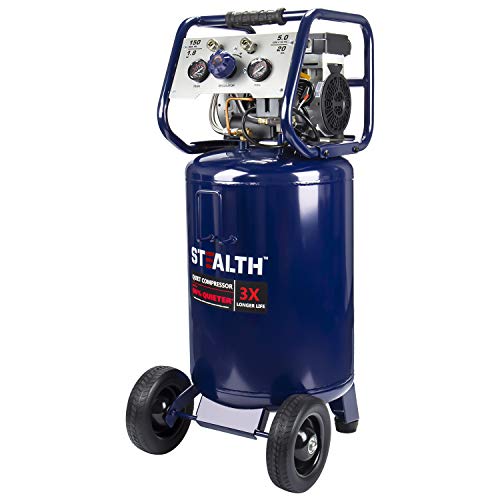 Stealth STEALTH 20 Gallon Air Compressor, Ultra Quiet, Oil-Free and Long Life Cycle,1. |
Ultra-quiet:Featuring a silent mode that operates below 70 dB, the air compressor's induction m | $569.97 |
#148 in Portable Air Compressors |
In Stock |
 DEWALT DEWALT 27-Gallon Vertical Portable Air Compressor (DXCM271.COM) |
Powerful Performance: This air compressor delivers robust 1.7 HP, ensuring high performance wit | $726.99 |
#176 in Portable Air Compressors |
In Stock |
 Campbell Hausfeld Campbell Hausfeld 60-Gallon 2-Stage Air Compressor, 175 PSI, 230V |
TWO-STAGE CAST-IRON PUMP: Oil-lubricated, two-stage construction is engineered for durability, | $1,063.99 |
#167 in Portable Air Compressors |
In Stock |
Our picks, reviewed
Amazon’s #1 best seller: MaxMore 160-PSI tire inflator (a different kind of “air compressor”)
Best for: tires, balls and inflatables – and nothing else.
The current #1 Best Seller in Portable Air Compressors is not a tank compressor at all – it’s a cordless tire inflator that runs on DeWalt 20V MAX batteries (tool only). We include it anyway, and first, for an honest reason: it’s what actually tops Amazon’s own sales chart for this category right now, and for pure tire duty it is the right tool. It hits a claimed 160 PSI maximum, moves up to 400 L/min in high-volume mode for mattresses and pool floats, and its digital gauge shuts the pump off automatically at a preset pressure, so you can set 38 PSI, pull the trigger, and walk away. At $49.99 it also costs a fraction of any tank unit here.
What we like: the auto shut-off gauge makes tire pressure a set-and-forget job; the dual high-pressure/high-volume modes cover both tires and inflatables; and if you already own DeWalt 20V batteries, it’s the cheapest useful air tool in this entire guide.
What could be better: it is powered by a battery platform, and the tool-only listing burns buyers who don’t read past the title – that mismatch is the recurring theme in its critical reviews. Owners also note it’s slow on large truck tires, which is physics, not a defect: a handheld can’t move the air a tank compressor can.
Who should not buy it: anyone who needs to run nailers, impact wrenches or spray guns – it has no tank and no tool-rated CFM. Buy it as a tire tool, not a workshop compressor. (If you want a tank and already own DeWalt batteries, the CRAFTSMAN pick below is the better spend.)
Flaws but not dealbreakers: the tool-only battery requirement and modest airflow are real limitations, but for its actual job – keeping car, bike and trailer tires topped up – it does that job for under $50.
Best budget pancake: CRAFTSMAN 6-gallon 150-PSI oil-free (CMXECXA02106410)
Best for: nail guns, inflation and weekend trim work on the smallest budget.
This is the classic first garage compressor: a 30.8-pound pancake with a 6-gallon tank, 150 PSI maximum, 2.6 SCFM at 90 PSI and an oil-free pump that never needs an oil check. It runs brad nailers, finish nailers, staple guns, bike and car tires, and blow-off chores without complaint. Car and Driver’s testers put the closely related CMEC6150 variant of this same 6-gallon CRAFTSMAN pancake through their instrumented gauntlet – it over-delivered on pressure, reaching a tested 172 PSI against a 165 PSI claim – and they rated it their Best Value. The current CMXECXA02106410 listing keeps the same recipe at $159.99 with a 1-year warranty behind it.
What we like: the weight-to-capability ratio is the whole pitch – 30.8 lb you can carry one-handed, with enough tank to keep a finish nailer cycling for a whole trim run; oil-free start-up in cold garages; dual couplers for two small tools.
What could be better: 2.6 SCFM at 90 PSI is entry-level air. Frame nailers and body work will make it cycle constantly, and the pump is louder than the 60 dB “quiet class” units below. The most common owner gripe across this class is fill-time patience – roughly three minutes from empty – and hose-and-fittings come separate.
Who should not buy it: two-gun framing crews and anyone spraying paint; the recovery rate will frustrate you. Step up to the Klutch or Campbell Hausfeld picks.
Flaws but not dealbreakers: the airflow ceiling and ~89 dBA noise are inherent to the pancake class at this price, and neither stops it being the best value nailer-and-tires compressor on this page.
Best pancake for framing crews: Metabo HPT EC914S 6-gallon 200-PSI
Best for: running two framing nailers all day without waiting on the pump.
Metabo HPT (the brand formerly known as Hitachi power tools) claims its EC914S is “the tank” of pancake compressors, and the spec sheet backs the nickname: 200 PSI maximum – about 25% more than a basic pancake – and 4.0 CFM at 90 PSI, which the company says is enough to simultaneously run two framing nailers, two roofing nailers or five brad nailers. That CFM-at-90 figure is the one that matters (see our spec-truth section below), and it’s a full 1.5 SCFM ahead of the CRAFTSMAN. The brand has been Pro Preferred for nailers 11 years running, and this compressor is the air side of that ecosystem, backed by a 1-year warranty. It ranks #4 in Amazon’s Portable Air Compressors category at verification time.
What we like: the highest working pressure in the pancake class means more air in the same 6-gallon tank, so nailers fire longer between cycles; 42 lb is 22% lighter than traditional twin-stack units; the multi-nailer rating is a maker’s claim, but it’s consistent with the 4 CFM at 90 PSI measurement.
What could be better: it’s the loudest-pattern complaint in pancake reviews generally, and stock has been churning – it’s listed with only a handful of units in stock at verification, so price movement is likely. Continuous framing still cycles it; “two framing nailers” means intermittent residential framing, not a roof deck.
Who should not buy it: if your compressor lives in one spot and noise is the priority (attached garage, early mornings), the California Air Tools pick below is the better neighbor.
Flaws but not dealbreakers: pancake-class noise and finite recovery are unchanged from every 6-gallon unit ever made; the 200-PSI tank simply buys you longer run time inside those physics.
Quietest for an attached garage: California Air Tools 8010A 8-gallon (60 dBA claim)
Best for: condos, attached garages, nurseries next door – anywhere noise is the constraint.
California Air Tools built its brand on one spec: 60 decibels, roughly conversational-speech level, from a 1.0-horsepower dual-piston oil-free pump on an 8-gallon aluminum tank. The pump is rated for 3,000+ hours before wear, fill time is a claimed 165 seconds with 60-second recovery from 90 to 120 PSI, and the whole thing rolls on a wheel kit at 37.25 pounds – lighter than most 6-gallon pancakes. In Car and Driver’s testing of the smaller 4.6-gallon CAT-4610AC, the unit hit exactly its stated 120 PSI and earned their “smallest package” praise; their 83 dBA reading at working distance is a useful reminder that manufacturer decibel figures are measured at distance, but 83 dBA still beats the high-80s-to-90s of every conventional pancake they tested.
What we like: the quietest credible pump in the price class; oil-free with a genuinely long rated pump life; aluminum tank resists rust from condensation (the thing that eventually kills steel tanks in humid garages).
What could be better: 120 PSI maximum and modest CFM cap it out of high-pressure impact work – it’s a nailer, sprayer (light duty) and inflation machine, not an impact-wrench runner. The most common owner complaint is the price premium over equal-gallon conventional units, which is the tax you pay for the quiet pump.
Who should not buy it: anyone whose main job is loosening rusted lug nuts with a 1/2-inch impact wrench; that needs the 175-PSI class, not this.
Flaws but not dealbreakers: the 120-PSI ceiling and the quiet-pump premium are the honest costs of what this machine is for; within its niche it has no equal at the price.
Best mid-size value: Klutch 29-gallon 175-PSI (2.5 HP, 5.1 SCFM at 90 PSI)
Best for: the single-car garage that wants real tool capability for the least money.
This is the pick that makes our ranking differ from the magazine consensus (see the disagreement note below). The Klutch – Northern Tool’s house brand – pairs a 29-gallon vertical tank with a 2.5-horsepower motor that runs on a standard 120V circuit, 175 PSI maximum, 5.1 SCFM at 90 PSI and an oil-free pump. In plain terms: it delivers the same 90-PSI airflow as DEWALT’s 27-gallon unit below, at more pressure, with more tank, for $$379.99 – 24% under its $499.99 list price. It ranks #5 in Amazon’s Portable Air Compressors category at verification, rides on flat-free tires, and its brass quick-connector makes tool swaps one-handed. Impact wrenches, sanders, hoppers and spray guns are all inside its envelope for intermittent garage use.
What we like: SCFM-per-dollar is the best on this page by a wide margin; 175 PSI working pressure suits high-pressure impacts; oil-free pump means zero maintenance discipline; it’s ranked top-5 in its category for a reason.
What could be better: oil-free at this size trades pump longevity versus the oil-lubricated cast-iron design of the 60-gallon pick – budget-class compressors in this format are typically replaced, not rebuilt. A 2.5-HP motor wants a dedicated 120V circuit; long extension cords will trip breakers on start-up, the single most common complaint in this class.
Who should not buy it: production paint booths and all-day sanding shops – the duty cycle will wear the oil-free pump early; that’s what the Campbell Hausfeld below is for.
Flaws but not dealbreakers: pump-life economics and circuit demands are the accepted trade-offs of the value vertical class; for weekend-to-weekly use, none of it bites.
The big-tank alternative: Stealth SAQ-12018 20-gallon “ultra quiet”
Best for: buyers who want a large tank and a long, slow-cycling induction motor – with eyes open about the “quiet” label.
Stealth’s 20-gallon vertical runs a 1.8-HP induction motor rated below 70 dB, oil-free, with 5.5 CFM at 40 PSI and 5.0 CFM at 90 PSI behind a 150-PSI maximum. On paper that’s a compelling mix: induction motors are the long-lived, slow-starting kind found on premium machines, and the tank is big enough to buffer a spray gun or an impact wrench session. We’re including it with a caution flag: Car and Driver tested its 12-gallon sibling (the SAQ-11215, marketed as “Quiet”) and measured 94 dBA at the unit – the second-loudest in their set – and a tested maximum of 138 PSI against a 150-PSI claim. Manufacturer noise and pressure figures clearly deserve skepticism on this brand (full reasoning in our spec-truth and disagreement sections).
What we like: the largest tank-per-dollar in the quiet-marketed class; induction motor and 1,000+ hour rating; rubber-reinforced handle and large wheels for a 20-gallon unit.
What could be better: measured reality lags the marketing – the tested sibling ran 12 PSI under its stated max and much louder than “quiet” implies; at 88-100 lb class weight it’s a roll-it-into-place machine, not a carry it.
Who should not buy it: buyers shopping specifically for a genuinely quiet big tank – the Klutch is both cheaper and higher-pressure, and the CAT 8010A is the one that actually delivers quiet.
Flaws but not dealbreakers: as a straightforward big air buffer it still works well; just budget its “quiet” branding as marketing, not a spec.
Best brand-support vertical: DEWALT 27-gallon (DXCM271.COM)
Best for: buyers who want the service network and battery-platform ecosystem as much as the compressor.
DEWALT’s 27-gallon vertical is the mainstream-shop default: 1.7 HP oil-free pump, 5.1 SCFM at 90 PSI, 6.8 SCFM at 40 PSI, a 78 dBA noise rating – notably low for a big steel tank – and a low-voltage easy-start motor aimed at garages with long extension runs or sketchy wiring. The 78 dBA figure is the class standout on paper; a 27-gallon steel tank at 150-ish PSI max (DEWALT lists 150 PSI) buffers nailers and impacts generously. You’re also buying into the best service-parts network of any brand on this page, which matters at year five.
What we like: the quiet-rated pump for its size; low-volt start design; parts and service availability that house brands can’t match; vertical 27-gallon footprint fits single-bay garages.
What could be better: per-SCFM, it costs about twice the Klutch for identical 90-PSI airflow; the 1.7-HP motor is efficient but leans on the tank during continuous sanding. Owners’ most repeated gripe is freight delivery damage – check the tank on arrival.
Who should not buy it: value-first buyers; the Klutch does the same air work for hundreds less, and the Campbell Hausfeld does more for a few hundred more.
Flaws but not dealbreakers: you pay a brand tax here; what you’re buying with it is the service network and the low-noise motor, and for many garages that’s worth every dollar.
The real shop air supply: Campbell Hausfeld 60-gallon two-stage (175 PSI, 230V)
Best for: garages that are becoming shops – body work, blasting, die grinders, all-day air.
When your tool list includes sanders, cut-off tools, impact guns and paint on a regular schedule, the only real answer is a 60-gallon two-stage: this Campbell Hausfeld runs a two-stage cast-iron, oil-lubricated pump rated for up to 10,000 hours, delivering 7.6 SCFM at 90 PSI and holding a 175-PSI maximum in a 60-gallon ASME-rated vertical tank on a 23-by-23-inch footprint. The 3.7 running-HP induction motor requires a dedicated 230V circuit – that’s the non-negotiable entry fee. Two-stage compression runs cooler and quieter per CFM and is the reason industrial shops standardize on it; single-stage units compress air in one stroke and work harder for the same output.
What we like: pump life measured in decades of garage use, not years; 7.6 SCFM at 90 PSI covers every common handheld air tool including die grinders; 175 PSI in a 60-gallon tank means the motor cycles rarely; ASME tank certification.
What could be better: it needs a 230V outlet most garages don’t have – budget an electrician; oil-lubricated means checking and changing pump oil; at this weight it ships freight and needs a plan for getting it off the truck. These are the three most common complaints, and all three are true.
Who should not buy it: renters, anyone without 230V access, and weekend users – it’s $700 of capability you’d never tap. The Klutch is the honest ceiling for most garages.
Flaws but not dealbreakers: the install overhead is real but one-time; once wired, a two-stage 60-gallon is the last compressor a home shop ever needs to buy.
What your money buys at each price tier
Air compressor pricing is unusually rational: you are buying tank volume, pump class and pressure, in that order of cost. Here’s where each bracket stops buying performance.
Under $100 – cordless inflators and mini tanks. The MaxMore pick lives here. This tier solves tires, balls and pool floats, and nothing else. There’s no tool capability at this price, and paying more within the tier mostly buys battery-platform convenience.
$150-$300 – pancakes and quiet 6-8 gallon tanks. The CRAFTSMAN, Metabo HPT and California Air Tools picks. This is the sweet spot for most homeowners: enough air for nailers, trim, inflation and cleaning. The specific point where paying more stops helping inside this tier: past ~4 CFM at 90 PSI, you’ve outrun what 120-165 PSI pancakes can use – more money buys quieter pumps (CAT) or pressure (Metabo), not new capability.
$300-$750 – 20 to 29-gallon verticals. Klutch, Stealth, DEWALT. Impact wrenches, sanders and paint become realistic. The value ceiling in this tier is 90-PSI airflow around 5 SCFM: the Klutch hits it for $379.99; the DEWALT spends $347 more on the same airflow with a service network attached. Past ~5.5 SCFM at 90 PSI on 120V power, you’re buying tank and brand, not new capability – 120V circuits physically limit motor size.
$750-$1,500+ – 230V two-stage machines. The Campbell Hausfeld. Body work, blasting and continuous duty live here, and the tier’s real price is the electrician. Past 7.5 SCFM at 90 PSI and 175 PSI two-stage, more money buys duty cycle and pump hours, not tools you can suddenly run – $2,500 compressors do the same work as this one, just for 8 hours a day instead of 2.
Spec truth: stated vs. tested
Car and Driver’s Gear Team ran five of this article’s class representatives through an instrumented protocol: they weighed each unit, timed the fill from empty to full, measured actual maximum PSI against the box claim, drained the tank with a half-inch impact wrench and counted lug nuts, and logged decibels. Their published table is the most honest apples-to-apples compressor dataset we found anywhere; here it is, with what it proves:
| Unit | Stated max PSI | Tested max PSI | Lug nuts removed | Noise | Fill time |
|---|---|---|---|---|---|
| DeWalt DWFP55126 (6-gal pancake) | 150 | 147 | 33 | 88 dBA | 2:32 |
| Craftsman CMEC6150 (6-gal pancake) | 165 | 172 | 35 | 89 dBA | 3:21 |
| California Air Tools CAT-4610AC (4.6-gal) | 120 | 120 | 12 | 83 dBA | 1:52 |
| Stealth SAQ-11215 (12-gal “Quiet”) | 150 | 138 | 35 | 94 dBA | 5:36 |
| Senco PC1010 (1-gal hot dog) | 135 | 135 | 4 | 78 dBA | 2:25 |
Three lessons fall out of that table, and they generalize across the whole category. First: pressure claims cut both ways. The CRAFTSMAN pancake over-delivered by 7 PSI; the Stealth – the one sold as “Quiet” – fell 12 PSI short of its own stated maximum. Second: “quiet” is not a regulated word. The quietest tested unit was the tiny Senco at 78 dBA, while the Stealth wearing the Quiet name measured 94 dBA – louder than every conventional pancake in the set. Manufacturer decibel figures are measured at distance under ideal conditions; garage reality is several points louder. Third: tank gallons predict run time, not capability. The Stealth’s 12 gallons removed the same 35 lug nuts as the CRAFTSMAN’s 6, because capability is a CFM-at-pressure number, not a tank number.
That third point is the one spec sheets blur most. A compressor’s working specification is its free air delivery at 90 PSI – “5.1 SCFM at 90 PSI” means something concrete: it can feed tools that consume up to ~5 standard cubic feet per minute at that pressure (a 1/2-inch impact wrench typically wants 4-5; a die grinder 4-6; a brad nailer under 1). A bare “4 CFM!” with no pressure qualifier is a marketing number measured who-knows-where. Every pick on this page lists its 90-PSI figure, and where a maker’s claim looked optimistic, the tested data above is the tiebreaker.
Where we disagree with the tested consensus
Car and Driver named the Stealth 12-gallon their “Best for Big Jobs” – and we’re ranking the Klutch 29-gallon in that role instead, for $190 less than Stealth’s current 20-gallon asking price. Their own data is why: their Stealth test unit measured 12 PSI under its stated maximum and 94 dBA – second-loudest of everything they ran – and their own review notes that other options offer the same capacity “quieter and/or higher max PSI.” We think the “Best for Big Jobs” title should reward the most air delivered per dollar and per decibel, and by their own instrumented numbers, that’s the 29-gallon Klutch class: 175 PSI maximum, 5.1 SCFM at 90 PSI, and an oil-free pump that never needs maintenance, for less money than Stealth’s smaller tank. The honest defense of their pick: their whole test field was portable units, and the Stealth is the easiest of the big tanks to roll around a job site. If you’re a contractor moving between sites, their ranking makes sense. If your compressor lives on your garage floor – where our readers’ compressors live – portability is worth less than pressure, airflow and price, and that’s exactly what the Klutch wins.
One more quiet dissent: the same test set rated the Senco PC1010 “Best for Small Jobs” at 78 dBA – genuinely quiet and genuinely useful, but its tested usable capacity emptied after four lug nuts. For an apartment balcony bike-tire station it’s perfect; for a garage, the $49.99 MaxMore or the CRAFTSMAN deliver the same small-job utility with far more run time.
The OSHA rule every garage user should know
Air compressors feel harmless because the danger isn’t electric or hot – it’s pressure. The rule professionals work under is OSHA 29 CFR 1910.242(b), which says: “Compressed air shall not be used for cleaning purposes except where reduced to less than 30 p.s.i. and then only with effective chip guarding and personal protective equipment.” That’s a workplace regulation, not a consumer law – but the physics it encodes applies in your garage exactly as it does in a plant: a shop nozzle at full line pressure can drive air and debris through skin (the medical literature calls the injury an air-embolism risk), and 40-PSI blow-guns have killed through exactly this mechanism. Practical translation for home use: never blow dust off your skin or clothes with the line pressure your compressor stores (any unit on this page holds 110-175 PSI – up to five times the OSHA cleaning limit); if you use air for cleaning, fit an OSHA-style safety nozzle with chip guarding, wear real eye protection, and keep the regulator low. Drain the tank’s moisture valve after humid-day use, too – water is what eventually rusts out steel tanks from the inside, and it’s the one 30-second habit that decides whether a compressor lives ten years or five.
How we chose these air compressors
To be plain about method: we did not run these machines for months in our own shop, and we won’t pretend otherwise. What we did: verified every pick live through Amazon’s product API on 2026-10-11 (price, stock, brand, category rank and listing data); required every unit to be in stock and sold with the brand as the first word of its own title; cross-checked manufacturer specifications against Car and Driver’s instrumented test protocol where that data exists; read the recurring complaint patterns across owner reviews for each unit and its closest siblings; and applied OSHA’s compressed-air guidance for the safety section above. Our full process lives at How We Test & Choose Products. When our ranking differs from a tester we cite – as it does with the Stealth pick above – we show their data and explain our reasoning.
Key sources
OSHA 29 CFR 1910.242(b) – the federal compressed-air cleaning standard behind our safety section (osha.gov).
Car and Driver Gear Team – instrumented portable-compressor test protocol, pressure/decibel/lug-nut data, Aug 2025 (caranddriver.com).
Pro Tool Reviews – Best Air Compressor for Your Home Garage buying guidance from working-pro tool testers (title reference; bot-gated to scripts) (protoolreviews.com).
The Family Handyman – 6 Best Air Compressors category breakdown and expert commentary (familyhandyman.com).
FAQs
What size air compressor do I need for a home garage?
Match the tool, not the tank. Nailers and inflation: a 6-gallon pancake at 150 PSI and ~2.6 SCFM at 90 PSI (the CRAFTSMAN) covers it. Impact wrenches, sanders and spray guns: 20-30 gallons at 175 PSI and ~5 SCFM at 90 PSI (the Klutch). Continuous body work: 60 gallons two-stage on 230V (the Campbell Hausfeld). If your entire use case is tires, the MaxMore inflator beats all three on price and convenience.
Is a bigger tank always better?
No. The tank is a buffer, not a source: a 12-gallon tank on a weak pump delivers exactly the same airflow as a 6-gallon one – it just delays the refill. Capability is the CFM-at-90-PSI number; the tank determines how long you can work between motor cycles. Buy airflow first, tank second.
What does “CFM at 90 PSI” actually mean?
It’s the volume of free air (standard cubic feet per minute) the pump can deliver while maintaining 90 pounds per square inch of working pressure – the pressure most air tools are rated at. A 5.0 SCFM-at-90 figure runs a typical 1/2-inch impact wrench; 2.6 runs nailers. Any spec that quotes CFM without the pressure qualifier isn’t comparable to one that does.
Oil-free or oil-lubricated pump?
Oil-free pumps (CRAFTSMAN, Metabo, CAT, Klutch, Stealth, DEWALT here) need zero maintenance, start in cold garages and weigh less – at the cost of shorter total pump life. Oil-lubricated cast-iron pumps (the Campbell Hausfeld) quietly last 10,000+ rated hours and run smoother, at the cost of oil checks and a heavier machine. Casual and weekly users should buy oil-free without guilt; daily production users get paid back for oil discipline.
Can one of these inflate my car tires?
All of them. A passenger car tire wants 32-40 PSI, which even the 110-PSI mini units vastly exceed. Set the regulator (or the MaxMore’s auto shut-off preset), seat the chuck, and check with a gauge – and remember the 30-PSI cleaning rule above doesn’t apply to tire inflation, only to blowing things off surfaces.
The bottom line
For most garages the decision tree is short. Tires only: the $49.99 MaxMore is Amazon’s #1 best seller in this category for good reason. Nailer and trim work: the CRAFTSMAN 6-gallon at $159.99 is the budget default, or the Metabo HPT EC914S if framing is regular work. A genuinely quiet attached garage: California Air Tools 8010A. Real tool capability – impacts, sanding, spray – for the least money: the Klutch 29-gallon, our value pick, at $379.99. Brand and service network above all: DEWALT’s 27-gallon. And if the garage is becoming a shop, the Campbell Hausfeld 60-gallon two-stage is the last compressor you’ll buy. Whichever you pick, drain the tank after humid days – and keep the blow-gun under 30 PSI.
Related reading: our best miter saws guide pairs with finish nailer work, the best portable power stations cover the cordless side of garage power, and the best garage heaters keep winter projects comfortable.