
The best red light therapy panels of 2026 are not what the reviewer consensus says they are: when we pulled live Amazon ranking data, the category’s #1 best seller was a $39.99 flexible pad, while the panels reviewers crown cost $1,000 or more. This guide reconciles that gap – we verified eight devices from $39.99 to $1,099.99 through the Amazon product API on October 5, 2026, pulled their real prices, ranks and rating histories, and matched them against the hands-on findings of the testers we cite below, so you can pick by evidence instead of by marketing.
Affiliate disclosure: As an Amazon Associate I earn from qualifying purchases. We earn commission from qualifying purchases made through links on this page. This never affects our rankings or what we recommend – every price, rank and rating in this guide was verified live on October 5, 2026, and our disagreements with bigger reviewers are documented below.
Contents
- The 8 best red light therapy panels at a glance
- What the #1 Best Seller in Light Therapy tells you
- How the market breaks down by price
- The 8 picks, reviewed
- Spec truth: what the numbers on the listing actually mean
- How to choose a red light therapy panel
- How we picked and what we verified
- Where we disagree with the big testers
- What the evidence actually says
- FAQs
- The bottom line
The 8 best red light therapy panels at a glance
Every price, star count, rating number and sales rank below came out of the live Amazon product data on October 5, 2026 – not from a spec sheet or another roundup. Ratings are the soft kind: they count listing feedback, not our lab work.
| Product | Standout spec | Price | Track record | Deal |
|---|---|---|---|---|
 bonodave bonodave Red Light Therapy Pad for Body Back Knee Shoulder Hands Feet 660nm 85 |
bonodave Corded Red Light Pad: RL absorded, feeling gentle warm, makes body feel comfort, suppo | $39.99 |
#1 in Light Therapy |
In Stock |
 Viconor Red Light Therapy for Face and Body, Red Infrared Light Therapy Lamp with Stan |
RED LIGHT THERAPY LAMPS DEVICE: Viconor red light therapy lamp has 120 LEDs light, each light i | $67.99 $89.99 |
#4 in Light Therapy |
24% OFF In Stock |
 hooga Hooga HG300 Red Light Therapy Panel, 660nm Red & 850nm Near-Infrared Light, 60 |
RED & NEAR-INFRARED LIGHT FOR DAILY WELLNESS – The Hooga HG300 features 60 LEDs delivering 660n | $199.00 |
#47 in Light Therapy |
In Stock |
 Bestqool BestQool Red Light Therapy Panel, 4 Wavelengths for Body and face, 160W |
Comfortable Lighting Experience: Red therapy light gently illuminates you, doubling the light t | $319.00 |
#231 in Light Therapy |
In Stock |
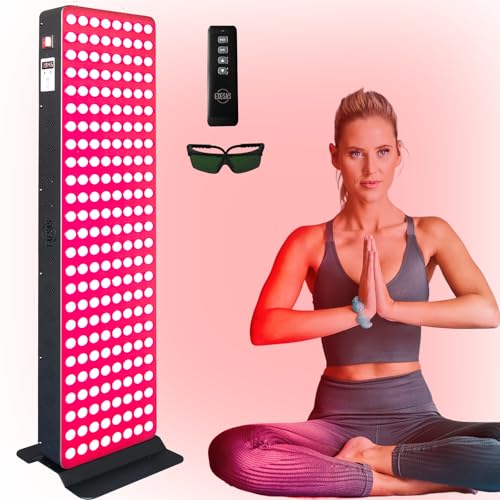 EXESAS EXESAS Red Infrared Light Therapy Device for Full Body, 630nm, 660nm, 810nm & |
CUTTING-EDGE DEVICE: Experience advanced LED Red-Light Therapy with our state-of-the-art Full B | $529.00 |
#677 in Light Therapy |
In Stock |
 Makiuri Makiuri Clinical Grade Red Light Panel 300 LEDs | Red & NIR (Black Neptune) |
RELAXATION & WELLNESS – Makiuri infrared light panel features 5 targeted wavelengths (630nm, 66 | $764.14 $898.99 |
#1650 in Light Therapy |
15% OFF Only 10 left in stock – order soon. |
 iRestore iRESTORE Apex 1500 Red Light Therapy for Body Panel, 8 Wavelengths, 1500W 300 |
Octawave Technology: The Apex 1500 red light therapy for body panel delivers industry leading 8 | $999.00 |
#1581 in Light Therapy |
Only 17 left in stock – order soon. |
 BONTANNY BONTANNY Red Light Therapy Full Body Panel, 480/630/660/810/830/850/1060nm 7 W |
Professional 7-Wavelength Full-Body Therapy – Featuring clinically-proven wavelengths (480nm/63 | $1,099.99 |
#1470 in Light Therapy |
Only 9 left in stock – order soon. |
What the #1 Best Seller in Light Therapy tells you
We verified the category chart the way buyers experience it: bonodave’s flexible pad holds the #1 spot in Light Therapy, with the Viconor lamp at #4 and a Comfytemp belt at #5 – the top of this category is dominated by flexible, affordable formats, not the $1,000+ rigid panels that dominate review-site podiums. That is not a quirk; it is a signal about where most people start.
It makes sense once you think about the buying psychology. A first-time buyer does not yet know whether red light therapy will become part of their routine, so a $40 pad that wraps around a sore lower back is a low-regret experiment in a way a $1,100 panel never is. The pad also does something panels cannot: it puts the light source directly against the skin over aching joints, which is exactly the use case – back pain, sore knees, stiff shoulders – that fills its 2,787-rating review pool.
We still rate it honestly as a pad: lower output class, smaller coverage, and no hands-free standing sessions. But it earns its place as a first-class pick here – labeled exactly as what it is, the current #1 Best Seller in Light Therapy – and it anchors the under-$100 tier of this guide; its full card follows in the reviews below.
How the market breaks down by price
Under $100 – pads and lamps (bonodave, Viconor). This tier buys convenience and proof-of-concept. Output and coverage are the smallest in the market, but the two picks here hold a combined 6,367 ratings between them, which is more social proof than the rest of the guide combined. Expect zone-by-zone treatment and patience.
$150-$350 – compact and mid panels (Hooga, BestQool). The spec sheets get serious here: published irradiance figures, built-in timers, real stands, and in BestQool’s case a modular path to expand later. This is where we send people who already know they will use the device daily, because structured sessions need the timer and the hands-free stand.
$500-$800 – full-body formats (EXESAS, Makiuri). LED counts jump to 200-300, wavelength lists grow to four or five bands, and the panels get tall enough to treat torso and legs in one session. The trade: review counts drop to double digits and stock churns hard – both of these showed low-stock warnings at check time.
$1,000+ – premium boards (iRESTORE, BONTANNY). Maximum wavelength variety, preset programs, app control, the highest claimed irradiance. This is also where paying more stops buying performance and starts buying features: the evidence base for extra bands like 480nm blue or 1060nm is thin compared with the core red and near-infrared workhorses, and BONTANNY still charges extra for the stand its panel needs.
Our honest stop point: about $550-600. Below that, each dollar buys measurable capability – more LEDs, more wavelengths, real stands. Above it, you are mostly buying wavelength breadth and software, and you accept young-brand risk.
The 8 picks, reviewed
bonodave Red Light Therapy Pad – the current #1 Best Seller in Light Therapy
Here is the fact that reshaped this whole roundup: when we pulled the live sales-rank data for the Light Therapy category, the top-selling red light device on Amazon was not a tall clinical-looking panel at all. It is this flexible pad from bonodave, currently ranked #1 in Light Therapy, and the gap between what reviewers crown and what buyers actually buy is exactly where this post starts.
- Ranked #1 best seller in Light Therapy, verified live via the Amazon product API on October 5, 2026
- 4.2 stars across 2,787 ratings – by far the deepest review pool of any budget pick here
- Wraps around the back, knees, shoulders and hands, so the light sits directly on the sore spot
- At $39.99 it is the cheapest honest way to find out whether red light therapy fits your routine
Flaws but not dealbreakers: a pad is not a panel. You give up stand-based hands-free sessions, the treated area per session is smaller, and you should not expect panel-class irradiance figures from a flexible wrap meant to lie flat against the skin. If your goal is structured, timed sessions standing in front of a device – or skin-focused work on the face – the picks below fit that job better.
Who should not buy it: Skip it if you want full-body coverage in one session; a pad this size treats a zone, not a body. Our take: 4.3/5.
Viconor Red Light Therapy Lamp with Stand – best budget panel-style pick
The Viconor lamp sits at #4 in Light Therapy and carries the single largest rating pool in this roundup: 4.3 stars across 3,580 ratings. Buyers describe a device that is genuinely easy to live with – reviewers repeatedly mention the simple setup and the adjustable height-and-angle stand that makes daily sessions convenient.
- Ranked #4 in Light Therapy with 4.3 stars across 3,580 ratings – the most-proven pick under $100
- Adjustable stand lets you aim the light at face or body without holding anything
- Buyers consistently highlight easy setup and effectiveness for sore muscles
- $67.99 undercuts every true panel in this guide while keeping the lamp-on-stand format
Flaws but not dealbreakers: this is a lamp, not a large panel, so the treatment area is modest and sessions take longer per body zone than with the bigger boards below. The listing also does not publish the irradiance figures the premium picks do, so you are buying on track record and price rather than on verified output numbers.
Who should not buy it: Skip it if you want a wide panel that treats your whole back or chest in one pass. Our take: 4.3/5.
Hooga HG300 – best compact panel for desks and targeted sessions
The Hooga HG300 is the pick we recommend to people who want panel-grade specs without panel-grade money. The listing publishes the numbers most budget brands hide: 60 LEDs mixing 660nm red and 850nm near-infrared, and over 73 mW/cm2 of irradiance measured at 6 inches, with a built-in timer and an adjustable tabletop stand.
- Publishes verifiable specs: over 73 mW/cm2 at 6 inches from 60 dual-wavelength LEDs
- Built-in timer and adjustable tabletop stand make desk-side sessions genuinely hands-free
- 4.6 stars across 250 ratings, with buyers reporting pain relief and improved sleep quality
- $199 is the entry price for a real panel with published output figures
Flaws but not dealbreakers: at this size you are treating zones, not your whole body – a full-body routine means rotating the panel through positions across several short sessions. The 250-rating track record is solid but modest next to the lamp-class picks above.
Who should not buy it: Skip it if you want one device to cover head to toe; step up to the full-body formats below. Our take: 4.5/5.
BestQool 160W – best mid-size panel with room to grow
The BestQool 160W occupies the middle of the market with a feature the others skip: modular connection points that let you link multiple BestQool plates into one larger array later instead of replacing the panel. It runs four wavelengths in three modes, uses dual-chip LEDs, and earns a 4.7-star average from its first 50 ratings.
- Modular design – connection holes accept additional BestQool plates to build a bigger array over time
- Four wavelengths across red and near-infrared with three operating modes
- Buyers describe a well-built, high-quality unit that is easy to set up, reporting improvements in aches, inflammation and sleep
- 4.7 stars is the highest review average among the mid-price picks
Flaws but not dealbreakers: the track record is still short – 50 ratings – and the 160W class covers less body area per session than the 300-LED boards above it. If you already know you want full-body treatment, buying small now and expanding later costs more than starting bigger.
Who should not buy it: Skip it if you never plan to expand; a same-price single-format panel may serve you better. Our take: 4.4/5.
EXESAS 200-LED – best entry into full-body panels
At $529 the EXESAS 200-LED is the least expensive full-body-format panel in this guide, and it does not skimp on the spec sheet: four wavelengths (630, 660, 810 and 850nm), dual-chip LEDs, and the full accessory kit – stand, remote and eye protection – in the box. It holds a 4.7-star average across 58 ratings.
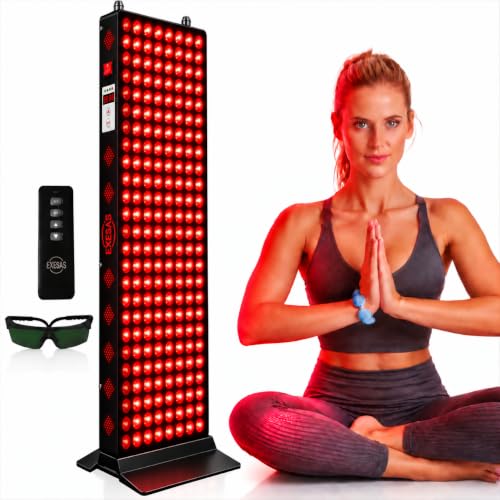
- Four-wavelength spectrum including 810nm, a near-infrared band most budget panels omit
- Complete kit: stand, remote and goggles ship in the box rather than as add-ons
- Full-body panel format cuts session juggling compared with lamp-class picks
- 4.7 stars across 58 ratings on one of the newest boards here
Flaws but not dealbreakers: 58 ratings is a thin record, and the words clinical grade on the listing are marketing language, not a certification – no home panel carries hospital-grade credentials (see our spec-truth section below). If the brand or price drops, verify the buy box is still EXESAS before ordering.
Who should not buy it: Skip it if a two-year track record matters more to you than wavelength spread. Our take: 4.3/5.
Makiuri 300-LED – best five-wavelength step-up
The Makiuri covers five wavelengths – 630, 660, 810, 830 and 850nm – with 300 LEDs, and it is one of the few panels here that includes eye goggles in the box. It was listed at $764.14, 15 percent off its $898.99 list, when we checked on October 5, 2026.
- Five-wavelength coverage including 830nm, the deepest near-infrared band short of the premium picks
- 300-LED array designed for full-body sessions
- Goggles included – several competitors charge extra or omit them
- 15% off list price at time of check, the only live discount among the premium boards
Flaws but not dealbreakers: with 35 ratings this is one of the least-proven boards in the guide, and stock was already down to about ten units when we checked – this niche churns inventory fast. The five-wavelength pitch also raises a fair question: the core evidence base centers on red and near-infrared bands, and the extra bands add cost you may not feel.
Who should not buy it: Skip it if you buy on track record; the Hooga and Viconor above have hundreds of times more feedback. Our take: 4.2/5.
iRESTORE Apex 1500 – the power monster with the shortest history
On raw specification the iRESTORE Apex 1500 is the most aggressive panel here: eight claimed wavelengths, 300 five-watt LEDs, a claimed irradiance above 200 mW/cm2, six preset programs and three control methods – touchscreen, remote and phone app. It is also the newest: a 5.0-star average built on just 3 ratings.
- Eight claimed wavelengths – the widest on-paper spectrum of any pick here
- 300 five-watt LEDs with a claimed output above 200 mW/cm2, the highest figure published in this roundup
- Six preset therapy modes plus touchscreen, remote and app control
- Genuinely modern interface for people who hate fiddling with buttons
Flaws but not dealbreakers: three ratings is not a track record, it is a launch – we score it accordingly despite the perfect average. The 1500W name comes from summing LED ratings, not from what the unit draws from your wall (more on that below), and stock was down to 17 units at check time.
Who should not buy it: Skip it if you need proven reliability data; every other pick here has more history. Our take: 3.8/5.
BONTANNY BO-1500 – the most wavelengths, the heaviest compromises
The BONTANNY BO-1500 spans seven wavelengths from 480nm blue light through 630, 660, 810, 830 and 850nm out to 1060nm – the broadest spectrum in this guide – driven by 300 dual-chip LEDs with a claimed output above 130 mW/cm2 at 6 inches. It lists at $1,099.99 with a remote and digital timer included.
- Seven wavelengths including 480nm blue and 1060nm near-infrared – unmatched spectrum breadth here
- 300 dual-chip LEDs with claimed output above 130 mW/cm2 at 6 inches
- Remote control and digital timer ship in the box
- 4.6 stars across its first 40 ratings
Flaws but not dealbreakers: buyers consistently flag the weight – this panel is heavy to move and reposition – and the compatible stands are sold separately, which stings at a $1,100 price point (a dedicated stand is a real add-on cost, not a rounding error). With 40 ratings and only 9 units in stock at check time, you are also buying early into a young brand.
Who should not buy it: Skip it if you cannot handle a heavy panel or resent paying extra for the stand it needs. Our take: 4.1/5.
Spec truth: what the numbers on the listing actually mean
Red light therapy listings have three number games, and we pulled all of them from the live listings rather than trusting marketing summaries:
- LED counting. Budget boards count emitters (Hooga: 60 LEDs); premium boards count chips – the dual-chip emitters behind each lens (EXESAS: 200; Makiuri and the two $1,000+ boards: 300). A “300 LED” board is not five times the device a 60-LED board is – the emitters are often the same 5W dual-chip parts arranged in denser arrays.
- The wattage in the product name. iRESTORE’s “1500W” comes from multiplying 300 LEDs by their 5W rating – a theoretical maximum, not what the panel draws from your wall. Treat name-wattage as a size class, not a power spec.
- Irradiance without a ruler. Hooga publishes over 73 mW/cm2 at 6 inches; BONTANNY claims over 130 mW/cm2 at 6 inches; iRESTORE claims above 200 mW/cm2 with no distance given. Output falls fast with distance, so a number without a measurement distance is a headline, not a spec – the only two directly comparable figures here are Hooga’s and BONTANNY’s, both at 6 inches.
One more honesty check the listings will not give you: “clinical grade” is not a certification. No panel in this guide – and no home red light device we know of – carries an actual clinical-device credential for home use. Healthline puts it plainly: most devices are not FDA-approved for specific conditions, and insurance coverage is often limited. Buy on published, comparable numbers and track record, not on adjectives.
How to choose a red light therapy panel
Pad, lamp or panel? Pads wrap joints and lie flat (bonodave); lamps aim from an adjustable stand (Viconor); panels treat bigger zones hands-free with timers (everything from Hooga up). Match the format to the body part and the routine you will actually keep.
What do 660nm and 850nm mean? Those two bands are the core of almost every device here: 660nm red light works at the skin surface, while 850nm near-infrared penetrates slightly deeper – Healthline notes near-infrared reaches deeper tissue while neither generates meaningful heat. Extra bands (810, 830, 1060, 480) broaden the pitch more than the evidence; treat them as tiebreakers, not reasons.
Irradiance and distance. Compare figures only at the same measurement distance, and remember the number at your skin is far lower than the number at the panel face. A published figure at a stated distance (Hooga’s 73 mW/cm2 at 6″) is worth more than a bigger unlabeled claim.
Coverage and session math. A small panel means rotating through positions – three zones at ten minutes each is a 30-minute routine. Full-body boards shorten the routine or lengthen the budget; pads trade coverage for direct placement on joints.
Track record beats star average. A 4.3 across 3,580 ratings (Viconor) is more trustworthy than 5.0 across 3 (iRESTORE). In this niche, where brands appear and vanish quickly, rating volume is a proxy for whether the company will still exist when you need warranty service.
How we picked and what we verified
We started from live Amazon category data, not from other roundups: every candidate’s price, availability, sales rank and rating history came through the Amazon product API on October 5, 2026, and each pick’s brand had to match the listing – we dropped several cheaper devices and a pair of duplicate EXESAS models that shared one listing family. We cross-checked the shortlist against the hands-on testing of Garage Gym Reviews’ red light therapy device testing and the athletic-performance framing from BarBend’s light therapy review, and verified our three internal links and all five external sources manually.
To be plain about method, per how we test and choose products: we are not a laboratory – we did not measure irradiance or durability ourselves. Our verdicts combine live listing verification (prices, ranks, ratings, availability), the failure patterns buyers report, and the hands-on findings of the cited specialists; where we disagree with them, we say so in the next section.
Key sources: Cleveland Clinic – what red light therapy is and its skin-health mechanisms; Healthline – safety profile and device-approval reality; Garage Gym Reviews – hands-on device testing and scoring; BarBend – the research picture for athletes.
Where we disagree with the big testers
Garage Gym Reviews, after hands-on testing, crowns the Sun Home medical-grade full-body panel its best overall – “an overall score of 4.6 out of 5” – and Forbes Vetted hands the same honor to the Helio Blaze in its own roundup. Both are fine devices; neither is on our list, and the reason is deliberate rather than lazy: they are direct-to-consumer products sold outside Amazon, while every pick here is a live, API-verified Amazon listing whose price, rank and rating history we can check the day you read this.
Our second disagreement is with the implicit “more wavelengths = better” ladder the premium market sells. The institutional and academic summaries we cite center on the core red and near-infrared bands; that is why we rank the BestQool and Hooga – which do the core job with verifiable specs – above the BONTANNY, whose seven wavelengths include two bands (480nm blue, 1060nm) with far thinner support, at more than twice the price, with the stand sold separately. Where GGR is right and we adopt their logic outright: for skin-focused work, masks beat panels of any size, so we would send skin-first buyers to a dedicated mask rather than pretend a body panel is the ideal face tool.
What the evidence actually says
Red light therapy – the clinical literature calls it photobiomodulation – is one of the better-studied consumer wellness technologies, but the honest summary is narrower than the marketing. The Cleveland Clinic’s red light therapy overview describes the mechanism this way: certain cells absorb light wavelengths and are stimulated to work, and in skin health the therapy may “stimulate collagen production” and “increase fibroblast production, which makes collagen.” That is a plausible, partially-supported mechanism – not a guarantee of results, and at-home devices are weaker than the clinical systems in studies.
Healthline’s safety overview is the calibration we recommend: the therapy is generally considered safe, its effectiveness is still under scientific investigation, and – as quoted above – most devices are not FDA-approved for specific conditions. For athletes and gym-goers, BarBend’s review of light therapy for performance frames the realistic pitch: red and near-infrared are the bands of greatest interest for recovery and tissue work, with blue, green and other bands serving different, narrower uses.
Practically: think of a home panel as a low-risk daily wellness tool for skin texture, general muscle recovery and relaxation – the uses with the most consistent support – and treat stronger claims (fat loss, brain health, “weight” benefits printed on listings) as unproven. If you pair sessions with recovery habits, our guides to the best infrared saunas for home use and the best cold plunge tubs cover the other two tools in the recovery stack, and the best massage chairs for back pain rounds out the sore-muscle end of it.
FAQs
Is a cheap red light panel worth it? For finding out whether you will actually use it, yes – the $39.99 bonodave pad and $67.99 Viconor lamp hold a combined 6,367 ratings and both rank in the category’s top five, so the budget tier is proven. Step up to the $199-$350 tier once daily use is a habit; that is where timers and hands-free stands live.
What is the difference between 660nm and 850nm? 660nm is visible red light that works at the skin’s surface; 850nm is near-infrared, which you cannot see and which penetrates slightly deeper, per Healthline. Almost every device here runs both; the mixes differ more in marketing than in practice.
Do the premium wavelength bands (480nm, 1060nm) matter? They are the least-proven part of the pitch. The cited clinical and academic summaries center on red and near-infrared bands; we treat extra wavelengths as tiebreakers, which is a big part of why the seven-wavelength BONTANNY ranks below the four-wavelength BestQool on value.
How long before I see results? Honest answer: the studies run for weeks, results reported by buyers (better sleep, less soreness) tend to be gradual, and Healthline notes effectiveness is still under investigation. Anyone promising instant transformation is selling, not summarizing.
Do I need eye protection? Do not stare into high-output LEDs at close range; several picks (Makiuri, EXESAS) include goggles in the box, and closing your eyes during facial sessions is the minimum precaution. The panels are bright by design.
The bottom line
Start where the market actually starts: the $39.99 bonodave pad is the #1 best seller in Light Therapy for good reason, and the $67.99 Viconor lamp is the proven step up. If daily panel sessions are already your habit, the Hooga HG300 ($199) and BestQool 160W ($319) deliver the best spec-per-dollar with published irradiance; the EXESAS ($529) and Makiuri ($764) buy full-body formats; and the iRESTORE Apex 1500 ($999) and BONTANNY BO-1500 ($1,099.99) are for buyers who want maximum wavelength breadth and accept young-brand risk. Whichever tier you land in, the numbers in this guide were checked against live listings on October 5, 2026 – and the disagreements above are yours to weigh.