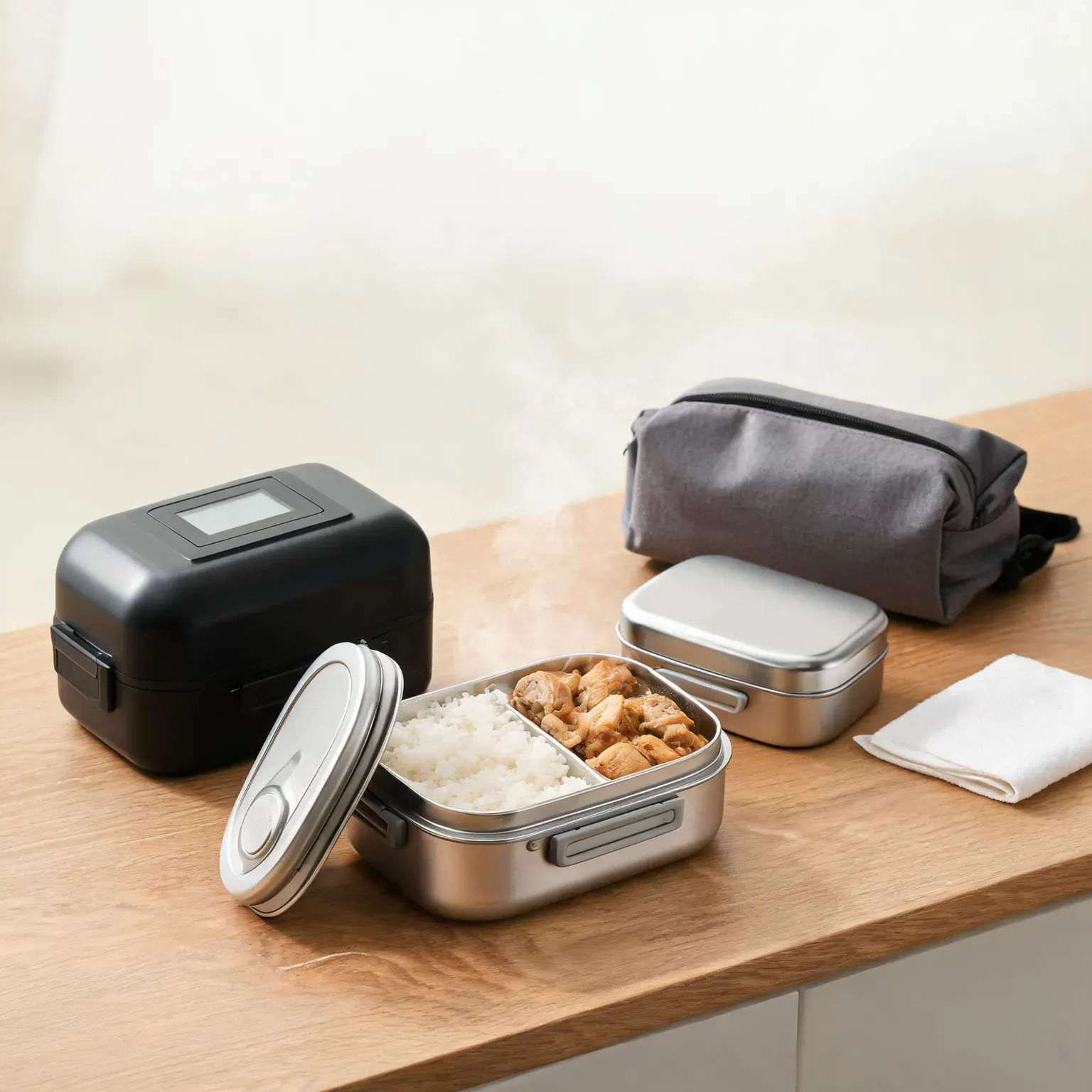
The best electric lunch boxes solve one narrow problem: getting a hot, genuinely safe meal at a desk, on a job site, or in a truck cab with no microwave in sight. We lined up seven models sold on Amazon in 2026 — cordless battery boxes and 12V/24V/110V plug-ins — and ranked them on heat time, food-safety limits, battery life, and value, checking every manufacturer claim against the food-temperature rules published by the USDA and the CDC and against the small amount of real lab testing that exists for this category.
Affiliate disclosure: As an Amazon Associate I earn from qualifying purchases. We earn commission from qualifying purchases made through links on this page. This never affects our rankings or what we recommend.
What’s in this guide
- How we picked these lunch boxes
- The 7 best electric lunch boxes at a glance
- 1. LunchEAZE Pro (best overall)
- 2. TRAVELISIMO 100W (best for cars and trucks)
- 3. Buddew 100W (best value plug-in)
- 4. LunchEAZE Core Gen 2 (best budget cordless)
- 5. Geveniss 80W (best dual-container)
- 6. DUPASU 1.8L (largest capacity)
- 7. Hugmazing 1.2L (lightest cordless)
- Cordless, 12V or 110V: which you actually need
- The food-safety test most listings will not mention
- Where we disagree with the big reviewers
- Where paying more stops buying better
- The failure modes to watch for
- Who should skip these boxes
- Frequently asked questions
- Sources and methodology
How we picked these lunch boxes
We started from the food, not the gadget. Every pick below was checked on its live Amazon listing on September 15, 2026, so the capacities, wattages, battery sizes, and rating counts here match what the page actually said that day. We cross-referenced the only temperature-lab evaluation published for this category — Consumer Reports’ six-model Electric Lunch Boxes test — a hands-on three-model test by UK food tester Barry Lewis, and the official hot-holding and reheating rules from the USDA Food Safety and Inspection Service and the CDC.
Sourcing transparency: what this guide is and isn’t. We did not run a temperature-chamber test of our own, and we don’t claim to. What we did is read each live product listing (capacity, wattage, voltage options, battery capacity, materials, and verified rating counts on September 15, 2026), compare those specs with the published lab and hands-on testing named above, and check every “keeps food hot” claim against the federal food-temperature rules. Where our ranking differs from the big reviewers, we say so explicitly and explain why. Our full process is on the How We Test & Choose Products page.
The 7 best electric lunch boxes at a glance
Every figure below was read off the live listing on September 15, 2026. Rating counts move week to week, so treat them as an order of magnitude, not a precise score.
| Lunch box | Capacity | Power | Best for | Rating (Sep 15, 2026) |
|---|---|---|---|---|
| LunchEAZE Pro | 4 cups | 8,000 mAh cordless | Best overall — scheduled heating, no outlet | 4.6 / ~750 ratings |
| TRAVELISIMO 100W | 1.5 L | 110V / 12V / 24V corded | Best for cars, trucks and offices | 4.6 / 24,900+ ratings |
| Buddew 100W | 1.5 L | 110V / 12V / 24V corded | Best value multi-voltage plug-in | 4.6 / 7,500+ ratings |
| LunchEAZE Core Gen 2 | 4 cups | 8,000 mAh cordless | Best budget cordless | 4.4 / ~740 ratings |
| Geveniss 80W | 1.5 L × 2 trays | 110V / 12V / 24V corded | Best for keeping two foods separate | 4.6 / 2,400+ ratings |
| DUPASU 1.8L | 1.8 L | 110V / 12V / 24V corded | Largest capacity for big appetites | 4.6 / 4,700+ ratings |
| Hugmazing 1.2L | 1.2 L | Battery, ~90 min heat | Lightest true cordless for short trips | 4.6 / 1,900+ ratings |
1. LunchEAZE Pro — best overall

LunchEAZE is the brand the category keeps pointing back to: Consumer Reports put LunchEAZE in the six models it bought and temperature-tested, and the Pro is the company’s current flagship. What separates it from every 12V plug-in here is scheduling. You set a mealtime, and the box works backwards from it so your food is hot when you want it — not 25 minutes after you sit down and start a stopwatch.
The Pro runs on a rechargeable 8,000 mAh battery with no cord at the table, holds 4 cups (about a full adult portion of rice or pasta plus a protein), and ships with a dual-chamber insulated bag that swallows the box, a drink, and a snack. The on-screen controls handle temperature and scheduling without an app, which matters if you have ever tried to pair a lunch box to a phone in a parking lot.
What We Like
- Scheduled heating works backwards from your mealtime, so the food is hot when you sit down
- Fully cordless on an 8,000 mAh battery — no outlet, no 12V socket, no car required
- 4-cup capacity and a sealed stainless container that — unlike most plug-ins — handles a real adult portion
- On-device display, no app needed; dual-chamber insulated bag included
What Could Be Better
- The most expensive box in this guide, and the battery is good for roughly one meal per charge
- Heavier than a 12V plug-in once the battery pack is in, so it is a bag item, not a pocket item
- 4 cups is a single serving — not a box to share
Flaws but not dealbreakers: you are paying a premium for scheduling and cordless freedom, and both depend on remembering to charge the night before. If your lunch is always the same time and your desk has a socket, a $40 plug-in does the reheating for far less.
2. TRAVELISIMO 100W — best for cars, trucks and offices

If your commute is the point — a work van, a truck, a car with a 12V socket — the TRAVELISIMO is the safest bet in the category by sheer volume of buyers: more than 24,900 ratings at 4.6 stars, by far the deepest pool here. It is a 100W corded warmer with a switchable 110V, 12V, and 24V input, so the same box plugs into a wall at the office, a car socket in the morning, and a truck socket on a long haul.
The stainless-steel tray holds 1.5 L and the manufacturer claims a 20–30 minute reheat. That lines up with the two other 100W corded boxes we checked, and it is honest about its limits: this is a reheat-and-hold box, not a cooker. You are starting from leftover food that is already safe, and bringing it back up to temperature.
What We Like
- Deepest rating pool in the guide (24,900+ at the time of writing) — strong evidence the plugs and seals last
- True 3-in-1 input: 110V wall, 12V car, 24V truck, so one box covers commute and office
- 1.5 L stainless tray takes a full meal; dishwasher-safe
- Cheaper than the cordless boxes, with no battery to wear out
What Could Be Better
- Needs an outlet or a vehicle socket — useless at a table with neither
- No scheduling; you start it when you arrive and wait 20–30 minutes
- No battery means no option to keep heating after you unplug
Flaws but not dealbreakers: the portability is in the box, not the power supply. If you cannot reach a socket at lunch, this is the wrong category of product — buy a cordless box instead.
3. Buddew 100W — best value plug-in

The Buddew is the value version of the same recipe: 100W, 1.5 L of food-grade 304 stainless, and 110V/12V/24V compatibility, for less than the TRAVELISIMO names its sibling at. Its point of difference is a PTC heating element that holds a constant temperature rather than cycling hard on and off, which the manufacturer claims reduces drying and the failure rate of the heating plate.
In practice the PTC design is the reason we rank it above cheaper no-name plug-ins: constant-temperature heating is gentler on sauces and rice than a cheap on/off element, and it is a well-established technology rather than an invented one. The listing also throws in a 0.4 L fruit container and both power cords.
What We Like
- 100W PTC constant-temperature heating is gentler on sauces than cheap on/off elements
- Food-grade 304 stainless tray, dishwasher-safe, with a bonus 0.4 L side container
- Ships with both the 110V home cord and the 12V/24V car cord
- One-year replacement and two-year warranty stated on the listing
What Could Be Better
- The listing describes the outer shell as plastic, so the premium feel is lower than an all-steel box
- Carrying bag is not included on this listing, so factor in one
- Still a corded box — no scheduling and no battery
Flaws but not dealbreakers: it is a value box and it wears that on the outside. The part that touches your food — the 304 stainless tray — is the part that matters, and that part is right.
4. LunchEAZE Core Gen 2 — best budget cordless

The Core Gen 2 is the way into scheduled, cordless reheating without the Pro’s price. It shares the Pro’s 8,000 mAh battery, 4-cup size, and on-screen scheduling, and it adds one thing the Pro does not advertise as prominently: frozen-food compatibility. That is the single most useful upgrade for anyone who preps meals on a Sunday and pulls one out on Tuesday morning.
You give up the Pro’s insulated bag and some polish, and the rating average sits lower (4.4 stars versus 4.6). For a first cordless box, though, the trade is sensible: the heating mechanism and the battery are the same, and those are the two things that determine whether the box works at noon.
What We Like
- Same 8,000 mAh battery and scheduled heating as the Pro for noticeably less money
- Explicitly rated to reheat frozen meals, not just leftovers
- Sealed, removable 6-cup BPA-free 304 stainless container
- No app required — schedule and temperature are set on the device
What Could Be Better
- 4.4-star average and a smaller rating pool than the Pro
- No insulated carry bag in the box
- Battery still covers roughly one meal per charge
Flaws but not dealbreakers: it is a streamlined Pro, not a different product. If you want the bag and the higher-rated fit and finish, pay for the Pro; if you just want hot food at noon without a socket, this does the job.
5. Geveniss 80W — best for keeping two foods separate

Most electric lunch boxes give you one tray and call it done, which means curry soaks the rice by the time you open the lid. The Geveniss ships two 1.5 L stainless containers — one single-compartment, one split in two — so you can keep a wet dish away from a dry one. It is the only box in this guide that treats separation as the feature rather than an accessory.
It runs on 110V, 12V, or 24V at 80W, and the listing is honest that heat time stretches to 20–40 minutes depending on ambient temperature and food type, with a note to add water for frozen or dry items. That honesty is worth something: 80W is less power than the 100W boxes here, and the brand does not pretend otherwise.
What We Like
- Two removable 1.5 L stainless containers (one split) — wet and dry food stay apart
- Leak-proof lid plus an insulated carry bag and utensils included
- Works on 110V, 12V and 24V
- Listing states realistic 20–40 minute heat times instead of a single best-case number
What Could Be Better
- 80W means slower reheating than the 100W boxes in this guide
- Two containers add bulk compared with a single-tray box
- Three compartments total is more to wash
Flaws but not dealbreakers: the extra container costs you bulk and a little heat speed. If you routinely pack a curry and rice, or a soup and a side, that is a trade worth making every day of the week.
6. DUPASU 1.8L — largest capacity

Capacity is where most electric lunch boxes quietly fail. A 1.2 L box sounds generous until you pack a real adult lunch into it. At 1.8 L across two compartments, the DUPASU is the biggest box here, and it is the pick for anyone whose lunch is a proper meal rather than a snack.
It is a corded 110V/12V/24V warmer with a detachable stainless container, and the plastic parts — container, fork, spoon — are dishwasher-safe. The listing leans on gift framing, and that is fair: it arrives with an insulated bag and looks the part.
What We Like
- 1.8 L across two compartments — the largest capacity in this guide
- Detachable stainless container and dishwasher-safe utensils
- Insulated carry bag included
- Two compartments keep a big lunch organised
What Could Be Better
- Bigger and heavier than the 1.2–1.5 L boxes
- Plastic outer shell rather than all-steel
- No published wattage on the listing, so heat time is less predictable
Flaws but not dealbreakers: the trade is simple — more food, more bulk. If your lunch is a big portion, that is exactly the trade you want; if it is a sandwich, this box is more than you need.
7. Hugmazing 1.2L — lightest cordless

The Hugmazing is the light end of the cordless category, and its listing is unusually candid about the number that matters: about 3.5 hours to charge for up to 90 minutes of heating, or roughly one meal. Plenty of cordless boxes bury that trade-off; this one puts it in the bullet points.
At 1.2 L it is the smallest box here, with a stainless container inside a plastic shell, a hidden carry handle, and a delay button for scheduled heating. Think of it as the box for a light lunch or a shorter day — not for a double portion or an overnight shift.
What We Like
- Lightest cordless box here, with a hidden handle for easy carrying
- Listing states the real numbers: 3.5-hour charge, up to 90 minutes of heating
- Delay button for scheduled heating; sealed lid resists leaks
- Quiet, low-odour heating and dishwasher-safe stainless container
What Could Be Better
- 1.2 L is a light lunch — too small for a large appetite
- 90 minutes of heating is one meal, not a whole shift
- Smaller rating pool than the plug-in picks
Flaws but not dealbreakers: capacity and battery are both modest by design. If you eat a light lunch and hate cords, that is the whole point; if you are a trucker, buy the 12V corded box instead.
Cordless, 12V, or 110V: which you actually need
There are three ways an electric lunch box gets its heat, and picking the wrong one is the most common buying mistake. Cordless boxes carry their own battery, so they work anywhere — but the battery is the single most expensive part and the first thing to fail. Corded 12V/24V boxes plug into a vehicle socket, which suits drivers and anyone whose car is their office. Corded 110V boxes plug into a wall, which is the cheapest and lightest option but ties you to an outlet.
| Power type | Works where | Trade-off | Typical price |
|---|---|---|---|
| Cordless battery | Anywhere (battery power) | One meal per charge; battery wears out; heavier | $60–$230 |
| Corded 12V / 24V | Car, van, truck, some worksites | Needs the vehicle; heat only while plugged in | $30–$60 |
| Corded 110V | Desk, office kitchen, job-site power | Needs a wall outlet; no battery backup | $30–$55 |
The rule we would give a friend: if you have a socket at lunch, buy a cheap corded box and spend the difference on better food. If you do not, pay for the battery — but understand that you are buying roughly one hot meal per charge, and the battery will not last forever.
The food-safety test most listings will not mention
Every “keeps food hot” claim on an Amazon listing runs into two federal numbers. The USDA says hot food must be held at 140 °F (60 °C) or above and that leftovers should be reheated to an internal temperature of 165 °F; the CDC puts the “danger zone” at 40 °F to 140 °F and warns that perishable food should not sit out for more than two hours (one hour above 90 °F). Bacteria in that band can double in as little as 20 minutes.
That is the lens to hold these boxes up to. A “warm” setting that tops out around 55–65 °C (131–149 °F) sits at or barely above the hot-holding line — fine for eating promptly, not a substitute for reheating to 165 °F. Our picks all heat in the 20–40 minute range and are designed to bring an already-safe meal back up to temperature, which is exactly what a lunch box should do.
The other number worth knowing comes from Consumer Reports’ lab test: it bought six boxes priced from $40 to $270, tested them in a temperature-controlled chamber, and found that none held food at or below 40 °F after just 20 minutes at room temperature. CR’s conclusion was blunt and correct — reheating within two hours, or packing the box in an insulated bag with an ice pack, is the safe pattern. CR also flags the one safety claim we would repeat here: because these boxes often run on lithium-ion batteries, buy one that is certified by UL Solutions, and use the manufacturer’s own charging cord. A cheap third-party replacement cord is how you turn a lunch box into a fire risk.
Where we disagree with the big reviewers
Consumer Reports frames this entire category around one finding: that no box it tested kept food cold, so the category is really about reheating safely within two hours. We agree on the food-safety conclusion and disagree on the emphasis — for most buyers the deciding question is not refrigeration (almost nobody expects a lunch box to be a fridge) but whether the box can deliver heat when you want it. That is why we rank a scheduled cordless box first, and why we weight battery scheduling so heavily.
Barry Lewis tested three boxes spanning the whole price range, including a £130 app-controlled model, and reached a similar conclusion from the opposite direction: the cheapest box (a £18.99 plug-in) “did better than I expected”, while the most expensive one left him unsure he would use it daily. We read that as the same signal our ranking sends — price buys convenience and scheduling, not better reheating — and it is why our best-value pick is a $40-class plug-in rather than a premium box.
Where paying more stops buying better
Electric lunch boxes cluster into three price tiers, and the differences inside each tier are cosmetic:
- About $30–$60 (corded, 100W). This is the value floor and honestly where most people should stop. You get 1.5 L of stainless, a 20–30 minute reheat, and 12V/24V/110V input. Everything above this buys convenience, not heat.
- About $60–$110 (cordless, 8,000 mAh-class). You are paying for the battery and the ability to heat anywhere. Worth it if and only if you have no outlet or socket at mealtime.
- About $150–$230 (premium cordless). Bigger batteries, better screens, insulated bags, sometimes an app. Real improvements, but diminishing: the food comes out at roughly the same temperature as the mid tier.
The stopping point we would draw is about $110. Past that, you are buying aesthetics, an app, and a larger bag — not a materially hotter or safer lunch.
The failure modes to watch for
- A battery that dies before lunch. The most common complaint across cordless reviews. Charge overnight, and treat “one meal per charge” as the real spec, not a marketing line.
- Leaks into the bag. A tired gasket or an over-filled tray soaks the bag. Look for a sealed, removable container and check the gasket before you trust it with soup.
- Capacity that looks bigger than it is. A 1.2 L rating assumes you fill it flat. A real adult portion of pasta and protein needs 1.5 L or more.
- Slow heat from low wattage. An 80W box takes longer than a 100W box, and both slow down in a cold cab. If heat speed matters, buy 100W.
- No UL certification on cheap lithium-ion boxes. Consumer Reports singles this out, and it is the one failure mode that can actually hurt you — not just disappoint you.
- Third-party charging cords. A cheap replacement cord that does not match the original spec can damage the battery. Use the supplied charger.
Who should skip these boxes
- Skip them entirely if you have a microwave at lunch. A lunch box reheats; a microwave reheats faster, hotter, and for free.
- Skip the LunchEAZE Pro if you always eat at the same desk with a socket — a $40 plug-in does the same job.
- Skip the TRAVELISIMO and Buddew if you have no 12V socket or wall outlet at mealtime.
- Skip the Geveniss if you want a single small tray and minimal washing.
- Skip the DUPASU if you pack a light lunch — you will carry 1.8 L and use half of it.
- Skip the Hugmazing if your shifts run long or your appetite is large; 1.2 L and 90 minutes of heat will not cover it.
- Skip any cordless box if you know you will not remember to charge it. A dead battery is colder than no box at all.
Frequently asked questions
Do electric lunch boxes actually get food hot enough?
The good ones reheat food to a genuinely hot, safe temperature — but they are reheaters, not cookers. Aim for a 100W box, give it 20–40 minutes, and check that the food is steaming before you eat. The USDA’s reheat target is 165 °F internal; holding food above 140 °F is what keeps it safe.
Cordless or corded — which should I buy?
Buy corded if you have a wall outlet or a 12V/24V socket at lunchtime: it is cheaper, lighter, and there is no battery to fail. Buy cordless if you genuinely eat away from any power source — and expect roughly one hot meal per charge.
Can I put the food tray in the dishwasher?
The stainless trays on our picks are dishwasher-safe, and so are the listed plastic parts on most. Never put the battery pack, the heating base, or the charging cord in water — wipe the housing clean and keep the electronics dry.
Is it safe to reheat food that has been sitting in the box?
Only if it stayed out of the danger zone. Perishable food left between 40 °F and 140 °F for more than two hours (one hour above 90 °F) should be thrown away rather than reheated. Pack cold food cold — an ice pack in an insulated bag — and reheating it later is fine.
Do I need a UL-certified lunch box?
For any box with a lithium-ion battery, yes — Consumer Reports explicitly recommends buying a model certified by UL Solutions, and using only the manufacturer’s charging cord. Lithium-ion batteries can catch fire in rare conditions, and certification plus the correct charger is the cheap insurance.
Sources and methodology
Product data (capacity, wattage, voltage options, battery capacity, materials, and rating counts) was read from each live Amazon listing on September 15, 2026. Temperature and food-safety rules come from the USDA FSIS “Danger Zone” (40 °F–140 °F) guidance and the CDC’s food-poisoning prevention guidance. Independent testing and safety notes come from Consumer Reports’ “Best Electric Lunch Boxes” (Perry Santanachote; six models, temperature-controlled lab; paywalled, summary used) and from Barry Lewis’s three-model electric lunchbox test.
Consumer Reports is a paywalled publication; we used the free summary it publishes and disclose that here. Barry Lewis is an independent food tester, not a lab. Prices and rating counts move; the food-temperature rules do not. For how we work, see How We Test & Choose Products.
Related reading: the best lunch boxes (non-electric), the best mug warmers, and Amazon essentials under $50.