Air mattresses have a reputation problem that no other bedding product has: everyone has a story about the night theirs deflated, yet almost nobody knows the real air mattress lifespan. So we went looking for the actual numbers — how long they really last, what breaks first, what the warranties actually cover, and what the safety record looks like. This page collects the verifiable data we found, separates measured results from manufacturer claims, and cites every source.
Affiliate disclosure: As an Amazon Associate I earn from qualifying purchases. We earn commission from qualifying purchases made through links on this page. This never affects our data or what we recommend.
How We Built This Page
We did not run a lab test for this page, and we say so plainly. What you will find below comes from three kinds of sources, each labelled:
- Measured — a credible tester documented the result with a method and a timeline. Example: Reviewed’s four-month nightly sleep test on a $45 air mattress. A second, repeatable example: Sleepopolis’ team tested air retention by loading each inflated bed for two to three nights and measuring the drop in height and firmness.
- Official — government or standards-body records. Example: the U.S. Consumer Product Safety Commission recall database.
- Claimed — manufacturer or retailer statements we could not independently verify. We mark these as claims, never as findings.
Where sources disagree, we say so rather than picking the flattering number. Full source list at the bottom of the page.
The 4-Month Wear Test: A Documented Timeline
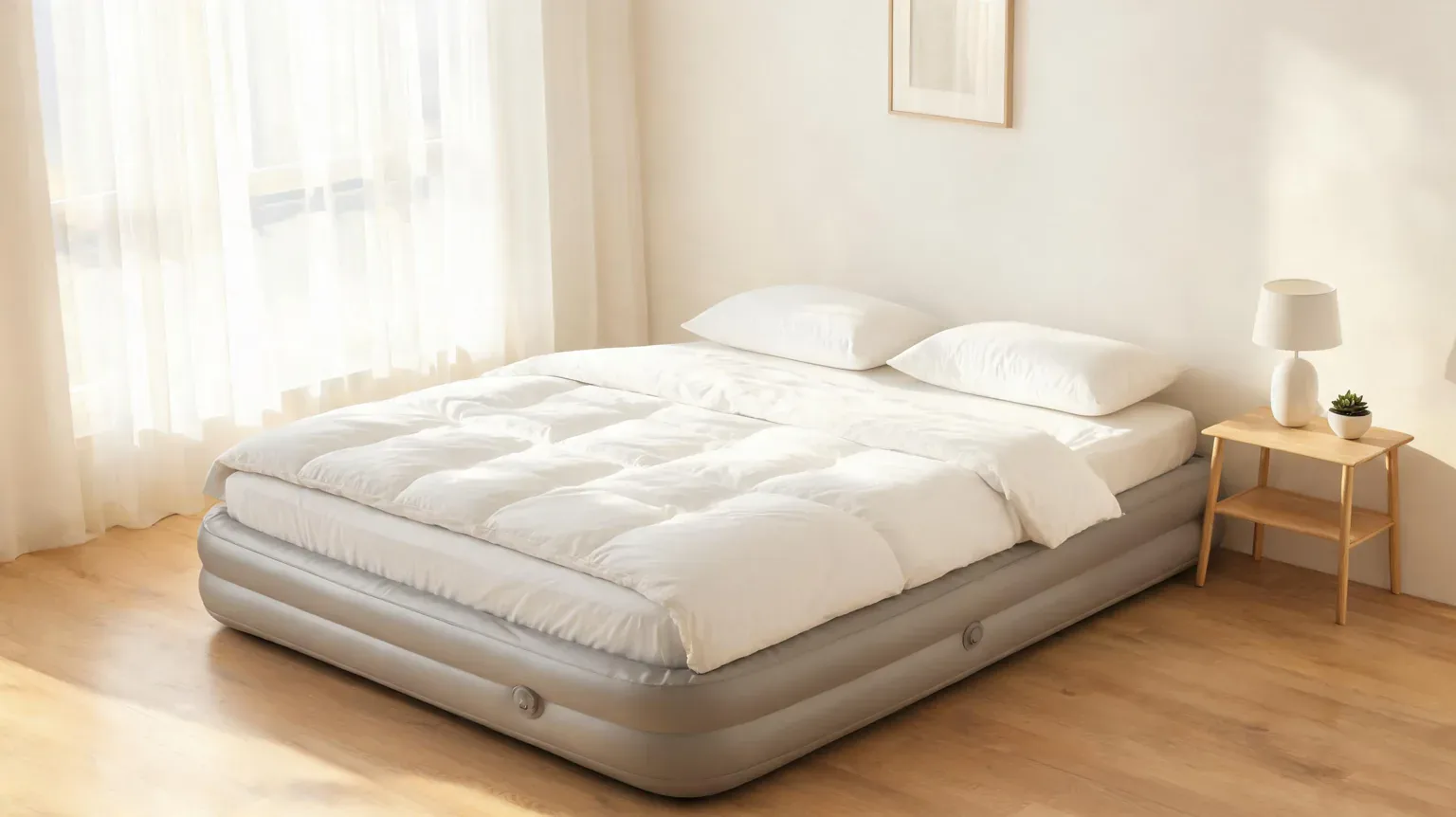
The most useful single data point on air-mattress durability we found is Reviewed’s account of sleeping on a $45 queen-size Intex air mattress as their only bed for four months. This is not a lab measurement, but it is a documented, real-world wear timeline — the closest thing to a stress test in public data.
| Time on the mattress | What was observed (Measured — Reviewed) |
|---|---|
| Months 1–3 | Held air well. Required topping off roughly every 3–4 days (about 5 minutes each time). No leaks. |
| Month 4, first event | Full deflation overnight — woke on the floor. Cause: a hole “no larger than the tip of a pin.” |
| After patching | Never fully recovered: maintenance went from every 3–4 days to every 1–2 days for the remaining month. |
| Total outcome | Survived 4 months of continuous nightly use, with one pinhole failure, at a $45 price point. |
The tester’s own conclusion is the most important line on this page: “This is the biggest flaw of any air mattress — the tiniest hole can ruin everything.” That is a structural property of the product category, not a brand defect: an air mattress is a single-chamber pressure vessel, so one compromised point affects the entire sleeping surface.
What Actually Breaks, Ranked by Frequency
Across the failure reports we reviewed — tester accounts, manufacturer warranty exclusions and official safety records — the same handful of failure points recur. Ranked from most to least common: Sleepopolis, which tested retention with weighted-load trials, names the same three causes — “faulty valves, leaks, and poor materials” — and notes that the flocked top most beds ship with sits over a puncture-resistant PVC layer, so the sleeping surface is not the weak point: the shell and the valve are.
| # | Failure mode | What the evidence shows | Source type |
|---|---|---|---|
| 1 | Pinhole punctures | The dominant failure in real-world use. A pin-tip hole caused total overnight deflation after 3 months of nightly use; wear afterwards accelerated (re-inflation every 1–2 days). | Measured |
| 2 | Air loss at seams and valves | Gradual pressure loss is normal even on healthy units — the same tester topped up every 3–4 days from day one. | Measured |
| 3 | Electric pump failure / cord faults | Pump and cord defects are serious enough to have triggered a federal recall: CPSC and Select Comfort recalled adjustable beds in 2003 because power-cord insulation on the electric air pump could crack after cold exposure, creating a fire and shock hazard. | Official (CPSC) |
| 4 | Warranty claim denial | Industry reporting describes return-policy traps and exclusions that leave buyers without recourse after a leak — the practical failure is often the claim, not the mattress. | Claimed (retailer/consumer reporting) |
How Long Do Air Mattresses Last? Claimed vs. Observed
Manufacturers rarely publish a lifespan, which is why most “how long does an air mattress last” answers online are retailer estimates. Here is what the sources actually claim, kept honest by labelling:
- Retailer guidance (claim): budget airbeds 1–6 months with regular use; mid-range 1–3 years; premium 3–5+ years.
- Medical-equipment retailer guidance (claim): up to 8 years with occasional use, about 2 years with continuous use.
- Observed (measured): a budget unit survived 4 months of continuous nightly use before its first failure — consistent with the “budget = months, not years” claim when the mattress is a full-time bed.
- Tester data (measured, independent): Sleepopolis’ air-mattress team — five certified sleep science coaches — scored beds on comfort, support, air retention, value, inflation and deflation, and tested retention by inflating each bed, leaving heavy weights on it for two to three nights, then measuring the loss in height and firmness. Their guidance: most air mattresses last up to about six years with occasional guest use, and “won’t last nearly as long” as a nightly bed.
The pattern to take away: usage intensity matters more than price. An air mattress used a few nights a year can last years; the same mattress used every night is measured in months. If you need an every-night bed, that is what the manufacturer math is telling you.
Sleep-Quality Findings Worth Knowing
Durability is only half the story. Two consistent findings from the testing account and sleep-focused coverage:
- Air mattresses sleep cold. The four-month tester reported waking up freezing on cold nights and had to layer blankets between their body and the mattress surface — air circulates inside the chamber and pulls heat away. A topper or an insulating layer underneath fixes it.
- They are the wrong bed for back pain, and the right one with a topper. The same tester had no back issues — but added a memory-foam topper and explicitly warned that sleeping on an air mattress is “NOT for people who suffer from back pain.” Support is a function of firmness and chamber construction, not price alone. That finding lines up with how the Sleep Foundation’s product-testing team frames bed-related back pain: the single most important factor is “proper spinal alignment through adequate support”, and most mattress-related pain comes from the mid-section sinking below the rest of the body overnight — which is precisely the failure mode of a soft or under-inflated single-chamber air bed. A topper changes the surface; it does not change the support underneath.
For the broader sleep-environment picture, our white noise machine guide and cooling pillows guide cover the other two variables.
How to Make an Air Mattress Last Longer (From the Data)
Every recommendation below comes directly from the failure modes above, not from manufacturer marketing:
- Keep the patch kit with the mattress. The tester’s own advice after the pinhole event: “just make sure you have an extra patch kit. They are life-savers.”
- Protect against punctures. No jewelry in bed, nothing dragged across the surface, no sharp bedding hardware. The dominant failure is mechanical, and it is preventable.
- Expect routine top-offs and budget for them. Every 3–4 days is normal on a healthy unit; if you drop to daily top-offs, you have a slow leak and should look for it early.
- Insulate underneath. A rug or blanket under the mattress addresses both the cold-sleep problem and floor-level punctures.
- Treat “warranty” as a claim, not a promise. Check the exclusions before buying — the recurrence of denied claims in consumer reporting suggests the fine print matters as much as the term length.
Our Related Buying Guides
If the data above tells you an air mattress still fits your use case, these are the guides where we verify every listing live and flag the flaws honestly:
- Best Air Mattresses 2026 — built-in-pump, everyday-use and guest-room picks, each verified in stock.
- Best Camping Hammocks 2026 — the lighter, more packable alternative for camping sleep.
Sources & Methodology
- Measured: Reviewed, “I slept on a budget blow-up mattress for 4 months — here’s what happened” — reviewed.com (four-month nightly wear timeline; top-off intervals; pinhole failure; cold-sleep and back-pain findings).
- Measured (independent tester): Sleepopolis, “Best Air Mattress (2026): Tested by Five Certified Sleep Science Coaches”, by Riley Otis — sleepopolis.com (retention test method, construction notes, lifespan guidance, causes of air loss).
- Institutional (sleep medicine): Sleep Foundation, “Best Mattress for Back Pain in 2026”, written and tested by the Sleep Foundation product-testing team — sleepfoundation.org (support and spinal-alignment criteria; the mid-section sink pattern behind bed-related back pain).
- Official: U.S. Consumer Product Safety Commission, recall of adjustable beds over electric air-pump power-cord insulation cracking — cpsc.gov.
- Claimed: retailer lifespan guidance (budget 1–6 months, mid-range 1–3 years, premium 3–5+ years); medical-equipment retailer guidance (up to 8 years occasional, ~2 years continuous); consumer reporting on air-mattress warranty exclusions and claim denials.
We update this page as new measured data or official records appear. No manufacturer paid for inclusion, and no measurement here was supplied by a brand. See how we test and choose products for the full method behind these numbers.
As an Amazon Associate I earn from qualifying purchases.