Published August 19, 2026 · Last updated September 13, 2026
The best cutting boards protect your knives, your counters, and your food—and the right one turns prep work into something you barely notice. Whether you want a workhorse maple board, a dishwasher-safe composite you can toss anywhere, a knife-gentle Japanese cypress board, or a dedicated board for raw meat, there is a pick here for every kitchen and budget. We compared material, size, ease of cleaning, and how kindly each board treats a sharp edge against published test-kitchen results, the live product listings, and tens of thousands of verified buyer reviews—and below are the seven we would actually buy.
We earn a commission from qualifying purchases made through links on this page. This never affects our rankings or what we recommend.
Our Picks at a Glance
- 🥇 Top Pick: John Boos R-Board Series Maple, 20 x 15 Inches
- 🥈 Best Dishwasher-Safe: Epicurean Kitchen Series, 17.5 x 13 Inches
- 🥉 Best End-Grain: All-Clad End-Grain Acacia Wood Board, 19 x 14 Inches
- ⭐ Best for Knife Edges: Shun Cutlery Medium Hinoki Board
- 💰 Best Professional: Asahi Cookin Cut Rubber Board, LL
- 💵 Best for Raw Meat: OXO Good Grips Plastic Carving & Cutting Board
- 🌱 Best Space-Saving Set: Joseph Joseph Nest Boards 3-Piece Bamboo Set
Our Verdict: Buy the John Boos R-Board Maple if you want the best cutting board we ranked—a thick, reversible edge-grain workhorse that will last decades and treat your knives well. If you want the easiest cleanup, the Epicurean Kitchen Series goes straight in the dishwasher and shrugs off stains and odors. Raw-meat prep calls for a dedicated plastic board, and the OXO Good Grips is the one we reach for—cheap, non-slip, and easy to sanitize.
Why Trust ShoppingPicker
We do not run a laboratory, and we will not pretend to. Every pick on this page was chosen by comparing published hands-on testing from test kitchens such as Bon Appétit and Serious Eats with the material, size, and care instructions stated on each product’s own Amazon listing, the recurring themes in buyers’ reviews, and food-safety guidance from public agencies and peer-reviewed research. We scored each board on knife-friendliness, size and stability, ease of cleaning and sanitizing, and long-term durability, then ranked them for a home cook rather than a restaurant line. Read exactly how we research and rank on our How We Test & Choose Products page. Prices in this guide are approximate, qualitative tiers and move with sales and bundles.
How to Choose the Right Cutting Board
Material: Wood vs. Plastic vs. Composite vs. Rubber
Wood is the classic choice—it is gentle on knives, naturally resists bacteria, and looks great on the counter, but it must be hand-washed and oiled. Plastic is cheap, dishwasher-safe, and color-codable for raw meat, but it dulls knives slightly faster and shows knife scars. Composite boards (like Epicurean’s wood-fiber material) split the difference: dishwasher-safe, knife-friendly, and nearly indestructible. Japanese synthetic rubber boards are the professional favorite—soft enough to protect edges yet easy to sanitize. Most home cooks are happiest with one quality wood board plus a dedicated plastic board for meat.
Edge Grain vs. End Grain
Edge-grain boards glue boards together along their long edges, so the surface shows long wood strips; they are affordable, durable, and the standard for everyday workhorses like the John Boos R-Board. End-grain boards glue the cut ends of wood blocks facing up, so the surface is a checkerboard of fibers. End grain is gentler on knife edges and self-heals from cuts, but it costs more and needs more oiling. For most people, a quality edge-grain board is the better value; end grain is worth it if you use high-end knives daily.
Size and Thickness
A cutting board should give you room to work without crowding the blade. For everyday chopping, look for at least 15 by 10 inches; for carving roasts or prepping for a family, 18 by 14 inches or larger is better. Thickness matters too—boards under half an inch can warp or flex, while 1.5-inch boards stay flat and feel stable. Measure your counter and sink first, because a board that is too big to wash comfortably will get used less.
Cleaning and Sanitizing
Wood boards should be hand-washed with mild soap, dried upright, and never soaked or put in the dishwasher—prolonged water warps and cracks the wood. Plastic and composite boards can go in the dishwasher, which is why they are the practical choice for raw meat and poultry. Whatever material you use, scrub well with hot, soapy water after cutting meat, and consider a food-safe sanitizing rinse. The golden rule: keep one board for raw meat and another for produce and bread.
Maintenance: Oil and Conditioning
Wood boards need occasional oiling to stay water-resistant and prevent cracking. Food-grade mineral oil or a dedicated board conditioner (often a blend of mineral oil and beeswax) applied once a month keeps the surface sealed and looking new. Avoid olive or vegetable oil, which can turn rancid over time. With proper oiling, a quality maple board like the John Boos can easily last a decade or more.
What the Listings Actually Say (Spec-Truth Table)
Roundups that copy each other all quote the same marketing copy. We pulled these figures straight from the seven live Amazon listings on September 13, 2026, so you can see exactly what you are buying. Sizes and materials come from the product titles and specification tables; care guidance comes from each listing’s own directions.
| Product | Material | Style | Listed size | Care | Amazon rating |
|---|---|---|---|---|---|
| John Boos R-Board | Hard-rock maple | Edge-grain, reversible | 20" × 15" × 1.5" | Hand-wash + oil | 4.5 (4,578) |
| Epicurean Kitchen Series | Wood-fiber composite | Solid composite | 17.5" × 13" | Dishwasher-safe | 4.4 (486) |
| All-Clad Acacia | Acacia wood | End-grain | 19" × 14" | Hand-wash + oil | 4.9 (50) |
| Shun Medium Hinoki | Hinoki cypress | Solid wood | 15.75" × 10.75" | Hand-wash | 4.4 (1,416) |
| Asahi Cookin Cut | Synthetic rubber | Solid rubber | 16.5" × 9.8" × 0.5" | Hand-wash | 4.3 (2,194) |
| OXO Good Grips Carving | Plastic (polypropylene) | Solid plastic | 21.1" × 14.3" | Dishwasher-safe | 4.6 (16,667) |
| Joseph Joseph Nest (3-piece) | Bamboo | Bamboo set | 3 graduated sizes | Hand-wash | 4.4 (122) |
Spec-claim reality check. Marketplace data is filed inconsistently, so trust the board, not the bullet points. The John Boos listing titles its board “12-lb” yet its own specification table lists the item weight as 2 kg (about 4.4 lb); the Shun Hinoki page lists 22.68 g—roughly three-quarters of an ounce—for a 15.75-inch cypress board. Neither figure survives contact with a kitchen scale. That is why our table quotes material, size and care from the listings but treats every seller-entered weight with caution. The one rule that is not negotiable comes from the U.S. Department of Agriculture’s Food Safety and Inspection Service, which advises choosing either a wood or a nonporous board and keeping a separate one for raw meat, poultry and seafood—whatever the material.
All Seven Picks Compared
| Product | Best For | Material | Size | Price tier |
|---|---|---|---|---|
| John Boos R-Board Maple | Overall / top pick | Maple wood | 20" × 15" | Mid |
| Epicurean Kitchen Series | Easiest cleanup | Wood-fiber composite | 17.5" × 13" | Budget–mid |
| All-Clad End-Grain Acacia | Best for knife edges | Acacia wood | 19" × 14" | Premium |
| Shun Medium Hinoki | Japanese knives, light prep | Hinoki cypress | 15.75" × 10.75" | Mid |
| Asahi Cookin Cut Rubber | Pro-style prep | Synthetic rubber | 16.5" × 9.8" | Mid–premium |
| OXO Good Grips Carving | Raw meat & carving | Plastic | 21.1" × 14.3" | Budget |
| Joseph Joseph Nest 3-Piece | Small kitchens | Bamboo | 3 sizes | Budget–mid |
How Much Should You Spend?
Cutting boards are one of the few kitchen tools where the price ladder is fairly honest—up to a point. Here is what actually changes as you spend more:
- Budget (roughly under $30): thin plastic and simple wood-fiber boards. You are buying convenience—dishwasher-safe, replaceable, and cheap enough to keep a dedicated raw-meat board—not knife care.
- Mid (roughly $30–$90): the sweet spot. This is where you get a genuinely knife-gentle surface: thin composite (Epicurean), soft Japanese cypress (Shun), synthetic rubber (Asahi), or a thick maple edge-grain board like the John Boos R-Board. Stability, thickness and edge-friendliness all improve sharply here.
- Premium (roughly $90–$180+): thick end-grain hardwood. Bon Appétit’s current top wood pick, the Sonder Los Angeles Alfred end-grain walnut board, sits here at $179. End grain is genuinely easier on knife edges and self-heals, but at this level you are mostly paying for thickness, grain cosmetics and a longer lifespan.
Where paying more stops buying performance: once a board is thick, stable, and made of a soft-enough material, nothing above roughly the mid tier makes your food safer or your knife sharper in a home kitchen. Material and the way you wash the board do that. Our advice is to spend on one good mid-tier board plus a cheap dedicated meat board rather than a single premium showpiece.
Where We Differ From Other Reviewers
We read the same test kitchens you do, and we do not always agree with them—which is the point. Bon Appétit’s editors recently shifted their wood recommendations to end-grain boards only, and their current top pick is the Sonder Los Angeles Alfred end-grain walnut board at $179. We lead instead with the far more affordable edge-grain John Boos R-Board. Not because end grain is not better for knife edges—it is—but because a 1.5-inch reversible maple board delivers most of the everyday benefit for a fraction of the price, and it is the board most people can actually abuse without guilt.
We also part ways on the wood-versus-plastic safety shorthand, which has quietly flipped. Bon Appétit notes that plastic is less absorbent than wood and therefore “won’t harbor bacteria as easily.” The peer-reviewed record is closer to a tie: a review of wood-antimicrobial test methods published in Coatings summarises a controlled cutting-board study in which “more microbes were recovered from plastic as compared to wood and bamboo.” Our conclusion is that the material matters far less than the habit of keeping a separate board for raw meat and washing it properly—so buy the board you will actually clean.
The Complaints Buyers Keep Repeating
Every pick here has a support group of one-star reviews, and the theme is consistent. These patterns are drawn from the “Customers say” summaries on each live listing rather than from our imagination:
- John Boos R-Board: buyers love the heft and grain, but the most repeated complaint is that some boards bow over time, and a minority feel it is not worth the premium price.
- Epicurean: the standout grumble is durability—several buyers report warping in under a year—with scratch resistance and value rated mixed.
- All-Clad end-grain acacia: a newer, thinner listing (about 50 ratings), so treat the 4.9-star score as early evidence rather than a proven record.
- Shun Hinoki: the soft wood that protects knives is also the complaint—reviews mention staining and, occasionally, boards coming apart within weeks.
- Asahi Cookin Cut: praised by knife enthusiasts, but reviewers repeatedly note it stains easily, can warp after a few washes, and costs more than it looks worth.
- OXO Good Grips Carving: the dominant theme is that it works and cleans up in the dishwasher; the dissent is that it can slide and that knife marks appear quickly.
- Joseph Joseph Nest: only about 120 ratings, and a nesting set can feel flimsy if the boards are not seated properly in the stand.
1. John Boos R-Board Series Rectangular Wooden Maple Cutting Board, 20 x 15 Inches, 1.5 Inch Thick

- Solid Wooden Cutting Board: Elevate your food prep with a John Boos R-Board series wood cutting board. It’s ideal for sl…
- Crafted for Your Home: This thick wooden charcuterie board boasts reversible sides, recessed finger grips, an oil finish…
- Made for Life: Available in 3 different sizes for your serving and charcuterie-board needs, this large wooden cutting bo…
What We Like
- Thick 1.5-inch hard rock maple that stays flat for decades
- Reversible surface doubles your working area
- Naturally resistant to bacteria and gentle on knives
- A classic recommended by Bon Appétit and Serious Eats
- Made in the USA with a food-safe oil finish
What Could Be Better
- Must be hand-washed and oiled regularly
- Heavy to haul around at about 12 pounds
- Pricier than basic plastic boards
Flaws but not dealbreakers: the R-Board demands a little upkeep—hand-washing and a monthly rubdown with mineral oil—and it is heavy to haul around. But that maintenance is exactly why a John Boos maple board lasts for decades while a cheap board warps in a year.
Best For: Home cooks who want a durable, classic wood workhorse that will outlast every other board in the kitchen.
Skip it if: Skip it if you will not hand-wash and oil a board—neglect is what bows and cracks wood.
2. Epicurean Kitchen Series Cutting Board, 17.5 x 13 Inches, Natural

- 17.5-Inch x 13-inch cutting board in natural; made in the USA from Richlite paper composite material; makes the cutting …
- Designed for the everyday use; it’s thin profile is lightweight and can be used on both sides; built in thumb hole allow…
- Perfect for chopping, slicing, cutting and serving; can be used both in and out of the kitchen
What We Like
- Dishwasher-safe wood-fiber composite cleans up in seconds
- Resists stains, odors, and deep knife scars
- Thin, lightweight, and easy to store
- Knife-friendly surface that will not dull blades quickly
- Made in the USA from recycled, food-safe material
What Could Be Better
- Lighter build can slide on the counter without a grip
- Surface is harder and noisier than wood
- No juice groove on this model
Flaws but not dealbreakers: the Epicurean is harder and louder under a knife than wood, and its light build can scoot around unless you set it on a damp towel. But no other board on this list is this easy to clean—it is the one you will actually reach for on a busy weeknight.
Best For: Anyone who wants a durable, low-maintenance board they can throw in the dishwasher.
Skip it if: Skip it if you want a quiet, wood-feel board; composite is noticeably harder and louder under a knife.
3. All-Clad End-Grain Acacia Wood Cutting Board with Juice Groove, 19 x 14 Inches

- This end-grain Cutting Board is 𝐦𝐚𝐝𝐞 𝐟𝐫𝐨𝐦 𝐛𝐞𝐚𝐮𝐭𝐢𝐟𝐮𝐥 𝐚𝐜𝐚𝐜𝐢𝐚 𝐰𝐨𝐨𝐝 and measures 19 x 14 x 1 inches. It can be used for ever…
- 𝐆𝐞𝐧𝐭𝐥𝐞 𝐨𝐧 𝐊𝐧𝐢𝐯𝐞𝐬: End-grain acacia wood offers a blade-friendly surface for all types of chopping and cutting.
- 𝐁𝐞𝐚𝐮𝐭𝐢𝐟𝐮𝐥 & 𝐅𝐮𝐧𝐜𝐭𝐢𝐨𝐧𝐚𝐥 𝐃𝐞𝐬𝐢𝐠𝐧: The unique patterns of acacia wood paired with integrated handles, making it perfect for …
What We Like
- End-grain construction is gentlest on knife edges
- Rich acacia wood with a deep juice groove for carving
- Self-healing surface hides knife marks
- Generous 19 by 14 inch work area
- Premium look that doubles as a serving board
What Could Be Better
- The most expensive board on this list
- Heavy and needs regular oiling
- Acacia can dry out if neglected
Flaws but not dealbreakers: the All-Clad costs more up front and, like any end-grain board, it wants consistent oiling to avoid drying out. If you invest in quality Japanese or German knives, though, the gentle end-grain surface is the best way to keep those edges sharp longer.
Best For: Serious cooks with quality knives who want the most knife-friendly cutting surface.
Skip it if: Skip it if you are on a budget—end-grain acacia is the priciest way to cut vegetables, and it is heavy to move.
4. Shun Cutlery Medium Hinoki Cutting Board, 15.75 x 10.75 Inches, Japanese Cypress

- MEDIUM CUTTING BOARD: The Shun Cutlery Medium Hinoki Cutting Board is expertly designed to be the perfect cutting surfac…
- PREMIUM MATERIALS: This Shun wood cutting board is made from hinoki, a type of Japanese cypress long-renowned for its be…
- VERSATILE DESIGN: The medium size and double-sided functionality of this kitchen cutting board makes it perfect for gene…
What We Like
- Soft hinoki cypress is exceptionally gentle on knife edges
- Naturally antibacterial and lightly aromatic
- Lightweight and easy to lift and carry
- Traditional Japanese craftsmanship from Shun Cutlery
- Smooth surface that dries quickly
What Could Be Better
- Softer wood shows cut marks more visibly
- Not dishwasher-safe and must dry upright
- Smaller than typical Western boards
Flaws but not dealbreakers: hinoki is soft, so it will show knife marks sooner than maple, and its smaller size is better for fine prep than carving a turkey. For daily vegetable and protein prep with a good Japanese knife, though, nothing protects your edge quite like cypress.
Best For: Cooks who use Japanese knives and want a lightweight, knife-gentle board for everyday prep.
Skip it if: Skip it if you carve large roasts—the 15.75 by 10.75 inch surface and soft face are for prep, not a holiday turkey.
5. Asahi Cookin Cut Rubber Cutting Board, Made in Japan, LL 16.5 x 9.8 x 0.5 Inches

- Material: Synthetic rubber
- Rubber cutting board
What We Like
- Professional synthetic rubber that chefs love in commercial kitchens
- Exceptionally gentle on knife edges
- Non-porous surface resists stains, odors, and bacteria
- Durable and warp-resistant with a grippy, stable surface
- Made in Japan to exacting standards
What Could Be Better
- Heavier than plastic and can smell slightly rubbery at first
- Hand-wash recommended despite durability
- Narrower working surface than wood boards
Flaws but not dealbreakers: the Asahi has a faint rubber scent when new and is best hand-washed despite its rugged build. Its narrow profile is meant for efficient line-style prep, but if you want the same surface professional chefs trust, this is the board to buy.
Best For: Home cooks who want a professional-grade, knife-friendly board that is easy to sanitize.
Skip it if: Skip it if you dislike the look—or the faint new-rubber smell—of a pro board, or if you want a wide carving surface.
6. OXO Good Grips Plastic Carving & Cutting Board, 14.34 x 21.11 Inches, White

- 14.34-in x 21.11-in Carving & Cutting Board holds roasts and poultry
- Double-sided non-porous surfaces resist odors and won’t dull knife blades
- Soft tapered edges form comfortable handles for carrying
What We Like
- Large non-slip board ideal for carving and raw meat
- Double-sided with a deep juice groove on one side
- Dishwasher-safe for easy, thorough sanitizing
- Soft-grip edges keep the board firmly in place
- Budget-friendly and easy to replace
What Could Be Better
- Plastic dulls knives a bit faster than wood
- Shows knife scars and stains over time
- Can warp if exposed to very high heat
Flaws but not dealbreakers: plastic boards will dull a knife edge marginally faster and eventually scar, which is why we use the OXO only for raw meat and reserve a wood board for everything else. At this price, you can replace it every couple of years without a second thought.
Best For: A dedicated raw-meat and poultry board that is cheap, stable, and dishwasher-safe.
Skip it if: Skip it if you want to protect high-end knife edges for decades—this is your meat board, not your heirloom.
7. Joseph Joseph Nest Boards 3-Piece Cutting Board Set with Storage Stand
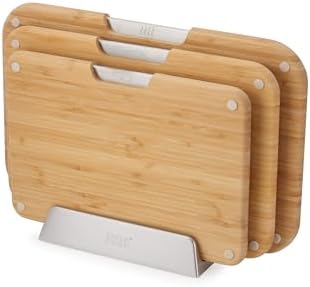
- 3-Piece Double-Sided Bamboo Cutting Boards – This set includes three durable bamboo boards with non-slip feet, offering …
- Prevent Cross-Contamination – Each board features food-specific icons, allowing you to easily separate raw meat, vegetab…
- Easy-Access Stainless Steel Tabs – The stylish stainless-steel tabs on each board ensure quick and effortless access, ma…
What We Like
- Three color-coded boards help prevent cross-contamination
- Nesting design with a stand saves counter space
- Bamboo surface with non-slip feet and stainless-steel hanging tabs
- Compact, lightweight, and great for small kitchens
- Knife-friendly cutting surfaces on all three boards
What Could Be Better
- Smaller boards are not ideal for large roasts
- Bamboo needs hand-washing and occasional oiling
- Stand can be unstable if boards are not nested properly
Flaws but not dealbreakers: the Nest Boards are modestly sized, and bamboo is a wood that needs hand-washing and the occasional oiling—they are no substitute for a large board when carving a roast. For apartment kitchens and cooks who want a clean, color-coded, space-saving setup, though, this set is the smartest way to avoid cross-contamination.
Best For: Small kitchens and cooks who want color-coded boards that nest for tidy storage.
Skip it if: Skip it if you need one large board—the three nesting boards are compact by design and not sized for big roasts.
Frequently Asked Questions
1. What is the best material for a cutting board?
For most home cooks, a quality hardwood board—like maple or walnut—is the best all-around choice because it is gentle on knives, naturally resists bacteria, and lasts for decades with proper oiling. Pair it with a cheap plastic board for raw meat, and you have the ideal setup. Composite and rubber boards are excellent low-maintenance alternatives if you want dishwasher convenience.
2. Are wood cutting boards sanitary?
Yes. Despite the old myth that plastic is inherently cleaner, controlled studies have found fewer bacteria surviving on wood than on plastic under the same contamination and cleaning conditions, and wood draws moisture and microbes away from the surface into the grain where they die off. The key is to wash promptly with hot, soapy water, dry the board upright, and never leave it soaking.
3. Should I use separate boards for meat and vegetables?
Yes—this is the single most important habit for board hygiene. Public food-safety guidance advises using a separate cutting board for raw meat, poultry, and seafood, whatever the material, and another for produce, bread, and ready-to-eat foods. A color-coded set like the Joseph Joseph Nest Boards makes this easy, but two boards of any material work just as well.
4. How do I care for a wood cutting board?
Hand-wash a wood board with warm water and mild soap, then dry it standing upright so air circulates. Never put it in the dishwasher or soak it. Once a month—or whenever the surface looks dry—rub in a food-grade mineral oil or board conditioner, let it soak in overnight, and wipe off the excess. Avoid olive and vegetable oils, which turn rancid.
5. What is the difference between edge grain and end grain?
Edge-grain boards show long wood strips on the surface and are affordable, durable workhorses. End-grain boards are made with the cut ends of wood blocks facing up, creating a checkerboard surface that is gentler on knife edges and self-heals from cuts—but they cost more and need more oiling. For most people, a good edge-grain board is the better value.
6. Do plastic cutting boards dull knives faster?
Slightly, yes. A plastic board is a harder, less forgiving surface than wood, so a knife edge will wear a little faster with heavy daily use. The difference is modest for most home cooks, and the dishwasher convenience of plastic makes it worth it for a dedicated meat board—just use a wood board for your everyday vegetable and protein prep.
7. What size cutting board do I need?
For everyday chopping, a board around 15 by 10 inches is a good minimum, but 18 by 14 inches or larger gives you room to work comfortably without crowding the blade. If you regularly carve roasts or prep for a family, go larger. Measure your counter and sink first so the board fits where you will actually use and wash it.
Sources & Further Reading
- Sekoai et al., “Insights into the Microbiological Safety of Wooden Cutting Boards Used for Meat Processing,” International Journal of Environmental Research and Public Health (U.S. National Library of Medicine) — peer-reviewed
- Vega Gutierrez et al., “Testing the Antimicrobial Characteristics of Wood Materials: A Review of Methods,” (U.S. National Library of Medicine) — peer-reviewed
- USDA Food Safety and Inspection Service: Cutting Boards
- Bon Appétit: Best Cutting Boards for Slicing, Dicing, Chopping, and Serving
- Serious Eats: The Best Cutting Boards of 2026, Tested & Reviewed